Professeur des universités en sciences de gestion
-

An expanded protein-protein interaction network in Bacillus subtilis reveals a group of hubs: Exploration by an integrative approach
- Type de publi. : Article dans une revue
- Date de publi. : 01/01/2011
-
Auteurs :
Elodie E. MarchadierRut R. Carballido y LopezSophie S. BrinsterCeline C. FabretPeggy MerveletPhilippe Bessieres BessièresMarie-Françoise Noirot-GrosVincent FromionPhilippe Noirot
Fiche détaillée
An expanded protein-protein interaction network in Bacillus subtilis reveals a group of hubs: Exploration by an integrative approach
- Type de publi. : Article dans une revue
- Date de publi. : 01/01/2011
-
Auteurs :
Elodie E. MarchadierRut R. Carballido y LopezSophie S. BrinsterCeline C. FabretPeggy MerveletPhilippe Bessieres BessièresMarie-Françoise Noirot-GrosVincent FromionPhilippe Noirot
-
Organismes :
Institut Jean-Pierre Bourgin
MICrobiologie de l'ALImentation au Service de la Santé
Unité Mathématique Informatique et Génome
MICrobiologie de l'ALImentation au Service de la Santé
Institut Cochin
Institut de génétique et microbiologie [Orsay]
MICrobiologie de l'ALImentation au Service de la Santé
Unité Mathématique Informatique et Génome
MICrobiologie de l'ALImentation au Service de la Santé
Unité Mathématique Informatique et Génome
MICrobiologie de l'ALImentation au Service de la Santé
- Publié dans Proteomics le 25/10/2020
Résumé : We have generated a protein-protein interaction network in Bacillus subtilis focused on several essential cellular processes such as cell division, cell responses to various stresses, the bacterial cytoskeleton, DNA replication and chromosome maintenance by careful application of the yeast two-hybrid approach. This network, composed of 793 interactions linking 287 proteins with an average connectivity of five interactions per protein, represents a valuable resource for future functional analyses. A striking feature of the network is a group of highly connected hubs (GoH) linking many different cellular processes. Most of the proteins of the GoH have unknown functions and are associated to the membrane. By the integration of available knowledge, in particular of transcriptome data sets, the GoH was decomposed into subgroups of party hubs corresponding to protein complexes or regulatory pathways expressed under different conditions. At a global level, the GoH might function as a very robust group of date hubs having partially redundant functions to integrate information from the different cellular pathways. Our analyses also provide a rational way to study the highly redundant functions of the GoH by a genetic approach.
Fichiers liés :
BESSIERES-PROTEOMICS_1.pdf
Source
-
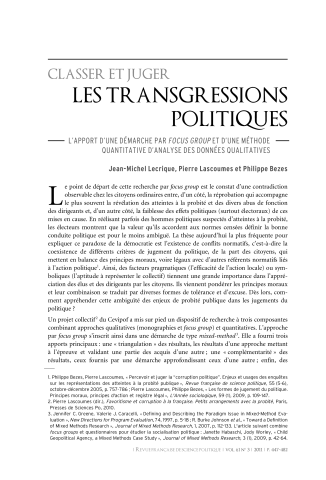
Classer et juger les transgressions politiques
- Type de publi. : Article dans une revue
- Date de publi. : 01/01/2011
-
Auteurs :
Jean-Michel LecriquePierre LascoumesPhilippe Bezes
Fiche détaillée
Classer et juger les transgressions politiques
- Type de publi. : Article dans une revue
- Date de publi. : 01/01/2011
-
Auteurs :
Jean-Michel LecriquePierre LascoumesPhilippe Bezes
-
Organismes :
Centre d'études européennes et de politique comparée (Sciences Po, CNRS)
Centre d'études européennes et de politique comparée (Sciences Po, CNRS)
- Publié dans Revue Française de Science Politique le 24/10/2020
Résumé : Les enjeux de probité publique se prêtent bien aux recherches qualitatives menées par focus group, habituellement utilisées dans l’exploration des conflits moraux et normatifs. La démarche est ici mobilisée pour explorer l’ambiguïté des jugements portés par les citoyens sur les pratiques et transgressions des élus. Elle repose sur huit groupes socio-culturellement différenciés et sur une exploitation originale à partir d’une méthode de quantification du contenu des discours recueillis. L’article montre l’existence d’une échelle homogène de qualification et de classification des pratiques politiques qui graduent les jugements de réprobation. La discussion collective favorise l’expression de formes de modération dans les jugements. L’exploitation pointe des différences liées aux caractéristiques sociales des groupes. Elle identifie des « répertoires argumentatifs », mobilisant des principes de jugement divergents.
Fichiers liés :
2011-classer-et-juger.pdf
Source
-

Time-Resolved Investigation of Excitation Energy Transfer in Carbon Nanotube-Porphyrin Compounds
- Type de publi. : Article dans une revue
- Date de publi. : 01/01/2011
-
Auteurs :
Damien GarrotBenjamin LangloisCyrielle RoqueletThierry MichelPhilippe RoussignolClaude DelalandeEmmanuelle DeleporteJean‐sébastien LauretChristophe Voisin
Fiche détaillée
Time-Resolved Investigation of Excitation Energy Transfer in Carbon Nanotube-Porphyrin Compounds
- Type de publi. : Article dans une revue
- Date de publi. : 01/01/2011
-
Auteurs :
Damien GarrotBenjamin LangloisCyrielle RoqueletThierry MichelPhilippe RoussignolClaude DelalandeEmmanuelle DeleporteJean‐sébastien LauretChristophe Voisin
-
Organismes :
Laboratoire de Photonique Quantique et Moléculaire
Laboratoire Pierre Aigrain
Laboratoire de Photonique Quantique et Moléculaire
Laboratoire Pierre Aigrain
Laboratoire Charles Coulomb
Laboratoire Pierre Aigrain
Laboratoire Pierre Aigrain
Laboratoire de Photonique Quantique et Moléculaire
Laboratoire de Photonique Quantique et Moléculaire
Laboratoire Pierre Aigrain
- Publié dans Journal of Physical Chemistry C le 26/10/2020
Résumé : Single-wall carbon nanotubes non-covalently functionalized with porphyrin molecules have proven to be a very promising light harvesting system either for energy or charge transfer. In this paper we investigate the dynamics of this coupling at a sub-picosecond time-scale, by means of transient absorption spectroscopy. We show that the ground state recovery time of the porphyrin is reduced by several orders of magnitude in the compound compared to the case of pristine porphyrin. Concomitantly, a strong bleaching signal is observed on the optical resonances of the nanotubes showing an ultrafast population buildup upon excitation of the porphyrin. We conclude that the energy transfer occurs on a time-scale shorter than 100 fs. Two-color measurements show that higher excited states of the nanotubes are populated on the same time-scale raising the point of the transfer mechanism. We briefly discuss two possible mechanisms.
Source
-
Influence of Heat Treatment on the Physical Transformation of Flint Used by Neolithic Societies in the Western Mediterranean
- Type de publi. : Chapître d'ouvrage
- Date de publi. : 01/01/2011
-
Auteurs :
Josep Roqué-RosellLoïc TorchyChristian RoucauVanessa LéaPhilippe ColombanMartine RegertDidier BinderJacques PelegrinPhilippe Sciau
Fiche détaillée
Influence of Heat Treatment on the Physical Transformation of Flint Used by Neolithic Societies in the Western Mediterranean
- Type de publi. : Chapître d'ouvrage
- Date de publi. : 01/01/2011
-
Auteurs :
Josep Roqué-RosellLoïc TorchyChristian RoucauVanessa LéaPhilippe ColombanMartine RegertDidier BinderJacques PelegrinPhilippe Sciau
-
Organismes :
Travaux et recherches archéologiques sur les cultures, les espaces et les sociétés
Travaux et recherches archéologiques sur les cultures, les espaces et les sociétés
Laboratoire de Dynamique Interactions et Réactivité
Centre d'Études Préhistoire, Antiquité, Moyen-Age
Centre d'Études Préhistoire, Antiquité, Moyen-Age
Préhistoire et Technologie
Centre d'élaboration de matériaux et d'études structurales
Résumé : The Neolithic period Chassey culture in southern France from 4200 to 3500 Cal. BC developed a specialized lithic technology for flint bladelets that used a heating process as an essential part of the production. Experimental archaeology demonstrated that the heating should take place at low temperature somewhere around 250°C. To identify and quantify the physical transformations of flint at low temperature, laboratory and synchrotron experiences have been carried out on a set of heated Barremo-Bedoulian flint samples. According to our measurements, this flint consists of a nanocrystalline matrix of quartz and moganite. Evolution of mesoporous structure was observed during heat treatment. The flint transformed between 200-300°C, resulting in a reduction in the size and volume of porosity. The densification of flint is linked to changes on the nanocrystalline grain boundaries, and it is thought to have a direct impact on the improved mechanical properties from the Chassey culture lithic productions.
Source
-
A Real-World Spreading Experiment in the Blogosphere
- Type de publi. : Article dans une revue
- Date de publi. : 01/01/2011
-
Auteurs :
Adrien FriggeriJean-Philippe CointetMatthieu Latapy
Fiche détaillée
A Real-World Spreading Experiment in the Blogosphere
- Type de publi. : Article dans une revue
- Date de publi. : 01/01/2011
-
Auteurs :
Adrien FriggeriJean-Philippe CointetMatthieu Latapy
-
Organismes :
Dynamic Networks
Centre de Recherche en Epistémologie Appliquée
Institut des Systèmes Complexes - Paris Ile-de-France
Sciences en Société
Institut francilien recherche, innovation et société
ComplexNetworks
- Publié dans Complex Systems le 01/11/2020
Résumé : An experiment was designed to observe a spreading phenomenon in the blogosphere. This experiment relied on a small applet that participants copied onto their own web page. The dataset obtained which is freely available for study is presented, and a basic analysis is conducted. It is discovered that, despite the classical assumption, in this experiment famous blogs do not necessarily act as super spreaders.
Source
-
Porphyromonas gingivalis participates in pathogenesis of human abdominal aortic aneurysm by neutrophil activation. Proof of concept in rats.
- Type de publi. : Article dans une revue
- Date de publi. : 01/01/2011
-
Auteurs :
Sandrine DelboscJean-Marc AlsacClement JourneLiliane LouedecYves CastierMartine Bonnaure-MalletRaymond RuimyPatrick RossignolPhilippe BouchardJean-Baptiste MichelOlivier Meilhac
Fiche détaillée
Porphyromonas gingivalis participates in pathogenesis of human abdominal aortic aneurysm by neutrophil activation. Proof of concept in rats.
- Type de publi. : Article dans une revue
- Date de publi. : 01/01/2011
-
Auteurs :
Sandrine DelboscJean-Marc AlsacClement JourneLiliane LouedecYves CastierMartine Bonnaure-MalletRaymond RuimyPatrick RossignolPhilippe BouchardJean-Baptiste MichelOlivier Meilhac
-
Organismes :
Hémostase, bio-ingénierie et remodelage cardiovasculaires
Hémostase, bio-ingénierie et remodelage cardiovasculaires
Hémostase, bio-ingénierie et remodelage cardiovasculaires
Hémostase, bio-ingénierie et remodelage cardiovasculaires
Service de Chirurgie cardiaque et vasculaire
Microbiologie : Risques Infectieux
Risque cardiovasculaire, rigidité-fibrose et hypercoagulabilité
Centre d'investigation clinique plurithématique Pierre Drouin [Nancy]
Hémostase, bio-ingénierie et remodelage cardiovasculaires
Hémostase, bio-ingénierie et remodelage cardiovasculaires
- Publié dans PLoS ONE le 25/10/2020
Résumé : BACKGROUND: Abdominal Aortic Aneurysms (AAAs) represent a particular form of atherothrombosis where neutrophil proteolytic activity plays a major role. We postulated that neutrophil recruitment and activation participating in AAA growth may originate in part from repeated episodes of periodontal bacteremia. METHODS AND FINDINGS: Our results show that neutrophil activation in human AAA was associated with Neutrophil Extracellular Trap (NET) formation in the IntraLuminal Thrombus, leading to the release of cell-free DNA. Human AAA samples were shown to contain bacterial DNA with high frequency (11/16), and in particular that of Porphyromonas gingivalis (Pg), the most prevalent pathogen involved in chronic periodontitis, a common form of periodontal disease. Both DNA reflecting the presence of NETs and antibodies to Pg were found to be increased in plasma of patients with AAA. Using a rat model of AAA, we demonstrated that repeated injection of Pg fostered aneurysm development, associated with pathological characteristics similar to those observed in humans, such as the persistence of a neutrophil-rich luminal thrombus, not observed in saline-injected rats in which a healing process was observed. CONCLUSIONS: Thus, the control of periodontal disease may represent a therapeutic target to limit human AAA progression.
Source
-
C*-simple groups: amalgamated free products, HNN extensions, and fundamental groups of 3-manifolds
- Type de publi. : Article dans une revue
- Date de publi. : 01/01/2011
-
Auteurs :
Jean-Philippe PréauxPierre de La Harpe
Fiche détaillée
C*-simple groups: amalgamated free products, HNN extensions, and fundamental groups of 3-manifolds
- Type de publi. : Article dans une revue
- Date de publi. : 01/01/2011
-
Auteurs :
Jean-Philippe PréauxPierre de La Harpe
-
Organismes :
Institut de Mathématiques de Marseille
Section de mathématiques [Genève]
- Publié dans Journal of Topology and Analysis le 21/02/2019
Source
-
A Table ! 15 pays, 16 familles, leur alimentation. Dossier pédagogique Collège/Lycée
- Type de publi. : Ouvrage (y compris édition critique et traduction)
- Date de publi. : 01/01/2011
-
Auteurs :
Laurent LitzenburgerPhilippe MorlotPierre-Jean Thomas
Fiche détaillée
A Table ! 15 pays, 16 familles, leur alimentation. Dossier pédagogique Collège/Lycée
- Type de publi. : Ouvrage (y compris édition critique et traduction)
- Date de publi. : 01/01/2011
-
Auteurs :
Laurent LitzenburgerPhilippe MorlotPierre-Jean Thomas
-
Organismes :
Centre de Recherche Universitaire Lorrain d'Histoire
Source
-

The West African climate system: a review of the AMMA model inter-comparison initiatives
- Type de publi. : Article dans une revue
- Date de publi. : 01/01/2011
-
Auteurs :
P. M. RutiJ. E. WilliamsF. HourdinFrancoise GuichardAaron BooneP. van VelthovenFlorence FavotI. MusatM. RummukainenM. DomínguezM. Á. GaertnerJean-Philippe LaforeT. LosadaM. B. Rodriguez de FonsecaJ. PolcherF. GiorgiY. XueTrissevgeni StavrakouKathy S. LawBéatrice JosseBrice BarretX. YangCéline MariA. K. Traore
Fiche détaillée
The West African climate system: a review of the AMMA model inter-comparison initiatives
- Type de publi. : Article dans une revue
- Date de publi. : 01/01/2011
-
Auteurs :
P. M. RutiJ. E. WilliamsF. HourdinFrancoise GuichardAaron BooneP. van VelthovenFlorence FavotI. MusatM. RummukainenM. DomínguezM. Á. GaertnerJean-Philippe LaforeT. LosadaM. B. Rodriguez de FonsecaJ. PolcherF. GiorgiY. XueTrissevgeni StavrakouKathy S. LawBéatrice JosseBrice BarretX. YangCéline MariA. K. Traore
-
Organismes :
Energy Environment Modeling Unit-Climate and Impact Modeling Laboratory
Royal Netherlands Meteorological Institute
Institut Pierre-Simon-Laplace
Laboratoire de Météorologie Dynamique (UMR 8539)
Centre national de recherches météorologiques
Centre national de recherches météorologiques
Royal Netherlands Meteorological Institute
Centre national de recherches météorologiques
Laboratoire de Météorologie Dynamique (UMR 8539)
Swedish Meteorological and Hydrological Institute
Instituto de Ciencias Ambientales [Toledo]
Instituto de Ciencias Ambientales [Toledo]
Centre national de recherches météorologiques
Departamento de Geofisica y Meteorologia [Madrid]
Departamento de Geofisica y Meteorologia [Madrid]
Laboratoire de Météorologie Dynamique (UMR 8539)
Abdus Salam International Centre for Theoretical Physics [Trieste]
Department of Geography [Los Angeles]
TROPO - LATMOS
TROPO - LATMOS
Centre national de recherches météorologiques
Laboratoire d'aérologie
Centre for Atmospheric Science [Cambridge, UK]
Laboratoire d'aérologie
Laboratoire de Physique de l'Atmosphère et de l'Océan Siméon Fongang
- Publié dans Atmospheric Science Letters le 28/10/2020
Résumé : We review the African Monsoon Multidisciplinary Analysis (AMMA) model inter-comparison activities for West Africa. The Model Inter-comparison Project is an evaluation exercise of how global and regional atmospheric models represent seasonal and intra-seasonal variations of the climate and rainfall over the Sahel. The Land surface Model Inter-comparison Project in turn focuses on modelling critical land surface processes over West Africa and on their link with the atmosphere. The CHEmistry Model Inter-comparison Project (CHEMIP) is a comparison of the tropospheric composition as simulated by a number of Chemical Transport Models (CTM) and Chemistry-Climate Models. We highlight the main model limitations and provide recommendations for future development.
Fichiers liés :
asl.305.pdf
Source
-

Réponse à la consultation de l’AESA sur le choix des comparateurs dans l’évaluation des risques des plantes génétiquement modifiées
- Type de publi. : Rapport
- Date de publi. : 01/01/2011
-
Auteurs :
Jean-Christophe PagèsJean-Jacques LeguayYves BertheauPascal BoireauDenis BourguetFlorence CoignardFrançois ColénoJean-Luc DarlixElie DassaMaryse DeguergueHubert De VerneuilRobert DrillienAnne Dubart-KupperchmittNicolas FerryClaudine FranchePhilippe GuercheJoël GuillemainMireille JacquemondAndré JestinBernard KlonjkowskiMarc LavielleJane LecomteOlivier Le GallBertrand NeyPatrick SaindrenanStéphane LemariéDidier LereclusRémy MaximilienAntoine MesséanJacques PagèsDaniel ParzyCatherine Regnault-RogerPierre RougéPascal SimonetVirginie TournayBernard E. VaissièreJean-Luc Vilotte
Fiche détaillée
Réponse à la consultation de l’AESA sur le choix des comparateurs dans l’évaluation des risques des plantes génétiquement modifiées
- Type de publi. : Rapport
- Date de publi. : 01/01/2011
-
Auteurs :
Jean-Christophe PagèsJean-Jacques LeguayYves BertheauPascal BoireauDenis BourguetFlorence CoignardFrançois ColénoJean-Luc DarlixElie DassaMaryse DeguergueHubert De VerneuilRobert DrillienAnne Dubart-KupperchmittNicolas FerryClaudine FranchePhilippe GuercheJoël GuillemainMireille JacquemondAndré JestinBernard KlonjkowskiMarc LavielleJane LecomteOlivier Le GallBertrand NeyPatrick SaindrenanStéphane LemariéDidier LereclusRémy MaximilienAntoine MesséanJacques PagèsDaniel ParzyCatherine Regnault-RogerPierre RougéPascal SimonetVirginie TournayBernard E. VaissièreJean-Luc Vilotte
-
Organismes :
Institut Jean-Pierre Bourgin
Fichiers liés :
110117consultationaesaevaluationenvironnementaledespgmcomparateursaviscshcb.pdf
Source