Professeur des universités en sciences de gestion
-
Strategies of initiation and streamlining of antibiotic therapy in 41 French intensive care units.
- Type de publi. : Article dans une revue
- Date de publi. : 01/01/2011
-
Auteurs :
Philippe MontraversHervé DupontRémy GauzitBenoit VeberJean-Pierre BedosAlain Lepape
Fiche détaillée
Strategies of initiation and streamlining of antibiotic therapy in 41 French intensive care units.
- Type de publi. : Article dans une revue
- Date de publi. : 01/01/2011
-
Auteurs :
Philippe MontraversHervé DupontRémy GauzitBenoit VeberJean-Pierre BedosAlain Lepape
-
Organismes :
Service d'anesthésie - réanimation chirurgicale
Pôle d'Anesthésie Réanimation
Affectations Mineralisantes du Systeme Cardiovasculaire : Calcifications Arterielles et Valvulaires Aortiques
Service d'anesthésie-réanimation [Hôtel-Dieu]
Service de Réanimation Médicale [CHU Rouen]
Service de réanimation [CH Versailles]
Service d'anesthésie-réanimation [Centre Hospitalier Lyon Sud - HCL]
- Publié dans Critical Care le 31/10/2020
Résumé : INTRODUCTION: Few studies have addressed the decision-making process of antibiotic therapy (AT) in intensive care unit (ICU) patients. METHODS: In a prospective observational study, all consecutive patients admitted over a one-month period (2004) to 41 French surgical (n = 22) or medical/medico-surgical ICUs (n = 19) in 29 teaching university and 12 non-teaching hospitals were screened daily for AT until ICU discharge. We assessed the modalities of initiating AT, reasons for changes and factors associated with in ICU mortality including a specific analysis of a new AT administered on suspicion of a new infection. RESULTS: A total of 1,043 patients (61% of the cohort) received antibiotics during their ICU stay. Thirty percent (509) of them received new AT mostly for suspected diagnosis of pneumonia (47%), bacteremia (24%), or intra-abdominal (21%) infections. New AT was prescribed on day shifts (45%) and out-of-hours (55%), mainly by a single senior physician (78%) or by a team decision (17%). This new AT was mainly started at the time of suspicion of infection (71%) and on the results of Gram-stained direct examination (21%). Susceptibility testing was performed in 261 (51%) patients with a new AT. This new AT was judged inappropriate in 58 of these 261 (22%) patients. In ICUs with written protocols for empiric AT (n = 25), new AT prescribed before the availability of culture results (P = 0.003) and out-of-hours (P = 0.04) was more frequently observed than in ICUs without protocols but the appropriateness of AT was not different. In multivariate analysis, the predictive factors of mortality for patients with new AT were absence of protocols for empiric AT (adjusted odds ratio (OR) = 1.64, 95% confidence interval (95%CI): 1.01 to 2.69), age ≥60 (OR = 1.97, 95% CI: 1.19 to 3.26), SAPS II score >38 (OR = 2.78, 95% CI: 1.60 to 4.84), rapidly fatal underlying diseases (OR = 2.91, 95% CI: 1.52 to 5.56), SOFA score ≥6 (OR = 4.48, 95% CI: 2.46 to 8.18). CONCLUSIONS: More than 60% of patients received AT during their ICU stay. Half of them received new AT, frequently initiated out-of-hours. In ICUs with written protocols, empiric AT was initiated more rapidly at the time of suspicion of infection and out-of-hours. These results encourage the establishment of local recommendations for empiric AT.
Fichiers liés :
cc9961.pdf
Source
-

The combination of Prolinoamino Acids and Cyclopropylamino Acids Leads to Fully Functionalized, Stable β-Turns in Water
- Type de publi. : Article dans une revue
- Date de publi. : 01/01/2011
-
Auteurs :
Karine GuitotMaud LarregolaTarun K. PradhanJean-Luc VasseSolange LaviellePhilippe BertusJan SzymoniakOlivier LequinPhilippe Karoyan
Fiche détaillée
The combination of Prolinoamino Acids and Cyclopropylamino Acids Leads to Fully Functionalized, Stable β-Turns in Water
- Type de publi. : Article dans une revue
- Date de publi. : 01/01/2011
-
Auteurs :
Karine GuitotMaud LarregolaTarun K. PradhanJean-Luc VasseSolange LaviellePhilippe BertusJan SzymoniakOlivier LequinPhilippe Karoyan
-
Organismes :
Université Pierre et Marie Curie - Paris 6
Université Pierre et Marie Curie - Paris 6
Institut de Chimie Moléculaire de Reims - UMR 7312
Institut de Chimie Moléculaire de Reims - UMR 7312
Université Pierre et Marie Curie - Paris 6
Unité de chimie organique moléculaire et macromoléculaire
Institut de Chimie Moléculaire de Reims - UMR 7312
Université Pierre et Marie Curie - Paris 6
Université Pierre et Marie Curie - Paris 6
- Publié dans ChemBioChem le 29/10/2020
Source
-
Predicting fadeout versus persistence of paratuberculosis in a dairy cattle herd for management and control purposes: a modelling study
- Type de publi. : Thèse
- Date de publi. : 01/01/2011
-
Auteurs :
Philippe NacryMuriel Vayssier-TaussatFrancis BivilleJean-Pierre J.-P. RosparsClaude C. Murat
Fiche détaillée
Predicting fadeout versus persistence of paratuberculosis in a dairy cattle herd for management and control purposes: a modelling study
- Type de publi. : Thèse
- Date de publi. : 01/01/2011
-
Auteurs :
Philippe NacryMuriel Vayssier-TaussatFrancis BivilleJean-Pierre J.-P. RosparsClaude C. Murat
-
Organismes :
Unité de Recherche Génétique et Amélioration des Plantes
Institut National de la Recherche Agronomique
Biologie Moléculaire et Immunologie Parasitaires et Fongiques
Biozentrum [Basel, Suisse]
Biologie Moléculaire et Immunologie Parasitaires et Fongiques
Physiologie de l'Insecte : Signalisation et Communication
Institut National de la Recherche Agronomique
Dipartimento di Biologia Vegetale
Résumé : Epidemiological models enable to better understand the dynamics of infectious diseases and to assess ex-ante control strategies. For Mycobacterium avium subsp. paratuberculosis (Map), possible transmission routes have been described, but Map spread in a herd and the relative importance of the routes are currently insufficiently understood to prioritize control measures. We aim to predict early after Map introduction in a dairy cattle herd whether infection is likely to fade out or persist, when no control measures are implemented, using a modelling approach. Both vertical transmission and horizontal transmission via the ingestion of colostrum, milk, or faeces present in the contaminated environment were modelled. Calf-to-calf indirect transmission was possible. Six health states were represented: susceptible, transiently infectious, latently infected, subclinically infected, clinically affected, and resistant. The model was partially validated by comparing the simulated prevalence with field data. Housing facilities and contacts between animals were specifically considered for calves and heifers. After the introduction of one infected animal in a naive herd, fadeout occurred in 66% of the runs. When Map persisted, the prevalence of infected animals increased to 88% in 25 years. The two main transmission routes were via the farm’s environment and in utero transmission. Calf-to-calf transmission was minor. Fadeout versus Map persistence could be differentiated with the number of clinically affected animals, which was rarely above one when fadeout occurred. Therefore, early detection of affected animals is crucial in preventing Map persistence in dairy herds
Fichiers liés :
45202_20111215052311995_1.pdf
Source
-
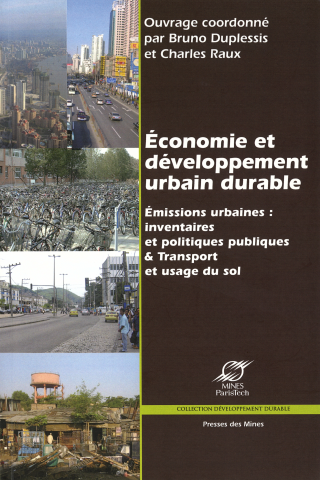
Économie et développement urbain durable : émissions urbaines. Inventaires et politiques publiques & transport et usage du sol
- Type de publi. : Ouvrage (y compris édition critique et traduction)
- Date de publi. : 01/01/2011
-
Auteurs :
Bruno DuplessisCharles RauxPaolo AvnerThierry AwIan CochranYves CrozetStéphane HallegatteHaitham JoumniMathieu LabarreJean LaterrasseFabien LeurentPhilippe MenanteauAurélie MercierNicolas OvtrachtVincent Viguie
Fiche détaillée
Économie et développement urbain durable : émissions urbaines. Inventaires et politiques publiques & transport et usage du sol
- Type de publi. : Ouvrage (y compris édition critique et traduction)
- Date de publi. : 01/01/2011
-
Auteurs :
Bruno DuplessisCharles RauxPaolo AvnerThierry AwIan CochranYves CrozetStéphane HallegatteHaitham JoumniMathieu LabarreJean LaterrasseFabien LeurentPhilippe MenanteauAurélie MercierNicolas OvtrachtVincent Viguie
-
Organismes :
CEP/Paris
Laboratoire d'économie des transports
Laboratoire d'Economie de la Production et de l'Intégration Internationale
Laboratoire Ville, Mobilité, Transport
Mines Paris - PSL (École nationale supérieure des mines de Paris)
Laboratoire d'économie des transports
centre international de recherche sur l'environnement et le développement
Météo-France
Centre Scientifique et Technique du Bâtiment
Centre Énergétique et Procédés
Laboratoire Ville, Mobilité, Transport
Laboratoire Ville, Mobilité, Transport
équipe EDDEN
Laboratoire d'économie des transports
Laboratoire d'économie des transports
centre international de recherche sur l'environnement et le développement
Résumé : Le réseau " Economie et Développement Urbain Durable " a comme ambition de contribuer au développement de la recherche économique dans le domaine du développement urbain durable en prenant en compte les préoccupations des acteurs socio-économiques (élus, entreprises, associations). Ce réseau rassemble sept équipes de recherche : le Centre International de Recherche sur l'Environnement et le Développement (CIRED), le Laboratoire d'Economie de la Production et de l'Intégration Internationale (LEPII), le Laboratoire d'Economie des Transports (LET), le Laboratoire Ville, Mobilité, Transports (LVMT), l'Ecole des Mines ParisTech, le Département Économie et Sciences Humaines du Centre Scientifique et Technique du Bâtiment et la Mission Climat de la Caisse des Dépôts. Ce livre présente les travaux exposés et partagés lors de la deuxième réunion annuelle du réseau en 2010. Ces travaux sont dédiés aux inventaires des émissions urbaines et aux politiques publiques en faveur de la maîtrise de ces émissions dans le bâtiment ainsi qu'à la problématique de l'usage des sols dans le cadre de la mise en œuvre de politiques publiques des transports.
Fichiers liés :
Economie_developpement_urbain_durable.pdf
Source
-
Drag reduction by pulsed jets on strongly unstructured wake: towards the square back control
- Type de publi. : Article dans une revue
- Date de publi. : 01/01/2011
-
Auteurs :
Eric BideauxPierre BobillierElisabeth FournierPatrick GilliéronMahmoud El HajemJean-Yves ChampagnePhilippe GilotteAzeddine Kourta
Fiche détaillée
Drag reduction by pulsed jets on strongly unstructured wake: towards the square back control
- Type de publi. : Article dans une revue
- Date de publi. : 01/01/2011
-
Auteurs :
Eric BideauxPierre BobillierElisabeth FournierPatrick GilliéronMahmoud El HajemJean-Yves ChampagnePhilippe GilotteAzeddine Kourta
-
Organismes :
Ampère
Renault DREAM
Renault DREAM
Renault DREAM
Laboratoire de Mecanique des Fluides et d'Acoustique
Laboratoire de Mecanique des Fluides et d'Acoustique
Plastic Omnium Auto Extérieur Service
Groupe Mécanique des Fluides et Aérodynamique Renault
Laboratoire Pluridisciplinaire de Recherche en Ingénierie des Systèmes, Mécanique et Energétique [2008-2013]
- Publié dans International Journal of Aerodynamics le 01/11/2020
Résumé : Experimental studies have been performed in a wind tunnel in order to control the flow separation on rear window of a generic vehicle shape (the Ahmed body with a scale of 0.7 and a slope angle of 35 degrees). The rear part of the geometry has been modified by replacing the sharp edge between roof and rear window by smooth curved surfaces. This model is equipped at the end of the roof with a strip of pulsed jets in order to control the flow with a velocity of 30 m.s−1. A 20% drag reduction has been obtained with a pulsed frequency at 500 Hz and a momentum coefficient Cµ = 2.75 10−3. This result confirms the interest in using pulsed jets in order to reduce aerodynamic drag and pollutant emission.
Source
-

Disruption of LACCASE4 and 17 results in tissue-specific alterations to lignification of Arabidopsis thaliana stems
- Type de publi. : Article dans une revue
- Date de publi. : 01/01/2011
-
Auteurs :
Serge S. BerthetNathalie N. Demont-CauletBrigitte B. PolletPrzemyslaw P. BidzinskiLaurent L. CezardPhilippe P. Le BrisNéro N. BorregaJonathan J. HerveEddy BlondetSandrine BalzergueCatherine C. LapierreLise L. Jouanin
Fiche détaillée
Disruption of LACCASE4 and 17 results in tissue-specific alterations to lignification of Arabidopsis thaliana stems
- Type de publi. : Article dans une revue
- Date de publi. : 01/01/2011
-
Auteurs :
Serge S. BerthetNathalie N. Demont-CauletBrigitte B. PolletPrzemyslaw P. BidzinskiLaurent L. CezardPhilippe P. Le BrisNéro N. BorregaJonathan J. HerveEddy BlondetSandrine BalzergueCatherine C. LapierreLise L. Jouanin
-
Organismes :
Institut Jean-Pierre Bourgin
Institut Jean-Pierre Bourgin
Institut Jean-Pierre Bourgin
Institut Jean-Pierre Bourgin
Institut Jean-Pierre Bourgin
Institut Jean-Pierre Bourgin
Institut Jean-Pierre Bourgin
Institut Jean-Pierre Bourgin
Institut Jean-Pierre Bourgin
Unité de recherche en génomique végétale
Unité de recherche en génomique végétale
Institut Jean-Pierre Bourgin
Institut Jean-Pierre Bourgin
- Publié dans The Plant cell le 27/10/2020
Résumé : Peroxidases have been shown to be involved in the polymerization of lignin precursors, but it remains unclear whether laccases (EC 1.10.3.2) participate in constitutive lignification. We addressed this issue by studying laccase T-DNA insertion mutants in Arabidopsis thaliana. We identified two genes, LAC4 and LAC17, which are strongly expressed in stems. LAC17 was mainly expressed in the interfascicular fibers, whereas LAC4 was expressed in vascular bundles and interfascicular fibers. We produced two double mutants by crossing the LAC17 (lac17) mutant with two LAC4 mutants (lac4-1 and lac4-2). The single and double mutants grew normally in greenhouse conditions. The single mutants had moderately low lignin levels, whereas the stems of lac4-1 lac17 and lac4-2 lac17 mutants had lignin contents that were 20 and 40% lower than those of the control, respectively. These lower lignin levels resulted in higher saccharification yields. Thioacidolysis revealed that disrupting LAC17 principally affected the deposition of G lignin units in the interfascicular fibers and that complementation of lac17 with LAC17 restored a normal lignin profile. This study provides evidence that both LAC4 and LAC17 contribute to the constitutive lignification of Arabidopsis stems and that LAC17 is involved in the deposition of G lignin units in fibers.
Fichiers liés :
Plant Cell-2011-Berthet-1124-37_1.pdf
Source
-
Bilan des pratiques funéraires du Second Âge du fer sur la façade méridionale du massif Central : Haute-Auvergne, Causses du Rouergue et du Gévaudan, Cévennes
- Type de publi. : Chapître d'ouvrage
- Date de publi. : 01/01/2011
-
Auteurs :
Fabien DelrieuPhilippe GruatLionel Izac-ImbertPierre-Yves Milcent
Fiche détaillée
Bilan des pratiques funéraires du Second Âge du fer sur la façade méridionale du massif Central : Haute-Auvergne, Causses du Rouergue et du Gévaudan, Cévennes
- Type de publi. : Chapître d'ouvrage
- Date de publi. : 01/01/2011
-
Auteurs :
Fabien DelrieuPhilippe GruatLionel Izac-ImbertPierre-Yves Milcent
-
Organismes :
Pôle d'Archéologie Interdépartemental Rhénan
Étude des Civilisations de l'Antiquité : de la Préhistoire à Byzance
Service départemental d'archéologie de l'Aveyron
Archéologie des Sociétés Méditerranéennes
SRA Midi-Pyrénées
Travaux et recherches archéologiques sur les cultures, les espaces et les sociétés
Travaux et recherches archéologiques sur les cultures, les espaces et les sociétés
Résumé : Les us et coutumes funéraires durant le Second Âge du fer dans les contrées sud du Massif central sont documentés de manière partielle et très inégale. La plupart des sépultures se rapportent essentiellement au Ve et, à un degré moindre, au IV
e siècles av. J.-C. Leur recensement montre qu’elles sont nettement moins nombreuses que pendant le premier âge du Fer. Il s’agit généralement de réutilisations de monuments plus anciens (tumulus, dolmens ou coffres), plus rarement de l’érection de nouveaux tertres. Leur corpus offre une certaine unité caractérisée par la généralisation de l’incinération, par une surreprésentation de tombes privilégiées et par des affinités culturelles avec les régions voisines occidentales et méridionales. Les sépultures des III
e au I
er siècles avant J.-C. sont quasiment inconnues. Une telle lacune pose questionnement. Est-elle due à notre incapacité méthodologique à les mettre en évidence ou est-ce le résultat de pratiques particulières ? Le problème se pose avec d’autant plus d’acuité que la tradition de construction ou de réutilisation de tertres, funéraires ou non, se poursuit tardivement, parfois jusqu’au haut Moyen Âge.
Source
-
Explore2070. Sélection de critères pour rendre compte des évolutions sur les débits
- Type de publi. : Rapport
- Date de publi. : 01/01/2011
-
Auteurs :
Charles PerrinPierre-Yves BourginJean-Philippe VidalEric SauquetSébastien ChazotThomas Norotte
Fiche détaillée
Explore2070. Sélection de critères pour rendre compte des évolutions sur les débits
- Type de publi. : Rapport
- Date de publi. : 01/01/2011
-
Auteurs :
Charles PerrinPierre-Yves BourginJean-Philippe VidalEric SauquetSébastien ChazotThomas Norotte
-
Organismes :
Hydrosystèmes et Bioprocédés
Hydrosystèmes et Bioprocédés
Hydrologie-Hydraulique
Hydrologie-Hydraulique
B.R.L. Ingénierie Co.
B.R.L. Ingénierie Co.
Résumé : Le Lot Hydrologie de surface produit des débits simulés en temps présent et temps futur pour une sélection de plus d'un millier de bassins répartis sur le territoire national. Ces débits simulés sont issus de deux modèles hydrologiques, SIM et GR4J, que l'on a alimentés avec les scénarios de changement climatiques fournis par Météo-France. Pour chaque station, on dispose donc de chroniques journalières de débits sur la période de référence (1961-1990) et sur la période future (2045-2065). Pour caractériser les évolutions entre ces deux périodes, il faut calculer un certain nombre de descripteurs qui permettront de rendre compte des changements sur les régimes, les crues, ou les étiages (en termes de tendances à la hausse ou à la baisse). Nous proposons dans cette note un certain nombre de descripteurs qui seront calculés pour chaque bassin. Ces descripteurs seront complétés par des descripteurs sur l'évolution des caractéristiques climatiques et sur les performances des modèles, qui peuvent aider à l'interprétation des résultats.
Source
-
Size distribution of meso- and bathypelagic fish in the Dumont d'Urville Sea (East Antarctica) during the CEAMARC surveys
- Type de publi. : Article dans une revue
- Date de publi. : 01/01/2011
-
Auteurs :
Philippe KoubbiPercy-Alexander HulleyP. PruvostPauline HenriJean-Philippe LabatVictoria WadleyDaisuke HiranoMasato Moteki
Fiche détaillée
Size distribution of meso- and bathypelagic fish in the Dumont d'Urville Sea (East Antarctica) during the CEAMARC surveys
- Type de publi. : Article dans une revue
- Date de publi. : 01/01/2011
-
Auteurs :
Philippe KoubbiPercy-Alexander HulleyP. PruvostPauline HenriJean-Philippe LabatVictoria WadleyDaisuke HiranoMasato Moteki
-
Organismes :
Biologie des Organismes et Ecosystèmes Aquatiques
Laboratoire d'océanographie de Villefranche
Muséum national d'Histoire naturelle
Institut de pharmacologie et de biologie structurale
Océanographie Biologique et Écologie du Plancton Marin
Australian Antarctic Division
Tokyo University of Marine Science and Technology
- Publié dans Polar Science le 02/11/2020
Résumé : The pelagic fish community of the Dumont d'Urville Sea (East Antarctica) was investigated during the 2008 austral-summer using IYGPT (International Young Gadoid Pelagic Trawl) samples taken in different depth layers from the surface to 1000 m. The aim of this paper is to describe the mesopelagic fish community and its size distribution. The family Myctophidae dominated the mesopelagic ichthyofauna, while bathylagids were abundant in deeper hauls. Bathylagids, Cyclothone spp., Gymnoscopelus opisthopterus, Electrona antarctica, Protomyctophum bolini, and Krefftichthys anderssoni were the most abundant taxa in the samples and showed size stratification with depth. Community and size structuring appear to be influenced by the hydrology and by the proximity of the continental margin, as well as a relationship to the circulation of the Modified Circumpolar Deep Water. (C) 2011 Elsevier B.V. and NIPR. All rights reserved.
Source
-
A longitudinal study of Besnoitia besnoiti infections and seasonal abundance of Stomoxys calcitrans in a dairy cattle farm of southwest France
- Type de publi. : Article dans une revue
- Date de publi. : 01/01/2011
-
Auteurs :
Emmanuel LienardAli SalemChristelle C. GrisezFrançoise Prevot PrévotJean-Paul J.-P. BergeaudMichel FrancBruno GottsteinJean-Pierre AlzieuYves LagalissePhilippe P. Jacquiet
Fiche détaillée
A longitudinal study of Besnoitia besnoiti infections and seasonal abundance of Stomoxys calcitrans in a dairy cattle farm of southwest France
- Type de publi. : Article dans une revue
- Date de publi. : 01/01/2011
-
Auteurs :
Emmanuel LienardAli SalemChristelle C. GrisezFrançoise Prevot PrévotJean-Paul J.-P. BergeaudMichel FrancBruno GottsteinJean-Pierre AlzieuYves LagalissePhilippe P. Jacquiet
-
Organismes :
Interactions hôtes-agents pathogènes [Toulouse]
Interactions hôtes-agents pathogènes [Toulouse]
Interactions hôtes-agents pathogènes [Toulouse]
Interactions hôtes-agents pathogènes [Toulouse]
Interactions hôtes-agents pathogènes [Toulouse]
Interactions hôtes-agents pathogènes [Toulouse]
Institute of Parasitology, Vetsuisse-Faculty
Laboratoire vétérinaire départemental
Intervet/Schering-Plough Animal Health
Interactions hôtes-agents pathogènes [Toulouse]
- Publié dans Veterinary Parasitology le 26/10/2020
Résumé : Bovine besnoitiosis, caused by the cyst-forming apicomplexan Besnoitia besnoiti, is commonly reported in some restricted regions of South-Western Europe, and in larger regions of Africa and Asia. This infection is thought to be transmitted by blood feeding insects and is responsible for major economic losses in cattle production. A recent emergence in Europe, notified in the Centre of France, Spain and Germany, has attracted more attention to this disease. Clinical signs could appear in some animals; however, many infected cattle remain asymptomatic or show scleral–conjunctival cysts (SCC) only. Recent development of serological methods allows carrying out seroepidemiological field studies. In this respect, a long-term investigation was performed in a dairy cattle farm localized in an enzootic area of besnoitiosis of South-western France between March 2008 and May 2009. The objective was to estimate the seasonal pattern of B. besnoiti infections based on the presence of SCC and serology (ELISA and Western blot). In parallel, an entomological survey was conducted to describe population dynamics of Stomoxys calcitrans and Tabanidae species. The seroprevalence determined by Western blot in a cohort of 57 animals continuously present during the whole survey increased from 30% in March 2008 to 89.5% in May 2009 and was always higher than the prevalence based on clinically assessed SCC.Newpositive B. besnoitia seroconversions occurred throughout the year with the highest number in spring. In addition, many seroconversions were reported in the two months before turn-out and could be associated with a high indoors activity of S. calcitrans during this period.
Source