Professeur des universités en sciences de gestion
-
Subthalamic nucleus stimulation reverses spinal motoneuron activity in parkinsonian patients
- Type de publi. : Article dans une revue
- Date de publi. : 01/01/2011
-
Auteurs :
Sylvie RaoulVincent RoualdesCéline DelignyDominique LeducJean-Charles LamyAlexandra Lacmy-ValléeJean-Paul N'GuyenPhilippe DamierRose Katz
Fiche détaillée
Subthalamic nucleus stimulation reverses spinal motoneuron activity in parkinsonian patients
- Type de publi. : Article dans une revue
- Date de publi. : 01/01/2011
-
Auteurs :
Sylvie RaoulVincent RoualdesCéline DelignyDominique LeducJean-Charles LamyAlexandra Lacmy-ValléeJean-Paul N'GuyenPhilippe DamierRose Katz
-
Organismes :
Centre Hospitalier Universitaire de Nantes = Nantes University Hospital
Centre Hospitalier Universitaire de Nantes = Nantes University Hospital
Centre Hospitalier Universitaire de Nantes = Nantes University Hospital
Contrôle de santé fiabilité et calcul des structures
Centre d'étude de la SensoriMotricité
Université Pierre et Marie Curie - Paris 6 - UFR de Médecine Pierre et Marie Curie
Centre Hospitalier Universitaire de Nantes = Nantes University Hospital
Centre Hospitalier Universitaire de Nantes = Nantes University Hospital
CHU Pitié-Salpêtrière [AP-HP]
- Publié dans Brain - A Journal of Neurology le 29/10/2020
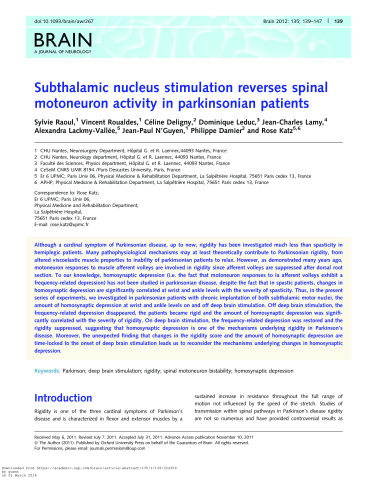
Résumé : Although a cardinal symptom of Parkinsonian disease, up to now, rigidity has been investigated much less than spasticity in hemiplegic patients. Many pathophysiological mechanisms may at least theoretically contribute to Parkinsonian rigidity, from altered viscoelastic muscle properties to inability of parkinsonian patients to relax. However, as demonstrated many years ago, motoneuron responses to muscle afferent volleys are involved in rigidity since afferent volleys are suppressed after dorsal root section. To our knowledge, homosynaptic depression (i.e. the fact that motoneuron responses to Ia afferent volleys exhibit a frequency-related depression) has not been studied in parkinsonian disease, despite the fact that in spastic patients, changes in homosynaptic depression are significantly correlated at wrist and ankle levels with the severity of spasticity. Thus, in the present series of experiments, we investigated in parkinsonian patients with chronic implantation of both subthalamic motor nuclei, the amount of homosynaptic depression at wrist and ankle levels on and off deep brain stimulation. Off deep brain stimulation, the frequency-related depression disappeared, the patients became rigid and the amount of homosynaptic depression was significantly correlated with the severity of rigidity. On deep brain stimulation, the frequency-related depression was restored and the rigidity suppressed, suggesting that homosynaptic depression is one of the mechanisms underlying rigidity in Parkinson's disease. Moreover, the unexpected finding that changes in the rigidity score and the amount of homosynaptic depression are time-locked to the onset of deep brain stimulation leads us to reconsider the mechanisms underlying changes in homosynaptic depression.
Fichiers liés :
awr267.pdf
Source
-

Théories de l'évolution et religions
- Type de publi. : Ouvrage (y compris édition critique et traduction)
- Date de publi. : 01/01/2011
-
Auteurs :
Philippe PortierJean-Paul WillaimeMichel Veuille
Fiche détaillée
Théories de l'évolution et religions
- Type de publi. : Ouvrage (y compris édition critique et traduction)
- Date de publi. : 01/01/2011
-
Auteurs :
Philippe PortierJean-Paul WillaimeMichel Veuille
-
Organismes :
Groupe Sociétés, Religions, Laïcités
Groupe Sociétés, Religions, Laïcités
Institut de Systématique, Evolution, Biodiversité
Résumé : Plus de 150 ans après la publication de l'Origine des espèces (1859) du biologiste anglais Charles Darwin (1809-1882), la théorie de l'évolution est toujours mise en cause aujourd'hui, tant en milieu chrétien que musulman, par des personnes considérant qu'elle est incompatible avec les enseignements de la Bible et du Coran. Ces conceptions dites " créationnistes " sont certes minoritaires, mais elles ont pu bénéficier d'une large diffusion (comme le montre l'envoi massif en 2007 d'un ouvrage créationniste musulman L'Atlas de la Création dans les écoles de France). Aux Etats-Unis, ces conceptions, notamment sous la forme des théories du " Dessein Intelligent " (Intelligent Design) ont provoqué de vifs débats sociaux obligeant la Cour Suprême fédérale à rappeler la distinction fondamentale, dans les pays démocratiques respectant la séparation des Religions et l'Etat, entre vérité scientifique et vérité religieuse. A l'occasion de " l'année Darwin " en 2009, nul n'était mieux placé que l'Ecole Pratique des Hautes Etudes (EPHE) pour examiner en profondeur l'histoire de la réception de la théorie de l'évolution et des débats scientifiques, philosophiques et religieux qu'elle a suscités. Riche de sa section des Sciences de la Vie et de la Terre et de sa section des Sciences Religieuses, l'EPHE a en effet pu mobiliser, tout en sollicitant l'apport de collègues d'autres universités, les compétences de ses enseignants-chercheurs pour étudier historiquement et philosophiquement la question et ses enjeux. Une des conclusions importantes de ce riche ensemble de contributions est la nécessité de renforcer dans l'enseignement scolaire aussi bien l'histoire et l'épistémologie des sciences que l'étude pluridisciplinaire des faits religieux.
Source
-
Les représentations des dieux des autres
- Type de publi. : Ouvrage (y compris édition critique et traduction)
- Date de publi. : 01/01/2011
-
Auteurs :
Jean-Pierre AlbertNicole BelaycheCorinne BonnetPhilippe BorgeaudAmandine DeclercqIwo Slobodzianek
Fiche détaillée
Les représentations des dieux des autres
- Type de publi. : Ouvrage (y compris édition critique et traduction)
- Date de publi. : 01/01/2011
-
Auteurs :
Jean-Pierre AlbertNicole BelaycheCorinne BonnetPhilippe BorgeaudAmandine DeclercqIwo Slobodzianek
-
Organismes :
UE 1298 Unité Commune d'Expérimentation Animale
Anthropologie et Histoire des Mondes Antiques
Patrimoine, Littérature, Histoire
Source
-

La science en caricatures
- Type de publi. :
- Date de publi. : 01/01/2011
-
Auteurs :
Jean-François BachJean-Pierre KahaneJean-Paul PoirierPierre SinaÿSuzanne DébarbatAnne Fagot-LargeaultPhilippe TaquetClaude DebruJean Dercourt
Fiche détaillée
La science en caricatures
- Type de publi. :
- Date de publi. : 01/01/2011
-
Auteurs :
Jean-François BachJean-Pierre KahaneJean-Paul PoirierPierre SinaÿSuzanne DébarbatAnne Fagot-LargeaultPhilippe TaquetClaude DebruJean Dercourt
-
Organismes :
Académie des sciences [Paris, France]
Académie des sciences [Paris, France]
Académie des sciences [Paris, France]
Académie des sciences [Paris, France]
Académie des sciences [Paris, France]
Académie des sciences [Paris, France]
Académie des sciences [Paris, France]
Académie des sciences [Paris, France]
- Publié dans La lettre de l'Académie des Sciences le 09/03/2009
Fichiers liés :
2011_Lettre_AS_28.pdf
Source
-
What are they up to? The role of sensory evidence and prior knowledge in action understanding.
- Type de publi. : Article dans une revue
- Date de publi. : 01/01/2011
-
Auteurs :
Valérian ChambonPhilippe DomenechElisabeth PacherieEtienne KoechlinPierre BaraducChloé Farrer
Fiche détaillée
What are they up to? The role of sensory evidence and prior knowledge in action understanding.
- Type de publi. : Article dans une revue
- Date de publi. : 01/01/2011
-
Auteurs :
Valérian ChambonPhilippe DomenechElisabeth PacherieEtienne KoechlinPierre BaraducChloé Farrer
-
Organismes :
Institut des Sciences Cognitives
Institut des Sciences Cognitives
Institut Jean-Nicod
Laboratoire de sciences cognitives et psycholinguistique
Institut des Sciences Cognitives
Centre de recherche cerveau et cognition
- Publié dans PLoS ONE le 25/10/2020
Résumé : Explaining or predicting the behaviour of our conspecifics requires the ability to infer the intentions that motivate it. Such inferences are assumed to rely on two types of information: (1) the sensory information conveyed by movement kinematics and (2) the observer's prior expectations - acquired from past experience or derived from prior knowledge. However, the respective contribution of these two sources of information is still controversial. This controversy stems in part from the fact that "intention" is an umbrella term that may embrace various sub-types each being assigned different scopes and targets. We hypothesized that variations in the scope and target of intentions may account for variations in the contribution of visual kinematics and prior knowledge to the intention inference process. To test this hypothesis, we conducted four behavioural experiments in which participants were instructed to identify different types of intention: basic intentions (i.e. simple goal of a motor act), superordinate intentions (i.e. general goal of a sequence of motor acts), or social intentions (i.e. intentions accomplished in a context of reciprocal interaction). For each of the above-mentioned intentions, we varied (1) the amount of visual information available from the action scene and (2) participant's prior expectations concerning the intention that was more likely to be accomplished. First, we showed that intentional judgments depend on a consistent interaction between visual information and participant's prior expectations. Moreover, we demonstrated that this interaction varied according to the type of intention to be inferred, with participant's priors rather than perceptual evidence exerting a greater effect on the inference of social and superordinate intentions. The results are discussed by appealing to the specific properties of each type of intention considered and further interpreted in the light of a hierarchical model of action representation.
Source
-
Development and implementation of a highly-multiplexed SNP array for genetic mapping in maritime pine and comparative mapping with loblolly pine
- Type de publi. : Article dans une revue
- Date de publi. : 01/01/2011
-
Auteurs :
Emilie E. ChancerelCamille LepoittevinGrégoire Le ProvostYao-Cheng LinJuan Pablo Jaramillo-CorreaAndrew J. EckertJill L. WegrzynDiana ZelenikaAnne BolandJean-Marc FrigerioPhilippe ChaumeilPauline Garnier‐géréChristophe BouryDelphine GrivetSantiago C. Gonzalez-MartinezPierre RouzéYves van de PeerDavid B. NealeMaria T. CerveraAntoine KremerChristophe Plomion
Fiche détaillée
Development and implementation of a highly-multiplexed SNP array for genetic mapping in maritime pine and comparative mapping with loblolly pine
- Type de publi. : Article dans une revue
- Date de publi. : 01/01/2011
-
Auteurs :
Emilie E. ChancerelCamille LepoittevinGrégoire Le ProvostYao-Cheng LinJuan Pablo Jaramillo-CorreaAndrew J. EckertJill L. WegrzynDiana ZelenikaAnne BolandJean-Marc FrigerioPhilippe ChaumeilPauline Garnier‐géréChristophe BouryDelphine GrivetSantiago C. Gonzalez-MartinezPierre RouzéYves van de PeerDavid B. NealeMaria T. CerveraAntoine KremerChristophe Plomion
-
Organismes :
Biodiversité, Gènes & Communautés
Biodiversité, Gènes & Communautés
Biodiversité, Gènes & Communautés
VIB-UGent Center for Plant Systems Biology
Instituto de Ecologia
University of California [Davis]
University of California [Davis]
Commissariat à l'énergie atomique et aux énergies alternatives
Commissariat à l'énergie atomique et aux énergies alternatives
Biodiversité, Gènes & Communautés
Biodiversité, Gènes & Communautés
Biodiversité, Gènes & Communautés
Biodiversité, Gènes & Communautés
Instituto Nacional de Investigación y Tecnología Agraria y Alimentaria = National Institute for Agricultural and Food Research and Technology
Department of Forest Ecology and GeneticsForest Research Centre
VIB-UGent Center for Plant Systems Biology
VIB-UGent Center for Plant Systems Biology
University of California [Davis]
Instituto Nacional de Investigación y Tecnología Agraria y Alimentaria = National Institute for Agricultural and Food Research and Technology
Biodiversité, Gènes & Communautés
Biodiversité, Gènes & Communautés
- Publié dans BMC Genomics le 01/11/2020
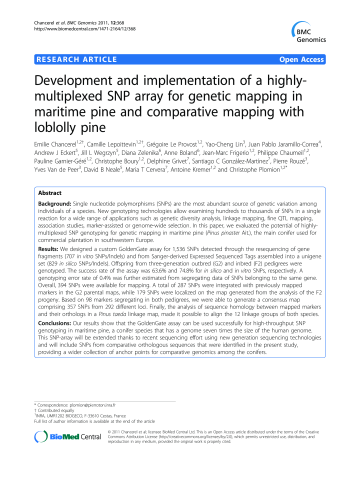
Résumé : *Background : Single nucleotide polymorphisms (SNPs) are the most abundant source of genetic variation among individuals of a species. New genotyping technologies allow examining hundreds to thousands of SNPs in a single reaction for a wide range of applications such as genetic diversity analysis, linkage mapping, fine QTL mapping, association studies, marker-assisted or genome-wide selection. In this paper, we evaluated the potential of highly-multiplexed SNP genotyping for genetic mapping in maritime pine (Pinus pinaster Ait.), the main conifer used for commercial plantation in southwestern Europe. *Results : We designed a custom GoldenGate assay for 1,536 SNPs detected through the resequencing of gene fragments (707 in vitro SNPs/Indels) and from Sanger-derived Expressed Sequenced Tags assembled into a unigene set (829 in silico SNPs/Indels). Offspring from three-generation outbred (G2) and inbred (F2) pedigrees were genotyped. The success rate of the assay was 63.6% and 74.8% for in silico and in vitro SNPs, respectively. A genotyping error rate of 0.4% was further estimated from segregating data of SNPs belonging to the same gene. Overall, 394 SNPs were available for mapping. A total of 287 SNPs were integrated with previously mapped markers in the G2 parental maps, while 179 SNPs were localized on the map generated from the analysis of the F2 progeny. Based on 98 markers segregating in both pedigrees, we were able to generate a consensus map comprising 357 SNPs from 292 different loci. Finally, the analysis of sequence homology between mapped markers and their orthologs in a Pinus taeda linkage map, made it possible to align the 12 linkage groups of both species. *Conclusions : Our results show that the GoldenGate assay can be used successfully for high-throughput SNP genotyping in maritime pine, a conifer species that has a genome seven times the size of the human genome. This SNP-array will be extended thanks to recent sequencing effort using new generation sequencing technologies and will include SNPs from comparative orthologous sequences that were identified in the present study, providing a wider collection of anchor points for comparative genomics among the conifers.
Fichiers liés :
2011_Chancerel_BMC-Genomics_1.pdf
Source
-
Lectures multiples de l'Imitation de Jésus Christ (XVIIe-XIXe siècles)
- Type de publi. : Chapître d'ouvrage
- Date de publi. : 01/01/2011
-
Auteurs :
Philippe Martin
Fiche détaillée
Lectures multiples de l'Imitation de Jésus Christ (XVIIe-XIXe siècles)
- Type de publi. : Chapître d'ouvrage
- Date de publi. : 01/01/2011
-
Auteurs :
Philippe Martin
-
Organismes :
Religions et croyances
Source
-

Operational meteorology in West Africa: observational networks, weather analysis and forecasting
- Type de publi. : Article dans une revue
- Date de publi. : 01/01/2011
-
Auteurs :
A. H. FinkA. Agustí-PanaredaD. J. ParkerJean-Philippe LaforeJ.-B. NgaminiE. AfiesimamaA. BeljaarsOlivier BockM. ChristophF. DidéC. FaccaniNadia FourriéFatima KarbouJ. PolcherZ. MumbaMathieu NuretS. PohleFlorence RabierA. M. TompkinsG. Wilson
Fiche détaillée
Operational meteorology in West Africa: observational networks, weather analysis and forecasting
- Type de publi. : Article dans une revue
- Date de publi. : 01/01/2011
-
Auteurs :
A. H. FinkA. Agustí-PanaredaD. J. ParkerJean-Philippe LaforeJ.-B. NgaminiE. AfiesimamaA. BeljaarsOlivier BockM. ChristophF. DidéC. FaccaniNadia FourriéFatima KarbouJ. PolcherZ. MumbaMathieu NuretS. PohleFlorence RabierA. M. TompkinsG. Wilson
-
Organismes :
Institute for Geophysics and Meteorology [Köln]
European Centre for Medium-Range Weather Forecasts
School of Earth and Environment [Leeds]
Centre national de recherches météorologiques
Agence pour la sécurité de la navigation aérienne en Afrique et à Madagascar
Nigerian Meteorological Agency
European Centre for Medium-Range Weather Forecasts
SPACE - LATMOS
LAboratoire de Recherche en Géodésie
Institute for Geophysics and Meteorology [Köln]
Agence nationale de la météorologie du Bénin
Centre national de recherches météorologiques
Centre national de recherches météorologiques
Centre national de recherches météorologiques
Laboratoire de Météorologie Dynamique (UMR 8539)
Centre national de recherches météorologiques
Institute for Geophysics and Meteorology [Köln]
Centre national de recherches météorologiques
- Publié dans Atmospheric Science Letters le 28/10/2020
Résumé : Real-time surface and upper-air observations are crucial to the analysis and forecasting of the West African monsoon (WAM). This paper will focus on the African Monsoon--Multidisciplinary Analyses (AMMA)-driven reactivation and modernisation of the radiosonde network over West Africa, its potential long-term impact on upper-air operations in the region, the influence of the additional data in WAM analyses and forecasting, and the AMMA-related development and usage of the West African Analysis/Forecasting (WASA/F) forecast method.
Fichiers liés :
asl.324.pdf
Source
-
Mutations of the Cystic Fibrosis Gene in Patients with Bronchiectasis Associated with Rheumatoid Arthritis
- Type de publi. : Article dans une revue
- Date de publi. : 01/01/2011
-
Auteurs :
Xavier PuéchalThierry BienvenuEmmanuelle GéninJean-Marie BerthelotJean SibiliaPhilippe GaudinChristian MarcelliSandra LasbleizLaëtitia MichouFrançois CornélisAndré KahanDaniel J Dusser
Fiche détaillée
Mutations of the Cystic Fibrosis Gene in Patients with Bronchiectasis Associated with Rheumatoid Arthritis
- Type de publi. : Article dans une revue
- Date de publi. : 01/01/2011
-
Auteurs :
Xavier PuéchalThierry BienvenuEmmanuelle GéninJean-Marie BerthelotJean SibiliaPhilippe GaudinChristian MarcelliSandra LasbleizLaëtitia MichouFrançois CornélisAndré KahanDaniel J Dusser
-
Organismes :
Service de rhumatologie [CHU Cochin]
Université Paris Descartes - Paris 5
Centre Hospitalier Le Mans (CH Le Mans)
Service de biochimie et de génétique moléculaire [CHU Cochin]
Laboratoire Charles Friedel
Service de rhumatologie [Nantes]
Physiopathologie des arthrites
Hôpital de Hautepierre [Strasbourg]
Hôpital Michallon
Groupe de Recherche et d’Étude du Processus Inflammatoire
Service de Rhumatologie [CHU Caen]
Hôpital Côte de Nacre [CHU Caen]
Centre Hospitalier Le Mans (CH Le Mans)
Université Paris Diderot, Sorbonne Paris Cité, Paris, France
Laboratoire de recherche européen pour la polyarthrite rhumatoïde
Laboratoire de recherche européen pour la polyarthrite rhumatoïde
Laboratoire de recherche européen pour la polyarthrite rhumatoïde
Service de rhumatologie [CHU Cochin]
Université Paris Descartes - Paris 5
AP-HP - Hôpital Cochin Broca Hôtel Dieu [Paris]
- Publié dans Annals of the Rheumatic Diseases le 26/10/2020
Résumé : Objectives: In cystic fibrosis, mutations of the CFTR gene lead to diffuse bronchiectasis (DB). DB is also associated with other diseases including rheumatoid arthritis (RA) in which the role of genetic factors in the predisposition to DB remains unclear. Methods: A family-based association study was carried out to determine whether the frequency of CFTR mutations was higher in patients with RA-associated DB and to determine whether a causal relationship could be established between the variant and the disease by evaluating its cosegregation with DB within families. Families of probands with RA-DB were included if one first-degree relative had RA and/or DB. The controls comprised healthy subjects requesting genetic counselling because their partner had cystic fibrosis. Results: The frequency of CFTR mutations was higher in family members with RA-DB or DB only than in unaffected relatives (p<0.005 for each comparison) and in unrelated healthy controls (p<0.001 for each comparison) but not in family members with RA only. CFTR mutations were more frequent in family members with RA-DB than in those with RA only (OR 5.30, 95% CI 2.48 to 11.33; p<5×10⁻⁵). They cosegregated with RA-DB in the families (sib-TDT=10.82, p=0.005). Conclusions: RA-DB should be added to the list of phenotypes in which CFTR mutations are pathogenic. CFTR mutation is the first genetic defect linked to an extra-articular feature of RA to be described. CFTR mutations in patients with RA appear to be an important marker of the risk of associated DB, which has been linked to a less favourable prognosis.
Source
-
Arles (13) - Extension du Musée Départemental de l'Arles Antique. Rapport de diagnostic archéologique
- Type de publi. : Rapport
- Date de publi. : 01/01/2011
-
Auteurs :
Philippe MellinandMarie-Pierre RothéOlivier SivanVeronique AbelPiton Jean
Fiche détaillée
Arles (13) - Extension du Musée Départemental de l'Arles Antique. Rapport de diagnostic archéologique
- Type de publi. : Rapport
- Date de publi. : 01/01/2011
-
Auteurs :
Philippe MellinandMarie-Pierre RothéOlivier SivanVeronique AbelPiton Jean
-
Organismes :
Institut national de recherches archéologiques préventives
Centre Camille Jullian - Histoire et archéologie de la Méditerranée et de l'Afrique du Nord de la protohistoire à la fin de l'Antiquité
Musée Départemental Arles Antique
Centre Camille Jullian - Histoire et archéologie de la Méditerranée et de l'Afrique du Nord de la protohistoire à la fin de l'Antiquité
Institut national de recherches archéologiques préventives
Institut national de recherches archéologiques préventives
Résumé : Ce diagnostic, situé entre les vestiges du cirque antique et le Rhône, a permis de mettre en évidence une très importante séquence alluviale datée, à sa base, des XVIIe-XVIIIe s. Elle témoigne de l’exhaussement très rapide de la berge durant le « Petit Age Glaciaire ». Cette succession sédimentaire dilatée sur près de 5m de hauteur scelle directement les niveaux antiques. Ces derniers sont représentés par un niveau de circulation vraisemblablement du Ve s. qui peut être mis en relation avec l’habitat voisin fouillé en 1990 et un dépotoir d’amphores du IIe s. certainement lié à la fréquentation du cirque.
Source