Professeur des universités en sciences de gestion
-

Donor P-gp polymorphisms strongly influence renal function and graft loss in a cohort of renal transplant recipients on cyclosporine therapy in a long-term follow-up.
- Type de publi. : Article dans une revue
- Date de publi. : 01/07/2010
-
Auteurs :
Jean-Baptiste WoillardJean-Philippe RerolleNicolas PicardAnnick RousseauA. GuillaudeauEtienne MunteanuMarie EssigM. DrouetYann Le MeurPierre Marquet
Fiche détaillée
Donor P-gp polymorphisms strongly influence renal function and graft loss in a cohort of renal transplant recipients on cyclosporine therapy in a long-term follow-up.
- Type de publi. : Article dans une revue
- Date de publi. : 01/07/2010
-
Auteurs :
Jean-Baptiste WoillardJean-Philippe RerolleNicolas PicardAnnick RousseauA. GuillaudeauEtienne MunteanuMarie EssigM. DrouetYann Le MeurPierre Marquet
-
Organismes :
Pharmacologie des Immunosuppresseurs et de la Transplantation
Pharmacologie des Immunosuppresseurs et de la Transplantation
Service de Néphrologie, Dialyse, Transplantations [CHU Limoges]
Pharmacologie des Immunosuppresseurs et de la Transplantation
Service de Pharmacologie, toxicologie et pharmacovigilance [CHU Limoges]
Pharmacologie des Immunosuppresseurs et de la Transplantation
Service d'Hématologie biologique [CHU Limoges]
Service de Néphrologie, Dialyse, Transplantations [CHU Limoges]
Pharmacologie des Immunosuppresseurs et de la Transplantation
Service de Néphrologie, Dialyse, Transplantations [CHU Limoges]
Service d'Immunologie et immunogénétique [CHU Limoges]
Pharmacologie des Immunosuppresseurs et de la Transplantation
Service de Néphrologie
Pharmacologie des Immunosuppresseurs et de la Transplantation
Service de Pharmacologie, toxicologie et pharmacovigilance [CHU Limoges]
- Publié dans Clinical Pharmacology and Therapeutics le 30/10/2020
Résumé : Cyclosporin A (CsA) is a substrate for cytochrome P450 3A and the efflux transporter P-glycoprotein (P-gp; ABCB1), both abundantly expressed in the kidney. In a long-term follow-up of a cohort of patients who had received kidney transplants between the years 1990 and 2005, we retrospectively investigated the effect of CYP3A4, CYP3A5, and ABCB1 polymorphisms in kidney graft donors on recipients' renal function and risk of subsequent graft loss. DNA samples from 227 donors and clinical data from the 259 respective recipients were analyzed. Graft loss was significantly associated with the presence of the ABCB1 variant haplotype 1236T/2677T/3435T in the donor (1236T/2677T/3435T vs. other haplotypes: hazard ratio = 9.346; 95% confidence interval (CI) (2.278-38.461); P = 0.0019) and with previous episodes of acute organ rejection (hazard ratio = 3.077; 95% CI (1.213-7.812); P = 0.0178). The variant haplotype was also associated with a greater decrease in renal function (homozygotes for TTT -3.047 mlxmin(-1)/year; heterozygotes for TTT -4.435 mlxmin(-1)/year; others -2.186 mlxmin(-1)/year; P = 0.0240). The study showed that the presence of ABCB1 polymorphisms in donors influences long-term graft outcome adversely with decrease in renal function and graft loss in transplant recipients receiving CsA.
Fichiers liés :
inserm-00462541_edited.pdf
JB_HAL.pdf
Source
-

Self-reconfigurable embedded systems: from modeling to implementation
- Type de publi. : Communication dans un congrès
- Date de publi. : 01/07/2010
-
Auteurs :
Gogniat GuyJorgiano VidalLinfeng YeJérémie CrenneSébastien GuilletFlorent Frizon de LamotteJean-Philippe DiguetPierre Bomel
Fiche détaillée
Self-reconfigurable embedded systems: from modeling to implementation
- Type de publi. : Communication dans un congrès
- Date de publi. : 01/07/2010
-
Auteurs :
Gogniat GuyJorgiano VidalLinfeng YeJérémie CrenneSébastien GuilletFlorent Frizon de LamotteJean-Philippe DiguetPierre Bomel
-
Organismes :
Laboratoire des sciences et techniques de l'information, de la communication et de la connaissance (UMR 3192)
Laboratoire des sciences et techniques de l'information, de la communication et de la connaissance (UMR 3192)
Laboratoire des sciences et techniques de l'information, de la communication et de la connaissance (UMR 3192)
Laboratoire des sciences et techniques de l'information, de la communication et de la connaissance (UMR 3192)
Laboratoire des sciences et techniques de l'information, de la communication et de la connaissance (UMR 3192)
Laboratoire des sciences et techniques de l'information, de la communication et de la connaissance (UMR 3192)
Lab-STICC_UBS_CACS_MOCS
Lab-STICC_UBS_CACS_MOCS
Source
-
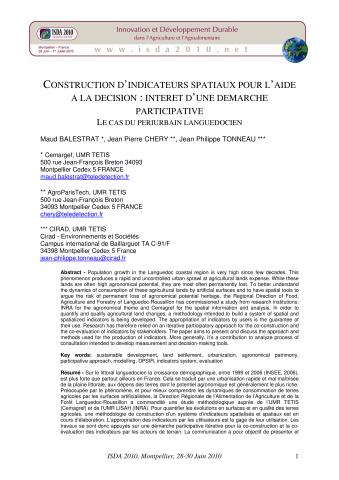
CONSTRUCTION D'INDICATEURS SPATIAUX POUR L'AIDE A LA DECISION : INTERET D'UNE DEMARCHE PARTICIPATIVE LE CAS DU PERIURBAIN LANGUEDOCIEN
- Type de publi. : Communication dans un congrès
- Date de publi. : 28/06/2010
-
Auteurs :
Maud BalestratJean-Pierre CheryJean-Philippe Tonneau
Fiche détaillée
CONSTRUCTION D'INDICATEURS SPATIAUX POUR L'AIDE A LA DECISION : INTERET D'UNE DEMARCHE PARTICIPATIVE LE CAS DU PERIURBAIN LANGUEDOCIEN
- Type de publi. : Communication dans un congrès
- Date de publi. : 28/06/2010
-
Auteurs :
Maud BalestratJean-Pierre CheryJean-Philippe Tonneau
-
Organismes :
Territoires, Environnement, Télédétection et Information Spatiale
Territoires, Environnement, Télédétection et Information Spatiale
Territoires, Environnement, Télédétection et Information Spatiale
Résumé : Population growth in the Languedoc coastal region is very high since few decades. This phenomenon produces a rapid and uncontrolled urban sprawl at agricultural lands expense. While these lands are often high agronomical potential, they are most often permanently lost. To better understand the dynamics of consumption of these agricultural lands by artificial surfaces and to have spatial tools to argue the risk of permanent loss of agronomical potential heritage, the Regional Direction of Food, Agriculture and Forestry of Languedoc-Roussillon has commissioned a study from research institutions: INRA for the agronomical theme and Cemagref for the spatial information and analysis. In order to quantify and qualify agricultural land changes, a methodology intended to build a system of spatial and spatialized indicators is being developed. The appropriation of indicators by users is the guarantee of their use. Research has therefore relied on an iterative participatory approach for the co-construction and the co-evaluation of indicators by stakeholders. The paper aims to present and discuss the approach and methods used for the production of indicators. More generally, it's a contribution to analyze process of consultation intended to develop measurement and decision-making tools.
Fichiers liés :
Balestrat.pdf
Source
-
Calibration and validation of SMOS brightness emperature over the Salar de Uyuni
- Type de publi. : Communication dans un congrès
- Date de publi. : 28/06/2010
-
Auteurs :
Maria Jose EscorihuelaYann H. KerrPhilippe RichaumeWigneron J.-P.Monica Roca
Fiche détaillée
Calibration and validation of SMOS brightness emperature over the Salar de Uyuni
- Type de publi. : Communication dans un congrès
- Date de publi. : 28/06/2010
-
Auteurs :
Maria Jose EscorihuelaYann H. KerrPhilippe RichaumeWigneron J.-P.Monica Roca
-
Organismes :
isardSAT
Centre d'études spatiales de la biosphère
Centre d'études spatiales de la biosphère
Écologie fonctionnelle et physique de l'environnement
isardSAT
Résumé : The Salar de Uyuni is the largest salt flat in the world. It is located in the Bolivian altiplane at a height of about 3700 m between latitudes 19o45' S and 20o40' S and between longitudes 68o17'W and 66o45'W. Its surface is about 9 600 km2 (several tenths the SMOS footprint). It is located in a rather uninhabited area where no RFI is to be expected. Potosi is the closest village. Salar's climate is cold and dry, being characterized by low temperatures, low relative humidity levels and low precipitation. The rainfall is very low and concentrated from December to March. During the austral summer (from December to March), the surface can be covered by a thin water layer. This water layer disappears in the dry season, from April to November, leaving the Salar surface extremely flat and smooth. Analysis of AMSR-E data at 6.9, 10 and 18 GHz shows that microwave emissivity over the Salar is spatially homogeneous. Temporal analysis of brightness temperature shows that at vertical polarization is basically dependent on soil temperature and that emissivity remains high and constant during the dry period (emissivity 0.93-0.94). Furthermore brightness temperature at vertical polarization was shown to be very similar at 6.9 and 10.7 GHz, indicating a very low penetration depth, similar behavior is to be expected for emissivity at 1.4 GHz. Vertically polarised brightness temperature at 6.9GHz was simulated with annual rmse of 1.1K. Further study is needed to characterize H-pol. A piece of the Salar has been taken for its dielectric constant characterisation (scheduled November 2009). The salar de Uyuni is therefore an excellent site for the calibration and validation of the SMOS brightness temperature. In this presentation, SMOS brightness temperatures measured over the Salar will be shown and compared to those of models and also compared to AMSR-E data.
Source
-
Spatio-Temporal Mining of PolSAR Satellite Image Time Series
- Type de publi. : Communication dans un congrès
- Date de publi. : 28/06/2010
-
Auteurs :
Andreea JuleaNicolas MégerEmmanuel TrouvéPhilippe BolonChristophe RigottiRenaud FallourdJean-Marie NicolasGabriel VasileMichel GayOlivier HarantLaurent Ferro-Famil
Fiche détaillée
Spatio-Temporal Mining of PolSAR Satellite Image Time Series
- Type de publi. : Communication dans un congrès
- Date de publi. : 28/06/2010
-
Auteurs :
Andreea JuleaNicolas MégerEmmanuel TrouvéPhilippe BolonChristophe RigottiRenaud FallourdJean-Marie NicolasGabriel VasileMichel GayOlivier HarantLaurent Ferro-Famil
-
Organismes :
Laboratoire d'Informatique, Systèmes, Traitement de l'Information et de la Connaissance
Laboratoire d'Analyse et Traitement d'Images
Laboratoire d'Informatique, Systèmes, Traitement de l'Information et de la Connaissance
Laboratoire d'Informatique, Systèmes, Traitement de l'Information et de la Connaissance
Laboratoire d'Informatique, Systèmes, Traitement de l'Information et de la Connaissance
Data Mining and Machine Learning
COMputational BIology and data miNING
Laboratoire d'Informatique, Systèmes, Traitement de l'Information et de la Connaissance
Télécom ParisTech
GIPSA - Signal Images Physique
GIPSA-Services
GIPSA - Signal Images Physique
Institut d'Electronique et de Télécommunications de Rennes
Institut d'Électronique et des Technologies du numéRique
Résumé : This paper presents an original data mining approach for describing Satellite Image Time Series (SITS) spa- tially and temporally. It relies on pixel-based evolution and sub-evolution extraction. These evolutions, namely the frequent grouped sequential patterns, are required to cover a minimum surface and to affect pixels that are sufficiently connected. These spatial constraints are ac- tively used to face large data volumes and to select evolu- tions making sense for end-users. In this paper, a specific application to fully polarimetric SAR image time series is presented. Preliminary experiments performed on a RADARSAT-2 SITS covering the Chamonix Mont-Blanc test-site are used to illustrate the proposed approach.
Source
-
SMOS: Objectives and Approach for Ocean Salinity Observations
- Type de publi. : Communication dans un congrès
- Date de publi. : 28/06/2010
-
Auteurs :
Jordi FontJacqueline BoutinNicolas ReulPaul SpurgeonJoaquim BallabereaAndrei ChuprinCarolina GabarroJerome GourrionClaire HénocqSamantha LavenderNicolas MartinJustino MartinezMichael MccullochIngo Meirold-MautnerFrançois PetitcolinMarcos PortabellaRoberto SabiaMarco TaloneJoseph TenerelliAntonio TurielJean-Luc VergelyPhilippe WaldteufelXiaobin YinSonia ZineSteven Delwart
Fiche détaillée
SMOS: Objectives and Approach for Ocean Salinity Observations
- Type de publi. : Communication dans un congrès
- Date de publi. : 28/06/2010
-
Auteurs :
Jordi FontJacqueline BoutinNicolas ReulPaul SpurgeonJoaquim BallabereaAndrei ChuprinCarolina GabarroJerome GourrionClaire HénocqSamantha LavenderNicolas MartinJustino MartinezMichael MccullochIngo Meirold-MautnerFrançois PetitcolinMarcos PortabellaRoberto SabiaMarco TaloneJoseph TenerelliAntonio TurielJean-Luc VergelyPhilippe WaldteufelXiaobin YinSonia ZineSteven Delwart
-
Organismes :
Institute of Marine Sciences / Institut de Ciències del Mar [Barcelona]
Laboratoire d'Océanographie et du Climat : Expérimentations et Approches Numériques
Domaines Océaniques
ARGANS Limited
Institute of Marine Sciences / Institut de Ciències del Mar [Barcelona]
ARGANS Limited
Institute of Marine Sciences / Institut de Ciències del Mar [Barcelona]
Institute of Marine Sciences / Institut de Ciències del Mar [Barcelona]
Analytic and Computational Research, Inc. - Earth Sciences
ARGANS Limited
Laboratoire d'Océanographie et du Climat : Expérimentations et Approches Numériques
Institute of Marine Sciences / Institut de Ciències del Mar [Barcelona]
ARGANS Limited
Analytic and Computational Research, Inc. - Earth Sciences
Analytic and Computational Research, Inc. - Earth Sciences
Institute of Marine Sciences / Institut de Ciències del Mar [Barcelona]
Institute of Marine Sciences / Institut de Ciències del Mar [Barcelona]
Institute of Marine Sciences / Institut de Ciències del Mar [Barcelona]
Collecte Localisation Satellites
Institute of Marine Sciences / Institut de Ciències del Mar [Barcelona]
Analytic and Computational Research, Inc. - Earth Sciences
Laboratoire Atmosphères, Milieux, Observations Spatiales
Laboratoire d'Océanographie et du Climat : Expérimentations et Approches Numériques
Université Grenoble Alpes
European Space Research and Technology Centre
Résumé : SMOS (Soil Moisture and Ocean Salinity), launched in November 2, 2009 is the first satellite mission addressing the salinity measurement from space through the use of MIRAS (Microwave Imaging Radiometer with Aperture Synthesis), a new two-dimensional interferometer designed by the European Space Agency (ESA) and operating at L-band. This paper presents a summary of the sea surface salinity retrieval approach implemented in SMOS, as well as first results obtained after completing the mission commissioning phase in May 2010. A large number of papers have been published about salinity remote sensing and its implementation in the SMOS mission. An extensive list of references is provided here, many authored by the SMOS ocean salinity team, with emphasis on the different physical processes that have been considered in the SMOS salinity retrieval algorithm.
Source
-
New generation multichannel subtractive double pass for EST imaging spectropolarimetry
- Type de publi. : Communication dans un congrès
- Date de publi. : 27/06/2010
-
Auteurs :
Frédéric SayèdePierre MeinJean-Philippe AmansJacques Moity
Fiche détaillée
New generation multichannel subtractive double pass for EST imaging spectropolarimetry
- Type de publi. : Communication dans un congrès
- Date de publi. : 27/06/2010
-
Auteurs :
Frédéric SayèdePierre MeinJean-Philippe AmansJacques Moity
-
Organismes :
Laboratoire d'études spatiales et d'instrumentation en astrophysique
Physique solaire
Laboratoire d'études spatiales et d'instrumentation en astrophysique
Physique solaire
Source
-
EAGLE: a MOAO fed multi-IFU NIR workhorse for E-ELT
- Type de publi. : Communication dans un congrès
- Date de publi. : 27/06/2010
-
Auteurs :
Jean-Gabriel CubySimon L. MorrisThierry FuscoMatthew D. LehnertPhilip Parr-BurmanGérard RoussetJean-Philippe AmansStephen BeardIan BrysonMathieu CohenNigel A. DipperChristopher EvansMarc FerrariÉric GendronJean-Luc GimenezDamien GratadourPeter R. HastingsZoltan HubertEmmanuel HugotPascal JagourelPhilippe LaporteVincent LebrunDavid Le MignantFabrice MadecRichard M. MyersBenoît NeichelTimothy J. MorrisClélia RobertHermine SchnetlerMark SwinbankGordon TalbotWilliam D. TaylorFabrice VidalSébastien VivèsPascal VolaNiraj WelikalaMartyn Wells
Fiche détaillée
EAGLE: a MOAO fed multi-IFU NIR workhorse for E-ELT
- Type de publi. : Communication dans un congrès
- Date de publi. : 27/06/2010
-
Auteurs :
Jean-Gabriel CubySimon L. MorrisThierry FuscoMatthew D. LehnertPhilip Parr-BurmanGérard RoussetJean-Philippe AmansStephen BeardIan BrysonMathieu CohenNigel A. DipperChristopher EvansMarc FerrariÉric GendronJean-Luc GimenezDamien GratadourPeter R. HastingsZoltan HubertEmmanuel HugotPascal JagourelPhilippe LaporteVincent LebrunDavid Le MignantFabrice MadecRichard M. MyersBenoît NeichelTimothy J. MorrisClélia RobertHermine SchnetlerMark SwinbankGordon TalbotWilliam D. TaylorFabrice VidalSébastien VivèsPascal VolaNiraj WelikalaMartyn Wells
-
Organismes :
Laboratoire d'études spatiales et d'instrumentation en astrophysique
Pôle Astronomie du LESIA
Laboratoire d'études spatiales et d'instrumentation en astrophysique
Pôle Astronomie du LESIA
Laboratoire d'études spatiales et d'instrumentation en astrophysique
Pôle Astronomie du LESIA
Laboratoire d'études spatiales et d'instrumentation en astrophysique
Pôle Astronomie du LESIA
Laboratoire d'études spatiales et d'instrumentation en astrophysique
Pôle Astronomie du LESIA
Source
-
The GRAVITY integrated optics beam combination
- Type de publi. : Communication dans un congrès
- Date de publi. : 27/06/2010
-
Auteurs :
Laurent JocouKarine PerrautA. NolotJean-Philippe BergerThibaut MoulinP. R. LabeyeSylvestre LacourGuy PerrinJean-Baptiste Le BouquinH. BartkoM. ThielFrank Eisenhauer
Fiche détaillée
The GRAVITY integrated optics beam combination
- Type de publi. : Communication dans un congrès
- Date de publi. : 27/06/2010
-
Auteurs :
Laurent JocouKarine PerrautA. NolotJean-Philippe BergerThibaut MoulinP. R. LabeyeSylvestre LacourGuy PerrinJean-Baptiste Le BouquinH. BartkoM. ThielFrank Eisenhauer
-
Organismes :
Laboratoire d'études spatiales et d'instrumentation en astrophysique
Pôle Astronomie du LESIA
Laboratoire d'études spatiales et d'instrumentation en astrophysique
Pôle Astronomie du LESIA
Source
-
Development of a high-dynamic range imaging instrument for a single telescope by a pupil remapping system
- Type de publi. : Communication dans un congrès
- Date de publi. : 27/06/2010
-
Auteurs :
Takayuki KotaniSylvestre LacourElodie ChoquetElsa HubyGuy PerrinPierre FédouFranck MarchisGaspard DuchêneEric ThiébautJulien M. WoillezJean-Philippe BergerP. BordéOlivier ChesneauPierre KervellaOlivier LaiStephen RidgwayDaniel RouanAlain Lecavelier Des EtangsA. Vidal-Madjar
Fiche détaillée
Development of a high-dynamic range imaging instrument for a single telescope by a pupil remapping system
- Type de publi. : Communication dans un congrès
- Date de publi. : 27/06/2010
-
Auteurs :
Takayuki KotaniSylvestre LacourElodie ChoquetElsa HubyGuy PerrinPierre FédouFranck MarchisGaspard DuchêneEric ThiébautJulien M. WoillezJean-Philippe BergerP. BordéOlivier ChesneauPierre KervellaOlivier LaiStephen RidgwayDaniel RouanAlain Lecavelier Des EtangsA. Vidal-Madjar
-
Organismes :
Laboratoire d'études spatiales et d'instrumentation en astrophysique
Pôle Astronomie du LESIA
Ingénieurs, Techniciens et Administratifs
Laboratoire d'études spatiales et d'instrumentation en astrophysique
Pôle Astronomie du LESIA
Ingénieurs, Techniciens et Administratifs
Laboratoire d'études spatiales et d'instrumentation en astrophysique
Pôle Astronomie du LESIA
Ingénieurs, Techniciens et Administratifs
Laboratoire d'études spatiales et d'instrumentation en astrophysique
Pôle Astronomie du LESIA
Ingénieurs, Techniciens et Administratifs
Laboratoire d'études spatiales et d'instrumentation en astrophysique
Pôle Astronomie du LESIA
Ingénieurs, Techniciens et Administratifs
Laboratoire d'études spatiales et d'instrumentation en astrophysique
Pôle Astronomie du LESIA
Ingénieurs, Techniciens et Administratifs
Source