Professeur des universités en sciences de gestion
-
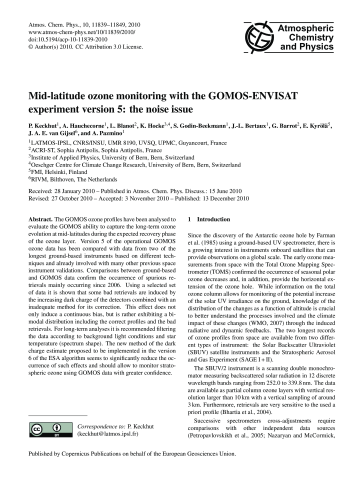
Mid-latitude ozone monitoring with the GOMOS-ENVISAT experiment version 5: the noise issue
- Type de publi. : Article dans une revue
- Date de publi. : 01/01/2010
-
Auteurs :
Philippe KeckhutAlain HauchecorneLaurent BlanotK. HockeSophie GodinJean-Loup BertauxGilbert BarrotE. KyröläA. van GijselAndrea Pazmiño
Fiche détaillée
Mid-latitude ozone monitoring with the GOMOS-ENVISAT experiment version 5: the noise issue
- Type de publi. : Article dans une revue
- Date de publi. : 01/01/2010
-
Auteurs :
Philippe KeckhutAlain HauchecorneLaurent BlanotK. HockeSophie GodinJean-Loup BertauxGilbert BarrotE. KyröläA. van GijselAndrea Pazmiño
-
Organismes :
STRATO - LATMOS
STRATO - LATMOS
Analytic and Computational Research, Inc. - Earth Sciences
Institut für angewandte Physik [Bern]
Oeschger Centre for Climate Change Research
STRATO - LATMOS
STRATO - LATMOS
Analytic and Computational Research, Inc. - Earth Sciences
Finnish Meteorological Institute
National Institute for Public Health and the Environment [Bilthoven]
STRATO - LATMOS
- Publié dans Atmospheric Chemistry and Physics le 31/10/2020
Résumé : The GOMOS ozone profiles have been analysed to evaluate the GOMOS ability to capture the long-term ozone evolution at mid-latitudes during the expected recovery phase of the ozone layer. Version 5 of the operational GOMOS ozone data has been compared with data from two of the longest ground-based instruments based on different techniques and already involved with many other previous space instrument validations. Comparisons between ground-based and GOMOS data confirm the occurrence of spurious retrievals mainly occurring since 2006. Using a selected set of data it is shown that some bad retrievals are induced by the increasing dark charge of the detectors combined with an inadequate method for its correction. This effect does not only induce a continuous bias, but is rather exhibiting a bimodal distribution including the correct profiles and the bad retrievals. For long-term analyses it is recommended filtering the data according to background light conditions and star temperature (spectrum shape). The new method of the dark charge estimate proposed to be implemented in the version 6 of the ESA algorithm seems to significantly reduce the occurrence of such effects and should allow to monitor stratospheric ozone using GOMOS data with greater confidence.
Fichiers liés :
acp-10-11839-2010.pdf
Source
-

Health impact of unicellular algae of the Ostreopsis genus blooms in the Mediterranean Sea: experience of the French Mediterranean coast surveillance network from 2006 to 2009
- Type de publi. : Article dans une revue
- Date de publi. : 01/01/2010
-
Auteurs :
Lucia TichadouMathieu GlaizalAlexis ArmengaudHubert GrosselRodolphe LeméeRoger KantinJean-Luc LasalleGeneveve DrouetLoic RambaudPhilippe MalfaitLuc De Haro
Fiche détaillée
Health impact of unicellular algae of the Ostreopsis genus blooms in the Mediterranean Sea: experience of the French Mediterranean coast surveillance network from 2006 to 2009
- Type de publi. : Article dans une revue
- Date de publi. : 01/01/2010
-
Auteurs :
Lucia TichadouMathieu GlaizalAlexis ArmengaudHubert GrosselRodolphe LeméeRoger KantinJean-Luc LasalleGeneveve DrouetLoic RambaudPhilippe MalfaitLuc De Haro
-
Organismes :
Hôpital Sainte-Marguerite [CHU - APHM]
"Personal Protection Against Vectors" working group
Laboratoire Environnement Ressources Morbihan Pays de Loire
Laboratoire d'océanographie de Villefranche
Laboratoire Environnement Ressources Provence Azur Corse
Santé publique France [Marseille]
Santé publique France - French National Public Health Agency [Saint-Maurice, France]
Cellule Interrégionale d'Epidémiologie
Hôpital Sainte-Marguerite [CHU - APHM]
- Publié dans Clinical Toxicology le 30/10/2020
Résumé : Objective. Ostreopsis ovata and Ostreopsis siamensis are tropical unicellular algae that have been found recently in the Mediterranean. Both of these dinoflagellates produce palytoxin (PTX)-like toxins that are powerful vasoconstrictors in mammals. Since 2003, Ostreopsis blooms in Italy and Spain have been accompanied by reports of respiratory problems and skin/mucosa irritation in persons in contact with toxic microalgal cells (epiphytes, plankton, or sea spray) or associated toxins. Methods. In France, a surveillance network has been set up to monitor water conditions and to protect swimmers from contamination due to Ostreopsis. Results. Between 2006 and 2009, a total of nine blooms were observed on the French Mediterranean coast including five that led to manifestations in divers, swimmers, and shoreline inhabitants. A total of 47 patients presented symptoms of involving benign or mild skin, mucosal, and/or respiratory irritation that regressed spontaneously without treatment within 12-72 h (4-12 h with nonsteroidal anti-inflammatory drugs). During the study period, five beaches were temporarily closed. Discussion. In the Mediterranean, Ostreopsis blooms induce skin and respiratory disorders when human beings are exposed to saltwater with a high concentration of algal cells. However, palytoxin dosages carried out on the food chain (urchins, mussels) indicate that this risk of toxins accumulation in seafood must be taken into account and that the surveillance network should be upgraded accordingly.
Source
-
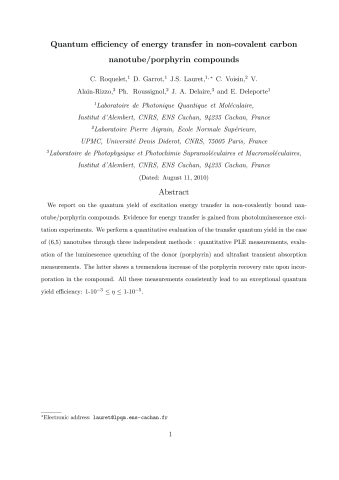
Quantum efficiency of energy transfer in noncovalent carbon nanotube/porphyrin compounds
- Type de publi. : Article dans une revue
- Date de publi. : 01/01/2010
-
Auteurs :
Cyrielle RoqueletDamien GarrotJean‐sébastien LauretC. VoisinValérie Alain-RizzoPhilippe RoussignolJacques A. DelaireEmmanuelle Deleporte
Fiche détaillée
Quantum efficiency of energy transfer in noncovalent carbon nanotube/porphyrin compounds
- Type de publi. : Article dans une revue
- Date de publi. : 01/01/2010
-
Auteurs :
Cyrielle RoqueletDamien GarrotJean‐sébastien LauretC. VoisinValérie Alain-RizzoPhilippe RoussignolJacques A. DelaireEmmanuelle Deleporte
-
Organismes :
Laboratoire de Photonique Quantique et Moléculaire
Laboratoire de Photonique Quantique et Moléculaire
Laboratoire de Photonique Quantique et Moléculaire
Laboratoire Pierre Aigrain
Laboratoire de Photophysique et Photochimie Supramoléculaires et Macromoléculaires
Laboratoire Pierre Aigrain
Laboratoire de Photophysique et Photochimie Supramoléculaires et Macromoléculaires
Laboratoire de Photonique Quantique et Moléculaire
- Publié dans Applied Physics Letters le 01/11/2020
Résumé : We report on the quantum yield of excitation energy transfer in non-covalently bound nan- otube/porphyrin compounds. Evidence for energy transfer is gained from photoluminescence exci- tation experiments. We perform a quantitative evaluation of the transfer quantum yield in the case of (6,5) nanotubes through three independent methods : quantitative PLE measurements, evalu- ation of the luminescence quenching of the donor (porphyrin) and ultrafast transient absorption measurements. The latter shows a tremendous increase of the porphyrin recovery rate upon incor- poration in the compound. All these measurements consistently lead to an exceptional quantum yield efficiency.
Fichiers liés :
apl_roquelet2010.pdf
Source
-
In vivo evaluation of intracellular drug-nanocarriers infused into intracranial tumours by convection-enhanced delivery: Distribution and radiosensitisation efficacy
- Type de publi. : Article dans une revue
- Date de publi. : 01/01/2010
-
Auteurs :
S. Vinchon-PetitD. JarnetA. Paillard-GiteauJean-Pierre BenoîtEmmanuel GarcionPhilippe Menei
Fiche détaillée
In vivo evaluation of intracellular drug-nanocarriers infused into intracranial tumours by convection-enhanced delivery: Distribution and radiosensitisation efficacy
- Type de publi. : Article dans une revue
- Date de publi. : 01/01/2010
-
Auteurs :
S. Vinchon-PetitD. JarnetA. Paillard-GiteauJean-Pierre BenoîtEmmanuel GarcionPhilippe Menei
-
Organismes :
CRLCC - Centre Paul Papin
Ingénierie de la vectorisation particulaire
Micro et Nanomédecines Biomimétiques
Micro et Nanomédecines Biomimétiques
Micro et Nanomédecines Biomimétiques
- Publié dans Journal of Neuro-Oncology le 25/10/2020
Source
-

Social and semantic coevolution in knowledge networks
- Type de publi. : Article dans une revue
- Date de publi. : 01/01/2010
-
Auteurs :
Camille RothJean-Philippe Cointet
Fiche détaillée
Social and semantic coevolution in knowledge networks
- Type de publi. : Article dans une revue
- Date de publi. : 01/01/2010
-
Auteurs :
Camille RothJean-Philippe Cointet
-
Organismes :
University of Surrey
Centre d'Analyse et de Mathématique sociales
Institut des Systèmes Complexes - Paris Ile-de-France
Sciences en Société
Institut des Systèmes Complexes - Paris Ile-de-France
Transformations Sociales et Politiques liées aux Vivants
- Publié dans Social Networks le 30/10/2020
Résumé : Socio-semantic networks involve agents creating and processing information: communities of scientists, software developers, wild Contributors and webloggers are, among others, examples Of Such knowledge networks. We aim at demonstrating that the dynamics of these communi ties can be adequately described as the coevolution of a social and a socio-semantic network. More precisely, we will first introduce a theoretical framework based on a social network and a socio-semantic network, i.e. an epistemic network featuring agents. concepts and links between agents and between agents and concepts. Adopting a relevant empirical protocol. we will then describe the joint dynamics of social and socio-semantic structures, at both macroscopic and microscopic scales, emphasizing the remarkable stability of these macroscopic properties in spite of a vivid local, agent-based network dynamics. (C) 2009 Elsevier B.V. All rights reserved.
Fichiers liés :
1-s2.0-S0378873309000215-main_1.pdf
Source
-
Lutte contre le terrorisme dans le monde
- Type de publi. : Article dans une revue
- Date de publi. : 01/01/2010
-
Auteurs :
Philippe GrécianoMathieu Guidère
Fiche détaillée
Lutte contre le terrorisme dans le monde
- Type de publi. : Article dans une revue
- Date de publi. : 01/01/2010
-
Auteurs :
Philippe GrécianoMathieu Guidère
-
Organismes :
Centre d'études sur la sécurité internationale et les coopérations européennes
France, Amériques, Espagne, Sociétés, Pouvoirs, Acteurs
- Publié dans Nouveaux Cahiers d'Allemand : Revue de linguistique et de didactique le 27/10/2020
Source
-
In Vivo Analysis of Ifn-gamma 1 and Ifn-gamma 2 Signaling in Zebrafish
- Type de publi. : Article dans une revue
- Date de publi. : 01/01/2010
-
Auteurs :
Dina AggadCornelia SteinDirk SiegerMartine MazelPierre BoudinotPhilippe HerbomelJean-Pierre LevraudGeorges LutfallaMaria Leptin
Fiche détaillée
In Vivo Analysis of Ifn-gamma 1 and Ifn-gamma 2 Signaling in Zebrafish
- Type de publi. : Article dans une revue
- Date de publi. : 01/01/2010
-
Auteurs :
Dina AggadCornelia SteinDirk SiegerMartine MazelPierre BoudinotPhilippe HerbomelJean-Pierre LevraudGeorges LutfallaMaria Leptin
-
Organismes :
Dynamique des interactions membranaires normales et pathologiques
Universität zu Köln = University of Cologne
Universität zu Köln = University of Cologne
Dynamique des interactions membranaires normales et pathologiques
Unité de recherche Virologie et Immunologie Moléculaires
Macrophages et Développement de l'Immunité
Macrophages et Développement de l'Immunité
Dynamique des interactions membranaires normales et pathologiques
Universität zu Köln = University of Cologne
- Publié dans Journal of Immunology le 27/10/2020
Résumé : The zebrafish genome contains a large number of genes encoding potential cytokine receptor genes as judged by homology to mammalian receptors. The sequences are too divergent to allow unambiguous assignments of all receptors to specific cytokines, and only a few have been assigned functions by functional studies. Among receptors for class II helical cytokines-i.e., IFNs that include virus-induced Ifns (Ifn-phi) and type II Ifns (Ifn-gamma), together with Il-10 and its related cytokines (Il-20, Il-22, and Il-26)-only the Ifn-phi-specific complexes have been functionally identified, whereas the receptors for the two Ifn-gamma (Ifn-gamma 1 and Ifn-gamma 2) are unknown. In this work, we identify conditions in which Ifn-gamma 1 and Ifn-gamma 2 (also called IFNG or IFN-gamma and IFN-gammarel) are induced in fish larvae and adults. We use morpholino-mediated loss-of-function analysis to screen candidate receptors and identify the components of their receptor complexes. We find that Ifn-gamma 1 and Ifn-gamma 2 bind to different receptor complexes. The receptor complex for Ifn-gamma 2 includes cytokine receptor family B (Crfb)6 together with Crfb13 and Crfb17, whereas the receptor complex for Ifn-gamma 1 does not include Crfb6 or Crfb13 but includes Crfb17. We also show that of the two Jak2 paralogues present in the zebrafish Jak2a but not Jak2b is involved in the intracellular transmission of the Ifn-gamma signal. These results shed new light on the evolution of the Ifn-gamma signaling in fish and tetrapods and contribute toward an integrated view of the innate immune regulation in vertebrates. The Journal of Immunology, 2010, 185: 6774-6782.
Source
-
Biogeochemical cycles of nutrients in tropical Eucalyptus plantations main features shown by intensive monitoring in Congo and Brazil
- Type de publi. : Article dans une revue
- Date de publi. : 01/01/2010
-
Auteurs :
Jean-Paul LaclauJacques J. RangerJosé Leonardo de Moraes GonçalvesValérie MaquereAlex V. KruscheArmel Thongo M'BouYann NouvellonLaurent Saint‐andréJean-Pierre BouilletMarisa de Cassia PiccoloPhilippe Deleporte
Fiche détaillée
Biogeochemical cycles of nutrients in tropical Eucalyptus plantations main features shown by intensive monitoring in Congo and Brazil
- Type de publi. : Article dans une revue
- Date de publi. : 01/01/2010
-
Auteurs :
Jean-Paul LaclauJacques J. RangerJosé Leonardo de Moraes GonçalvesValérie MaquereAlex V. KruscheArmel Thongo M'BouYann NouvellonLaurent Saint‐andréJean-Pierre BouilletMarisa de Cassia PiccoloPhilippe Deleporte
-
Organismes :
Centre de Coopération Internationale en Recherche Agronomique pour le Développement
Escola Superior de Agricultura Luiz de Queiroz
Universidade de São Paulo = University of São Paulo
Unité de recherche Biogéochimie des Ecosystèmes Forestiers
Escola Superior de Agricultura Luiz de Queiroz
Universidade de São Paulo = University of São Paulo
AgroParisTech
Ecole Nationale du Génie Rural, des Eaux et des Forêts
Centro de Energia Nuclear na Agricultura (CENA)
Centre de Coopération Internationale en Recherche Agronomique pour le Développement
Centre de Coopération Internationale en Recherche Agronomique pour le Développement
Escola Superior de Agricultura Luiz de Queiroz
Unité de recherche Biogéochimie des Ecosystèmes Forestiers
Centre de Coopération Internationale en Recherche Agronomique pour le Développement
Centre de Coopération Internationale en Recherche Agronomique pour le Développement
Escola Superior de Agricultura Luiz de Queiroz
Centro de Energia Nuclear na Agricultura (CENA)
Centre de Coopération Internationale en Recherche Agronomique pour le Développement
- Publié dans Forest Ecology and Management le 26/10/2020
Résumé : The sustainability of fast-growing tropical Eucalyptus plantations is of concern in a context of rising fertilizer costs, since large amounts of nutrients are removed with biomass every 6–7 years from highly weathered soils. A better understanding of the dynamics of tree requirements is required to match fertilization regimes to the availability of each nutrient in the soil. The nutrition of Eucalyptus plantations has been intensively investigated and many studies have focused on specific fluxes in the biogeochemical cycles of nutrients. However, studies dealing with complete cycles are scarce for the Tropics. The objective of this paper was to compare these cycles for Eucalyptus plantations in Congo and Brazil, with contrasting climates, soil properties, and management practices. The main features were similar in the two situations. Most nutrient fluxes were driven by crown establishment the two first years after planting and total biomass production thereafter. These forests were characterized by huge nutrient requirements: 155, 10, 52, 55 and 23 kg ha_1 of N, P, K, Ca and Mg the first year after planting at the Brazilian study site, respectively. High growth rates the first months after planting were essential to take advantage of the large amounts of nutrients released into the soil solutions by organic matter mineralization after harvesting. This study highlighted the predominant role of biological and biochemical cycles over the geochemical cycle of nutrients in tropical Eucalyptus plantations and indicated the prime importance of carefully managing organic matter in these soils. Limited nutrient losses through deep drainage after clear-cutting in the sandy soils of the two study sites showed the remarkable efficiency of Eucalyptus trees in keeping limited nutrient pools within the ecosystem, even after major disturbances. Nutrient input–output budgets suggested that Eucalyptus plantations take advantage of soil fertility inherited from previous land uses and that long-term sustainability will require an increase in the inputs of certain nutrients.
Source
-
L'habitant dans les recherches scientifiques sur le bruit, et dans l'évaluation sonore pour l'action urbaine et territoriale
- Type de publi. : Rapport
- Date de publi. : 01/01/2010
-
Auteurs :
Guillaume FaburelN GourlotThéa ManolaO HernandezJean-Dominique PolackD DuboisPh Resche-RigonDamien MassonOlivia GermonJulien DelasJacques LolivePhilippe WoloszynB Schulte-FortkampPh Beaumont
Fiche détaillée
L'habitant dans les recherches scientifiques sur le bruit, et dans l'évaluation sonore pour l'action urbaine et territoriale
- Type de publi. : Rapport
- Date de publi. : 01/01/2010
-
Auteurs :
Guillaume FaburelN GourlotThéa ManolaO HernandezJean-Dominique PolackD DuboisPh Resche-RigonDamien MassonOlivia GermonJulien DelasJacques LolivePhilippe WoloszynB Schulte-FortkampPh Beaumont
-
Organismes :
LAB'URBA
LAB'URBA
Centre de recherche sur l'espace sonore et l'environnement urbain
Centre de recherche sur l'espace sonore et l'environnement urbain
Centre de recherche sur l'espace sonore et l'environnement urbain
Pacte, Laboratoire de sciences sociales
Espaces et Sociétés
Résumé : Programme SASUPHII - Séminaires sur les Ambiances Sonores Urbaines : Pratiques et Habitudes de l’Interdisciplinarité pour l’Intersectoriel
Source
-
Traitements photopériodiques et reproduction chez les animaux d'élevage
- Type de publi. : Article dans une revue
- Date de publi. : 01/01/2010
-
Auteurs :
Philippe ChemineauBenoit MalpauxJean-Pierre BrillardAlexis Fostier
Fiche détaillée
Traitements photopériodiques et reproduction chez les animaux d'élevage
- Type de publi. : Article dans une revue
- Date de publi. : 01/01/2010
-
Auteurs :
Philippe ChemineauBenoit MalpauxJean-Pierre BrillardAlexis Fostier
-
Organismes :
Physiologie de la reproduction et des comportements [Nouzilly]
Physiologie de la reproduction et des comportements [Nouzilly]
Physiologie de la reproduction et des comportements [Nouzilly]
Station commune de Recherches en Ichtyophysiologie, Biodiversité et Environnement
- Publié dans Bulletin de l'Académie Vétérinaire de France le 21/10/2020
Résumé : Les productions issues d'animaux d'élevage sont fréquemment rythmées sur les saisons, avec pour conséquence une disponibilité saisonnière en produits frais sur les marchés (viandes, lait et fromages, oeufs). Parmi les espèces d'intérêt en production animale, les poissons et les oiseaux sont généralement considérés comme plus directement sensibles aux facteurs externes, essentiellement les variations de la température pour les poissons et de la durée de la phase claire du jour, ou photopériode, pour les oiseaux. Chez de nombreuses espèces incluant des mammifères, nous utilisons largement des traitements photopériodiques artificiels qui consistent en un éclairement supplémentaire pendant les jours courts naturels (chez le poulet, la dinde, la pintade, le mouton et la chèvre) ou en l'administration de mélatonine pendant les jours longs (chez le mouton et la chèvre); ils permettent d'ajuster la période de reproduction aux souhaits de l'éleveur et/ou d'abolir complètement les variations saisonnières de la production spermatique dans les centres producteurs de semence destinée à l'insémination artificielle (mammifères), et dans les élevages (volailles, poissons). Par ailleurs, des traitements photopériodiques « purs » (sans mélatonine), en particulier lorsqu'ils sont appliqués en bâtiments ouverts, sont non invasifs et donc respectent l'intégrité et le bien-être des animaux.
Source