Professeur des universités en sciences de gestion
-
Characterization of Dynamic Measurements with Nanoparticular SnO 2 Gas Sensors
- Type de publi. : Communication dans un congrès
- Date de publi. : 20/09/2009
-
Auteurs :
Cyril TropisPhilippe MeniniAlejandra MartinezP. YobouéFrédéric BlancBernard FrancPaul FadelDenis LagrangePierre FauAndré Maisonnat
Fiche détaillée
Characterization of Dynamic Measurements with Nanoparticular SnO 2 Gas Sensors
- Type de publi. : Communication dans un congrès
- Date de publi. : 20/09/2009
-
Auteurs :
Cyril TropisPhilippe MeniniAlejandra MartinezP. YobouéFrédéric BlancBernard FrancPaul FadelDenis LagrangePierre FauAndré Maisonnat
-
Organismes :
Laboratoire d'analyse et d'architecture des systèmes
Laboratoire d'analyse et d'architecture des systèmes
Laboratoire d'analyse et d'architecture des systèmes
Laboratoire d'analyse et d'architecture des systèmes
Laboratoire d'analyse et d'architecture des systèmes
Laboratoire d'analyse et d'architecture des systèmes
Service Techniques et Équipements Appliqués à la Microélectronique
Laboratoire d'analyse et d'architecture des systèmes
Laboratoire de chimie de coordination
Laboratoire de chimie de coordination
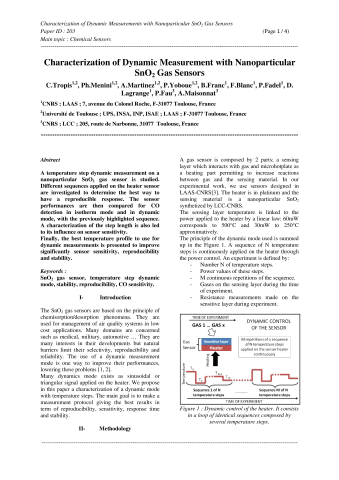
Résumé : A temperature step dynamic measurement on a nanoparticular SnO2 gas sensor is studied. Different sequences applied on the heater sensor are investigated to determine the best way to have a reproducible response. The sensor performances are then compared for CO detection in isotherm mode and in dynamic mode, with the previously highlighted sequence. A characterization of the step length is also led to its influence on sensor sensitivity. Finally, the best temperature profile to use for dynamic measurements is presented to improve significantly sensor sensitivity, reproducibility and stability.
Fichiers liés :
MME09_Tropis.pdf
Source
-

Hierarchical image analysis for roughness characterization
- Type de publi. : Communication dans un congrès
- Date de publi. : 20/09/2009
-
Auteurs :
Pierre-Yves DuvivierVincent MandrillonJean-Philippe PolizziKarim Inal
Fiche détaillée
Hierarchical image analysis for roughness characterization
- Type de publi. : Communication dans un congrès
- Date de publi. : 20/09/2009
-
Auteurs :
Pierre-Yves DuvivierVincent MandrillonJean-Philippe PolizziKarim Inal
-
Organismes :
Département Packaging et Supports Souples
Département Packaging et Supports Souples
Centre Microélectronique de Provence - Site Georges Charpak (CMP-GC)
Commissariat à l'énergie atomique et aux énergies alternatives - Laboratoire d'Electronique et de Technologie de l'Information
Département Packaging et Supports Souples
Source
-

PERFORMANCES OF A NEW GENERATION OF METAL OXIDE GAS SENSOR BASED ON NANOSTRUCTURED-SnO 2 AND ON HIGH OPERATING TEMPERATURE MICROHOTPLATE
- Type de publi. : Communication dans un congrès
- Date de publi. : 20/09/2009
-
Auteurs :
N YobouePhilippe MeniniC TropisPierre FauAndré Maisonnat
Fiche détaillée
PERFORMANCES OF A NEW GENERATION OF METAL OXIDE GAS SENSOR BASED ON NANOSTRUCTURED-SnO 2 AND ON HIGH OPERATING TEMPERATURE MICROHOTPLATE
- Type de publi. : Communication dans un congrès
- Date de publi. : 20/09/2009
-
Auteurs :
N YobouePhilippe MeniniC TropisPierre FauAndré Maisonnat
-
Organismes :
Laboratoire d'analyse et d'architecture des systèmes
Résumé : The sensor presented in this article consists of a nanostructured SnO2 as high sensitive material and an efficient high temperature microhotplate. Tin oxide nanoparticles are in suspension in a solvent (colloidal solution) and then are deposited by contactless methods such as microinjection that insure a good control of thin films deposition. A new efficient microhotplate has been developed with high electrical and mechanical stabilities up to 600°C with a low power consumption (<70mW) and allows an efficient control of temperature, useful for detection of gases. In this work, our new generation of metal oxide gas sensor is exposed to different polluting gases like CO, C3H8 and NO2 at different temperatures to determine the optimum operating temperatures which allow obtaining the highest sensitivity for each gas and then a good selectivity. We also demonstrated that these gas sensors present a better sensitivity and above all a better stability compare to commercial metal oxide gas sensors
Fichiers liés :
Paper-185-YOBOUE.pdf
Source
-
The LOFAR Transients Key Project
- Type de publi. : Communication dans un congrès
- Date de publi. : 18/09/2009
-
Auteurs :
Robert P. FenderRalph A. M. J. WijersBenjamin W. StappersR. BraunMichael W. WiseThijs CoenenHeino FalckeJean-Mathias GriessmeierM. P. van HaarlemP. JonkerCasey J. LawSera MarkoffJ. MastersJames C. Miller-JonesR. A. OstenBart ScheersHanno SpreeuwJohn D. SwinbankC. VogtRudy WijnandsPhilippe Zarka
Fiche détaillée
The LOFAR Transients Key Project
- Type de publi. : Communication dans un congrès
- Date de publi. : 18/09/2009
-
Auteurs :
Robert P. FenderRalph A. M. J. WijersBenjamin W. StappersR. BraunMichael W. WiseThijs CoenenHeino FalckeJean-Mathias GriessmeierM. P. van HaarlemP. JonkerCasey J. LawSera MarkoffJ. MastersJames C. Miller-JonesR. A. OstenBart ScheersHanno SpreeuwJohn D. SwinbankC. VogtRudy WijnandsPhilippe Zarka
-
Organismes :
Laboratoire d'études spatiales et d'instrumentation en astrophysique
Physique des plasmas
Laboratoire d'études spatiales et d'instrumentation en astrophysique
Physique des plasmas
Source
-
IRMPD spectroscopy and quantum chemistry: two ideal partners for probing the structure of gaseous ions
- Type de publi. : Communication dans un congrès
- Date de publi. : 17/09/2009
-
Auteurs :
Jean-Yves SalpinEdith NicolThierry BessonWilliam BuchmannMarie-Pierre GaigeotPhilippe MaıtreRiccardo Spezia
Fiche détaillée
IRMPD spectroscopy and quantum chemistry: two ideal partners for probing the structure of gaseous ions
- Type de publi. : Communication dans un congrès
- Date de publi. : 17/09/2009
-
Auteurs :
Jean-Yves SalpinEdith NicolThierry BessonWilliam BuchmannMarie-Pierre GaigeotPhilippe MaıtreRiccardo Spezia
-
Organismes :
Laboratoire Analyse et Modélisation pour la Biologie et l'Environnement
Laboratoire de Chimie Physique D'Orsay
Laboratoire de Chimie Physique D'Orsay
Laboratoire Analyse et Modélisation pour la Biologie et l'Environnement
Laboratoire Analyse et Modélisation pour la Biologie et l'Environnement
Laboratoire de Chimie Physique D'Orsay
Laboratoire Analyse et Modélisation pour la Biologie et l'Environnement
Source
-
Performance of the Cophasing System of Persee, a Dynamic Nulling Demonstrator
- Type de publi. : Communication dans un congrès
- Date de publi. : 14/09/2009
-
Auteurs :
Kamel HouairiFrédéric CassaingJean-Michel Le DuigouJean-Philippe AmansMarc BarillotVincent Coudé Du ForestoFrançois HénaultSophie JacquinodGarima SinghJoseph MontriMarc OllivierJean-Michel ReessBéatrice SorrenteDawn M. GelinoIgnasi Ribas
Fiche détaillée
Performance of the Cophasing System of Persee, a Dynamic Nulling Demonstrator
- Type de publi. : Communication dans un congrès
- Date de publi. : 14/09/2009
-
Auteurs :
Kamel HouairiFrédéric CassaingJean-Michel Le DuigouJean-Philippe AmansMarc BarillotVincent Coudé Du ForestoFrançois HénaultSophie JacquinodGarima SinghJoseph MontriMarc OllivierJean-Michel ReessBéatrice SorrenteDawn M. GelinoIgnasi Ribas
-
Organismes :
Laboratoire d'études spatiales et d'instrumentation en astrophysique
Pôle Astronomie du LESIA
Laboratoire d'études spatiales et d'instrumentation en astrophysique
Pôle Astronomie du LESIA
Laboratoire d'études spatiales et d'instrumentation en astrophysique
Pôle Astronomie du LESIA
Source
-
A whole farm-model to simulate the environmental impacts of animal farming system: Melodie
- Type de publi. : Communication dans un congrès
- Date de publi. : 10/09/2009
-
Auteurs :
Xavier ChardonCyrille RigolotChristine BaratteRoger Martin-ClouaireJean-Pierre RellierC. RaisonAndré Le GallJean-Yves DourmadJean-Claude PoupaLuc DelabyThierry MorvanPhilippe LetermeJean-Marie PaillatS. EspagnolPhilippe Faverdin
Fiche détaillée
A whole farm-model to simulate the environmental impacts of animal farming system: Melodie
- Type de publi. : Communication dans un congrès
- Date de publi. : 10/09/2009
-
Auteurs :
Xavier ChardonCyrille RigolotChristine BaratteRoger Martin-ClouaireJean-Pierre RellierC. RaisonAndré Le GallJean-Yves DourmadJean-Claude PoupaLuc DelabyThierry MorvanPhilippe LetermeJean-Marie PaillatS. EspagnolPhilippe Faverdin
-
Organismes :
Production du lait
Production du lait
Production du lait
Unité de Biométrie et Intelligence Artificielle (ancêtre de MIAT)
Unité de Biométrie et Intelligence Artificielle (ancêtre de MIAT)
Institut de l'élevage
Institut de l'élevage
Systèmes d'élevage, nutrition animale et humaine
Structures et Marché Agricoles, Ressources et Territoires
Production du lait
Sol Agro et hydrosystème Spatialisation
Sol Agro et hydrosystème Spatialisation
Sol Agro et hydrosystème Spatialisation
Institut du Porc
Production du lait
Résumé : A whole farm-model to simulate the environmental impacts of animal farming system: Melodie. 7. International Workshop. Modelling nutrient digestion and utilization in farm animals
Source
-
A model relating management practices and nutrient flows in indoor pig farming
- Type de publi. : Communication dans un congrès
- Date de publi. : 10/09/2009
-
Auteurs :
Cyrille C. RigolotJean-Pierre RellierRoger Martin-ClouairePhilippe FaverdinChristine BaratteJean-Yves Dourmad
Fiche détaillée
A model relating management practices and nutrient flows in indoor pig farming
- Type de publi. : Communication dans un congrès
- Date de publi. : 10/09/2009
-
Auteurs :
Cyrille C. RigolotJean-Pierre RellierRoger Martin-ClouairePhilippe FaverdinChristine BaratteJean-Yves Dourmad
-
Organismes :
Production du lait
Unité de Biométrie et Intelligence Artificielle (ancêtre de MIAT)
Unité de Biométrie et Intelligence Artificielle (ancêtre de MIAT)
Production du lait
Production du lait
Systèmes d'élevage, nutrition animale et humaine
Source
-

A Secure and Efficient Authenticated Diffie–Hellman Protocol
- Type de publi. : Communication dans un congrès
- Date de publi. : 10/09/2009
-
Auteurs :
Augustin SarrPhilippe Elbaz-VincentJean Claude Bajard
Fiche détaillée
A Secure and Efficient Authenticated Diffie–Hellman Protocol
- Type de publi. : Communication dans un congrès
- Date de publi. : 10/09/2009
-
Auteurs :
Augustin SarrPhilippe Elbaz-VincentJean Claude Bajard
-
Organismes :
Institut Fourier
Institut Fourier
Performance et Qualité des Algorithmes Numériques
Résumé : The Exponential Challenge Response (XRC) and Dual Exponential Challenge Response (DCR) signature schemes are the building blocks of the HMQV protocol. We pro-pose a complementary analysis of these schemes; on the basis of this analysis we show how impersonation and man in the middle attacks can be mounted against the HMQV protocol when some session specific information leakages happen. We define the Full Exponential Challenge Response (FXRC) and Full Dual Exponential Challenge Response (FDCR) sig-nature schemes; using these schemes we propose the Fully Hashed MQV protocol (with security arguments), which preserves the remarkable performance of the (H)MQV protocols and resists the attacks we present.
Fichiers liés :
408.pdf
Source
-

A potential link between PPAR signaling and the pathogenesis of arrhythmogenic right ventricular cardiomyopathy (ARVC) Time for Primary review: 50 Days Cardiovascular Research Advance
- Type de publi. : Article dans une revue
- Date de publi. : 10/09/2009
-
Auteurs :
Fatima DjouadiYves LecarpentierJean-Louis HebertPhilippe CharronJean BastinCatherine Coirault
Fiche détaillée
A potential link between PPAR signaling and the pathogenesis of arrhythmogenic right ventricular cardiomyopathy (ARVC) Time for Primary review: 50 Days Cardiovascular Research Advance
- Type de publi. : Article dans une revue
- Date de publi. : 10/09/2009
-
Auteurs :
Fatima DjouadiYves LecarpentierJean-Louis HebertPhilippe CharronJean BastinCatherine Coirault
-
Organismes :
Centre de Recherche des Cordeliers
Service d'Explorations Fonctionnelles Cardio-Respiratoires
Service d'Explorations Fonctionnelles Cardio-Respiratoires
CHU Pitié-Salpêtrière [AP-HP]
Centre de Recherche des Cordeliers
Thérapie des maladies du muscle strié
- Publié dans Cardiovascular Research le 29/10/2020
Fichiers liés :
ARVD cardiovasular research.pdf
Source