Professeur des universités en sciences de gestion
-

Extreme Magnification Microlensing Event OGLE-2008-BLG-279: Strong Limits on Planetary Companions to the Lens Star
- Type de publi. : Article dans une revue
- Date de publi. : 01/10/2009
-
Auteurs :
J. C. YeeA. UdalskiT. SumiSubo DongS. KozłowskiJ. C. BirdAndrew ColeD. HigginsJ. MccormickL. A. G. MonardD. PolishookA. ShporerO. SpectorM. K. SzymańskiM. KubiakGrzegorz PietrzyńskiI. SoszyńskiO. SzewczykK. UlaczykŁ. WyrzykowskiR. PoleskiW. AllenM. BosG. W. ChristieD. L. DepoyJ. D. EastmanB. S. GaudiA. GouldC. HanS. KaspiC.-U. LeeF. MalliaA. MauryD. MaozT. NatuschB.-G. ParkR. W. PoggeR. SantalloF. AbeI. A. BondA. FukuiK. FurusawaJ. B. HearnshawS. HosakaY. ItowK. KamiyaA. V. KorpelaP. M. KilmartinW. LinC. H. LingS. MakitaK. MasudaY. MatsubaraN. MiyakeY. MurakiM. NagayaK. NishimotoK. OhnishiY. C. PerrottN. J. RattenburyT. SakoTo. SaitoL. SkuljanD. J. SullivanW. L. SweatmanP. J. TristramP. C. M. YockM. D. AlbrowV. BatistaP. FouquéJean-Philippe BeaulieuD. P. BennettA. CassanJohan ComparatC. CouturesS. DietersJ. GreenhillK. HorneN. KainsD. KubasRoland MartinJ. MenziesJ. WambsganssAmy J. WilliamsM. Zub
Fiche détaillée
Extreme Magnification Microlensing Event OGLE-2008-BLG-279: Strong Limits on Planetary Companions to the Lens Star
- Type de publi. : Article dans une revue
- Date de publi. : 01/10/2009
-
Auteurs :
J. C. YeeA. UdalskiT. SumiSubo DongS. KozłowskiJ. C. BirdAndrew ColeD. HigginsJ. MccormickL. A. G. MonardD. PolishookA. ShporerO. SpectorM. K. SzymańskiM. KubiakGrzegorz PietrzyńskiI. SoszyńskiO. SzewczykK. UlaczykŁ. WyrzykowskiR. PoleskiW. AllenM. BosG. W. ChristieD. L. DepoyJ. D. EastmanB. S. GaudiA. GouldC. HanS. KaspiC.-U. LeeF. MalliaA. MauryD. MaozT. NatuschB.-G. ParkR. W. PoggeR. SantalloF. AbeI. A. BondA. FukuiK. FurusawaJ. B. HearnshawS. HosakaY. ItowK. KamiyaA. V. KorpelaP. M. KilmartinW. LinC. H. LingS. MakitaK. MasudaY. MatsubaraN. MiyakeY. MurakiM. NagayaK. NishimotoK. OhnishiY. C. PerrottN. J. RattenburyT. SakoTo. SaitoL. SkuljanD. J. SullivanW. L. SweatmanP. J. TristramP. C. M. YockM. D. AlbrowV. BatistaP. FouquéJean-Philippe BeaulieuD. P. BennettA. CassanJohan ComparatC. CouturesS. DietersJ. GreenhillK. HorneN. KainsD. KubasRoland MartinJ. MenziesJ. WambsganssAmy J. WilliamsM. Zub
-
Organismes :
The Ohio State University [Columbus]
Laboratoire Astrophysique de Toulouse-Tarbes
Institut d'Astrophysique de Paris
Astronomische Rechen-Institut [Heidelberg]
- Publié dans The Astrophysical Journal le 22/10/2020
Résumé : We analyze the extreme high-magnification microlensing event OGLE-2008-BLG-279, which peaked at a maximum magnification of A ~ 1600 on 2008 May 30. The peak of this event exhibits both finite-source effects and terrestrial parallax, from which we determine the mass of the lens, Ml = 0.64 ± 0.10 M sun, and its distance, Dl = 4.0 ± 0.6 kpc. We rule out Jupiter-mass planetary companions to the lens star for projected separations in the range 0.5-20 AU. More generally, we find that this event was sensitive to planets with masses as small as 0.2 \;M_\oplus \simeq 2 \;M_{Mars} with projected separations near the Einstein ring (~3 AU).
Source
-
NLP Contribution to the Semantic Web: Linking the Term to the Concept
- Type de publi. : Communication dans un congrès
- Date de publi. : 28/09/2009
-
Auteurs :
Gaëlle LortalNathalie ChaignaudJean-Philippe KotowiczJean-Pierre Pécuchet
Fiche détaillée
NLP Contribution to the Semantic Web: Linking the Term to the Concept
- Type de publi. : Communication dans un congrès
- Date de publi. : 28/09/2009
-
Auteurs :
Gaëlle LortalNathalie ChaignaudJean-Philippe KotowiczJean-Pierre Pécuchet
-
Organismes :
Thales Research and Technology [Palaiseau]
Equipe Multi-agent, Interaction, Décision
Equipe Multi-agent, Interaction, Décision
Equipe Multi-agent, Interaction, Décision
Résumé : The Semantic Web (SW) originally aims at studying a system interoperability based on a shared common knowledge base (ontology). Henceforth, the SW sets its heart on a semantic coordination of community parlance representative resources (in complement to a common knowledge base shared by the users). The matter is not only to use techniques to handle a large amount of data, but also to use approaches to keep the community parlance features. Thus, Web documents and folksonomies are the main semantic vehicle. They are little structured and Natural Language Processing (NLP) methods are then beneficial to analyze language specificities with a view to automating tasks about text. This paper describes a use of NLP techniques for the SW through a document engineering application: the information retrieval in a catalogue of online medical resources. Our approach emphasizes benefits of NLP techniques to handle multi-granular terminological resources.
Source
-
G-765C COX-2 gene promoter polymorphism and risk of atherosclerosis after kidney transplantation.
- Type de publi. : Article dans une revue
- Date de publi. : 27/09/2009
-
Auteurs :
Cécile CourivaudJamal BamoulidPierre TiberghienPhilippe SaasJean-Marc ChalopinDidier DuclouxChristophe LegendreÉric Thervet
Fiche détaillée
G-765C COX-2 gene promoter polymorphism and risk of atherosclerosis after kidney transplantation.
- Type de publi. : Article dans une revue
- Date de publi. : 27/09/2009
-
Auteurs :
Cécile CourivaudJamal BamoulidPierre TiberghienPhilippe SaasJean-Marc ChalopinDidier DuclouxChristophe LegendreÉric Thervet
-
Organismes :
Interactions hôte-greffon-tumeur, ingénierie cellulaire et génique - UFC (UMR INSERM 1098)
Service d'urologie, andrologie et transplantation rénale
Interactions hôte-greffon-tumeur, ingénierie cellulaire et génique - UFC (UMR INSERM 1098)
Service d'urologie, andrologie et transplantation rénale
Interactions hôte-greffon-tumeur, ingénierie cellulaire et génique - UFC (UMR INSERM 1098)
Plateforme de Biomonitoring
Interactions hôte-greffon-tumeur, ingénierie cellulaire et génique - UFC (UMR INSERM 1098)
Plateforme de Biomonitoring
Interactions hôte-greffon-tumeur, ingénierie cellulaire et génique - UFC (UMR INSERM 1098)
Service d'urologie, andrologie et transplantation rénale
Interactions hôte-greffon-tumeur, ingénierie cellulaire et génique - UFC (UMR INSERM 1098)
Service d'urologie, andrologie et transplantation rénale
Service de néphrologie adultes [CHU Necker]
Service de néphrologie adultes [CHU Necker]
- Publié dans Transplantation le 25/10/2020
Source
-
Local adaptations of life history traits of a Drosophila parasitoid, Leptopilina boulardi: climate and host distribution as agents of selection.
- Type de publi. : Communication dans un congrès
- Date de publi. : 24/09/2009
-
Auteurs :
Joffrey MoirouxCecile Le LannMajeed A. SeyahooeiPhilippe VernonJean-Sébastien PierreJoan van BaarenJacques J.M. J.M. van Alphen
Fiche détaillée
Local adaptations of life history traits of a Drosophila parasitoid, Leptopilina boulardi: climate and host distribution as agents of selection.
- Type de publi. : Communication dans un congrès
- Date de publi. : 24/09/2009
-
Auteurs :
Joffrey MoirouxCecile Le LannMajeed A. SeyahooeiPhilippe VernonJean-Sébastien PierreJoan van BaarenJacques J.M. J.M. van Alphen
-
Organismes :
Ecosystèmes, biodiversité, évolution [Rennes]
Ecosystèmes, biodiversité, évolution [Rennes]
Institute Biology Leiden
Ecosystèmes, biodiversité, évolution [Rennes]
Ecosystèmes, biodiversité, évolution [Rennes]
Ecosystèmes, biodiversité, évolution [Rennes]
Paysages, Changements Climatique, Biodiversité
Source
-
Do broad patents deter research cooperation?
- Type de publi. : Communication dans un congrès
- Date de publi. : 24/09/2009
-
Auteurs :
Michel TrommetterJean-Philippe Tropeano
Fiche détaillée
Do broad patents deter research cooperation?
- Type de publi. : Communication dans un congrès
- Date de publi. : 24/09/2009
-
Auteurs :
Michel TrommetterJean-Philippe Tropeano
-
Organismes :
Laboratoire d'Economie Appliquée = Grenoble Applied Economics Laboratory
Laboratoire d'Economie Appliquée = Grenoble Applied Economics Laboratory
Résumé : The authors develop a theoretical model where two competing firms need access to basic knowledge that only one firm owns. They determine the impact of an imperfect property right on the incentive to transfer that knowledge to the competitor. They compare these transfer strategies. (i) Patenting may lead to litigation costs that depend on the competition toughness. (ii) Keeping the knowledge secret involves no licence revenue but ensures a monopoly profit. (iii) The firm can also coooperate with the competitor and thereby avoids litigation. They show that whenever competition between both firms is low, making patentable basic knowledge promotes knowledge transfer through research cooperation.
Source
-

Reconfigurable SCA Applications with the FraSCAti Platform
- Type de publi. : Communication dans un congrès
- Date de publi. : 21/09/2009
-
Auteurs :
Lionel SeinturierPhilippe MerleDamien FournierNicolas DoletValerio SchiavoniJean-Bernard Stefani
Fiche détaillée
Reconfigurable SCA Applications with the FraSCAti Platform
- Type de publi. : Communication dans un congrès
- Date de publi. : 21/09/2009
-
Auteurs :
Lionel SeinturierPhilippe MerleDamien FournierNicolas DoletValerio SchiavoniJean-Bernard Stefani
-
Organismes :
Laboratoire d'Informatique Fondamentale de Lille
Adaptive Distributed Applications and Middleware
Adaptive Distributed Applications and Middleware
Adaptive Distributed Applications and Middleware
Adaptive Distributed Applications and Middleware
System architecture for reflective distributed computing environments
System architecture for reflective distributed computing environments
Résumé : The Service Component Architecture (SCA) is a technology agnostic standard for developing and deploying distributed service-oriented applications. However, SCA does not define standard means for runtime manageability (including introspection and reconfiguration) of SOA applications and of their supporting environment. This paper presents the FraSCAti platform, which brings runtime management features to SCA, and discusses key principles in its design: the adoption of an extended SCA component model for the implementation of SOA applications and of the FraSCAti platform itself; the use of component-based interception techniques for dynamically weaving non-functional services such as transaction management with components. The paper presents micro-benchmarks that show that runtime manageability in the FraSCAti platform is achieved without hindering its performance relative to the de facto reference SCA implementation, Apache's Tuscany.
Fichiers liés :
frascati.pdf
Source
-

The Solar Wind as Seen by SOHO/SWAN Since 1996: Comparison with SOHO/LASCO C2 Coronal Densities
- Type de publi. : Communication dans un congrès
- Date de publi. : 21/09/2009
-
Auteurs :
Rosine LallementEric QuémeraisPhilippe LamyJean-Loup BertauxStéphane FerronW. Schmidt
Fiche détaillée
The Solar Wind as Seen by SOHO/SWAN Since 1996: Comparison with SOHO/LASCO C2 Coronal Densities
- Type de publi. : Communication dans un congrès
- Date de publi. : 21/09/2009
-
Auteurs :
Rosine LallementEric QuémeraisPhilippe LamyJean-Loup BertauxStéphane FerronW. Schmidt
-
Organismes :
HELIOS - LATMOS
HELIOS - LATMOS
Laboratoire d'Astrophysique de Marseille
HELIOS - LATMOS
HELIOS - LATMOS
Finnish Meteorological Institute
Résumé : We update the SOHO/SWAN H Lyman-α brightness analysis to cover the 1996-2008 time interval. A forward model applied to the intensity maps provides the latitude and time dependence of the interstellar hydrogen ionization rate over more than a full solar cycle. The hydrogen ionization, being almost entirely due to charge-exchange with solar wind ions, reflects closely the solar wind flux. Our results show that the solar wind latitudinal structure during the present solar minimum is strikingly different from the previous minimum, with a much wider slow solar wind equatorial belt which persists until at least the end of 2008. We compute absolute values of the in-ecliptic H ionization rates using OMNI solar wind data and use them to calibrate our ionization rates at all heliographic latitudes. We then compare the resulting fluxes with the synoptic LASCO/C2 electron densities at 6 solar radii. The two time-latitude patterns are strikingly similar over all the cycle. This comparison shows that 6 Rs densities can be used to infer the solar wind type close to its source, with high (low) densities tracing the slow (fast) solar wind, simply because the density reflects the altitude at which the acceleration occurs. The comparison between the two minima suggests that the fast polar wind acceleration occurs at a larger distance during the current minimum compared to the previous one. This difference, potentially linked to the magnetic field decrease and/or the coronal temperature decrease should be reproduced by solar wind expansion models.
Fichiers liés :
1003.4243.pdf
Source
-
Characterization of Dynamic Measurements with Nanoparticular SnO 2 Gas Sensors
- Type de publi. : Communication dans un congrès
- Date de publi. : 20/09/2009
-
Auteurs :
Cyril TropisPhilippe MeniniAlejandra MartinezP. YobouéFrédéric BlancBernard FrancPaul FadelDenis LagrangePierre FauAndré Maisonnat
Fiche détaillée
Characterization of Dynamic Measurements with Nanoparticular SnO 2 Gas Sensors
- Type de publi. : Communication dans un congrès
- Date de publi. : 20/09/2009
-
Auteurs :
Cyril TropisPhilippe MeniniAlejandra MartinezP. YobouéFrédéric BlancBernard FrancPaul FadelDenis LagrangePierre FauAndré Maisonnat
-
Organismes :
Laboratoire d'analyse et d'architecture des systèmes
Laboratoire d'analyse et d'architecture des systèmes
Laboratoire d'analyse et d'architecture des systèmes
Laboratoire d'analyse et d'architecture des systèmes
Laboratoire d'analyse et d'architecture des systèmes
Laboratoire d'analyse et d'architecture des systèmes
Service Techniques et Équipements Appliqués à la Microélectronique
Laboratoire d'analyse et d'architecture des systèmes
Laboratoire de chimie de coordination
Laboratoire de chimie de coordination
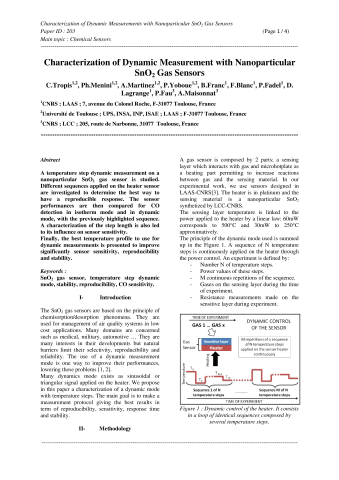
Résumé : A temperature step dynamic measurement on a nanoparticular SnO2 gas sensor is studied. Different sequences applied on the heater sensor are investigated to determine the best way to have a reproducible response. The sensor performances are then compared for CO detection in isotherm mode and in dynamic mode, with the previously highlighted sequence. A characterization of the step length is also led to its influence on sensor sensitivity. Finally, the best temperature profile to use for dynamic measurements is presented to improve significantly sensor sensitivity, reproducibility and stability.
Fichiers liés :
MME09_Tropis.pdf
Source
-
Hierarchical image analysis for roughness characterization
- Type de publi. : Communication dans un congrès
- Date de publi. : 20/09/2009
-
Auteurs :
Pierre-Yves DuvivierVincent MandrillonJean-Philippe PolizziKarim Inal
Fiche détaillée
Hierarchical image analysis for roughness characterization
- Type de publi. : Communication dans un congrès
- Date de publi. : 20/09/2009
-
Auteurs :
Pierre-Yves DuvivierVincent MandrillonJean-Philippe PolizziKarim Inal
-
Organismes :
Département Packaging et Supports Souples
Département Packaging et Supports Souples
Centre Microélectronique de Provence - Site Georges Charpak (CMP-GC)
Commissariat à l'énergie atomique et aux énergies alternatives - Laboratoire d'Electronique et de Technologie de l'Information
Département Packaging et Supports Souples
Source
-

PERFORMANCES OF A NEW GENERATION OF METAL OXIDE GAS SENSOR BASED ON NANOSTRUCTURED-SnO 2 AND ON HIGH OPERATING TEMPERATURE MICROHOTPLATE
- Type de publi. : Communication dans un congrès
- Date de publi. : 20/09/2009
-
Auteurs :
N YobouePhilippe MeniniC TropisPierre FauAndré Maisonnat
Fiche détaillée
PERFORMANCES OF A NEW GENERATION OF METAL OXIDE GAS SENSOR BASED ON NANOSTRUCTURED-SnO 2 AND ON HIGH OPERATING TEMPERATURE MICROHOTPLATE
- Type de publi. : Communication dans un congrès
- Date de publi. : 20/09/2009
-
Auteurs :
N YobouePhilippe MeniniC TropisPierre FauAndré Maisonnat
-
Organismes :
Laboratoire d'analyse et d'architecture des systèmes
Résumé : The sensor presented in this article consists of a nanostructured SnO2 as high sensitive material and an efficient high temperature microhotplate. Tin oxide nanoparticles are in suspension in a solvent (colloidal solution) and then are deposited by contactless methods such as microinjection that insure a good control of thin films deposition. A new efficient microhotplate has been developed with high electrical and mechanical stabilities up to 600°C with a low power consumption (<70mW) and allows an efficient control of temperature, useful for detection of gases. In this work, our new generation of metal oxide gas sensor is exposed to different polluting gases like CO, C3H8 and NO2 at different temperatures to determine the optimum operating temperatures which allow obtaining the highest sensitivity for each gas and then a good selectivity. We also demonstrated that these gas sensors present a better sensitivity and above all a better stability compare to commercial metal oxide gas sensors
Fichiers liés :
Paper-185-YOBOUE.pdf
Source