Professeur des universités en sciences de gestion
-

Differential expression and regulation of ADAM17 and TIMP3 in acute inflamed intestinal epithelia.
- Type de publi. : Article dans une revue
- Date de publi. : 01/06/2009
-
Auteurs :
Annabelle CesaroAbakar Abakar-MahamatPatrick BrestSandra LassalleEric SelvaJérôme FilippiXavier HébuterneJean-Pierre HugotAlain DoglioFranck GallandPhilippe NaquetValérie Vouret-CraviariBaharia MograbiPaul M Hofman
Fiche détaillée
Differential expression and regulation of ADAM17 and TIMP3 in acute inflamed intestinal epithelia.
- Type de publi. : Article dans une revue
- Date de publi. : 01/06/2009
-
Auteurs :
Annabelle CesaroAbakar Abakar-MahamatPatrick BrestSandra LassalleEric SelvaJérôme FilippiXavier HébuterneJean-Pierre HugotAlain DoglioFranck GallandPhilippe NaquetValérie Vouret-CraviariBaharia MograbiPaul M Hofman
-
Organismes :
Infection bactérienne, inflammation, et carcinogenèse digestive
Infection bactérienne, inflammation, et carcinogenèse digestive
Immunité muqueuse et vaccination
Infection bactérienne, inflammation, et carcinogenèse digestive
Infection bactérienne, inflammation, et carcinogenèse digestive
Immunité muqueuse et vaccination
Immunité muqueuse et vaccination
Infection bactérienne, inflammation, et carcinogenèse digestive
Immunité muqueuse et vaccination
Inflammation intestinale pathologique de l'enfant
Infection bactérienne, inflammation, et carcinogenèse digestive
Centre d'Immunologie de Marseille - Luminy
Centre d'Immunologie de Marseille - Luminy
Infection bactérienne, inflammation, et carcinogenèse digestive
Immunité muqueuse et vaccination
Infection bactérienne, inflammation, et carcinogenèse digestive
Immunité muqueuse et vaccination
- Publié dans AJP - Gastrointestinal and Liver Physiology le 26/10/2020
Résumé : The acute phase of Crohn's disease (CD) is characterized by a large afflux of polymorphonuclear leukocytes (PMNL) into the mucosa and by the release of TNF-alpha. Conversion of inactive TNF-alpha into an active form requires the cleavage of a transmembrane TNF-alpha precursor by the TNF-alpha-converting enzyme (ADAM17), a protease mainly regulated by the tissue inhibitor of metalloproteinase 3 (TIMP3). The aim of the present study was to investigate in an in vitro model of PMNL transepithelial migration and in the intestinal mucosa of patients with CD the expression and regulation of ADAM17 and TIMP3 in intestinal epithelial cells (IEC). ADAM17 and TIMP3 expression was analyzed by Western blotting, RT-PCR, confocal microscopy, and immunohistochemistry by using the T84 model and digestive biopsies. ADAM17 expression in IEC was increased at a posttranscriptional level during the early phase (from 2 to 4 h) of PMNL transepithelial migration whereas TIMP3 was only increased 24 h later. TNF-alpha induced an early upregulation of ADAM17 in T84 cells, whereas PMNL adhesion, H(2)O(2), or epithelial tight junction opening alone did not affect the amount of ADAM17. Immunohistochemistry of intestinal biopsies revealed that strong expression of ADAM17 was associated with a high activity of CD. In contrast, TIMP3 was very poorly expressed in these biopsies. ADAM17 and TIMP3 profiling did not correlated with the NOD2/CARD15 status. The ADAM17 activity was higher both in the early phase of PMNL transepithelial migration and in active CD. These results showed early posttranscriptional upregulation of ADAM17 in IEC linked to PMNL transepithelial migration and a high activity of CD.
Source
-
Highly directive ISM band cavity antenna using a bi-layered metasurface reflector
- Type de publi. : Article dans une revue
- Date de publi. : 01/06/2009
-
Auteurs :
Shah Nawaz BurokurAbdelwaheb OurirJean-Pierre DanielPhilippe RatajczakAndré De Lustrac
Fiche détaillée
Highly directive ISM band cavity antenna using a bi-layered metasurface reflector
- Type de publi. : Article dans une revue
- Date de publi. : 01/06/2009
-
Auteurs :
Shah Nawaz BurokurAbdelwaheb OurirJean-Pierre DanielPhilippe RatajczakAndré De Lustrac
-
Organismes :
Laboratoire Energétique Mécanique Electromagnétisme
Institut Langevin - Ondes et Images (UMR7587)
Ecole Nationale de l'Aviation Civile
Gvh et Gvl : Physiopathologie Chez l'Homme et Chez l'Animal, Incidence et Role Therapeutique
IEF
- Publié dans Microwave and Optical Technology Letters le 28/10/2020
Source
-
The use of partial nephrectomy in European tertiary care centers.
- Type de publi. : Article dans une revue
- Date de publi. : 01/06/2009
-
Auteurs :
Laurent ZiniJean-Jacques PatardUmberto CapitanioArnaud MejeanArnauld VillersAlexandre de La TailleVincenzo FicarraMaxime CrépelRoberto BertiniLaurent J. SalomonGregory VerhoestPaul PerrotteKarim BensalahPhilippe ArjaneJacques BiserteFrancesco MontorsiPierre I. Karakiewicz
Fiche détaillée
The use of partial nephrectomy in European tertiary care centers.
- Type de publi. : Article dans une revue
- Date de publi. : 01/06/2009
-
Auteurs :
Laurent ZiniJean-Jacques PatardUmberto CapitanioArnaud MejeanArnauld VillersAlexandre de La TailleVincenzo FicarraMaxime CrépelRoberto BertiniLaurent J. SalomonGregory VerhoestPaul PerrotteKarim BensalahPhilippe ArjaneJacques BiserteFrancesco MontorsiPierre I. Karakiewicz
-
Organismes :
Cancer Prognostics and Health Outcome Unit
Service d'urologie
Institut de Génétique et Développement de Rennes
Service d'urologie [Rennes] = Urology [Rennes]
Cancer Prognostics and Health Outcome Unit
Department of urology
Service d'urologie
Département d'urologie
Service d'urologie [Mondor]
Department of Oncological and Surgical Sciences
Service d'urologie [Rennes] = Urology [Rennes]
Department of urology
Service d'urologie [Mondor]
Service d'urologie [Rennes] = Urology [Rennes]
Cancer Prognostics and Health Outcomes Unit
Service d'urologie [Rennes] = Urology [Rennes]
Cancer Prognostics and Health Outcomes Unit
Département d'urologie
Department of urology
Cancer Prognostics and Health Outcome Unit
- Publié dans EJSO - European Journal of Surgical Oncology le 22/10/2020
Résumé : PURPOSE: The objective was to define the trends of PN use over time at six tertiary care European centers. METHODS: Data were retrieved from institutional databases for patients treated with either PN or radical nephrectomy (RN) for stages T(1-2)N(0)M(0) renal cell carcinoma (RCC) between 1987 and 2007. For purpose of temporal trend analyses patients were divided into five equally sized groups according to the date of surgery. Categorical and multivariable logistic regression analyses assessed predictors of PN use. RESULTS: Overall 597 (31.7%) patients were treated with PN. Overall, a 4.5-fold increase of PN was recorded. The absolute increases were 41.7-86.3%, 14.9-69.3% and 8.1-35.3% for lesions < or = 2 cm, 2.1-4 cm and 4.1-7 cm (chi-square trend test p<0.001), respectively. In multivariable logistic regression models, decreasing tumor size, younger age, more contemporary date of surgery, male gender and institutional PN rate represented independent predictors of the individual probability of treatment with PN. Lack of data from community hospitals limits the generalizability of our findings. CONCLUSION: Based on data from six tertiary care centers, the contemporary rate of PN ranges from 86 to 35% for renal masses < or = 2 cm to 4.1-7 cm and is indicative of excellent quality of care.
Source
-

Ciliary defects and genetics of primary ciliary dyskinesia.
- Type de publi. : Article dans une revue
- Date de publi. : 01/06/2009
-
Auteurs :
Estelle EscudierPhilippe DuquesnoyJean-François PaponSerge Amselem
Fiche détaillée
Ciliary defects and genetics of primary ciliary dyskinesia.
- Type de publi. : Article dans une revue
- Date de publi. : 01/06/2009
-
Auteurs :
Estelle EscudierPhilippe DuquesnoyJean-François PaponSerge Amselem
-
Organismes :
Physiopathologie des maladies génétiques d'expression pédiatrique
CHU Trousseau [APHP]
Physiopathologie des maladies génétiques d'expression pédiatrique
CHU Trousseau [APHP]
Institut Mondor de Recherche Biomédicale
Physiopathologie des maladies génétiques d'expression pédiatrique
CHU Trousseau [APHP]
- Publié dans Paediatric Respiratory Reviews le 02/11/2020
Résumé : Cilia are evolutionarily conserved structures that play key roles in diverse cell types. Motile cilia are involved in the most prominent ciliopathy called primary ciliary dyskinesia (PCD) that combines respiratory symptoms, male infertility, and, in nearly 50% cases, situs inversus. The diagnosis of PCD relies on the identification of ciliary abnormalities that mainly concern outer and/or inner dynein arms (ODA, IDA). PCD is a genetic condition, usually inherited as an autosomal recessive trait. To date, six genes have been clearly implicated in PCD. Two "major" genes, DNAI1 and DNAH5, underlie PCD in nearly half of the patients with ODA defects, whereas RPGR, DNAH11 and TXNDC3 are implicated in rare families with specific phenotypes (retinitis pigmentosa, abnormal beating of structurally normal cilia, and situs ambiguous, respectively). The relative contribution of DNAI2 is currently being assessed. In all the other patients with ODA or other ultrastructural defects, the causative genes remain to be identified.
Fichiers liés :
PCD_Review_Escudier.pdf
Source
-
Gaining insight into Clipperton's lagoon hydrology using tritium
- Type de publi. : Article dans une revue
- Date de publi. : 01/06/2009
-
Auteurs :
Philippe Jean-BaptisteElise FourréJean-Luc CharlouJean-Pierre DonvalThierry Corrège
Fiche détaillée
Gaining insight into Clipperton's lagoon hydrology using tritium
- Type de publi. : Article dans une revue
- Date de publi. : 01/06/2009
-
Auteurs :
Philippe Jean-BaptisteElise FourréJean-Luc CharlouJean-Pierre DonvalThierry Corrège
-
Organismes :
Laboratoire des Sciences du Climat et de l'Environnement [Gif-sur-Yvette]
Glaces et Continents, Climats et Isotopes Stables
Laboratoire des Sciences du Climat et de l'Environnement [Gif-sur-Yvette]
Glaces et Continents, Climats et Isotopes Stables
- Publié dans Estuarine, Coastal and Shelf Science le 22/10/2020
Fichiers liés :
publication-6457.pdf
Source
-
Influence of pesticide residues on honey bee (Hymenoptera: Apidae) colony health in France.
- Type de publi. : Article dans une revue
- Date de publi. : 01/06/2009
-
Auteurs :
Marie-Pierre ChauzatPatrice CarpentierAnne-Claire MartelStéphanie BougeardNicolas CougoulePhilippe PortaJulie LachaizeFrançois MadecMichel AubertJean-Paul Faucon
Fiche détaillée
Influence of pesticide residues on honey bee (Hymenoptera: Apidae) colony health in France.
- Type de publi. : Article dans une revue
- Date de publi. : 01/06/2009
-
Auteurs :
Marie-Pierre ChauzatPatrice CarpentierAnne-Claire MartelStéphanie BougeardNicolas CougoulePhilippe PortaJulie LachaizeFrançois MadecMichel AubertJean-Paul Faucon
-
Organismes :
Laboratoire d'études et de recherches sur les petits ruminants et les abeilles
Direction du végétal et de l'environnement
Laboratoire d'études et de recherches sur les petits ruminants et les abeilles
Laboratoire d'études et de recherches avicoles, porcines et piscicoles
Laboratoire d'études et de recherches sur les petits ruminants et les abeilles
Laboratoire d'études et de recherches sur les petits ruminants et les abeilles
Laboratoire d'études et de recherches sur les petits ruminants et les abeilles
Laboratoire d'études et de recherches avicoles, porcines et piscicoles
Laboratoire d'études et de recherches sur les petits ruminants et les abeilles
Laboratoire d'études et de recherches sur les petits ruminants et les abeilles
- Publié dans Environmental Entomology le 24/10/2020
Résumé : A 3-yr field survey was carried out in France, from 2002 to 2005, to study honey bee (Apis mellifera L.) colony health in relation to pesticide residues found in the colonies. This study was motivated by recent massive losses of honey bee colonies, and our objective was to examine the possible relationship between low levels of pesticide residues in apicultural matrices (honey, pollen collected by honey bees, beeswax) and colony health as measured by colony mortality and adult and brood population abundance. When all apicultural matrices were pooled together, the number of pesticide residue detected per sampling period (four sampling periods per year) and per apiary ranged from 0 to 9, with the most frequent being two (29.6%). No pesticide residues were detected during 12.7% of the sampling periods. Residues of imidacloprid and 6- chloronicotinic acid were the most frequently detected in pollen loads, honey, and honey bee matrices. Several pairs of active ingredients were present concurrently within honey bees and in pollen loads but not in beeswax and honey samples. No statistical relationship was found between colony mortality and pesticide residues. When pesticide residues from all matrices were pooled together, a mixed model analysis did not show a significant relationship between the presence of pesticide residues and the abundance of brood and adults, and no statistical relationship was found between colony mortality and pesticide residues. Thus, although certain pesticide residues were detected in apicultural matrices and occasionally with another pesticide residual, more work is needed to determine the role these residues play in affecting colony health.
Source
-
Lanthanide Salts Concentrated Aqueous Solutions: Structural Characterization
- Type de publi. : Communication dans un congrès
- Date de publi. : 27/05/2009
-
Auteurs :
Magali DuvailAlexandre RuasPhilippe MoisyJean-Pierre SimoninOlivier BernardPhilippe Guilbaud
Fiche détaillée
Lanthanide Salts Concentrated Aqueous Solutions: Structural Characterization
- Type de publi. : Communication dans un congrès
- Date de publi. : 27/05/2009
-
Auteurs :
Magali DuvailAlexandre RuasPhilippe MoisyJean-Pierre SimoninOlivier BernardPhilippe Guilbaud
-
Organismes :
Département de recherche sur les procédés pour la mine et le recyclage du combustible
Laboratoire de Chimie des Actinides
Département de recherche sur les procédés pour la mine et le recyclage du combustible
PHysicochimie des Electrolytes et Nanosystèmes InterfaciauX
PHysicochimie des Electrolytes et Nanosystèmes InterfaciauX
Département de recherche sur les procédés pour la mine et le recyclage du combustible
Source
-
Faisabilité de référence haute fréquence pour les architectures RF
- Type de publi. : Communication dans un congrès
- Date de publi. : 27/05/2009
-
Auteurs :
Pierre GuillotPascal PhilippeCorinne BerlandJean-François Bercher
Fiche détaillée
Faisabilité de référence haute fréquence pour les architectures RF
- Type de publi. : Communication dans un congrès
- Date de publi. : 27/05/2009
-
Auteurs :
Pierre GuillotPascal PhilippeCorinne BerlandJean-François Bercher
-
Organismes :
NXP Semiconductors
NXP Semiconductors
Electronique, Systèmes de communication et Microsystèmes
Laboratoire des signaux et systèmes
Laboratoire d'Informatique Gaspard-Monge
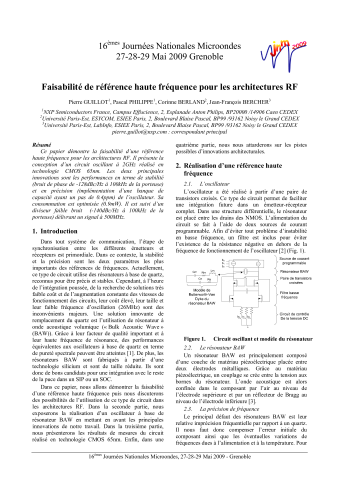
Résumé : Ce papier démontre la faisabilité d’une référence haute fréquence pour les architectures RF. Il présente la conception d’un circuit oscillant à 2GHz réalisé en technologie CMOS 65nm. Les deux principales innovations sont les performances en terme de stabilité (bruit de phase de -128dBc/Hz à 100kHz de la porteuse) et en précision (implémentation d’une banque de capacité ayant un pas de 0.4ppm) de l’oscillateur. Sa consommation est optimisée (0.9mW). Il est suivi d’un diviseur faible bruit (-140dBc/Hz à 100kHz de la porteuse) délivrant un signal à 500MHz.
Fichiers liés :
guillot_jnm_2009.pdf
Source
-
Shallow water tomography: Ray theory vs travel-time sensitivity kernels
- Type de publi. : Communication dans un congrès
- Date de publi. : 18/05/2009
-
Auteurs :
Ion IturbePhilippe RouxBarbara NicolasJean VirieuxJerome I. Mars
Fiche détaillée
Shallow water tomography: Ray theory vs travel-time sensitivity kernels
- Type de publi. : Communication dans un congrès
- Date de publi. : 18/05/2009
-
Auteurs :
Ion IturbePhilippe RouxBarbara NicolasJean VirieuxJerome I. Mars
-
Organismes :
GIPSA - Signal Images Physique
Laboratoire de Géophysique Interne et Tectonophysique
GIPSA - Signal Images Physique
Laboratoire de Géophysique Interne et Tectonophysique
GIPSA - Signal Images Physique
Résumé : In underwater acoustics, ray tomography is the classical method used to estimate velocity variations, but recently. Travel-Time Sensitivity Kernels (TSK) approaches have been developed. In this paper, we deal with TSK for two source-receive arrays in an acoustic waveguide for shallow water tomography. As a first step, we show that separation of the different raypaths is improved by using a recently proposed new array processing [time-delay double beamforming (DBF) algorithm]. DBF consists of changing the 3-D data space from source depth, receiver depth and time into a new 3-D space related to ray propagation expressed by the beamformed variables, source angle, receive angle and time. As a consequence, each eigenray of the multipath propagation for a source-receiver couple can be identified and separated through DBF. In this context of DBF, the TSK is no longer point-to-point as usual, but relies on all source-receiver time series. Kernels are computed using the fact that the processed signal is a linear combination of time-delayed signals between all sources and receivers. Results in simulated data and in real datasets recorded in an ultrasonic tank prove that combination of TSK and DBF increases the resolution and robustness performance of shallow-water acoustic tomography.
Source
-
Juliette Récamier et les codes du portrait autour de 1800
- Type de publi. : Communication dans un congrès
- Date de publi. : 16/05/2009
-
Auteurs :
Philippe Bordes
Fiche détaillée
Juliette Récamier et les codes du portrait autour de 1800
- Type de publi. : Communication dans un congrès
- Date de publi. : 16/05/2009
-
Auteurs :
Philippe Bordes
-
Organismes :
Art, images, sociétés
Source