Professeur des universités en sciences de gestion
-

Radar Rectification of GIS Data for SAR Image Analysis in Mountain Areas
- Type de publi. : Communication dans un congrès
- Date de publi. : 02/06/2008
-
Auteurs :
Ivan PétillotEmmanuel TrouvéPhilippe BolonJean-Michel VanpéMichel Gay
Fiche détaillée
Radar Rectification of GIS Data for SAR Image Analysis in Mountain Areas
- Type de publi. : Communication dans un congrès
- Date de publi. : 02/06/2008
-
Auteurs :
Ivan PétillotEmmanuel TrouvéPhilippe BolonJean-Michel VanpéMichel Gay
-
Organismes :
Laboratoire d'Informatique, Systèmes, Traitement de l'Information et de la Connaissance
Laboratoire d'Informatique, Systèmes, Traitement de l'Information et de la Connaissance
Laboratoire d'Informatique, Systèmes, Traitement de l'Information et de la Connaissance
GIPSA - Signal Images Physique
GIPSA-Services
GIPSA-Services
GIPSA - Signal Images Physique
Résumé : Geographic Information System, GIS, are dedicated to view and to process georeferenced images. For the data fusion of Synthetic Aperture Radar (SAR) images with other information sources, one usually uses processing software to orthorectify the SAR images in order to add them in a GIS. Nevertheless, this projection involves an important alteration of the information of SAR images. In this paper, we propose a simple and efficient method by inverting the process: the radar rectification of georeferenced data. Coding data from a GIS into the radar geometry, allows the use of different information sources to improve the analysis of SAR images and the result interpretation. This approach is applied to a high relief area in the Alps, where SAR images are used for glacier evolution monitoring. Results are illustrated over the Chamonix Mont-Blanc test site on spaceborne images (ERS and ENVISAT data) and airborne E-SAR images.
Source
-
Monitoring alpine glacier activity by a combined use of terrasar-x images and continuous gps measurements - the argentière glacier experiment
- Type de publi. : Communication dans un congrès
- Date de publi. : 02/06/2008
-
Auteurs :
Emmanuel TrouvéIvan PétillotPhilippe BolonMichel GayLionel BombrunJean Marie NicolasFlorence TupinAndrea WalpersdorfNathalie CotteIrena HajnsekMartin Kellert
Fiche détaillée
Monitoring alpine glacier activity by a combined use of terrasar-x images and continuous gps measurements - the argentière glacier experiment
- Type de publi. : Communication dans un congrès
- Date de publi. : 02/06/2008
-
Auteurs :
Emmanuel TrouvéIvan PétillotPhilippe BolonMichel GayLionel BombrunJean Marie NicolasFlorence TupinAndrea WalpersdorfNathalie CotteIrena HajnsekMartin Kellert
-
Organismes :
Laboratoire d'Informatique, Systèmes, Traitement de l'Information et de la Connaissance
Laboratoire d'Informatique, Systèmes, Traitement de l'Information et de la Connaissance
Laboratoire d'Informatique, Systèmes, Traitement de l'Information et de la Connaissance
GIPSA-Services
GIPSA - Signal Images Physique
GIPSA - Signal Images Physique
GIPSA-Services
Image, Modélisation, Analyse, GEométrie, Synthèse
Département Images, Données, Signal
Image, Modélisation, Analyse, GEométrie, Synthèse
Département Images, Données, Signal
Laboratoire de Géophysique Interne et Tectonophysique
Laboratoire de Géophysique Interne et Tectonophysique
DLR Microwaves and Radar Institute
DLR Microwaves and Radar Institute
Résumé : The monitoring of Alpine glacier activity is one of the applications which require the combined use of ground measurements and SAR data. It should become feasible thanks to the new generation SAR satellites (ALOS, TerraSAR-X, Cosmo-SkyMed and RadarSAT-2) and the high precision GPS measurements. This paper presents the early results of an experiment which started in 2007 on Argentière glacier (Mont-Blanc area) and includes a moving corner reflector (CR) oriented for TerraSAR-X acquisitions, SAR images where this CR is visible and 3 continuous GPS stations providing the CR position and information on the tropospheric path delay corrections
Source
-

Adjuvant Radioimmunotherapy Trial with Iodine-131-Labeled Anti-Carcinoembryonic Antigen Monoclonal Antibody F6 F(ab')2 after Resection of Liver Metastases from Colorectal Cancer.
- Type de publi. : Article dans une revue
- Date de publi. : 01/06/2008
-
Auteurs :
Marc YchouDavid AzriaCathy MenkariosPatrick FaurousFrançois QuenetBernard Saint-AubertPhilippe RouanetMonique PèlegrinCaroline MolleviDominique GuerreauJean-Claude SaccaviniJean-Pierre MachJean-Claude ArtusAndré Pèlegrin
Fiche détaillée
Adjuvant Radioimmunotherapy Trial with Iodine-131-Labeled Anti-Carcinoembryonic Antigen Monoclonal Antibody F6 F(ab')2 after Resection of Liver Metastases from Colorectal Cancer.
- Type de publi. : Article dans une revue
- Date de publi. : 01/06/2008
-
Auteurs :
Marc YchouDavid AzriaCathy MenkariosPatrick FaurousFrançois QuenetBernard Saint-AubertPhilippe RouanetMonique PèlegrinCaroline MolleviDominique GuerreauJean-Claude SaccaviniJean-Pierre MachJean-Claude ArtusAndré Pèlegrin
-
Organismes :
Immunociblage et radiobiologie en oncologie
CRLCC Val d'Aurelle - Paul Lamarque
Immunociblage et radiobiologie en oncologie
CRLCC Val d'Aurelle - Paul Lamarque
CRLCC Val d'Aurelle - Paul Lamarque
Department of Radiation Oncology
CRLCC Val d'Aurelle - Paul Lamarque
CRLCC Val d'Aurelle - Paul Lamarque
CRLCC Val d'Aurelle - Paul Lamarque
CRLCC Val d'Aurelle - Paul Lamarque
Immunociblage et radiobiologie en oncologie
CRLCC Val d'Aurelle - Paul Lamarque
CRLCC Val d'Aurelle - Paul Lamarque
Schering-CIS Bio International
Schering-CIS Bio International
Département de Biochimie
CRLCC Val d'Aurelle - Paul Lamarque
Immunociblage et radiobiologie en oncologie
- Publié dans Clinical Cancer Research le 30/10/2020
Résumé : PURPOSE: To evaluate the feasibility of radioimmunotherapy (RIT) with radiolabeled anti-carcinoembryonic antigen antibodies after complete resection of liver metastases (LM) from colorectal cancer. Patients and Methods: Twenty-two patients planned for surgery of one to four LM received a preoperative diagnostic dose of a (131)I-F(ab')(2)-labeled anti-carcinoembryonic antigen monoclonal antibody F6 (8-10 mCi/5 mg). (131)I-F(ab')(2) uptake was analyzed using direct radioactivity counting, and tumor-to-normal liver ratios were recorded. Ten patients with tumor-to-normal liver ratios of >5 and three others were treated with a therapeutic injection [180-200 mCi (131)I/50 mg F(ab')(2)] 30 to 64 days after surgery. RESULTS: Median (131)I-F(ab')(2) immunoreactivity in patient serum remained at 91% of initial values for up to 96 hours after injection. The main and dose-limiting-toxicity was hematologic, with 92% and 85% grades 3 to 4 neutropenia and thrombocytopenia, respectively. Complete spontaneous recovery occurred in all patients. No human anti-mouse antibody response was observed after the diagnosis dose; however, 10 of the 13 treated patients developed human anti-mouse antibody approximately 3 months later. Two treated patients presented extrahepatic metastases at the time of RIT (one bone and one abdominal node) and two relapsed within 3 months of RIT (one in the lung and the other in the liver). Two patients are still alive, and one of these is disease-free at 93 months after resection. At a median follow-up of 127 months, the median disease-free survival is 12 months and the median overall survival is 50 months. CONCLUSION: RIT is feasible in an adjuvant setting after complete resection of LM from colorectal cancer and should be considered for future trials, possibly in combination with chemotherapy, because of the generally poor prognosis of these patients.
Fichiers liés :
inserm-00292535_edited.pdf
Clin_Cancer_Res._2008_Ychou_M_-_Pelegrin_A.pdf
Source
-
Effect of photoperiod on aerial morphogenesis of eight Medicago truncatula lines
- Type de publi. : Communication dans un congrès
- Date de publi. : 01/06/2008
-
Auteurs :
Bernadette JulierJean-Baptiste PierrePhilippe BarreChristian Huyghe
Fiche détaillée
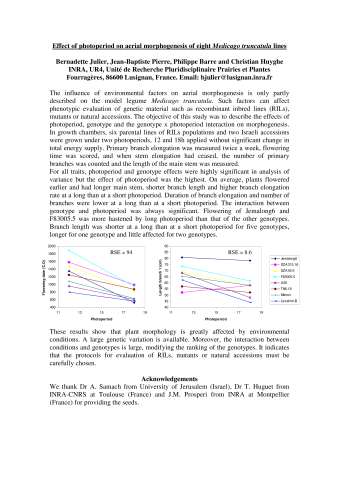
Effect of photoperiod on aerial morphogenesis of eight Medicago truncatula lines
- Type de publi. : Communication dans un congrès
- Date de publi. : 01/06/2008
-
Auteurs :
Bernadette JulierJean-Baptiste PierrePhilippe BarreChristian Huyghe
-
Organismes :
Unité de Recherche Pluridisciplinaire Prairies et Plantes Fourragères
Unité de Recherche Pluridisciplinaire Prairies et Plantes Fourragères
Unité de Recherche Pluridisciplinaire Prairies et Plantes Fourragères
Unité de Recherche Pluridisciplinaire Prairies et Plantes Fourragères
Fichiers liés :
Julier_Huyghe_2008_NAAIC_1.pdf
Source
-

QTL for flowering date in three mapping populations of Medicago truncatula
- Type de publi. : Communication dans un congrès
- Date de publi. : 01/06/2008
-
Auteurs :
Jean-Baptiste PierreThierry HuguetPhilippe BarreChristian HuygheBernadette Julier
Fiche détaillée
QTL for flowering date in three mapping populations of Medicago truncatula
- Type de publi. : Communication dans un congrès
- Date de publi. : 01/06/2008
-
Auteurs :
Jean-Baptiste PierreThierry HuguetPhilippe BarreChristian HuygheBernadette Julier
-
Organismes :
Unité de Recherche Pluridisciplinaire Prairies et Plantes Fourragères
Université Toulouse III - Paul Sabatier
Unité de Recherche Pluridisciplinaire Prairies et Plantes Fourragères
Unité de Recherche Pluridisciplinaire Prairies et Plantes Fourragères
Unité de Recherche Pluridisciplinaire Prairies et Plantes Fourragères
Fichiers liés :
Pierre_Julier_2008_NAAIC_1.pdf
Source
-

Consistency of the regression estimator with functional data under long memory conditions
- Type de publi. : Article dans une revue
- Date de publi. : 01/06/2008
-
Auteurs :
Karim BenhenniSonia Hedli-GricheMustapha RachdiPhilippe Vieu
Fiche détaillée
Consistency of the regression estimator with functional data under long memory conditions
- Type de publi. : Article dans une revue
- Date de publi. : 01/06/2008
-
Auteurs :
Karim BenhenniSonia Hedli-GricheMustapha RachdiPhilippe Vieu
-
Organismes :
Méthodologie Statistique et Sciences Sociales
Statistique Fonctionnelle & Sondages
Statistique Fonctionnelle & Sondages
Institut de Mathématiques de Toulouse UMR5219
- Publié dans Statistics and Probability Letters le 31/10/2020
Résumé : We study the nonparametric regression estimation when the explanatory variable takes values in some abstract functional space. We establish some asymptotic results and we give the (pointwise and uniform) convergence of the kernel type estimator constructed from functional data under long memory conditions.
Fichiers liés :
PEER_stage2_10.1016%2Fj.spl.2007.11.011.pdf
Source
-
Longitudinal effect following initiation of highly active antiretroviral therapy on plasma and cervico-vaginal HIV-1 RNA among women in Burkina Faso
- Type de publi. : Article dans une revue
- Date de publi. : 01/06/2008
-
Auteurs :
Nicolas NagotAbdoulaye OuedraogoHelen A WeissIssouf KonatéAnselme SanonMarie-Christine DeferAdrien SawadogoJean-Baptiste AndonabaR. ValloPierre BecquartMichel SegondyPhilippe MayaudPhilippe Van de Perre
Fiche détaillée
Longitudinal effect following initiation of highly active antiretroviral therapy on plasma and cervico-vaginal HIV-1 RNA among women in Burkina Faso
- Type de publi. : Article dans une revue
- Date de publi. : 01/06/2008
-
Auteurs :
Nicolas NagotAbdoulaye OuedraogoHelen A WeissIssouf KonatéAnselme SanonMarie-Christine DeferAdrien SawadogoJean-Baptiste AndonabaR. ValloPierre BecquartMichel SegondyPhilippe MayaudPhilippe Van de Perre
-
Organismes :
Centre Muraz [Bobo-Dioulasso, Burkina Faso]
Laboratoire de Virologie [CHRU Montpellier]
Université Montpellier 1
Centre Muraz [Bobo-Dioulasso, Burkina Faso]
London School of Hygiene and Tropical Medicine
Centre Muraz [Bobo-Dioulasso, Burkina Faso]
Centre Muraz [Bobo-Dioulasso, Burkina Faso]
Centre Muraz [Bobo-Dioulasso, Burkina Faso]
Centre Hospitalier Universitaire Souro Sanou [Bobo-Dioulasso]
Centre Hospitalier Universitaire Souro Sanou [Bobo-Dioulasso]
Centre Muraz [Bobo-Dioulasso, Burkina Faso]
Laboratoire de Virologie [CHRU Montpellier]
Université Montpellier 1
Laboratoire de Virologie [CHRU Montpellier]
Université Montpellier 1
London School of Hygiene and Tropical Medicine
Laboratoire de Virologie [CHRU Montpellier]
Université Montpellier 1
- Publié dans Sexually Transmitted Infections le 30/10/2020
Résumé : Background: Highly active antiretroviral therapy (HAART) could decrease HIV-1 transmissibility by reducing genital and plasma HIV-1 RNA. Methods: We evaluated the effect of HAART on genital and plasma HIV-1 RNA in a cohort of 39 antiretroviral-naïve women in Burkina Faso. Cervico-vaginal lavages were collected before HAART initiation and at six visits over 28 weeks while on HAART. Blood samples were collected at baseline and at three and four visits for CD4 and plasma HIV-1 RNA measurements, respectively. Results: Before HAART, 72% of women had detectable genital HIV-1 RNA. After 18 weeks on HAART, only one woman (2.5%) had detectable plasma HIV-1 RNA and two women (5.1%) had detectable genital HIV-1 RNA. Similar results were observed at each follow-up visit. However, 16/34 (47%) women with consistently undetectable plasma HIV-1 RNA shed HIV-1 at least once between weeks 18 and 28. In samples with detectable genital HIV-1, the mean quantity of HIV-1 RNA decreased from 3.87 prior to HAART to 3.04 log10 copies/mL at last visit (median 29 weeks; a 6.8-fold decrease in absolute number of copies/mL) (p = 0.04). A significant median CD4 lymphocyte cell gain of 121 cells/μL (interquartile range 59 to 204) was measured between pre-HAART and last visit. Conclusion: These findings suggest that HAART could play a role in reducing HIV transmission in Africa; however, they underscore the need to emphasise safe sex practices with patients taking HAART.
Source
-
A preliminary study of the relationship between crystal-chemistry and the magnetic properties of cronstedtite, an iron-rich layered silicate found in meteorites
- Type de publi. : Communication dans un congrès
- Date de publi. : 01/06/2008
-
Auteurs :
Agnès ElmalehPh. SainctavitAnne-Line AuzendeBertrand Devouard
Fiche détaillée
A preliminary study of the relationship between crystal-chemistry and the magnetic properties of cronstedtite, an iron-rich layered silicate found in meteorites
- Type de publi. : Communication dans un congrès
- Date de publi. : 01/06/2008
-
Auteurs :
Agnès ElmalehPh. SainctavitAnne-Line AuzendeBertrand Devouard
-
Organismes :
Institut de minéralogie et de physique des milieux condensés
Institut de minéralogie et de physique des milieux condensés
Institut de minéralogie et de physique des milieux condensés
Laboratoire Magmas et Volcans
Source
-
Increase of monoamine oxidase-B activity in the brain of scrapie-infected hamsters
- Type de publi. : Article dans une revue
- Date de publi. : 01/06/2008
-
Auteurs :
Karim AdjouPierre DildaPascal AumondSalah GueddariJean-Philippe DeslysDominique DormontMichel Seman
Fiche détaillée
Increase of monoamine oxidase-B activity in the brain of scrapie-infected hamsters
- Type de publi. : Article dans une revue
- Date de publi. : 01/06/2008
-
Auteurs :
Karim AdjouPierre DildaPascal AumondSalah GueddariJean-Philippe DeslysDominique DormontMichel Seman
-
Organismes :
Biologie moléculaire et immunologie parasitaires et fongiques
- Publié dans Neurochemistry International le 01/11/2020
Source
-
Residential environment and blood pressure in the PRIME Study: is the association mediated by body mass index and waist circumference?
- Type de publi. : Article dans une revue
- Date de publi. : 01/06/2008
-
Auteurs :
Basile ChaixPierre DucimetièreThierry LangBernadette HaasMichèle MontayeJean-Bernard RuidavetsDominique ArveilerPhillippe AmouyelJean FerrièresAnnie BinghamPierre Chauvin
Fiche détaillée
Residential environment and blood pressure in the PRIME Study: is the association mediated by body mass index and waist circumference?
- Type de publi. : Article dans une revue
- Date de publi. : 01/06/2008
-
Auteurs :
Basile ChaixPierre DucimetièreThierry LangBernadette HaasMichèle MontayeJean-Bernard RuidavetsDominique ArveilerPhillippe AmouyelJean FerrièresAnnie BinghamPierre Chauvin
-
Organismes :
ESIM - Déterminants Sociaux de la Santé et du Recours aux Soins
Recherche en épidémiologie et biostatistique
Epidémiologie et Analyses en Santé Publique : risques, maladies chroniques et handicap
Université Louis Pasteur - Strasbourg I
Epidémiologie des maladies chroniques : impact des interactions gène environnement sur la santé des populations
Epidémiologie et Analyses en Santé Publique : risques, maladies chroniques et handicap
Université Louis Pasteur - Strasbourg I
Epidémiologie des maladies chroniques : impact des interactions gène environnement sur la santé des populations
Epidémiologie et Analyses en Santé Publique : risques, maladies chroniques et handicap
Recherche en épidémiologie et biostatistique
ESIM - Déterminants Sociaux de la Santé et du Recours aux Soins
CHU Saint-Antoine [AP-HP]
- Publié dans Journal of Hypertension le 23/10/2020
Résumé : OBJECTIVES: Few studies have examined whether social characteristics of the residential environment are associated with blood pressure after controlling for individual sociodemographic characteristics. Even less is known about the processes by which these associations operate. Therefore, we examined whether distinct dimensions of the residential environment (socioeconomic position and urbanicity) were associated with systolic blood pressure. To better understand the processes involved in the associations between contextual factors and blood pressure, we assessed the extent to which these associations were mediated by body mass index and waist circumference. METHODS: We analysed data from the PRIME Study (7850, 50-60-year-old men surveyed in 1991-1993 in three French regions and recently geocoded on a local scale). We used multilevel regression models to estimate associations between contextual factors and blood pressure, and path analysis to investigate possible mediators of these associations. RESULTS: After adjustment for individual socioeconomic variables, systolic blood pressure increased independently with decreasing municipality population density and decreasing neighbourhood educational level. Path analysis indicated that approximately 37% of the association between neighbourhood education and blood pressure was statistically explained by the heavier weight and stronger central adiposity of people from deprived neighbourhoods. Approximately 19% of the association with population density was mediated by anthropometric factors. CONCLUSIONS: These data suggest that the neighbourhood environment may influence blood pressure; only part of the associations between contextual factors and blood pressure may operate through body weight and body shape modification.
Source