Professeur des universités en sciences de gestion
-

Herschel-SPIRE: design, ground test results, and predicted performance
- Type de publi. : Communication dans un congrès
- Date de publi. : 01/01/2008
-
Auteurs :
Matt GriffinBruce SwinyardLaurent VigrouxAlain AbergelPeter AdePhilippe AndreJean-Paul BaluteauJames BockAlberto FranceschiniWalter GearJason GlennMaohai HuangDouglas GriffinKen KingEmmanuel LellouchDavid NaylorSeb OliverGöran OlofssonIsmael Perez-FournonMat PageMichael Rowan-RobinsonPaolo SaracenoEric SawyerGillian WrightAnnie ZavagnoAsier AbreuGeorge BendoAlan DowellDarren DowellMarc FerletTrevor FultonPeter HargraveGlenn LaurentSarah LeeksTanya LimNanyao LuHien NguyenAlan PearceEdward PolehamptonDavide RizzoBernhard SchulzSunil SidherDave SmithLocke SpencerIvan ValtchanovAdam WoodcraftKevin XuLijun Zhang
Fiche détaillée
Herschel-SPIRE: design, ground test results, and predicted performance
- Type de publi. : Communication dans un congrès
- Date de publi. : 01/01/2008
-
Auteurs :
Matt GriffinBruce SwinyardLaurent VigrouxAlain AbergelPeter AdePhilippe AndreJean-Paul BaluteauJames BockAlberto FranceschiniWalter GearJason GlennMaohai HuangDouglas GriffinKen KingEmmanuel LellouchDavid NaylorSeb OliverGöran OlofssonIsmael Perez-FournonMat PageMichael Rowan-RobinsonPaolo SaracenoEric SawyerGillian WrightAnnie ZavagnoAsier AbreuGeorge BendoAlan DowellDarren DowellMarc FerletTrevor FultonPeter HargraveGlenn LaurentSarah LeeksTanya LimNanyao LuHien NguyenAlan PearceEdward PolehamptonDavide RizzoBernhard SchulzSunil SidherDave SmithLocke SpencerIvan ValtchanovAdam WoodcraftKevin XuLijun Zhang
-
Organismes :
Service d'Astrophysique
Institut d'astrophysique spatiale
Recherche en épidémiologie et biostatistique
Observatoire Astronomique de Marseille Provence
Laboratoire d'Astrophysique de Marseille
Laboratoire d'études spatiales et d'instrumentation en astrophysique
Astronomy Centre, University of Sussex
Imperial College London
Observatoire Astronomique de Marseille Provence
Laboratoire d'Astrophysique de Marseille
CEA Cadarache
Ton Duc Thang University [Hô-Chi-Minh-City]
University of Pisa [Italy] = Università di Pisa [Italia] = Université de Pise [Italie]
NASA Herschel Science Center
Herschel Science Centre
Department of Informatics and Mathematical Modelling [Lyngby]
Résumé : SPIRE, the Spectral and Photometric Imaging Receiver, is a submillimetre camera and spectrometer for Herschel. It comprises a three-band camera operating at 250, 350 and 500 Â\textmum, and an imaging Fourier Transform Spectrometer covering 194-672 \ensuremathμm. The photometer field of view is 4x8 arcmin., viewed simultaneously in the three bands. The FTS has an approximately circular field of view of 2.6 arcmin. diameter and spectral resolution adjustable between 0.04 and 2 cm^-1 ( \ensuremathλ/▵\ensuremathλ=20-1000 at 250 \ensuremathμm). Following successful testing in a dedicated facility designed to simulate the in-flight operational conditions, SPIRE has been integrated in the Herschel spacecraft and is now undergoing system-level testing prior to launch. The main design features of SPIRE are reviewed, the key results of instrument testing are outlined, and a summary of the predicted in-flight performance is given.
Source
-

High resolution SAR interferometry: estimation of local frequencies in the context of Alpine glaciers
- Type de publi. : Article dans une revue
- Date de publi. : 01/01/2008
-
Auteurs :
Gabriel VasileEmmanuel TrouvéIvan PétillotPhilippe BolonJean-Marie NicolasMichel GayJocelyn ChanussotTania LandesP. GrussenmeyerVasile BuzuloiuIrena HajnsekChristian AndresMartin KellerRalf Horn
Fiche détaillée
High resolution SAR interferometry: estimation of local frequencies in the context of Alpine glaciers
- Type de publi. : Article dans une revue
- Date de publi. : 01/01/2008
-
Auteurs :
Gabriel VasileEmmanuel TrouvéIvan PétillotPhilippe BolonJean-Marie NicolasMichel GayJocelyn ChanussotTania LandesP. GrussenmeyerVasile BuzuloiuIrena HajnsekChristian AndresMartin KellerRalf Horn
-
Organismes :
Laboratoire d'Informatique, Systèmes, Traitement de l'Information et de la Connaissance
Laboratoire d'Informatique, Systèmes, Traitement de l'Information et de la Connaissance
Laboratoire d'Informatique, Systèmes, Traitement de l'Information et de la Connaissance
Laboratoire d'Informatique, Systèmes, Traitement de l'Information et de la Connaissance
Département Traitement du Signal et des Images
GIPSA-Services
GIPSA - Signal Images Physique
GIPSA - Signal Images Physique
Equipe Photogrammétrie et Géomatique
Equipe Photogrammétrie et Géomatique
Laboratorul de Analiza si Prelucrarea Imaginilor [Bucarest]
German Aerospace Center
German Aerospace Center
German Aerospace Center
German Aerospace Center
- Publié dans IEEE Transactions on Geoscience and Remote Sensing le 31/10/2020
Résumé : Synthetic aperture radar (SAR) interferometric data offer the opportunity to measure temperate glacier surface topography and displacement. The increase of the resolution provided by the most recent SAR systems has some critical implications. For instance, a reliable estimate of the phase gradient can only be achieved by using interferogram local frequencies. In this paper, an original two-step method for estimating local frequencies is proposed. The 2-D phase signal is considered to have two deterministic components corresponding to low-resolution (LR) fringes and high-resolution (HR) patterns due to the local microrelief, respectively. The first step of the proposed algorithm consists in the LR phase flattening. In the second step, the local HR frequencies are estimated from the phase 2-D autocorrelation function computed on adaptive neighborhoods. This neighborhood is the set of connected pixels belonging to the same HR spatial feature and respecting the "local stationarity" hypothesis. Results with both simulated TerraSAR-X interferograms and real airborne E-SAR images are presented to illustrate the potential of the proposed method.
Fichiers liés :
ieee_tgars_08_vasile_sar_interfero.pdf
Source
-
Droit administratif des biens : domaine public et privé, travaux et ouvrages publics, expropriation
- Type de publi. : Ouvrage (y compris édition critique et traduction)
- Date de publi. : 01/01/2008
-
Auteurs :
Jean-Marie AubyPhilippe TerneyreJean-Bernard AubyPierre Bon
Fiche détaillée
Droit administratif des biens : domaine public et privé, travaux et ouvrages publics, expropriation
- Type de publi. : Ouvrage (y compris édition critique et traduction)
- Date de publi. : 01/01/2008
-
Auteurs :
Jean-Marie AubyPhilippe TerneyreJean-Bernard AubyPierre Bon
-
Organismes :
Centre d’Étude et de Recherche sur le Droit Administratif et la Réforme de l’État
Université de Pau et des Pays de l'Adour
École de Droit de Sciences Po (Sciences Po)
Droit public comparé - Droit international et Droit européen
Droits International, Comparé et Européen / Institut d'études ibériques et ibérico-américaines (IE2IA)
Résumé : Manifestation du caractère dérogatoire du droit administratif, les biens de l’administration obéissent à des règles propres, qu’elles portent sur leurs statuts, leurs modes d’acquisition ou la façon d’y conduire des travaux. Maintenant dans sa quatrième édition, le Précis de Droit administratif des biens analyse les évolutions sensibles de ce droit au cours des dernières, notamment grâce à l'enrichissement du droit administratif des contrats, à la préoccupation croissante de valoriser économiquement le patrimoine public ainsi qu'aux incidences de la Convention européenne des droits de l'homme en matière d'expulsion.
Source
-
Polyelectrolyte multilayer coatings that resist protein adsorption at rest and under stretching
- Type de publi. : Article dans une revue
- Date de publi. : 01/01/2008
-
Auteurs :
Andreas ReischJoseph HemmerléJean-Claude VoegelEric GonthierGero DecherNadia Benkirane-JesselArmelle ChassepotDamien MertzPhilippe LavallePhilippe MésiniPierre Schaaf
Fiche détaillée
Polyelectrolyte multilayer coatings that resist protein adsorption at rest and under stretching
- Type de publi. : Article dans une revue
- Date de publi. : 01/01/2008
-
Auteurs :
Andreas ReischJoseph HemmerléJean-Claude VoegelEric GonthierGero DecherNadia Benkirane-JesselArmelle ChassepotDamien MertzPhilippe LavallePhilippe MésiniPierre Schaaf
-
Organismes :
Institut Charles Sadron
Biomatériaux : Processus biophysiques et biologiques aux interfaces
Biomatériaux : Processus biophysiques et biologiques aux interfaces
Institut Charles Sadron
Institut Charles Sadron
Biomatériaux : Processus biophysiques et biologiques aux interfaces
Biomatériaux : Processus biophysiques et biologiques aux interfaces
Biomatériaux : Processus biophysiques et biologiques aux interfaces
Biomatériaux : Processus biophysiques et biologiques aux interfaces
Institut Charles Sadron
Institut Charles Sadron
- Publié dans Journal of Materials Chemistry le 25/10/2020
Source
-
Sulfates have been discovered by the OMEGA spectrometer in different locations of the planet Mars. They are strongly correlated to light toned layered deposits in the equatorial regions. West Candor Chasma is the canyon with the thickest stack of layers and one with the largest area covered by sulfates. A detailed study coupling mineralogy derived from OMEGA spectral data and geology derived from HRSC imager and other datasets leads to some straightforward issues. The monohydrated sulfate kieserite is found mainly over heavily eroded scarps of light toned material. It likely corresponds to a mineral present in the initial rock formed either during formation and diagenesis of sediments, or during hydrothermal alteration at depth, because it is typically found on outcrops that are eroded and steep. Polyhydrated sulfates, that match any Ca-, Na-, Fe-, or Mg-sulfates with more than one water molecule, are preferentially present on less eroded and darker outcrops than outcrops of kieserite. These variations can be the result of a diversity in the composition and/or of the rehydration of kieserite on surfaces with longer exposure. The latter possibility of rehydration in the current, or recent, atmosphere suggests the low surface temperatures preserve sulfates from desiccation, and, also can rehydrate part of them. Strong signatures of iron oxides are present on sulfate-rich scarps and at the base of layered deposits scarps. They are correlated with TES gray hematite signature and might correspond to iron oxides present in the rock as sand-size grains, or possibly larger concretions, that are eroded and transported down by gravity at the base of the scarp. Pyroxenes are present mainly on sand dunes in the low lying terrains. Pyroxene is strongly depleted or absent in the layered deposits. When mixed with kieserite, local observations favor a spatial mixing with dunes over layered deposits. Sulfates such as those detected in the studied area require the presence of liquid water to form by precipitation, either in an intermittent lacustrine environment or by hydrothermal fluid circulation. Both possibilities require the presence of sulfur-rich groundwater to explain fluid circulation. The elevation of the uppermost sulfate signatures suggests the presence of aquifers up to 2.5 km above datum, only 1 km below the plateau surface.
- Type de publi. : Article dans une revue
- Date de publi. : 01/01/2008
-
Auteurs :
Nicolas MangoldAline GendrinBrigitte GondetStéphane Le MouélicCathy Quantin-NatafV. AnsanJean-Pierre BibringYves LangevinPhilippe MassonGerhard Neukum
Fiche détaillée
Sulfates have been discovered by the OMEGA spectrometer in different locations of the planet Mars. They are strongly correlated to light toned layered deposits in the equatorial regions. West Candor Chasma is the canyon with the thickest stack of layers and one with the largest area covered by sulfates. A detailed study coupling mineralogy derived from OMEGA spectral data and geology derived from HRSC imager and other datasets leads to some straightforward issues. The monohydrated sulfate kieserite is found mainly over heavily eroded scarps of light toned material. It likely corresponds to a mineral present in the initial rock formed either during formation and diagenesis of sediments, or during hydrothermal alteration at depth, because it is typically found on outcrops that are eroded and steep. Polyhydrated sulfates, that match any Ca-, Na-, Fe-, or Mg-sulfates with more than one water molecule, are preferentially present on less eroded and darker outcrops than outcrops of kieserite. These variations can be the result of a diversity in the composition and/or of the rehydration of kieserite on surfaces with longer exposure. The latter possibility of rehydration in the current, or recent, atmosphere suggests the low surface temperatures preserve sulfates from desiccation, and, also can rehydrate part of them. Strong signatures of iron oxides are present on sulfate-rich scarps and at the base of layered deposits scarps. They are correlated with TES gray hematite signature and might correspond to iron oxides present in the rock as sand-size grains, or possibly larger concretions, that are eroded and transported down by gravity at the base of the scarp. Pyroxenes are present mainly on sand dunes in the low lying terrains. Pyroxene is strongly depleted or absent in the layered deposits. When mixed with kieserite, local observations favor a spatial mixing with dunes over layered deposits. Sulfates such as those detected in the studied area require the presence of liquid water to form by precipitation, either in an intermittent lacustrine environment or by hydrothermal fluid circulation. Both possibilities require the presence of sulfur-rich groundwater to explain fluid circulation. The elevation of the uppermost sulfate signatures suggests the presence of aquifers up to 2.5 km above datum, only 1 km below the plateau surface.
- Type de publi. : Article dans une revue
- Date de publi. : 01/01/2008
-
Auteurs :
Nicolas MangoldAline GendrinBrigitte GondetStéphane Le MouélicCathy Quantin-NatafV. AnsanJean-Pierre BibringYves LangevinPhilippe MassonGerhard Neukum
-
Organismes :
Interactions et dynamique des environnements de surface
Institut d'astrophysique spatiale
Institut d'astrophysique spatiale
Laboratoire de Planétologie et Géodynamique de Nantes [UMR 6112]
Interactions et dynamique des environnements de surface
Interactions et dynamique des environnements de surface
Institut d'astrophysique spatiale
Institut d'astrophysique spatiale
Interactions et dynamique des environnements de surface
- Publié dans Icarus le 30/10/2020
Source
-
Cyclic nucleotide phosphodiesterase type 4 inhibitors : evaluation of pyrazolo [1,5-a]-1,3,5-triazine ring system as an adenine bioisostere.
- Type de publi. : Article dans une revue
- Date de publi. : 01/01/2008
-
Auteurs :
Pierre RaboissonDominique SchultzChristian MullerJean-Marie ReimundGuillaume PinnaRomain MathieuPhilippe BernardQuoc-Tuan DoRenee DesjarlaisHélène JustianoClaire LugnierJean-Jacques Bourguignon
Fiche détaillée
Cyclic nucleotide phosphodiesterase type 4 inhibitors : evaluation of pyrazolo [1,5-a]-1,3,5-triazine ring system as an adenine bioisostere.
- Type de publi. : Article dans une revue
- Date de publi. : 01/01/2008
-
Auteurs :
Pierre RaboissonDominique SchultzChristian MullerJean-Marie ReimundGuillaume PinnaRomain MathieuPhilippe BernardQuoc-Tuan DoRenee DesjarlaisHélène JustianoClaire LugnierJean-Jacques Bourguignon
-
Organismes :
Institut Gilbert-Laustriat : Biomolécules, Biotechnologie, Innovation Thérapeutique
Institut Gilbert-Laustriat : Biomolécules, Biotechnologie, Innovation Thérapeutique
Cooltech Applications
Service d'Hépato-Gastro-Enterologie et Nutrition [CHU Caen]
Institut de Biologie Intégrative de la Cellule
Centre de Recherches Pétrographiques et Géochimiques
Institut Gilbert-Laustriat : Biomolécules, Biotechnologie, Innovation Thérapeutique
Institut Gilbert-Laustriat : Biomolécules, Biotechnologie, Innovation Thérapeutique
- Publié dans European Journal of Medicinal Chemistry le 31/10/2020
Résumé : A series of 8-substituted pyrazolo[1,5-a]-1,3,5-triazines were considered as a bioisosteric replacement for the 9-substituted adenine derivatives resulting in the discovery of 8-(2-methoxybenzyl)-4-(N-methylamino)-2-n-propylpyrazolo[1,5-a]-1,3,5-triazine (14d) and 2-trifluoromethyl-8-(2-methoxybenzyl)-4-(N-methylamino)pyrazolo[1,5-a]-1,3,5-triazine (14e) as a new structural class of potent phosphodiesterase type 4 inhibitors (IC50 = 13 nM and 11 nM, respectively) with high isoenzyme selectivity. An original tandem of reactions involving a palladium-mediated cross-coupling reaction (PMCCR) of the readily available 8-iodo-2-methyl-4-(N-methyl-N-phenylamino)pyrazolo[1,5-a]-1,3,5-triazine (11a) and arylboronic acids or alkynes followed by the displacement of the N-methyl-N-phenylamino group constitute the key steps in a novel synthetic approach developed herein. The treatment of 11a–c with n-BuLi and selected aldehydes represents an interesting alternative to the PMCCR for the synthesis of benzylic derivatives 14a–i. Preliminary biological testing has shown that compounds 14d and 14e strongly inhibit LPS-induced TNFα release from human mononuclear cells from healthy subjects. These two compounds were selected for further biological evaluation. Some derivatives belonging to the series of pyrazolo[1,5-a]-1,3,5 triazines act as adenine bioisosteres and present potent and selective PDE4 inhibitory properties.
Source
-
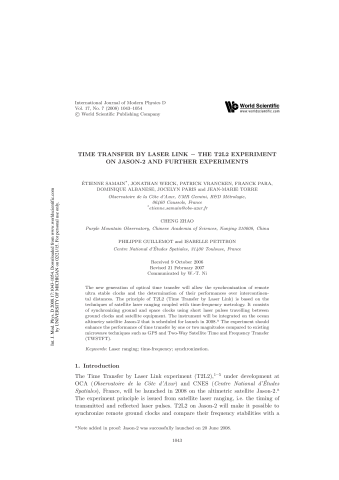
TIME TRANSFER BY LASER LINK − THE T2L2 EXPERIMENT ON JASON-2 AND FURTHER EXPERIMENTS
- Type de publi. : Article dans une revue
- Date de publi. : 01/01/2008
-
Auteurs :
Etienne SamainJonathan WeickPatrick VranckenFranck ParaDominique AlbaneseJocelyn ParisJean-Marie TorreCheng ZhaoPhilippe GuillemotIsabelle Petitbon
Fiche détaillée
TIME TRANSFER BY LASER LINK − THE T2L2 EXPERIMENT ON JASON-2 AND FURTHER EXPERIMENTS
- Type de publi. : Article dans une revue
- Date de publi. : 01/01/2008
-
Auteurs :
Etienne SamainJonathan WeickPatrick VranckenFranck ParaDominique AlbaneseJocelyn ParisJean-Marie TorreCheng ZhaoPhilippe GuillemotIsabelle Petitbon
-
Organismes :
Laboratoire Gemini
Géoazur
Laboratoire Gemini
Géoazur
Laboratoire Gemini
Institut des Matériaux, de Microélectronique et des Nanosciences de Provence
Laboratoire Gemini
Laboratoire Gemini
Laboratoire Gemini
Laboratoire Gemini
Chinese Academy of Sciences [Changchun Branch]
Centre National d'Études Spatiales [Toulouse]
Centre National d'Études Spatiales [Toulouse]
- Publié dans International Journal of Modern Physics D le 25/10/2020
Résumé : The new generation of optical time transfer will allow the synchronization of remote ultra stable clocks and the determination of their performances over intercontinen-tal distances. The principle of T2L2 (Time Transfer by Laser Link) is based on the techniques of satellite laser ranging coupled with time-frequency metrology. It consists of synchronizing ground and space clocks using short laser pulses travelling between ground clocks and satellite equipment. The instrument will be integrated on the ocean altimetry satellite Jason-2 that is scheduled for launch in 2008. a The experiment should enhance the performance of time transfer by one or two magnitudes compared to existing microwave techniques such as GPS and Two-Way Satellite Time and Frequency Transfer (TWSTFT).
Fichiers liés :
2008_International Journal of Modern Physics D.pdf
Source
-
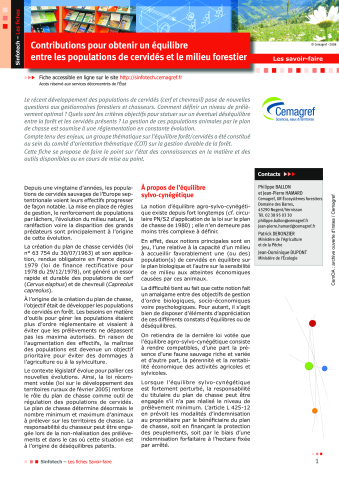
Contributions pour obtenir un équilibre entre les populations de cervidés et le milieu forestier
- Type de publi. : Autre publication
- Date de publi. : 01/01/2008
-
Auteurs :
Philippe BallonJean-Pierre HamardP. DeronzierJ.D. Dupont
Fiche détaillée
Contributions pour obtenir un équilibre entre les populations de cervidés et le milieu forestier
- Type de publi. : Autre publication
- Date de publi. : 01/01/2008
-
Auteurs :
Philippe BallonJean-Pierre HamardP. DeronzierJ.D. Dupont
-
Organismes :
Écosystèmes forestiers
Écosystèmes forestiers
Ministère de l'agriculture et de la pêche [Paris, France]
Ministère de l'Ecologie, du Développement durable et du Transport
Résumé : Cette fiche fait le point des travaux menés par le Cemagref sur l'équilibre forêt cervidés et les outils pour y parvenir.
Fichiers liés :
pub00024364.pdf
Source
-
Chronic atrial fibrillation ablation impact on endocrine and mechanical cardiac functions
- Type de publi. : Article dans une revue
- Date de publi. : 01/01/2008
-
Auteurs :
Frederic SacherJean-Benoît J.-B. CorcuffPhilippe SchraubValérie Le BouffosAgnès GeorgesSamuel O. JonesStéphane LafittePierre BordacharMélèze HociniJacques ClémentyMichel HaïssaguerreLaurence BordenaveRaymond RoudautPierre Jais
Fiche détaillée
Chronic atrial fibrillation ablation impact on endocrine and mechanical cardiac functions
- Type de publi. : Article dans une revue
- Date de publi. : 01/01/2008
-
Auteurs :
Frederic SacherJean-Benoît J.-B. CorcuffPhilippe SchraubValérie Le BouffosAgnès GeorgesSamuel O. JonesStéphane LafittePierre BordacharMélèze HociniJacques ClémentyMichel HaïssaguerreLaurence BordenaveRaymond RoudautPierre Jais
-
Organismes :
Centre Hospitalier Universitaire de Bordeaux
Psychoneuroimmunologie, nutrition et génétique
Service de médecine nucléaire
Centre Hospitalier Universitaire de Bordeaux
Centre Hospitalier Universitaire de Bordeaux
Service de médecine nucléaire
Centre Hospitalier Universitaire de Bordeaux
Centre Hospitalier Universitaire de Bordeaux
Centre Hospitalier Universitaire de Bordeaux
Centre Hospitalier Universitaire de Bordeaux
Centre Hospitalier Universitaire de Bordeaux
Centre Hospitalier Universitaire de Bordeaux
Service de médecine nucléaire
Centre Hospitalier Universitaire de Bordeaux
Centre Hospitalier Universitaire de Bordeaux
- Publié dans European Heart Journal le 30/10/2020
Résumé : *Aims : Assess the impact of persistent/permanent atrial fibrillation (AF) ablation on endocrine and mechanical cardiac functions. *Methods and results : In all, 43 patients (40 males, 53 ± 12 years) undergoing persistent/permanent AF ablation had atrial (ANP) and brain natriuretic peptide (BNP) measurements before day 1, 3, and 3 months after ablation. In the same period of time transthoracic echocardiography was performed. With a mean radiofrequency delivery of 98 ± 29 min, sinus rhythm (SR) was restored in 30 patients (70%) without DC shock. ANP decreased significantly (P < 0.001) with restoration of SR and then increased until day 3 post ablation without reaching the level observed during AF. At 3 months, ANP was significantly lower than day 3 reaching normal value in 28 (65%) patients and being <7 pg/mL in 4 (9%). The BNP followed the same trend with normal BNP level in 23 (53%) patients at 3 months. Identifiable atrial filling waves on the pulsed Doppler transmitral recordings performed between day 2 and day 4 after the procedure were seen in 18 patients (42%). At 3 months, 39 (95%) of the patients with SR during echocardiography had a significant A wave. *Conclusion : SR following persistent/permanent AF ablation is associated with a dramatic decrease in natriuretic peptides. At 3 months, despite relatively extensive atrial ablation, endocrine and mechanical cardiac functions are significantly improved.
Source
-
High-solids anaerobic digestion: comparison of three pilot scales
- Type de publi. : Article dans une revue
- Date de publi. : 01/01/2008
-
Auteurs :
Jeremy GuendouzPierre BuffièreJuan CachoMyriam CarrèreJean-Philippe Delgenès
Fiche détaillée
High-solids anaerobic digestion: comparison of three pilot scales
- Type de publi. : Article dans une revue
- Date de publi. : 01/01/2008
-
Auteurs :
Jeremy GuendouzPierre BuffièreJuan CachoMyriam CarrèreJean-Philippe Delgenès
-
Organismes :
VEOLIA France
Laboratoire de Génie Civil et d'Ingénierie Environnementale
VEOLIA France
VEOLIA France
Laboratoire de Biotechnologie de l'Environnement [Narbonne]
- Publié dans Water Science and Technology le 26/10/2020
Résumé : Two experiments were undertaken in three different experimental set-ups in order to compare them: an industrial 21-m(3) pilot reactor, a new 40-l laboratory pilot reactor and bmp type plasma bottles. Three consecutive batch dry digestion tests of municipal solid waste were performed under mesophilic conditions with the same feedstock in all vessels. Biogas and methane production at the end of the tests were similar (around 200m(3) CH4STP/tVS) for both pilot reactors and were different from the bottle tests. The dynamics of methane production and VFA accumulation concurred. However, the maximal levels of VFA transitory accumulation varied between reactors and between runs in a same reactor. Ammonia levels were similar in both reactors. These results show that the new reactor accurately imitates the conditions found in the larger one. Adaptation of microorganisms to the waste and operating conditions was also pointed out along the consecutive batches. Thermophilic semi-continuous tests were performed in both reactors with similar conditions. The methane production efficiencies were similar.
Source