Professeur des universités en sciences de gestion
-

Preventive effect of ultraviolet radiation on murine chronic sclerodermatous graft-versus-host disease.
- Type de publi. : Article dans une revue
- Date de publi. : 27/12/2007
-
Auteurs :
Isabelle MermetFrançois M. KleinclaussAliette MarandinJean Sébastien GuérriniRégis AngoninPierre TiberghienPhilippe SaasFrançois Aubin
Fiche détaillée
Preventive effect of ultraviolet radiation on murine chronic sclerodermatous graft-versus-host disease.
- Type de publi. : Article dans une revue
- Date de publi. : 27/12/2007
-
Auteurs :
Isabelle MermetFrançois M. KleinclaussAliette MarandinJean Sébastien GuérriniRégis AngoninPierre TiberghienPhilippe SaasFrançois Aubin
-
Organismes :
Département de dermatologie
Interactions hôte-greffon-tumeur, ingénierie cellulaire et génique - UFC (UMR INSERM 1098)
Interactions hôte-greffon-tumeur, ingénierie cellulaire et génique - UFC (UMR INSERM 1098)
Département de dermatologie
Service d'Anatomie pathologique [CHRU Besançon]
Interactions hôte-greffon-tumeur, ingénierie cellulaire et génique - UFC (UMR INSERM 1098)
Interactions hôte-greffon-tumeur, ingénierie cellulaire et génique - UFC (UMR INSERM 1098)
Département de dermatologie
- Publié dans Transplantation le 25/10/2020
Résumé : Although previous studies have demonstrated the efficient modulatory effects of ultraviolet radiation B (UVB) on cutaneous graft-versus-host disease (GVHD), most animal research on GVHD has been performed in murine models of acute GVHD. Here, we studied the preventive effect of UVB radiation on the occurrence of chronic sclerodermatous (Scl) GVHD in a murine model. Scl GVHD was induced by transplanting lethally irradiated BALB/c mice with B10.D2 bone marrow and spleen cells. Recipient mice were exposed to UVB before or after bone marrow and spleen cell infusion. Histological and clinical evaluation of GVHD was performed, in association with the characterization of epidermal Langerhans cells. UVB irradiation of recipients after, and more remarkably before, transplantation induced a decrease of Scl GVHD severity associated with epidermal Langerhans cells depletion. We conclude that UVB irradiation of recipient before or after transplantation has a preventive effect on cutaneous Scl GVHD and may represent an effective strategy for prevention of Scl GVHD.
Source
-
DISPOSITIF DE GENERATION D'UNE LUMIERE POLYCHROMATIQUE A SPECTRE CONTINU PAR EXCITATION A UNE LONGUEUR D'ONDE
- Type de publi. :
- Date de publi. : 26/12/2007
-
Auteurs :
Vincent CoudercPhilippe LeprouxVincent TombelainePierre-Alain ChampertSébastien FévrierAlain BarthélémyJean-Louis AugusteJean-Marc Blondy
Fiche détaillée
DISPOSITIF DE GENERATION D'UNE LUMIERE POLYCHROMATIQUE A SPECTRE CONTINU PAR EXCITATION A UNE LONGUEUR D'ONDE
- Type de publi. :
- Date de publi. : 26/12/2007
-
Auteurs :
Vincent CoudercPhilippe LeprouxVincent TombelainePierre-Alain ChampertSébastien FévrierAlain BarthélémyJean-Louis AugusteJean-Marc Blondy
-
Organismes :
PHOTONIQUE
PHOTONIQUE
PHOTONIQUE
PHOTONIQUE
PHOTONIQUE
PHOTONIQUE
PHOTONIQUE
PHOTONIQUE
Source
-
On Robust Fitting of Curves and Sets of Curves
- Type de publi. : Communication dans un congrès
- Date de publi. : 17/12/2007
-
Auteurs :
Jean-Philippe TarelSio Song IengPierre Charbonnier
Fiche détaillée
On Robust Fitting of Curves and Sets of Curves
- Type de publi. : Communication dans un congrès
- Date de publi. : 17/12/2007
-
Auteurs :
Jean-Philippe TarelSio Song IengPierre Charbonnier
-
Organismes :
Division Exploitation-Signalisation-Éclairage
Division Exploitation-Signalisation-Éclairage
Centre d'études techniques de l'équipement Est
Résumé : Automatic road markings detection is a central point in road scene analysis from images. Its applications concern as well the inventory of lane marking types on a road network, as the design of driver assistance systems on-board vehicles. We here describe a model and an estimation algorithm which account for the geometric specificity and variability of the markings and, above all, which are robust to the numerous perturbations that can be observed in real-world images.
Source
-
The influence of laser power and repetition rate on oxygen and nitrogen insertion into titanium using pulsed Nd:YAG laser irradiation
- Type de publi. : Article dans une revue
- Date de publi. : 15/12/2007
-
Auteurs :
L. LavisseJean-Marie JouvardJ.P. GallienP. BergerDominique GreveyNaudy Philippe
Fiche détaillée
The influence of laser power and repetition rate on oxygen and nitrogen insertion into titanium using pulsed Nd:YAG laser irradiation
- Type de publi. : Article dans une revue
- Date de publi. : 15/12/2007
-
Auteurs :
L. LavisseJean-Marie JouvardJ.P. GallienP. BergerDominique GreveyNaudy Philippe
-
Organismes :
Laboratoire Interdisciplinaire Carnot de Bourgogne
Laboratoire Interdisciplinaire Carnot de Bourgogne
Laboratoire Pierre Süe
Laboratoire Pierre Süe
Laboratoire Interdisciplinaire Carnot de Bourgogne
VALDUC
- Publié dans Applied Surface Science le 27/10/2020
Source
-
An Accelerometry-Based Comparison of 2 Robotic Assistive Devices For Treadmill Training of Gait.
- Type de publi. : Article dans une revue
- Date de publi. : 11/12/2007
-
Auteurs :
Jean-Philippe RegnauxKaveh SaremiJon MarehbianBernard BusselBruce H Dobkin
Fiche détaillée
An Accelerometry-Based Comparison of 2 Robotic Assistive Devices For Treadmill Training of Gait.
- Type de publi. : Article dans une revue
- Date de publi. : 11/12/2007
-
Auteurs :
Jean-Philippe RegnauxKaveh SaremiJon MarehbianBernard BusselBruce H Dobkin
-
Organismes :
Department of Neurology
Physiologie et physiopathologie de la motricité chez l'homme
Department of Neurological Rehabilitation
- Publié dans Journal of Neurologic Rehabilitation le 27/10/2020
Résumé : OBJECTIVE: . Two commercial robotic devices, the Gait Trainer (GT) and the Lokomat (LOKO), assist task-oriented practice of walking. The gait patterns induced by these motor-driven devices have not been characterized and compared. METHODS: . A healthy participant chose the most comfortable gait pattern on each device and for treadmill (TM) walking at 1, 2 (maximum for the GT), and 3 km/h and over ground at similar speeds. A system of accelerometers on the thighs and feet allowed the calculation of spatiotemporal features and accelerations during the gait cycle. RESULTS: . At the 1 and 2 km/h speed settings, single-limb stance times were prolonged on the devices compared with overground walking. Differences on the LOKO were decreased by adjusting the hip and knee angles and step length. At the 3 km/h setting, the LOKO approximated the participant's overground parameters. Irregular accelerations and decelerations from toe-off to heel contact were induced by the devices, especially at slower speeds. CONCLUSIONS: . The LOKO and GT impose mechanical constraints that may alter leg accelerations-decelerations during stance and swing phases, as well as stance duration, especially at their slower speed settings, that are not found during TM and overground walking. The potential impact of these perturbations on training to improve gait needs further study.
Source
-
MELODIE : a whole-farm model to study the dynamics of nutrients in integrated dairy and pig farms
- Type de publi. : Communication dans un congrès
- Date de publi. : 10/12/2007
-
Auteurs :
Xavier ChardonCyrille RigolotChristine BaratteAlain-Hervé Le GallS. EspagnolRoger Martin-ClouaireJean-Pierre RellierChristelle RaisonJean-Claude PoupaPhilippe Faverdin
Fiche détaillée
MELODIE : a whole-farm model to study the dynamics of nutrients in integrated dairy and pig farms
- Type de publi. : Communication dans un congrès
- Date de publi. : 10/12/2007
-
Auteurs :
Xavier ChardonCyrille RigolotChristine BaratteAlain-Hervé Le GallS. EspagnolRoger Martin-ClouaireJean-Pierre RellierChristelle RaisonJean-Claude PoupaPhilippe Faverdin
-
Organismes :
Production du lait
Institut de l'élevage
Systèmes d'Elevage, Nutrition Animale et Humaine
Institut du Porc
Production du lait
Institut de l'élevage
Institut du Porc
Unité de Biométrie et Intelligence Artificielle (ancêtre de MIAT)
Unité de Biométrie et Intelligence Artificielle (ancêtre de MIAT)
Institut de l'élevage
Unité de recherche d'Économie et Sociologie Rurales
Production du lait
Source
-
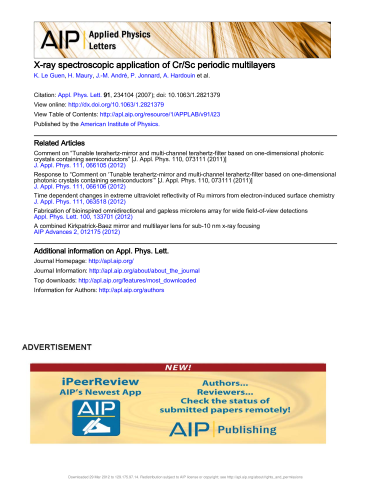
X-ray spectroscopic application of Cr/Sc periodic multilayers
- Type de publi. : Article dans une revue
- Date de publi. : 05/12/2007
-
Auteurs :
Karine Le GuenHélène MauryJean-Michel AndréPhilippe JonnardAurélie HardouinFranck DelmotteMarie-Françoise Ravet-Krill
Fiche détaillée
X-ray spectroscopic application of Cr/Sc periodic multilayers
- Type de publi. : Article dans une revue
- Date de publi. : 05/12/2007
-
Auteurs :
Karine Le GuenHélène MauryJean-Michel AndréPhilippe JonnardAurélie HardouinFranck DelmotteMarie-Françoise Ravet-Krill
-
Organismes :
Laboratoire de Chimie Physique - Matière et Rayonnement
Laboratoire de Chimie Physique - Matière et Rayonnement
Laboratoire de Chimie Physique - Matière et Rayonnement
Laboratoire de Chimie Physique - Matière et Rayonnement
Laboratoire Charles Fabry de l'Institut d'Optique / Scop
Laboratoire Charles Fabry de l'Institut d'Optique / Scop
Laboratoire Charles Fabry de l'Institut d'Optique / Scop
- Publié dans Applied Physics Letters le 01/11/2020
Résumé : The use of Cr/Sc multilayer interferential mirrors (MIMs) in optical systems such as x-ray microscopes or telescopes have been reported for the water window (between C K- and O K-absorption edges). However, their possibilities in spectroscopic application have never been described in the literature. The purpose of the paper is to report for the first time on the performances of Cr/Sc MIMs as Bragg dispersive devices for the analysis in wavelength dispersive spectrometry of samples containing N or Sc atoms. The possibility to distinguish the chemical state of the emitting N or Sc atoms is evidenced by using Johan-type and double-crystal spectrometers.
Fichiers liés :
00575878.pdf
Source
-
Role of STAT3 in CD4+CD25+FOXP3+ regulatory lymphocyte generation: implications in graft-versus-host disease and antitumor immunity.
- Type de publi. : Article dans une revue
- Date de publi. : 01/12/2007
-
Auteurs :
Jean-René PallandreEmilie BrillardGilles CréhangeAmandine RadlovicJean-Paul Remy-MartinPhilippe SaasPierre-Simon RohrlichXavier B. PivotXiang LingPierre TiberghienChristophe Borg
Fiche détaillée
Role of STAT3 in CD4+CD25+FOXP3+ regulatory lymphocyte generation: implications in graft-versus-host disease and antitumor immunity.
- Type de publi. : Article dans une revue
- Date de publi. : 01/12/2007
-
Auteurs :
Jean-René PallandreEmilie BrillardGilles CréhangeAmandine RadlovicJean-Paul Remy-MartinPhilippe SaasPierre-Simon RohrlichXavier B. PivotXiang LingPierre TiberghienChristophe Borg
-
Organismes :
Interactions hôte-greffon-tumeur, ingénierie cellulaire et génique - UFC (UMR INSERM 1098)
Service de Radiothérapie [CHRU Besançon]
Service de Radiothérapie [CHRU Besançon]
Service de Radiothérapie [CHRU Besançon]
Interactions hôte-greffon-tumeur, ingénierie cellulaire et génique - UFC (UMR INSERM 1098)
Interactions hôte-greffon-tumeur, ingénierie cellulaire et génique - UFC (UMR INSERM 1098)
Interactions hôte-greffon-tumeur, ingénierie cellulaire et génique - UFC (UMR INSERM 1098)
Interactions hôte-greffon-tumeur, ingénierie cellulaire et génique - UFC (UMR INSERM 1098)
Service d'Oncologie Médicale [CHRU Besançon]
Section of Molecular Hematology and Therapy
Interactions hôte-greffon-tumeur, ingénierie cellulaire et génique - UFC (UMR INSERM 1098)
Interactions hôte-greffon-tumeur, ingénierie cellulaire et génique - UFC (UMR INSERM 1098)
Service d'Oncologie Médicale [CHRU Besançon]
- Publié dans Journal of Immunology le 27/10/2020
Résumé : Immunological tolerance is maintained by specialized subsets of T cells including CD4(+)CD25(+)FOXP3(+) regulatory cells (Treg). Previous studies established that Treg thymic differentiation or peripheral conversion depend on CD28 and Lck signaling. Moreover, foxp3 gene transfer in murine CD4(+)CD25(-) T lymphocytes results in the acquisition of suppressive functions. However, molecular pathways leading to FOXP3 expression remain to be described. In this study, we investigated the molecular events driving FOXP3 expression. We demonstrated that CD28 activation in CD4(+)CD25(-) T lymphocytes leads to STAT3 Tyr(705) phosphorylation in an Lck-dependent manner. STAT3 neutralization during naive peripheral CD4(+)CD25(-) T cell conversion into Treg through costimulation with TCR/CD28 and TGF-beta1, decreased FOXP3 expression, prevented the acquisition of suppressive functions and restored the ability of the converted lymphocytes to produce IL-2 and IFN-gamma. Furthermore, we observed that STAT3 ablation using small interfering RNA strategies inhibited FOXP3 expression and suppressive functions among naturally differentiated CD4(+)CD25(+) T lymphocytes, suggesting a direct role of STAT3 in Treg phenotype and function maintenance. CD4(+)CD25(+) T lymphocytes transduced with specific STAT3 small interfering RNA were devoid of suppressive functions and failed to control the occurrence of acute graft-vs-host disease. Finally, STAT3 inhibition in CD4(+) lymphocytes enhanced the anti-tumor immunity conferred by a lymphocyte adoptive transfer. In summary, our findings determine that STAT3 is critical in the molecular pathway required for FOXP3 expression. STAT3 modulation should be taken into account when assessing how regulatory T cells contribute to inflammatory diseases and tumor immunosurveillance.
Source
-

Une Caractérisation non gaussienne et à longue mémoire du trafic Internet et de ses anomalies
- Type de publi. : Article dans une revue
- Date de publi. : 01/12/2007
-
Auteurs :
Pierre BorgnatPatrice AbryGuillaume DewaeleAntoine ScherrerNicolas LarrieuPhilippe OwezarskiYann LabitLaurent GallonJulien Aussibal
Fiche détaillée
Une Caractérisation non gaussienne et à longue mémoire du trafic Internet et de ses anomalies
- Type de publi. : Article dans une revue
- Date de publi. : 01/12/2007
-
Auteurs :
Pierre BorgnatPatrice AbryGuillaume DewaeleAntoine ScherrerNicolas LarrieuPhilippe OwezarskiYann LabitLaurent GallonJulien Aussibal
-
Organismes :
Laboratoire de Physique de l'ENS Lyon
Laboratoire de Physique de l'ENS Lyon
Laboratoire de Physique de l'ENS Lyon
Laboratoire de Physique de l'ENS Lyon
Laboratoire de l'Informatique du Parallélisme
Laboratoire d'analyse et d'architecture des systèmes
Laboratoire d'analyse et d'architecture des systèmes
Laboratoire d'analyse et d'architecture des systèmes
Laboratoire Informatique de l'Université de Pau et des Pays de l'Adour
Laboratoire Informatique de l'Université de Pau et des Pays de l'Adour
- Publié dans Annals of Telecommunications - annales des télécommunications le 22/10/2020
Résumé : Being now a mainstream communication, Internet is subject to many kinds of anomalies (failures, flash-crowds, attacks). In order to compare the statistics of normal traffic with traffic with anomalies, we collect both regular and anomalous traffic. The traffic is collected on the RENATER network by the METROSEC project and we produce both Denial of Service (DoS) attacks with real attack softwares (TFN2K, TRIN00) aimed at various services (ICMP, SYN, UDP, TCP), and flash-crowd anomalies. We propose a multiresolution, non-Gaussian model with long memory and the corresponding estimators. It models, jointly at all aggregation levels, normal traffic, and also traffic containing anomalies. We show that the model enables to detect the anomalies in the traffic and distinguish between flash-crowd and DoS types of anomaly.
Fichiers liés :
07_annales_telecoms_borgnat_draft.pdf
Source
-
Jonquetella anthropi gen. nov., sp. nov., the first member of the candidate phylum 'Synergistetes' isolated from man.
- Type de publi. : Article dans une revue
- Date de publi. : 01/12/2007
-
Auteurs :
Estelle Jumas-BilakJean-Philippe CarlierHélène Jean-PierreDiane CitronKathryn BernardAudrey DamayBernard GayCorinne TeyssierJosiane CamposH. Marchandin
Fiche détaillée
Jonquetella anthropi gen. nov., sp. nov., the first member of the candidate phylum 'Synergistetes' isolated from man.
- Type de publi. : Article dans une revue
- Date de publi. : 01/12/2007
-
Auteurs :
Estelle Jumas-BilakJean-Philippe CarlierHélène Jean-PierreDiane CitronKathryn BernardAudrey DamayBernard GayCorinne TeyssierJosiane CamposH. Marchandin
-
Organismes :
Laboratoire universitaire d'antibiologie
Laboratoire de Bactériologie
Institut de Recherche en Infectiologie de Montpellier
Department of Geology and Geophysics
Facultat de Fisica, Departament Universitari d'Optica
Laboratoire universitaire d'antibiologie
Laboratoire de Bactériologie
- Publié dans International Journal of Systematic and Evolutionary Microbiology le 31/10/2020
Résumé : Six clinical isolates of a hitherto unknown, strictly anaerobic, Gram-negative rod showing fastidious growth were subjected to a polyphasic taxonomic study, including phenotypic, genomic and phylogenetic feature analyses. 16S rRNA gene sequenced-based phylogeny revealed that the novel strains represent a homogeneous group distant from any recognized species in the candidate phylum 'Synergistetes'. The novel isolates were most closely related to species of the genus Dethiosulfovibrio, with 88.2-88.7 % 16S rRNA gene sequence similarity. Large-scale chromosome structure and DNA G+C content also differentiated the novel strains from members of the genus Dethiosulfovibrio. The novel strains were asaccharolytic. Major metabolic end products in trypticase/glucose/yeast extract broth were acetic, lactic, succinic and isovaleric acids and the major cellular fatty acids iso-C(15 : 0) and C(16 : 0). Based on the data presented here, a new genus, Jonquetella gen. nov., is proposed with one novel species, Jonquetella anthropi sp. nov. J. anthropi is the first characterized species of the candidate phylum 'Synergistetes' that includes human isolates. The G+C content of the DNA of the type strain of J. anthropi ADV 126(T) (=AIP 136.05(T)=CIP 109408(T)=CCUG 53819(T)) is 59.4 mol%.
Source