Professeur des universités en sciences de gestion
-
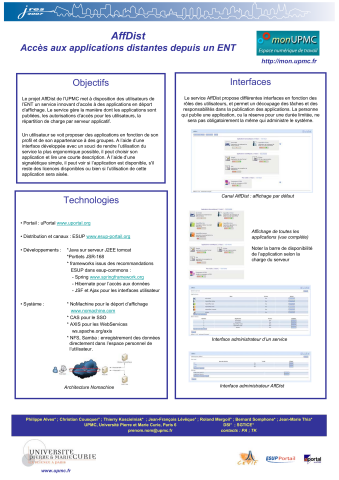
Projet AffDist : Accès aux applications distantes depuis un ENT
- Type de publi. :
- Date de publi. : 20/11/2007
-
Auteurs :
Philippe AlvesChristian CousquerThierry KoscielniakJean-François LevequeRoland MergoilBernard SomphoneJean-Marie Thia
Fiche détaillée
Projet AffDist : Accès aux applications distantes depuis un ENT
- Type de publi. :
- Date de publi. : 20/11/2007
-
Auteurs :
Philippe AlvesChristian CousquerThierry KoscielniakJean-François LevequeRoland MergoilBernard SomphoneJean-Marie Thia
-
Organismes :
Université Pierre et Marie Curie - Paris 6
Université Pierre et Marie Curie - Paris 6
Université Pierre et Marie Curie - Paris 6
Université Pierre et Marie Curie - Paris 6
Université Pierre et Marie Curie - Paris 6
Université Pierre et Marie Curie - Paris 6
Université Pierre et Marie Curie - Paris 6
Résumé : Le projet AffDist de l'UPMC met à disposition des utilisateurs de l'ENT un service innovant d'accès à des applications en déport d'affichage. Le service gère la manière dont les applications sont publiées, les autorisations d'accès pour les utilisateurs, la répartition de charge par serveur applicatif. Un utilisateur se voit proposer des applications en fonction de son profil et de son appartenance à des groupes. A l'aide d'une interface développée avec un souci de rendre l'utilisation du service la plus ergonomique possible, il peut choisir son application et lire une courte description. À l'aide d'une signalétique simple, il peut voir si l'application est disponible, s'il reste des licences disponibles ou bien si l'utilisation de cette application sera aisée (en fonction de la charge des serveurs qui l'hébergent). Le service AffDist propose différentes interfaces en fonction des rôles des utilisateurs, et permet un découpage des tâches / responsabilités dans la publication des applications. La personne qui publie une application, ou la réserve pour une durée limitée, ne sera pas obligatoirement la même qui administre le système.
Fichiers liés :
presentation_111.pdf
Source
-

UDP-glucuronosyltransferase UGT1A7 genetic polymorphisms in hepatocellular carcinoma: a differential impact according to seropositivity of HBV or HCV markers?
- Type de publi. : Article dans une revue
- Date de publi. : 19/11/2007
-
Auteurs :
Isabelle StückerMarie-Anne LoriotGiselle N'KoutchouSylvie CénéeLaurent BodinClaire MulotMoana Gelu-SimeonLaurence PelletierJp BroniwickiFrançoise F. DegosPhilippe BeaunePierre Laurent-PuigDenis HémonJean-Claude TrinchetGilles G. Pelletier
Fiche détaillée
UDP-glucuronosyltransferase UGT1A7 genetic polymorphisms in hepatocellular carcinoma: a differential impact according to seropositivity of HBV or HCV markers?
- Type de publi. : Article dans une revue
- Date de publi. : 19/11/2007
-
Auteurs :
Isabelle StückerMarie-Anne LoriotGiselle N'KoutchouSylvie CénéeLaurent BodinClaire MulotMoana Gelu-SimeonLaurence PelletierJp BroniwickiFrançoise F. DegosPhilippe BeaunePierre Laurent-PuigDenis HémonJean-Claude TrinchetGilles G. Pelletier
-
Organismes :
Epidémiologie environnementale des cancers
Bases moléculaires de la réponse aux xénobiotiques
Service d'hépato-gastroentérologie
Epidémiologie environnementale des cancers
Bases moléculaires de la réponse aux xénobiotiques
Epidémiologie environnementale des cancers
Bases moléculaires de la réponse aux xénobiotiques
Hôpital Bicêtre
Bases moléculaires de la réponse aux xénobiotiques
Centre d'investigation clinique plurithématique Pierre Drouin [Nancy]
Service d'hépatologie
Bases moléculaires de la réponse aux xénobiotiques
Bases moléculaires de la réponse aux xénobiotiques
Epidémiologie environnementale des cancers
Service d'hépato-gastroentérologie
Hôpital Bicêtre
- Publié dans BMC Cancer le 01/11/2020
Résumé : ABSTRACT: BACKGROUND: We conducted a case-control study to evaluate the role of UDP-glucuronosyltransferase 1A7 (UGT1A7) polymorphisms in the onset of hepatocellular carcinoma (HCC). Patients and Methods The study included 165 patients with HCC, 134 with cirrhosis and 142 controls without liver disease, matched for age and hospital. All were men younger than 75 years. HCC and cirrhosis patients were stratified according to time since cirrhosis diagnosis. RESULTS: We found a positive association between the UGT1A7*3/*3 genotype and HCC when the comparison was restricted to patients whose disease was of viral origin [OR=3.4 (0.3-45)] but a negative association when it included only alcoholic patients [OR=0.1 (0.02-0.6)]. CONCLUSION: Our study shows that UGT1A7 may play a role in hepatocellular carcinogenesis and that this role may differ according to the primary cause of the cirrhosis.
Fichiers liés :
StuckerI_2007.pdf
Source
-

Optimization of hydrogen production in anaerobic digesters with input and state estimation and model predictive control
- Type de publi. : Communication dans un congrès
- Date de publi. : 13/11/2007
-
Auteurs :
César Arturo Aceves-LaraEric LatrilleNicolas BernetPierre BuffièreJean-Philippe Steyer
Fiche détaillée
Optimization of hydrogen production in anaerobic digesters with input and state estimation and model predictive control
- Type de publi. : Communication dans un congrès
- Date de publi. : 13/11/2007
-
Auteurs :
César Arturo Aceves-LaraEric LatrilleNicolas BernetPierre BuffièreJean-Philippe Steyer
-
Organismes :
Laboratoire de Biotechnologie de l'Environnement [Narbonne]
Laboratoire de Biotechnologie de l'Environnement [Narbonne]
Laboratoire de Biotechnologie de l'Environnement [Narbonne]
Laboratoire de Biotechnologie de l'Environnement [Narbonne]
Laboratoire de Biotechnologie de l'Environnement [Narbonne]
Résumé : This paper addresses the problem of optimization of hydrogen production in continuous anaerobic digesters utilizing an model predictive control (MPC) strategy. The process is described by a dynamic nonlinear model. The influent COD concentration together with the effluent substrate and product concentrations are considered as state variables and estimated by an asymptotic online observer from measurements of gas composition and gas flow rate. It is experimentally demonstrated that a 75% increase of the hydrogen production can be obtained using the influent flow rate as the main control variable while keeping the conversion of the influent COD concentration higher than 95 %.
Source
-
Modélisation d’une filière de traitement des effluents d’élevage couplant la digestion anaérobie et le traitement biologique de l’azote
- Type de publi. : Communication dans un congrès
- Date de publi. : 13/11/2007
-
Auteurs :
Pierre RousseauJean-Philippe SteyerEveline VolckeNicolas BernetFabrice Beline
Fiche détaillée
Modélisation d’une filière de traitement des effluents d’élevage couplant la digestion anaérobie et le traitement biologique de l’azote
- Type de publi. : Communication dans un congrès
- Date de publi. : 13/11/2007
-
Auteurs :
Pierre RousseauJean-Philippe SteyerEveline VolckeNicolas BernetFabrice Beline
-
Organismes :
Institut national de recherche en sciences et technologies pour l'environnement et l'agriculture
Laboratoire de Biotechnologie de l'Environnement [Narbonne]
Laboratoire de Biotechnologie de l'Environnement [Narbonne]
Laboratoire de Biotechnologie de l'Environnement [Narbonne]
Institut national de recherche en sciences et technologies pour l'environnement et l'agriculture
Résumé : Dans le cadre de l’industrialisation de l’élevage porcin en Bretagne et face à l’augmentation des couts énergétiques, un procédé de traitement du lisier de porcs associant la digestion anaérobie et le traitement de l’azote par boues activées a été développé. Cependant, face à la complexité du système et des processus mis en jeu, l’optimisation expérimentale du procédé s’avère difficile. Une approche numérique a donc été développée afin d’optimiser cette filière de traitement. Une version modifiée du modèle ASM prenant en compte les spécificités du substrat a été utilisée. Le modèle ADM pour la digestion anaérobie a été modifié pour prendre en compte la possibilité de dénitrifier dans le digesteur. Les processus physico-chimiques liés à la dénitrification (pH, transfert liquide-gaz) ont également été pris en compte. Enfin, une interface permettant de faire communiquer les deux modèles a été mise en place Celle-ci optimise la répartition de la DCO et de l’azote entre les deux modèles. Cependant, afin de garantir les bilans matières à l’interface, certaines hypothèses ont dues être avancées et nécessiteront d’être vérifiées.
Source
-

Dissimulation de Données par Changement de Connexité d'un Maillage 3D
- Type de publi. : Communication dans un congrès
- Date de publi. : 09/11/2007
-
Auteurs :
Philippe AmatWilliam PuechSébastien DruonJean-Pierre Pedeboy
Fiche détaillée
Dissimulation de Données par Changement de Connexité d'un Maillage 3D
- Type de publi. : Communication dans un congrès
- Date de publi. : 09/11/2007
-
Auteurs :
Philippe AmatWilliam PuechSébastien DruonJean-Pierre Pedeboy
-
Organismes :
Stratégies S.A. [Rungis]
Image & Interaction
Interactive Digital Humans
Stratégies S.A. [Rungis]
Résumé : Cet article présente une nouvelle méthode d'insertion de données cachées dans des modèles 3D surfacique. Les méthodes d'insertion de données se basent généralement sur la modification des sommets du modèle pour réaliser l'insertion. Dans notre méthode l'insertion des bits du message s'appuie sur une modification de la connexité du maillage. De ce fait nous ne modifions pas la position des sommets du modèle pour réaliser l'insertion. Notre approche privilégie la capacité d'insertion à la robustesse.
Fichiers liés :
19.pdf
Source
-
Designing a reconfigurable processing datapath for SDR over heterogeneous reconfigurable platforms
- Type de publi. : Communication dans un congrès
- Date de publi. : 05/11/2007
-
Auteurs :
Jean-Philippe DelahayePierre LerayChristophe Moy
Fiche détaillée
Designing a reconfigurable processing datapath for SDR over heterogeneous reconfigurable platforms
- Type de publi. : Communication dans un congrès
- Date de publi. : 05/11/2007
-
Auteurs :
Jean-Philippe DelahayePierre LerayChristophe Moy
-
Organismes :
Institut d'Électronique et des Technologies du numéRique
Institut d'Electronique et de Télécommunications de Rennes
Institut d'Électronique et des Technologies du numéRique
Source
-
A 6-Month Interruption of Antiretroviral Therapy Improves Adipose Tissue Function in HIV-Infected Patients: The ANRS EP29 Lipostop Study
- Type de publi. : Article dans une revue
- Date de publi. : 01/11/2007
-
Auteurs :
Min Ji KimPascale LeclercqEmilie LanoyPascale CerveraBarbara Antuna-PuenteMustapha MaachiElena DorofeevLaurence SlamaMarc Antoine ValantinDominique CostagliolaAnne LombèsJean-Philippe BastardJacqueline Capeau
Fiche détaillée
A 6-Month Interruption of Antiretroviral Therapy Improves Adipose Tissue Function in HIV-Infected Patients: The ANRS EP29 Lipostop Study
- Type de publi. : Article dans une revue
- Date de publi. : 01/11/2007
-
Auteurs :
Min Ji KimPascale LeclercqEmilie LanoyPascale CerveraBarbara Antuna-PuenteMustapha MaachiElena DorofeevLaurence SlamaMarc Antoine ValantinDominique CostagliolaAnne LombèsJean-Philippe BastardJacqueline Capeau
-
Organismes :
Pathologie de l'Adipocyte et des Cellules Hepatiques
- Publié dans Antiviral Therapy le 24/10/2020
Résumé : Objective To examine the reversibility of adipose tissue alterations in HIV-infected patients after a 6-month interruption of antiretroviral therapy (ART). Methods Forty HIV-infected patients on stable effective ART were enrolled, 33 of them completed the study. Patients underwent a physical examination, laboratory tests and needle biopsy of subcutaneous abdominal adipose tissue both at inclusion and at month 6. Changes in fat morphology, mitochondrial DNA (mtDNA) content and gene expression were examined in 29, 23 and 20 patients, respectively. Results Body fat distribution was not clearly modified at month 6. Adipose tissue inflammation improved markedly, with fewer infiltrating macrophages and fewer tumour necrosis factor a (TNFα)- and interleukin 6 (IL6)-expressing cells. Expression of peroxisome proliferator-activated receptor γ (PPAR-γ) and of markers of mitochondrial function and biogenesis (cytochrome oxidase 2 and PPAR-γ coreceptor 1α) improved after protease inhibitor (PI) withdrawal. In patients who stopped taking stavudine or zidovudine, the number of TNFα- and IL6-expressing cells was lower at month 6 than at month 0, and so was CD68 expression, a macrophage marker. Adipocyte mitochondrial status also improved, with lower mitochondrial density and cytochrome oxidase 4 mRNA levels, and higher mtDNA content. Sterol regulatory element binding protein 1 mRNA levels increased, reflecting better adipocyte differentiation. Conclusions A 6-month ART interruption markedly improved adipose tissue functions, although fat distribution did not visibly change. Stavudine and zidovudine were associated with marked inflammation, which improved when these drugs were withdrawn; they also had a negative effect on differentiation and mitochondrial status. PIs were also associated with altered adipocyte differentiation and mitochondrial status. These data clearly show the detrimental effect of antiretroviral drugs, in particular thymidine analogues, on adipose tissue and argue for switch strategies sparing these drugs.
Source
-
Relationship between gamma-glutamyltransferase and fat mass in a general population of 8-17 years old children. The FLVS II study.
- Type de publi. : Article dans une revue
- Date de publi. : 01/11/2007
-
Auteurs :
Jérémie BottonB. HeudePh. AndréJean-Louis BressonPierre DucimetièreMarie‐aline CharlesFlvs Study Group
Fiche détaillée
Relationship between gamma-glutamyltransferase and fat mass in a general population of 8-17 years old children. The FLVS II study.
- Type de publi. : Article dans une revue
- Date de publi. : 01/11/2007
-
Auteurs :
Jérémie BottonB. HeudePh. AndréJean-Louis BressonPierre DucimetièreMarie‐aline CharlesFlvs Study Group
-
Organismes :
Recherche en épidémiologie et biostatistique
Recherche en épidémiologie et biostatistique
Recherche en épidémiologie et biostatistique
CIC Necker Enfants Malades
Recherche en épidémiologie et biostatistique
Recherche en épidémiologie et biostatistique
Association Fleurbaix Laventie Ville Santé
- Publié dans Diabetes & Metabolism le 31/10/2020
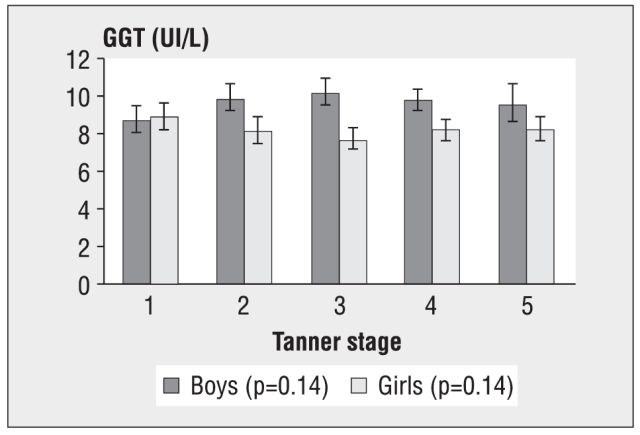
Résumé : AIM: Elevated gamma-glutamyltransferase (GGT) is positively associated with severity of obesity in obese children and with increased BMI and waist circumference in general populations of adults. We aimed to study the relationships between GGT and anthropometric parameters in a general population of children. METHODS: This cross-sectional study was conducted in 219 boys and 214 girls included in the Fleurbaix Laventie Ville Sant?I study. Weight, height, four skinfolds and waist circumference were measured. We compared the means of GGT activity according to gender and Tanner stage, and according to overweight status (IOTF definition) and quartiles of anthropometric parameters. We then calculated partial Pearson correlations by gender between GGT and anthropometric parameters taking age and Tanner stage into account. RESULTS: GGT activity was higher in boys than in girls as soon as puberty started (P<0.001). The higher difference was observed for Tanner stage III (GGT=10.2 UI/L, CI95% of mean (9.5, 11.1) vs. 7.8 UI/L (7.2, 8.4)). Anthropometric parameters were significantly associated with GGT, particularly waist circumference (r=0.28 in boys; r=0.24 in girls). After an additional adjustment for sum of skinfolds, this correlation disappeared in boys (r=0.06), and was still significant in girls (r=0.19). CONCLUSION: In a general population of children, overweight and abdominal fat distribution were associated with increased GGT. As some studies have shown that GGT could predict the metabolic syndrome in children and type 2 diabetes in adults, the modest elevation of GGT observed in overweight children may be of pathophysiological importance in the long term.
Fichiers liés :
botton_fig1.pdf
botton_fig2.pdf
botton_fig3.pdf
botton_fig4.pdf
botton_fig5.pdf
Diab_Metab-botton-V2.pdf
Source
-

Production and Emission of Volatile Compounds by Petal Cells.
- Type de publi. : Article dans une revue
- Date de publi. : 01/11/2007
-
Auteurs :
Sylvie BaudinoJean-Claude CaissardVéronique BergougnouxFrédéric JullienJean-Louis MagnardGabriel ScallietJ. Mark CockPhilippe Hugueney
Fiche détaillée
Production and Emission of Volatile Compounds by Petal Cells.
- Type de publi. : Article dans une revue
- Date de publi. : 01/11/2007
-
Auteurs :
Sylvie BaudinoJean-Claude CaissardVéronique BergougnouxFrédéric JullienJean-Louis MagnardGabriel ScallietJ. Mark CockPhilippe Hugueney
-
Organismes :
Laboratoire de Biotechnologies Végétales appliquées aux Plantes Aromatiques et Médicinales
Laboratoire de Biotechnologies Végétales appliquées aux Plantes Aromatiques et Médicinales
Laboratoire de Biotechnologies Végétales appliquées aux Plantes Aromatiques et Médicinales
Laboratoire de Biotechnologies Végétales appliquées aux Plantes Aromatiques et Médicinales
Laboratoire de Biotechnologies Végétales appliquées aux Plantes Aromatiques et Médicinales
BioSciences Lyon-Gerland
Reproduction et développement des plantes
Végétaux marins et biomolécules
BioSciences Lyon-Gerland
Reproduction et développement des plantes
- Publié dans Plant Signaling and Behavior le 02/11/2020
Résumé : We localized the tissues and cells that contribute to scent biosynthesis in scented and nonscented Rosa x hybrida cultivars as part of a detailed cytological analysis of the rose petal. Adaxial petal epidermal cells have a typical conical, papillate shape whereas abaxial petal epidermal cells are flat. Using two different techniques, solid/liquid phase extraction and headspace collection of volatiles, we showed that, in roses, both epidermal layers are capable of producing and emitting scent volatiles, despite the different morphologies of the cells of these two tissues. Moreover, OOMT, an enzyme involved in scent molecule biosynthesis, was localized in both epidermal layers. These results are discussed in view of results found in others species such as Antirrhinum majus, where it has been shown that the adaxial epidermis is the preferential site of scent production and emission.
Fichiers liés :
BaudinoPSB2007.pdf
Source
-
Interference of coherent polariton beams in microcavities: polarization controlled optical gates
- Type de publi. : Article dans une revue
- Date de publi. : 01/11/2007
-
Auteurs :
Charles LeyderTim C.H. LiewAlexey KavokinIvan A. ShelykhMarco RomanelliJean-Philippe KarrElisabeth GiacobinoAlberto Bramati
Fiche détaillée
Interference of coherent polariton beams in microcavities: polarization controlled optical gates
- Type de publi. : Article dans une revue
- Date de publi. : 01/11/2007
-
Auteurs :
Charles LeyderTim C.H. LiewAlexey KavokinIvan A. ShelykhMarco RomanelliJean-Philippe KarrElisabeth GiacobinoAlberto Bramati
-
Organismes :
Laboratoire Kastler Brossel
Nanyang Technological University [Singapour]
University of Southampton
Science Institute
Institut de Physique de Rennes
Laboratoire Kastler Brossel
Département de Physique et Modélisation (Evry)
Laboratoire Kastler Brossel
Laboratoire Kastler Brossel
- Publié dans Physical Review Letters le 02/11/2020
Résumé : We demonstrate, theoretically and experimentally, a polarization-controlled optical gate based on a degenerate polariton-polariton scattering process occurring in semiconductor microcavities. Because of the interference between coherent polaritons, this process is observed in the case of polaritons generated from two collinearly polarized coherent pump beams. On the contrary, if the beams are cross polarized, the scattering is suppressed.
Source