Professeur des universités en sciences de gestion
-

Isolated ZP-N domains constitute the N-terminal extensions of Zona Pellucida proteins
- Type de publi. : Article dans une revue
- Date de publi. : 01/01/2007
-
Auteurs :
Isabelle CallebautJean-Paul MornonPhilippe Monget
Fiche détaillée
Isolated ZP-N domains constitute the N-terminal extensions of Zona Pellucida proteins
- Type de publi. : Article dans une revue
- Date de publi. : 01/01/2007
-
Auteurs :
Isabelle CallebautJean-Paul MornonPhilippe Monget
-
Organismes :
Institut de minéralogie et de physique des milieux condensés
Institut de minéralogie et de physique des milieux condensés
Physiologie de la reproduction et des comportements [Nouzilly]
- Publié dans Bioinformatics le 25/10/2020
Résumé : Zona Pellucida (ZP) domains have been found in a wide variety of extracellular proteins, in which they play essential role for polymerization. They are shared by the ZP proteins, which constitute the extracellular coat of animal eggs. Except from ZP3, constituting the primary sperm receptor, the ZP proteins possess, in addition to their C-terminal ZP domains, N-terminal extensions, which are thought to play an important role in the species-specific gamete recognition. Here, we show that these extensions are made of single or multiple copies of a small globular domain, which can be significantly related to the N-terminal region of ZP domains (ZP-N domains). This finding brings new insights into the molecular evolution of ZP proteins, which may have evolved around a common ZP-N architecture, and more generally into the noticeable sequence diversity of ZP-N domains, which can be found as isolated subunits or tightly associated with ZP-C domains to form complete, canonical ZP domains.
Source
-
Alimentation végétale et systèmes de production en Limousin de l’âge du Fer à la fin du Moyen Âge
- Type de publi. : Rapport
- Date de publi. : 01/01/2007
-
Auteurs :
Anne BouchetteJean-Michel BeausoleilAlexandra BesombesMichel BotineauPatrice ConteIsabel FigueiralSerge GadyPierre MilleHenri PigeyrePhilippe PoirierFrédérique Robin
Fiche détaillée
Alimentation végétale et systèmes de production en Limousin de l’âge du Fer à la fin du Moyen Âge
- Type de publi. : Rapport
- Date de publi. : 01/01/2007
-
Auteurs :
Anne BouchetteJean-Michel BeausoleilAlexandra BesombesMichel BotineauPatrice ConteIsabel FigueiralSerge GadyPierre MilleHenri PigeyrePhilippe PoirierFrédérique Robin
-
Organismes :
Archéologie des Sociétés Méditerranéennes
Archéologie des Sociétés Méditerranéennes
Source
-
Effet de la substitution d'essence sur le fonctionnement et la durabilité des écosystèmes forestiers : l'apport des travaux pluridisciplinaires menés en forêt de Breuil Chenue - Morvan
- Type de publi. : Article dans une revue
- Date de publi. : 01/01/2007
-
Auteurs :
Jacques J. RangerDominique GelhayeSéverine BienaimeM. BonneauPascal BonnaudJean-Pierre CalmetChristophe C. CalvarusoM. ForetLouisette GelhayeFrançoise GérardJérôme JaffrainLouis MareschalJudicaël MoukoumiGilles NourrissonClaude C. NysBenoit PollierLaurent Saint‐andré- SicardMarie-Pierre TurpaultBernhard ZellerMarc BuéePascale Frey-KlettFrançois F. Le TaconStéphane UrozJean-Paul MauricePhilippe Amiotte-SuchetFrancis AndreuxRémi ChaussodDavid LejonLionel RanjardM. SimmonsonJacques BerthelinThierry BeguiristainJ.P. BoudotA. KulhankovaN. MallouhiC. Munier-LamyB. DelvauxH. TiteuxF. Trum
Fiche détaillée
Effet de la substitution d'essence sur le fonctionnement et la durabilité des écosystèmes forestiers : l'apport des travaux pluridisciplinaires menés en forêt de Breuil Chenue - Morvan
- Type de publi. : Article dans une revue
- Date de publi. : 01/01/2007
-
Auteurs :
Jacques J. RangerDominique GelhayeSéverine BienaimeM. BonneauPascal BonnaudJean-Pierre CalmetChristophe C. CalvarusoM. ForetLouisette GelhayeFrançoise GérardJérôme JaffrainLouis MareschalJudicaël MoukoumiGilles NourrissonClaude C. NysBenoit PollierLaurent Saint‐andré- SicardMarie-Pierre TurpaultBernhard ZellerMarc BuéePascale Frey-KlettFrançois F. Le TaconStéphane UrozJean-Paul MauricePhilippe Amiotte-SuchetFrancis AndreuxRémi ChaussodDavid LejonLionel RanjardM. SimmonsonJacques BerthelinThierry BeguiristainJ.P. BoudotA. KulhankovaN. MallouhiC. Munier-LamyB. DelvauxH. TiteuxF. Trum
-
Organismes :
Unité de recherche Biogéochimie des Ecosystèmes Forestiers
Unité de recherche Biogéochimie des Ecosystèmes Forestiers
Unité de recherche Biogéochimie des Ecosystèmes Forestiers
Ecologie fonctionnelle et écotoxicologie des agroécosystèmes
Unité de recherche Biogéochimie des Ecosystèmes Forestiers
Unité de recherche Biogéochimie des Ecosystèmes Forestiers
Unité de recherche Biogéochimie des Ecosystèmes Forestiers
Ecologie fonctionnelle et écotoxicologie des agroécosystèmes
Unité de recherche Biogéochimie des Ecosystèmes Forestiers
Unité de recherche Biogéochimie des Ecosystèmes Forestiers
Unité de recherche Biogéochimie des Ecosystèmes Forestiers
Unité de recherche Biogéochimie des Ecosystèmes Forestiers
Ecologie fonctionnelle et écotoxicologie des agroécosystèmes
Unité de recherche Biogéochimie des Ecosystèmes Forestiers
Unité de recherche Biogéochimie des Ecosystèmes Forestiers
Unité de recherche Biogéochimie des Ecosystèmes Forestiers
Unité de recherche Biogéochimie des Ecosystèmes Forestiers
Unité de recherche Biogéochimie des Ecosystèmes Forestiers
Unité de recherche Biogéochimie des Ecosystèmes Forestiers
Unité de recherche Biogéochimie des Ecosystèmes Forestiers
Ecologie et Ecophysiologie Forestières [devient SILVA en 2018]
Ecologie et Ecophysiologie Forestières [devient SILVA en 2018]
Ecologie et Ecophysiologie Forestières [devient SILVA en 2018]
Ecologie et Ecophysiologie Forestières [devient SILVA en 2018]
Ecologie et Ecophysiologie Forestières [devient SILVA en 2018]
Microbiologie
Microbiologie
Microbiologie
Microbiologie
Microbiologie
Institut National de la Recherche Agronomique
Laboratoire des Interactions Microorganismes-Minéraux-Matière Organique dans les sols
Université de Lorraine
Laboratoire des Interactions Microorganismes-Minéraux-Matière Organique dans les sols
Université de Lorraine
Laboratoire des Interactions Microorganismes-Minéraux-Matière Organique dans les sols
Université de Lorraine
Laboratoire des Interactions Microorganismes-Minéraux-Matière Organique dans les sols
Université de Lorraine
Laboratoire des Interactions Microorganismes-Minéraux-Matière Organique dans les sols
Université de Lorraine
Laboratoire des Interactions Microorganismes-Minéraux-Matière Organique dans les sols
Université de Lorraine
Unité des sciences du sol
Unité des sciences du sol
Unité des sciences du sol
- Publié dans Bourgogne Nature le 01/11/2020
Résumé : Le site-atelier de Breuil (Morvan), appartenant à l’Observatoire de Recherche sur l’Environnement F-ORE-T, est un support opérationnel des travaux actuels sur les cycles biogéochimiques en relation avec la diversité biologique du sol. De nombreux projets multidisciplinaires sont en cours sur ce site dont l’objectif commun est d’améliorer les connaissances sur les effets physiques, chimiques et biologiques des substitutions d’essences. Des travaux y sont menés à différentes échelles temporelles et spatiales, de l’instantané au pluriannuel, du microsystème fonctionnel jusqu’à l’écosystème complet. Les travaux développés à Breuil depuis 2001, montrent que les essences ont affecté les cycles clé du carbone et de l’azote avec les conséquences sur le fonctionnement des cycles de tous les autres éléments. Ces modifications sont entre autres liées à un contrôle des populations de micro-organismes du sol par les essences forestières qui les structurent. Les recherches en cours tentent d’élucider cette question pertinente d’écologie. Compte tenu de la longévité des essences forestières, ce site devra être suivi sur le long terme, vraisemblablement par une approche diachronique.
Source
-
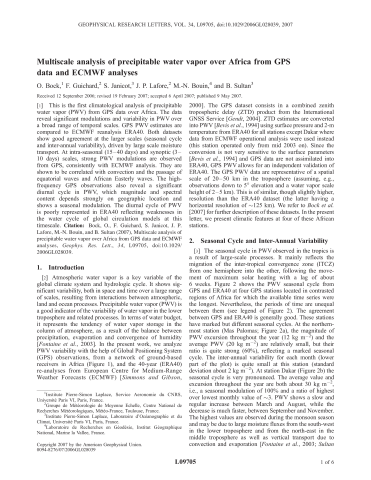
Multiscale analysis of precipitable water vapor over Africa from GPS data and ECMWF analyses
- Type de publi. : Article dans une revue
- Date de publi. : 01/01/2007
-
Auteurs :
Olivier BockFrancoise GuichardSerge JanicotJean-Philippe LaforeMarie-Noëlle BouinBenjamin Sultan
Fiche détaillée
Multiscale analysis of precipitable water vapor over Africa from GPS data and ECMWF analyses
- Type de publi. : Article dans une revue
- Date de publi. : 01/01/2007
-
Auteurs :
Olivier BockFrancoise GuichardSerge JanicotJean-Philippe LaforeMarie-Noëlle BouinBenjamin Sultan
-
Organismes :
Service d'aéronomie
Centre national de recherches météorologiques
Laboratoire d'Océanographie et du Climat : Expérimentations et Approches Numériques
Centre national de recherches météorologiques
Institut géographique national [IGN]
Laboratoire d'Océanographie et du Climat : Expérimentations et Approches Numériques
- Publié dans Geophysical Research Letters le 25/10/2020
Résumé : This is the first climatological analysis of precipitable water vapor (PWV) from GPS data over Africa. The data reveal significant modulations and variability in PWV over a broad range of temporal scales. GPS PWV estimates are compared to ECMWF reanalysis ERA40. Both datasets show good agreement at the larger scales (seasonal cycle and inter-annual variability), driven by large scale moisture transport. At intra-seasonal (15–40 days) and synoptic (3–10 days) scales, strong PWV modulations are observed from GPS, consistently with ECMWF analysis. They are shown to be correlated with convection and the passage of equatorial waves and African Easterly waves. The high-frequency GPS observations also reveal a significant diurnal cycle in PWV, which magnitude and spectral content depends strongly on geographic location and shows a seasonal modulation. The diurnal cycle of PWV is poorly represented in ERA40 reflecting weaknesses in the water cycle of global circulation models at this timescale.
Fichiers liés :
2006GL028039.pdf
Source
-
The ARGOS campaign: Evaluation of Video Analysis Tools
- Type de publi. : Communication dans un congrès
- Date de publi. : 01/01/2007
-
Auteurs :
Philippe JolyJenny Benois-PineauEwa KijakGeorges Quénot
Fiche détaillée
The ARGOS campaign: Evaluation of Video Analysis Tools
- Type de publi. : Communication dans un congrès
- Date de publi. : 01/01/2007
-
Auteurs :
Philippe JolyJenny Benois-PineauEwa KijakGeorges Quénot
-
Organismes :
Équipe Structuration, Analyse et MOdélisation de documents Vidéo et Audio
Laboratoire Bordelais de Recherche en Informatique
Multimedia content-based indexing
Modélisation et Recherche d’Information Multimédia [Grenoble]
Résumé : The benchmarking of various methods of video analysis and indexing has become a research problem per se. The Argos evaluation campaign supported by the French Techno-Vision program aimed at developing resources for a benchmarking of video content analysis and indexing methods. The paper describes the type of the evaluated tasks, the way the content set has been produced, metrics and tools developed for the evaluations and some of the results obtained at the end of the first phase. Perspectives based on current works will be given to conclude this paper.
Source
-

A New Method for Intra Ocular Pressure in vivo Measurement: First Clinical Trials.
- Type de publi. : Article dans une revue
- Date de publi. : 01/01/2007
-
Auteurs :
Patrick DuboisJaouad ZemmouriJean François RoulandPierre Paul ElenaRenaud LopesPhilippe Puech
Fiche détaillée
A New Method for Intra Ocular Pressure in vivo Measurement: First Clinical Trials.
- Type de publi. : Article dans une revue
- Date de publi. : 01/01/2007
-
Auteurs :
Patrick DuboisJaouad ZemmouriJean François RoulandPierre Paul ElenaRenaud LopesPhilippe Puech
-
Organismes :
Therapies Interventionnelles Assistees Par l'Image et la Simulation - U 703
Osyris SA
Laboratoire de Spectroscopie Hertzienne
Service d'ophtalmologie[Lille]
Iris-Pharma
Therapies Interventionnelles Assistees Par l'Image et la Simulation - U 703
Therapies Interventionnelles Assistees Par l'Image et la Simulation - U 703
- Publié dans Conf Proc IEEE Eng Med Biol Soc le 01/01/2003
Résumé : Glaucoma is an ocular disease clinically manifested by an abnormal rise of the Intra Ocular Pressure (IOP) that causes lesions of the optic nerve and can lead to blindness. Ophthalmologists currently use aplanation tonometers whose utilization induces multiple constraints. We propose an investigative method being at one and the same time atraumatic and ambulatory. This original device, taking profit of a physical relation between frequency of mechanical vibration of the ocular globe and IOP, involves vibrometry by laser interferometry and spectral analysis of a mechanical impulse using a temporal micro hammer. The laser energy delivered to the eye by the device was confirmed to be safe and in full agreement with the authorized security norms. After preliminary in vitro experiments performed using enucleated animal eyes, we made a clinical study on 25 volunteers to evaluate the innocuity and the reliability of this device and to quantify the reproducibility of measurements. All patients declared that discomfort is comparable with that felt during similar tests. Reliability is good and the intra individual reproducibility reveals a high value (R¿ 0.93). These works will be carried on to check the correlation between the variation of measured values (resonance frequency of the eye-ball) and the variation of reference (IOP) values.
Fichiers liés :
PDubois_EMBC_2007_revise.pdf
Source
-
Aerosols direct radiative forcing on Djougou (Northern Benin) during the AMMA dry season experiment
- Type de publi. : Chapître d'ouvrage
- Date de publi. : 01/01/2007
-
Auteurs :
Marc MalletVéronique PontCathy LiousseArmand MariscalValérie ThouretLaurent GomesJacques PelonS. OsborneJ. HaywoodPhilippe DubuissonJean-Claude RogerPhilippe Goloub
Fiche détaillée
Aerosols direct radiative forcing on Djougou (Northern Benin) during the AMMA dry season experiment
- Type de publi. : Chapître d'ouvrage
- Date de publi. : 01/01/2007
-
Auteurs :
Marc MalletVéronique PontCathy LiousseArmand MariscalValérie ThouretLaurent GomesJacques PelonS. OsborneJ. HaywoodPhilippe DubuissonJean-Claude RogerPhilippe Goloub
-
Organismes :
Laboratoire d'aérologie
Laboratoire d'aérologie
Laboratoire d'aérologie
Laboratoire d'aérologie
Laboratoire d'aérologie
Centre national de recherches météorologiques
Service d'aéronomie
United Kingdom Met Office [Exeter]
United Kingdom Met Office [Exeter]
Ecosystèmes Littoraux et Cotiers
Laboratoire de météorologie physique
Laboratoire d’Optique Atmosphérique - UMR 8518
Source
-
Safum: statistical analysis of SSCP fingerprints using PCA projections, dendrograms and diversity estimators
- Type de publi. : Article dans une revue
- Date de publi. : 01/01/2007
-
Auteurs :
Olivier ZembBart HaegemanJean-Philippe DelgenèsPhilippe LebaronJean-Jacques Godon
Fiche détaillée
Safum: statistical analysis of SSCP fingerprints using PCA projections, dendrograms and diversity estimators
- Type de publi. : Article dans une revue
- Date de publi. : 01/01/2007
-
Auteurs :
Olivier ZembBart HaegemanJean-Philippe DelgenèsPhilippe LebaronJean-Jacques Godon
-
Organismes :
Laboratoire de Biotechnologie de l'Environnement [Narbonne]
Université Pierre et Marie Curie - Paris 6
Laboratoire de Biotechnologie de l'Environnement [Narbonne]
Water Resource Modeling
Laboratoire de Biotechnologie de l'Environnement [Narbonne]
Université Pierre et Marie Curie - Paris 6
Laboratoire de Biotechnologie de l'Environnement [Narbonne]
- Publié dans Molecular Ecology Notes le 29/10/2020
Résumé : The program safum provides a smart interface to import, visualize and compare fingerprinting profiles, especially on capillary electrophoresis single strand conformation polymorphism data, in conjunction with basic statistical analysis tools. It includes principal component analysis, two- or three-dimensional representations, dendrograms based on Euclidean distance, and easily exportable files for subsequent applications. safum is useful for the analysis of spatial or temporal sequences of microbial community fingerprints obtained with an ABI prism sequencer.
Source
-
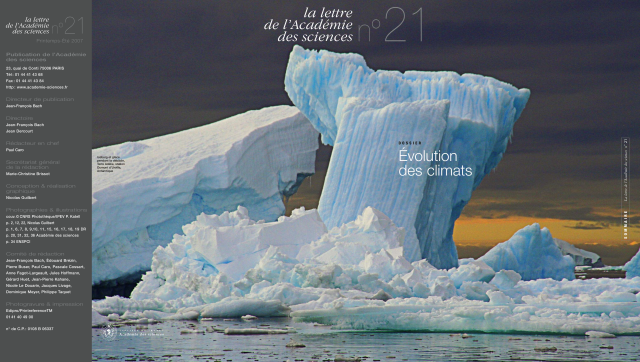
Évolution des climats
- Type de publi. :
- Date de publi. : 01/01/2007
-
Auteurs :
Jean DercourtMichel PetitHervé Le TreutEdouard BardSusan SolomonPaul CaroVincent CourtillotGeorges GonthierBenjamin WernerP. BuserPhilippe TaquetPhilippe NozièresPierre Corvol
Fiche détaillée
Évolution des climats
- Type de publi. :
- Date de publi. : 01/01/2007
-
Auteurs :
Jean DercourtMichel PetitHervé Le TreutEdouard BardSusan SolomonPaul CaroVincent CourtillotGeorges GonthierBenjamin WernerP. BuserPhilippe TaquetPhilippe NozièresPierre Corvol
-
Organismes :
Académie des sciences [Paris, France]
Académie des sciences [Paris, France]
Académie des sciences [Paris, France]
Académie des sciences [Paris, France]
Académie des sciences [Paris, France]
Académie des sciences [Paris, France]
Laboratoire d'informatique de l'École polytechnique [Palaiseau]
Académie des sciences [Paris, France]
Académie des sciences [Paris, France]
Académie des sciences [Paris, France]
Académie des sciences [Paris, France]
- Publié dans La lettre de l'Académie des Sciences le 09/03/2009
Fichiers liés :
2007_Lettre_AS_21.pdf
Source
-
Nanostructuring of hybrid silicas : new approach to bridges silsesquioxanes with purine-pyrimidine base pairs as bridging units
- Type de publi. : Article dans une revue
- Date de publi. : 01/01/2007
-
Auteurs :
Michel Wong Chi ManGuilhem ArrachartCarole CarcelJoël J E MoreauChristian BonhommeBruno AlonsoFlorence BabonneauGaelle CreffJean-Louis BantigniesPhilippe Dieudonné-George
Fiche détaillée
Nanostructuring of hybrid silicas : new approach to bridges silsesquioxanes with purine-pyrimidine base pairs as bridging units
- Type de publi. : Article dans une revue
- Date de publi. : 01/01/2007
-
Auteurs :
Michel Wong Chi ManGuilhem ArrachartCarole CarcelJoël J E MoreauChristian BonhommeBruno AlonsoFlorence BabonneauGaelle CreffJean-Louis BantigniesPhilippe Dieudonné-George
-
Organismes :
Institut Charles Gerhardt Montpellier - Institut de Chimie Moléculaire et des Matériaux de Montpellier
Institut Charles Gerhardt Montpellier - Institut de Chimie Moléculaire et des Matériaux de Montpellier
Institut Charles Gerhardt Montpellier - Institut de Chimie Moléculaire et des Matériaux de Montpellier
Institut Charles Gerhardt Montpellier - Institut de Chimie Moléculaire et des Matériaux de Montpellier
Laboratoire de Chimie de la Matière Condensée de Paris (site Paris VI)
Institut Charles Gerhardt Montpellier - Institut de Chimie Moléculaire et des Matériaux de Montpellier
Laboratoire des colloïdes, verres et nanomatériaux
Laboratoire des colloïdes, verres et nanomatériaux
Laboratoire des colloïdes, verres et nanomatériaux
- Publié dans Materials Research Society Symposia Proceedings le 01/01/2003
Source