Professeur des universités en sciences de gestion
-
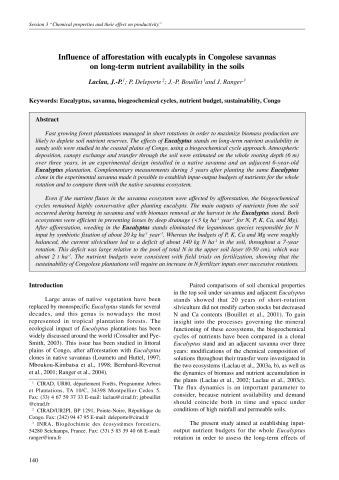
Influence of afforestation with eucalypts in Congolese Savannas on longterm nutrient availability in the soils
- Type de publi. :
- Date de publi. : 27/11/2005
-
Auteurs :
Jean-Paul LaclauPhilippe DeleporteJean-Pierre BouilletJacques Ranger
Fiche détaillée
Influence of afforestation with eucalypts in Congolese Savannas on longterm nutrient availability in the soils
- Type de publi. :
- Date de publi. : 27/11/2005
-
Auteurs :
Jean-Paul LaclauPhilippe DeleporteJean-Pierre BouilletJacques Ranger
-
Organismes :
Centre de Coopération Internationale en Recherche Agronomique pour le Développement
Centre de Coopération Internationale en Recherche Agronomique pour le Développement
Centre de Coopération Internationale en Recherche Agronomique pour le Développement
Unité de recherche Biogéochimie des Ecosystèmes Forestiers
Résumé : Fast growing forest plantations managed in short rotations in order to maximize biomass production are likely to deplete soil nutrient reserves. The effects of Eucalyptus stands on long-term nutrient availability in sandy soils were studied in the coastal plains of Congo, using a biogeochemical cycle approach. Atmospheric deposition, canopy exchange and transfer through the soil were estimated on the whole rooting depth (6 m) over three years, in an experimental design installed in a native savanna and an adjacent 6-year-old Eucalyptus plantation. Complementary measurements during 3 years after planting the same Eucalyptus clone in the experimental savanna made it possible to establish input-output budgets of nutrients for the whole rotation and to compare them with the native savanna ecosystem. Even if the nutrient fluxes in the savanna ecosystem were affected by afforestation, the biogeochemical cycles remained highly conservative after planting eucalypts. The main outputs of nutrients from the soil occurred during burning in savanna and with biomass removal at the harvest in the Eucalyptus stand. Both ecosystems were efficient in preventing losses by deep drainage (<5 kg ha-1 year-1 for N, P, K, Ca, and Mg). After afforestation, weeding in the Eucalyptus stands eliminated the leguminous species responsible for N input by symbiotic fixation of about 20 kg ha-1 year-1. Whereas the budgets of P, K, Ca and Mg were roughly balanced, the current silviculture led to a deficit of about 140 kg N ha-1 in the soil, throughout a 7-year rotation. This deficit was large relative to the pool of total N in the upper soil layer (0-50 cm), which was about 2 t ha-1. The nutrient budgets were consistent with field trials on fertilization, showing that the sustainability of Congolese plantations will require an increase in N fertilizer inputs over successive rotations.
Fichiers liés :
Laclau_2005_ag125el_1.pdf
Source
-

A critical overview of French social scientific research on rock climbing and mountaineering
- Type de publi. : Communication dans un congrès
- Date de publi. : 24/11/2005
-
Auteurs :
Philippe BourdeauJean CorneloupPascal Mao
Fiche détaillée
A critical overview of French social scientific research on rock climbing and mountaineering
- Type de publi. : Communication dans un congrès
- Date de publi. : 24/11/2005
-
Auteurs :
Philippe BourdeauJean CorneloupPascal Mao
-
Organismes :
Pacte, Laboratoire de sciences sociales
Pacte, Laboratoire de sciences sociales
Pacte, Laboratoire de sciences sociales
Source
-
Rapport final de la phase 1 du projet HyFrance : contribution à l'élaboration de la "roadmap" technico- et socio-économique française de l'hydrogène énergie.
- Type de publi. : Pré-publication, Document de travail
- Date de publi. : 15/11/2005
-
Auteurs :
Jean-Marc AgatorBertrand BelloPhilippe MenanteauSilvana Mima
Fiche détaillée
Rapport final de la phase 1 du projet HyFrance : contribution à l'élaboration de la "roadmap" technico- et socio-économique française de l'hydrogène énergie.
- Type de publi. : Pré-publication, Document de travail
- Date de publi. : 15/11/2005
-
Auteurs :
Jean-Marc AgatorBertrand BelloPhilippe MenanteauSilvana Mima
-
Organismes :
Commissariat à l'énergie atomique et aux énergies alternatives
ALPHEA
Laboratoire d'Economie de la Production et de l'Intégration Internationale
équipe EDDEN
Résumé : Le projet HyFrance est le projet d'application française des modèles technico et socio-économiques1 utilisés dans le projet européen HyWays qui a démarré le 30 mars 2004. Le projet HyWays vise à développer, sur une période de 36 mois, une "roadmap" européenne de l'hydrogène énergie, c'est-à-dire un ensemble de recommandations visant à favoriser l'introduction des technologies et des infrastructures de l'hydrogène en Europe d'ici à 2020-2050, sur la base de critères techniques, économiques, environnementaux et sociaux pertinents. Il est porté par un consortium de 33 partenaires de l'industrie, d'instituts de recherche et d'organismes publics, coordonné par le consultant allemand LBST. Le présent rapport détaille les travaux réalisés pendant cette 1ère phase de HyFrance (et donc de HyWays) et les résultats obtenus. Ces travaux ont consisté à élaborer et fournir, à la demande du projet HyWays et sur une base consensuelle, un ensemble de données représentatives de la situation française, de même qu'à expertiser et exploiter les résultats obtenus à l'aide des modèles de HyWays pour la France.
Fichiers liés :
SM-PM-Rapport_HyFrance_Phase_1_V1.pdf
Source
-
Towards quantum correlated polariton modes in semiconductor microcavities
- Type de publi. : Article dans une revue
- Date de publi. : 15/11/2005
-
Auteurs :
Marco RomanelliCharles LeyderJean-Philippe KarrAugustin BaasElisabeth GiacobinoAlberto Bramati
Fiche détaillée
Towards quantum correlated polariton modes in semiconductor microcavities
- Type de publi. : Article dans une revue
- Date de publi. : 15/11/2005
-
Auteurs :
Marco RomanelliCharles LeyderJean-Philippe KarrAugustin BaasElisabeth GiacobinoAlberto Bramati
-
Organismes :
Laboratoire Kastler Brossel
Laboratoire Kastler Brossel
Laboratoire Kastler Brossel
Laboratoire Kastler Brossel
Laboratoire Kastler Brossel
Laboratoire Kastler Brossel
- Publié dans Journal of Optics B Quantum and Semiclassical Optics le 25/10/2020
Résumé : In planar semiconductor microcavities in the strong coupling regime, nonlinear effects such as Kerr-like effect, parametric fluorescence and parametric oscillation are observed, as a result of parametric scattering of polaritons. After discussing the basic physical properties of the system and their theoretical description, we report on our experimental demonstration of polariton squeezing in the degenerate scattering configuration (Kerr configuration), and on the generation of correlated polaritons in the nondegenerate configuration. The latter results open the way to the generation of quantum correlated polariton modes.
Source
-
Changements d'échelle et évaluation du risque écotoxicologique de mélanges entre substances actives herbicides et adjuvant (CEREMEL)
- Type de publi. : Communication dans un congrès
- Date de publi. : 14/11/2005
-
Auteurs :
Laurent LagadicDidier AzamMichaël CoeurdassierC. Cossu-LeguilleMarie-Agnès CoutellecJean Pierre J. P. CravediR. DenoyellesLaure GiamberiniE. GuerbetMicheline HeydorffAnne HillenweckJean-Philippe JaegLuz Lefeuvre-OrfilaJ.P. PorcherAlphonse QuémeneurWilfried SanchezPaule VasseurAnnette de Vaufleury
Fiche détaillée
Changements d'échelle et évaluation du risque écotoxicologique de mélanges entre substances actives herbicides et adjuvant (CEREMEL)
- Type de publi. : Communication dans un congrès
- Date de publi. : 14/11/2005
-
Auteurs :
Laurent LagadicDidier AzamMichaël CoeurdassierC. Cossu-LeguilleMarie-Agnès CoutellecJean Pierre J. P. CravediR. DenoyellesLaure GiamberiniE. GuerbetMicheline HeydorffAnne HillenweckJean-Philippe JaegLuz Lefeuvre-OrfilaJ.P. PorcherAlphonse QuémeneurWilfried SanchezPaule VasseurAnnette de Vaufleury
-
Organismes :
Écologie et santé des écosystèmes
Unité d'Ecologie et Ecotoxicologie Aquatiques
Laboratoire de Biologie et Ecophysiologie
Laboratoire Ecotoxicité, Biodiversité, Santé Environnementale
Écologie et santé des écosystèmes
Xénobiotiques
Laboratoire Ecotoxicité, Biodiversité, Santé Environnementale
Laboratoire Ecotoxicité, Biodiversité, Santé Environnementale
Laboratoire Ecotoxicité, Biodiversité, Santé Environnementale
Écologie et santé des écosystèmes
Xénobiotiques
Xénobiotiques
Écologie et santé des écosystèmes
Institut National de l'Environnement Industriel et des Risques
Unité d'Ecologie et Ecotoxicologie Aquatiques
Institut National de l'Environnement Industriel et des Risques
Laboratoire Ecotoxicité, Biodiversité, Santé Environnementale
Laboratoire de Biologie et Ecophysiologie
Résumé : Changements d'échelle et évaluation du risque écotoxicologique de mélanges entre substances actives herbicides et adjuvant (CEREMEL). Colloque de restitution du Programme "Evaluation et réduction des risques liés à l'utilisation des pesticides" du MEDD
Source
-
Sélection de modes d’ordres superieurs par réseaux de Bragg en angle inscrits dans une fibre microstructurée ; applications à la réfractométrie et à l'imagerie modale
- Type de publi. : Communication dans un congrès
- Date de publi. : 08/11/2005
-
Auteurs :
Guillaume LaffontM.C. Phan HuyVéronique Dewinter-MartyPierre FerdinandPhilippe RoyJean-Marc BlondyLaurent LabontéDominique PagnouxWilfried BlancBernard Dussardier
Fiche détaillée
Sélection de modes d’ordres superieurs par réseaux de Bragg en angle inscrits dans une fibre microstructurée ; applications à la réfractométrie et à l'imagerie modale
- Type de publi. : Communication dans un congrès
- Date de publi. : 08/11/2005
-
Auteurs :
Guillaume LaffontM.C. Phan HuyVéronique Dewinter-MartyPierre FerdinandPhilippe RoyJean-Marc BlondyLaurent LabontéDominique PagnouxWilfried BlancBernard Dussardier
-
Organismes :
Laboratoire Capteurs Fibres Optiques (CEA, LIST)
Laboratoire Capteurs Fibres Optiques (CEA, LIST)
Laboratoire Capteurs Fibres Optiques (CEA, LIST)
Laboratoire Capteurs Fibres Optiques (CEA, LIST)
PHOTONIQUE
PHOTONIQUE
PHOTONIQUE
PHOTONIQUE
Laboratoire de physique de la matière condensée
Laboratoire de physique de la matière condensée
Source
-
Towards understanding the presence/absence of Human African Trypanosomiasis in a focus of Côte d'Ivoire : a spatial analysis of the pathogenic system.
- Type de publi. : Article dans une revue
- Date de publi. : 03/11/2005
-
Auteurs :
Fabrice CourtinJamonneau VincentEmmanuel OkéBamoro CoulibalyJohan OszwaldSophie DupontGérard CunyJean-Pierre DoumengePhilippe Solano
Fiche détaillée
Towards understanding the presence/absence of Human African Trypanosomiasis in a focus of Côte d'Ivoire : a spatial analysis of the pathogenic system.
- Type de publi. : Article dans une revue
- Date de publi. : 03/11/2005
-
Auteurs :
Fabrice CourtinJamonneau VincentEmmanuel OkéBamoro CoulibalyJohan OszwaldSophie DupontGérard CunyJean-Pierre DoumengePhilippe Solano
-
Organismes :
Littoral, Environnement, Télédétection, Géomatique
Université Paul-Valéry - Montpellier 3
- Publié dans International Journal of Health Geographics le 22/10/2020
Résumé : Background This study aimed at identifying factors influencing the development of Human African Trypanosomosis (HAT, or sleeping sickness) in the focus of Bonon, located in the mesophile forest of Côte d'Ivoire. A previous study mapping the main daytime activity sites of 96 patients revealed an important disparity between the area south of the town- where all the patients lived- and the area north of the town, apparently free of disease. In order to explain this disparity, we carried out a spatial analysis of the key components of the pathogenic system, i.e. the human host, the tsetse vector and the trypanosomes in their environment using a geographic information system (GIS). Results This approach at the scale of a HAT focus enabled us to identify spatial patterns which linked to the transmission and the dissemination of this disease. The history of human settlement (with the rural northern area exploited much earlier than the southern one) appears to be a major factor which determines the land use pattern, which itself may account for differences found in vector densities (tsetse were found six times more abundant in the southern rural area than in the northern). Vector density, according to the human and environmental context in which it is found (here an intense mobility between the town of Bonon and the rural areas), may explain the observed spatial differences in HAT prevalence. Conclusion This work demonstrates the role of GIS analyses of key components of the pathogenic system in providing a better understanding of transmission and dissemination of HAT. Moreover, following the identification of the most active transmission areas, and of an area unfavourable to HAT transmission, this study more precisely delineates the boundaries of the Bonon focus. As a follow-up, targeted tsetse control activities starting north of Bonon (with few chances of reinvasion due to very low densities) going south, and additional medical surveys in the south will be proposed to the Ivoirian HAT control program to enhance the control of the disease in this focus. This work also shows the evolution of HAT regarding time and environment, and the methodology used may be able to predict possible sleeping sickness development/extinction in areas with similar history and space organization.
Source
-
A Hierarchical Modeling Approach in Software Defined Radio System Design
- Type de publi. : Communication dans un congrès
- Date de publi. : 02/11/2005
-
Auteurs :
Jean-Philippe DelahayeJacques PalicotPierre Leray
Fiche détaillée
A Hierarchical Modeling Approach in Software Defined Radio System Design
- Type de publi. : Communication dans un congrès
- Date de publi. : 02/11/2005
-
Auteurs :
Jean-Philippe DelahayeJacques PalicotPierre Leray
-
Organismes :
Réseau National des Systèmes Complexes
Institut d'Électronique et des Technologies du numéRique
Institut d'Électronique et des Technologies du numéRique
Source
-
CD36 involvement in orosensory detection of dietary lipids, spontaneous fat preference, and digestive secretions
- Type de publi. : Article dans une revue
- Date de publi. : 01/11/2005
-
Auteurs :
Fabienne LaugerettePatricia Passilly-DegraceBruno PatrisIsabelle NiotMaria FebbraioJean-Pierre MontmayeurPhilippe Besnard
Fiche détaillée
CD36 involvement in orosensory detection of dietary lipids, spontaneous fat preference, and digestive secretions
- Type de publi. : Article dans une revue
- Date de publi. : 01/11/2005
-
Auteurs :
Fabienne LaugerettePatricia Passilly-DegraceBruno PatrisIsabelle NiotMaria FebbraioJean-Pierre MontmayeurPhilippe Besnard
-
Organismes :
Laboratoire de Physiologie de la Nutrition
Laboratoire de Physiologie de la Nutrition
Laboratoire de Physiologie de la Nutrition
Laboratoire de Physiologie de la Nutrition
- Publié dans Journal of Clinical Investigation le 24/10/2020
Résumé : Rats and mice exhibit a spontaneous attraction for lipids. Such a behavior raises the possibility that an orosensory system is responsible for the detection of dietary lipids. The fatty acid transporter CD36 appears to be a plausible candidate for this function since it has a high affinity for long-chain fatty acids (LCFAs) and is found in lingual papillae in the rat. To explore this hypothesis further, experiments were conducted in rats and in wild-type and CD36-null mice. In mice, RT-PCR experiments with primers specific for candidate lipid-binding proteins revealed that only CD36 expression was restricted to lingual papillae although absent from the palatal papillae. Immunostaining studies showed a distribution of CD36 along the apical side of circumvallate taste bud cells. CD36 gene inactivation fully abolished the preference for LCFA-enriched solutions and solid diet observed in wild-type mice. Furthermore, in rats and wild-type mice with an esophageal ligation, deposition of unsaturated LCFAs onto the tongue led to a rapid and sustained rise in flux and protein content of pancreatobiliary secretions. These findings demonstrate that CD36 is involved in oral LCFA detection and raise the possibility that an alteration in the lingual fat perception may be linked to feeding dysregulation.
Source
-
Serological and Molecular Evidence That Human Herpesvirus 8 Is Endemic among Amerindians in French Guiana
- Type de publi. : Article dans une revue
- Date de publi. : 01/11/2005
-
Auteurs :
Mirdad KazanjiPhilippe DussartRenan DuprezPatricia TortevoyeJean-François PouliquenJulie VandekerkhovePierre CouppiéJacques MorvanAntoine TalarminPhilippe Mauclère
Fiche détaillée
Serological and Molecular Evidence That Human Herpesvirus 8 Is Endemic among Amerindians in French Guiana
- Type de publi. : Article dans une revue
- Date de publi. : 01/11/2005
-
Auteurs :
Mirdad KazanjiPhilippe DussartRenan DuprezPatricia TortevoyeJean-François PouliquenJulie VandekerkhovePierre CouppiéJacques MorvanAntoine TalarminPhilippe Mauclère
-
Organismes :
Laboratoire de Rétrovirologie [Cayenne, Guyane française]
Epidémiologie et Physiopathologie des Virus Oncogènes
Laboratoire de virologie [Cayenne, Guyane française]
Epidémiologie et Physiopathologie des Virus Oncogènes
Epidémiologie et Physiopathologie des Virus Oncogènes
Laboratoire de Rétrovirologie [Cayenne, Guyane française]
Laboratoire de virologie [Cayenne, Guyane française]
Centre Hospitalier Andrée Rosemon [Cayenne, Guyane Française]
Laboratoire de virologie [Cayenne, Guyane française]
Laboratoire de virologie [Cayenne, Guyane française]
Epidémiologie et Physiopathologie des Virus Oncogènes
- Publié dans Journal of Infectious Diseases le 27/10/2020
Résumé : We evaluated the presence of human herpesvirus 8 (HHV-8) infection among groups of Amerindians in French Guiana. The overall prevalence of antibodies against lytic HHV-8 antigens was 23.0% (180/781), increasing from 18.4% in children <6 years old to approximately 30% in older persons (>45 years). Seroprevalence was higher in Amerindians living in remote localities than it was in those living in the coastal region. Analysis of a 725-base pair fragment of the K1 gene amplified from DNA from a Wayampi Amerindian showed that the virus belonged to molecular subtype E, which has hitherto been found in only a few Amerindians in Brazil and Ecuador.
Source