Professeur des universités en sciences de gestion
-

Présentation
- Type de publi. : Communication dans un congrès
- Date de publi. : 01/09/2005
-
Auteurs :
Alain FaureJean-Philippe LereschePierre MullerStéphane NahrathYannis Papadoupolous
Fiche détaillée
Présentation
- Type de publi. : Communication dans un congrès
- Date de publi. : 01/09/2005
-
Auteurs :
Alain FaureJean-Philippe LereschePierre MullerStéphane NahrathYannis Papadoupolous
-
Organismes :
Pacte, Laboratoire de sciences sociales
Pacte, Laboratoire de sciences sociales
Source
-
Villes, Régions, Etats, Europe : l'action publique à l'épreuve des changements d'échelle. Recueil des interventions. Table Ronde 6 Internationale. 8e Congrès de l'AFSP (Association Française de Science Politique), Institut d'Etudes Politiques, Lyon, 14-16 septembre 2005
- Type de publi. : Ouvrage (y compris édition critique et traduction)
- Date de publi. : 01/09/2005
-
Auteurs :
Alain FaureJean-Philippe LereschePierre MullerStéphane NahrathYannis Papadoupolous
Fiche détaillée
Villes, Régions, Etats, Europe : l'action publique à l'épreuve des changements d'échelle. Recueil des interventions. Table Ronde 6 Internationale. 8e Congrès de l'AFSP (Association Française de Science Politique), Institut d'Etudes Politiques, Lyon, 14-16 septembre 2005
- Type de publi. : Ouvrage (y compris édition critique et traduction)
- Date de publi. : 01/09/2005
-
Auteurs :
Alain FaureJean-Philippe LereschePierre MullerStéphane NahrathYannis Papadoupolous
-
Organismes :
Pacte, Laboratoire de sciences sociales
Pacte, Laboratoire de sciences sociales
Source
-

Non Gaussian and long memory statistical characterisations for Internet traffic with anomalies
- Type de publi. : Rapport
- Date de publi. : 01/09/2005
-
Auteurs :
Antoine ScherrerNicolas LarrieuPhilippe OwezarskiPierre BorgnatPatrice Abry
Fiche détaillée
Non Gaussian and long memory statistical characterisations for Internet traffic with anomalies
- Type de publi. : Rapport
- Date de publi. : 01/09/2005
-
Auteurs :
Antoine ScherrerNicolas LarrieuPhilippe OwezarskiPierre BorgnatPatrice Abry
-
Organismes :
Laboratoire de l'Informatique du Parallélisme
Laboratoire d'analyse et d'architecture des systèmes
Laboratoire d'analyse et d'architecture des systèmes
Laboratoire de l'Informatique du Parallélisme
Laboratoire de l'Informatique du Parallélisme
Résumé : The Internet aims at providing a wide range of services for a large variety of applications. Hence, it is highly sensitive to traffic anomalies (e.g., failures, flash crowds,...) as well as to DoS attacks, which are likely to significantly reduce the Quality of Service level. Current intrusion detection systems, specially those based on anomaly detection, are not providing efficient nor satisfactory solutions for DoS attack tracking. This is mainly due to difficulties in distinguishing between strong but legitimate traffic variations and DoS attack induced changes. The goal of this work is to compare relevant statistical characteristics of regular traffic to those of traffic presenting anomalies. To do so, we introduce a non Gaussian long memory model and develop estimators for the corresponding parameters. First, we show that this model relevantly describes Internet traffic for a wide range of aggregation levels, using both a large set of data taken from public reference repositories (Bellcore, LBL, Auckland, UNC, CAIDA) and data collected by ourselves. Second, we show that the proposed model also describes meaningfully traffic with anomalies such as flash crowd and DoS attacks which we generated and collected. We show that the behaviors of the parameters of the model enables us to discriminate between regular and anomalous traffic, and between flash crowds and DoS attacks. We also derive analytically procedures to numerically synthesize realizations of stochastic processes with prescribed non Gaussian marginals and long range dependent covariances. This enables us to validate the relevance and accuracy of our characterization procedures. Finally, we describe various applications based on the proposed model.
Fichiers liés :
RR2005-35.pdf
Source
-
Towards new indicators for the prediction of solid waste anaerobic digestion properties
- Type de publi. : Communication dans un congrès
- Date de publi. : 31/08/2005
-
Auteurs :
Pierre BuffièreDenis LoiselNicolas BernetJean-Philippe Delgenès
Fiche détaillée
Towards new indicators for the prediction of solid waste anaerobic digestion properties
- Type de publi. : Communication dans un congrès
- Date de publi. : 31/08/2005
-
Auteurs :
Pierre BuffièreDenis LoiselNicolas BernetJean-Philippe Delgenès
-
Organismes :
Laboratoire de Biotechnologie de l'Environnement [Narbonne]
Laboratoire de Biotechnologie de l'Environnement [Narbonne]
Laboratoire de Biotechnologie de l'Environnement [Narbonne]
Laboratoire de Biotechnologie de l'Environnement [Narbonne]
Résumé : The biochemical composition can be seen as a good indicator of both the biodegradability and the methane potential of a given waste. The work presented here is an attempt to elaborate a typology of wastes and to compare it to the anaerobic degradation characteristics. The first data indicate that there is a link between the ligno-cellulosic content of the waste and the biodegradability. When dealing with application to anaerobic digestion processes, having a tool to predict the ability of the waste to be degraded could be of the greatest interest for preventing failures, estimating biogas production, methane content, or for the management of co-digestion processes.
Source
-
An integrated system to remote monitor and control anaerobic wastewater treatment plant through the internet
- Type de publi. : Communication dans un congrès
- Date de publi. : 29/08/2005
-
Auteurs :
Olivier BernardBenoit ChachuatArnaud HéliasBruno Le DantecBruno SialveJean-Philippe SteyerLaurent LardonPascal NeveuSimon Auguste LambertJulian GallopMaurice DixonPaulo RatiniAndreas QuintabaStefano FrattesiJuan LemaEnrique RocaGonzalo RuizJorge RodriguezAmayo FrancoPeter VanrolleghemU. ZaherDirk de PauwKristof de NeveKristof LievensDenis DochainOlivier SchoefsHadrien FibriantoRoberto FarinaVictor Alcaraz-GonzalezVictor Gonzalez-AlvarezJose Antonio MartinezF. EsandiO. DuclaudJean-François LavignePierre Lemaire
Fiche détaillée
An integrated system to remote monitor and control anaerobic wastewater treatment plant through the internet
- Type de publi. : Communication dans un congrès
- Date de publi. : 29/08/2005
-
Auteurs :
Olivier BernardBenoit ChachuatArnaud HéliasBruno Le DantecBruno SialveJean-Philippe SteyerLaurent LardonPascal NeveuSimon Auguste LambertJulian GallopMaurice DixonPaulo RatiniAndreas QuintabaStefano FrattesiJuan LemaEnrique RocaGonzalo RuizJorge RodriguezAmayo FrancoPeter VanrolleghemU. ZaherDirk de PauwKristof de NeveKristof LievensDenis DochainOlivier SchoefsHadrien FibriantoRoberto FarinaVictor Alcaraz-GonzalezVictor Gonzalez-AlvarezJose Antonio MartinezF. EsandiO. DuclaudJean-François LavignePierre Lemaire
-
Organismes :
Modeling and control of renewable resources
Modeling and control of renewable resources
Modeling and control of renewable resources
GEIE-ERCIM
GEIE-ERCIM
Laboratoire de Biotechnologie de l'Environnement [Narbonne]
Laboratoire de Biotechnologie de l'Environnement [Narbonne]
Analyse des Systèmes et Biométrie
STFC Rutherford Appleton Laboratory
STFC Rutherford Appleton Laboratory
STFC Rutherford Appleton Laboratory
Societa' Progettazione Elettronica Software
Societa' Progettazione Elettronica Software
Societa' Progettazione Elettronica Software
Universidade de Santiago
Universidade de Santiago
Universidade de Santiago
Universidade de Santiago
Universidade de Santiago
BIOMATH
BIOMATH
BIOMATH
Centre for systems engineering and applied mechanics [Louvain]
Centre for systems engineering and applied mechanics [Louvain]
Centre for systems engineering and applied mechanics [Louvain]
Italian National Agency for New Tecnologies Energy and Sustainable Economic Development
Universidad de Guadalajara
Universidad de Guadalajara
Agrupacion Alcoholera de Bodega Cooperativa
Agrupacion Alcoholera de Bodega Cooperativa
Tequila Sauza S.A.
Allied Domecq
Pierre Lemaire
Résumé : The TELEMAC project brings new methodologies from the Information and Science Technologies field to the world of water treatment. TELEMAC offers an advanced remote management system which adapts to most of the anaerobic wastewater treatment plants that do not benefit from a local expert in wastewater treatment. The TELEMAC system takes advantage of new sensors to better monitor the process dynamics and to run automatic controllers that stabilise the treatment plant, meet the depollution requirements and provide a biogas quality suitable for cogeneration. If the automatic system detects a failure which cannot be solved automatically or locally by a technician, then an expert from the TELEMAC Control Centre is contacted via the internet and manages the problem.
Source
-
Electrophilic Nitration of Electron-Rich Acetophenones
- Type de publi. : Article dans une revue
- Date de publi. : 12/08/2005
-
Auteurs :
Natacha MaleckiPascal CaratoRaymond HoussinPhilippe CotelleJean-Pierre Hénichart
Fiche détaillée
Electrophilic Nitration of Electron-Rich Acetophenones
- Type de publi. : Article dans une revue
- Date de publi. : 12/08/2005
-
Auteurs :
Natacha MaleckiPascal CaratoRaymond HoussinPhilippe CotelleJean-Pierre Hénichart
-
Organismes :
Université de Lille
Université de Lille
Université de Lille
Université catholique de Lille
Université de Lille
- Publié dans Chemical Monthly = Monatshefte für Chemie le 31/10/2020
Source
-
c-Krox down-regulates the expression of UDP–glucose dehydrogenase in chondrocytes
- Type de publi. : Article dans une revue
- Date de publi. : 01/08/2005
-
Auteurs :
Gallic BeauchefMagdalini KypriotouChristos E ChadjichristosRussell WidomBenoît PoréeEmmanuelle RenardSafa MoslemiYanusz WegrowskiFrançois-Xavier MaquartJean-Pierre PujolPhilippe Galéra
Fiche détaillée
c-Krox down-regulates the expression of UDP–glucose dehydrogenase in chondrocytes
- Type de publi. : Article dans une revue
- Date de publi. : 01/08/2005
-
Auteurs :
Gallic BeauchefMagdalini KypriotouChristos E ChadjichristosRussell WidomBenoît PoréeEmmanuelle RenardSafa MoslemiYanusz WegrowskiFrançois-Xavier MaquartJean-Pierre PujolPhilippe Galéra
-
Organismes :
Université de Caen Normandie
Microenvironnement cellulaire et pathologie
Université de Caen Normandie
Microenvironnement cellulaire et pathologie
CoRaKiD - Maladies rénales fréquentes et rares : des mécanismes moléculaires à la médecine personnalisée
Université de Caen Normandie
Microenvironnement cellulaire et pathologie
Boston University [Boston]
Microenvironnement cellulaire et pathologie
Université de Caen Normandie
Université de Caen Normandie
Microenvironnement cellulaire et pathologie
Microenvironnement cellulaire et pathologie
Université de Caen Normandie
Matrice Extracellulaire et Dynamique Cellulaire - UMR CNRS 7369
Université de Caen Normandie
Microenvironnement cellulaire et pathologie
Université de Caen Normandie
Microenvironnement cellulaire et pathologie
Université de Caen Normandie
Microenvironnement cellulaire et pathologie
- Publié dans Biochemical and Biophysical Research Communications le 28/10/2020
Résumé : Chondrocyte glycosaminoglycan (GAG) synthesis is regulated by the availability of UDP–glucuronate, the substrate of glucuronosyl transferases which form the GAG chains in proteoglycans and hyaluronan. UDP–glucose dehydrogenase (UDPGD) is therefore a key enzyme in the synthesis of UDP–glucuronate from glucose. However, the mechanisms regulating its expression in chondrocytes are not fully understood. We investigated the effect of c-Krox, a zinc-finger transcription factor previously shown to modulate several matrix genes, on the synthesis of GAG and transcriptional activity of several UDPGD gene promoter constructs, using transient transfection and decoy experiments in rabbit articular chondrocytes (RACs). We show that overexpression of c-Krox inhibits radiosulfate incorporation into neosynthesized GAG and that the effect was mediated by a cis-sequence located between +18 and +39 bp of the UDPGD gene. Since that sequence can also bind Sp1/Sp3 factors, it is likely that c-Krox acts in concert with these proteins to modulate the UDPGD gene expression in articular chondrocytes.
Source
-
Décantation assistée par ultrasons des eaux résiduaires
- Type de publi. : Article dans une revue
- Date de publi. : 01/08/2005
-
Auteurs :
Nicolas AugisPhilippe HusPierre-Xavier ThivelJean-Yves Viau
Fiche détaillée
Décantation assistée par ultrasons des eaux résiduaires
- Type de publi. : Article dans une revue
- Date de publi. : 01/08/2005
-
Auteurs :
Nicolas AugisPhilippe HusPierre-Xavier ThivelJean-Yves Viau
-
Organismes :
Saint-Dizier Environnement
Laboratoire de ThermoPhysique de la Matière Condensée
Saint-Dizier Environnement
- Publié dans Canadian Journal of Chemical Engineering le 27/10/2020
Résumé : Cette étude consiste à mettre en évidence l'impact des ultrasons sur le traitement des eaux par décantation. Elle a permis d'une part, d'identifier les effets déjà mesurés des ultrasons sur les propriétés de décantabilité de différents effluents et d'autre part, d'observer ces effets lors d'une étude statique puis dynamique. Des conditions de sonification favorables à l'optimisation d'un tel procédé ont été déterminées. Les résultats mettent en évidence le rôle fondamental joué par les systèmes d'ondes stationnaires dans l'amélioration de la décantabilité des effluents (floculés ou non, de synthèse ou réels). Dans le cas d'effluents floculés, un impact réel sur la décantation est visible.
Source
-
Genotype Distribution and Molecular Epidemiology of Hepatitis C Virus in Blood Donors from Southeast France
- Type de publi. : Article dans une revue
- Date de publi. : 01/08/2005
-
Auteurs :
Jean-François CantaloubePierre GallianHoussam AttouiPhilippe BiaginiPhilippe de MiccoXavier de Lamballerie
Fiche détaillée
Genotype Distribution and Molecular Epidemiology of Hepatitis C Virus in Blood Donors from Southeast France
- Type de publi. : Article dans une revue
- Date de publi. : 01/08/2005
-
Auteurs :
Jean-François CantaloubePierre GallianHoussam AttouiPhilippe BiaginiPhilippe de MiccoXavier de Lamballerie
-
Organismes :
Virologie UMR1161
- Publié dans Journal of Clinical Microbiology le 01/11/2020
Source
-
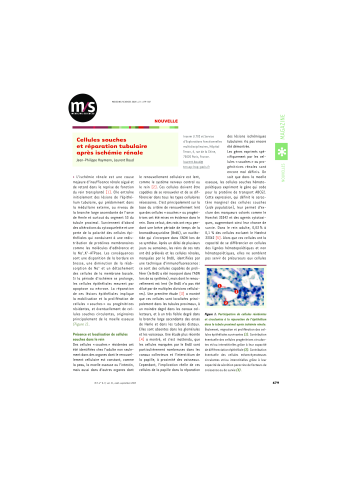
Cellules souches et réparation tubulaire après ischémie rénale
- Type de publi. : Article dans une revue
- Date de publi. : 01/08/2005
-
Auteurs :
Jean-Philippe HaymannLaurent Baud
Fiche détaillée
Cellules souches et réparation tubulaire après ischémie rénale
- Type de publi. : Article dans une revue
- Date de publi. : 01/08/2005
-
Auteurs :
Jean-Philippe HaymannLaurent Baud
-
Organismes :
Remodelage et Reparation du Tissu Renal
Remodelage et Reparation du Tissu Renal
- Publié dans Médecine/Sciences le 25/10/2020
Fichiers liés :
HaymannBaud.pdf
Source