Professeur des universités en sciences de gestion
-

PABPN1 overexpression leads to upregulation of genes encoding nuclear proteins that are sequestered in oculopharyngeal muscular dystrophy nuclear inclusions
- Type de publi. : Article dans une revue
- Date de publi. : 01/04/2005
-
Auteurs :
Louis-Philippe Corbeil-GirardArnaud F. KleinA. Marie-Josée SassevilleHugo LavoieMarie-Josée DicaireAnik Saint-DenisMartin PagéAndré DuranceauFrançois CodèreJean-Pierre BouchardGeorge KarpatiGuy A RouleauBernard MassieYves LangelierBernard Brais
Fiche détaillée
PABPN1 overexpression leads to upregulation of genes encoding nuclear proteins that are sequestered in oculopharyngeal muscular dystrophy nuclear inclusions
- Type de publi. : Article dans une revue
- Date de publi. : 01/04/2005
-
Auteurs :
Louis-Philippe Corbeil-GirardArnaud F. KleinA. Marie-Josée SassevilleHugo LavoieMarie-Josée DicaireAnik Saint-DenisMartin PagéAndré DuranceauFrançois CodèreJean-Pierre BouchardGeorge KarpatiGuy A RouleauBernard MassieYves LangelierBernard Brais
-
Organismes :
Laboratoire de Neurogénétique
Laboratoire de Neurogénétique
Laboratoire de Neurogénétique
Laboratoire de Neurogénétique
Laboratoire de Neurogénétique
Laboratoire de Neurogénétique
Laboratoire de Neurogénétique
McGill University Health Center [Montreal]
McGill University Health Center [Montreal]
McGill University Health Center [Montreal]
CRCHUM-Notre-Dame Hospital
Laboratoire de Neurogénétique
- Publié dans Neurobiology of Disease le 23/10/2020
Résumé : Oculopharyngeal muscular dystrophy (OPMD) is an adult-onset disease caused by expanded (GCN) 12-17 stretches encoding the Nterminal polyalanine domain of the poly(A) binding protein nuclear 1 (PABPN1). OPMD is characterized by intranuclear inclusions (INIs) in skeletal muscle fibers, which contain PABPN1, molecular chaperones, ubiquitin, proteasome subunits, and poly(A)-mRNA. We describe an adenoviral model of PABPN1 expression that produces INIs in most cells. Microarray analysis revealed that PABPN1 overexpression reproducibly changed the expression of 202 genes. Sixty percent of upregulated genes encode nuclear proteins, including many RNA and DNA binding proteins. Immunofluorescence microscopy revealed that all tested nuclear proteins encoded by eight upregulated genes colocalize with PABPN1 within the INIs: CUGBP1, SFRS3, FKBP1A, HMG2, HNRPA1, PRC1, S100P, and HSP70. In addition, CUGBP1, SFRS3, and FKBP1A were also found in OPMD muscle INIs. This study demonstrates that a large number of nuclear proteins are sequestered in OPMD INIs, which may compromise cellular function.
Source
-
Retinaldehyde dehydrogenase 2 and Hoxc8 are required in the murine brachial spinal cord for the specification of Lim1+ motoneurons and the correct distribution of Islet1+ motoneurons.
- Type de publi. : Article dans une revue
- Date de publi. : 01/04/2005
-
Auteurs :
Julien VermotBrigitte SchuhbaurHervé Le MouellicPeter MccafferyJean-Marie GarnierDidier HentschPhilippe BrûletKaren NiederreitherPierre ChambonPascal DolléIsabelle Le Roux
Fiche détaillée
Retinaldehyde dehydrogenase 2 and Hoxc8 are required in the murine brachial spinal cord for the specification of Lim1+ motoneurons and the correct distribution of Islet1+ motoneurons.
- Type de publi. : Article dans une revue
- Date de publi. : 01/04/2005
-
Auteurs :
Julien VermotBrigitte SchuhbaurHervé Le MouellicPeter MccafferyJean-Marie GarnierDidier HentschPhilippe BrûletKaren NiederreitherPierre ChambonPascal DolléIsabelle Le Roux
-
Organismes :
Institut de génétique et biologie moléculaire et cellulaire
Institut de génétique et biologie moléculaire et cellulaire
Institut de génétique et biologie moléculaire et cellulaire
Institut de génétique et biologie moléculaire et cellulaire
Institut de génétique et biologie moléculaire et cellulaire
Institut de génétique et biologie moléculaire et cellulaire
Institut de génétique et biologie moléculaire et cellulaire
- Publié dans Development (Cambridge, England) le 02/11/2020
Résumé : Retinoic acid (RA) activity plays sequential roles during the development of the ventral spinal cord. Here, we have investigated the functions of local RA synthesis in the process of motoneuron specification and early differentiation using a conditional knockout strategy that ablates the function of the retinaldehyde dehydrogenase 2 (Raldh2) synthesizing enzyme essentially in brachial motoneurons, and later in mesenchymal cells at the base of the forelimb. Mutant (Raldh2L-/-) embryos display an early embryonic loss of a subset of Lim1+ brachial motoneurons, a mispositioning of Islet1+ neurons and inappropriate axonal projections of one of the nerves innervating extensor limb muscles, which lead to an adult forepaw neuromuscular defect. The molecular basis of the Raldh2L-/- phenotype relies in part on the deregulation of Hoxc8, which in turn regulates the RA receptor RARbeta. We further show that Hoxc8 mutant mice, which exhibit a similar congenital forepaw defect, display at embryonic stages molecular defects that phenocopy the Raldh2L-/- motoneuron abnormalities. Thus, interdependent RA signaling and Hox gene functions are required for the specification of brachial motoneurons in the mouse.
Source
-
PABPN1 overexpression leads to upregulation of genes encoding nuclear proteins that are sequestered in oculopharyngeal muscular dystrophy nuclear inclusions
- Type de publi. : Article dans une revue
- Date de publi. : 01/04/2005
-
Auteurs :
Louis-Philippe Corbeil-GirardArnaud F. KleinA. Marie-Josée SassevilleHugo LavoieAnik Saint-DenisMartin PagéAndré DuranceauFrançois CodèreJean-Pierre BouchardGeorge KarpatiGuy RouleauBernard MassieYves LangelierBernard Brais
Fiche détaillée
PABPN1 overexpression leads to upregulation of genes encoding nuclear proteins that are sequestered in oculopharyngeal muscular dystrophy nuclear inclusions
- Type de publi. : Article dans une revue
- Date de publi. : 01/04/2005
-
Auteurs :
Louis-Philippe Corbeil-GirardArnaud F. KleinA. Marie-Josée SassevilleHugo LavoieAnik Saint-DenisMartin PagéAndré DuranceauFrançois CodèreJean-Pierre BouchardGeorge KarpatiGuy RouleauBernard MassieYves LangelierBernard Brais
-
Organismes :
Laboratoire de Neurogénétique
Laboratoire de Neurogénétique
CEVE GT12
Laboratoire National d’Hydraulique et Environnement
McGill University = Université McGill [Montréal, Canada]
CRCHUM-Notre-Dame Hospital
Laboratoire de Neurogénétique
- Publié dans Neurobiology of Disease le 23/10/2020
Source
-
Measurement of bioimpedance : does it contribute ?
- Type de publi. : Communication dans un congrès
- Date de publi. : 18/03/2005
-
Auteurs :
Jean-Claude DesportPhilippe CouratierPierre-Marie PreuxPatrick Carrier
Fiche détaillée
Measurement of bioimpedance : does it contribute ?
- Type de publi. : Communication dans un congrès
- Date de publi. : 18/03/2005
-
Auteurs :
Jean-Claude DesportPhilippe CouratierPierre-Marie PreuxPatrick Carrier
-
Organismes :
Neuroépidémiologie Tropicale et Comparée
Service d'Hépato-gastro-entérologie et Nutrition [CHU Dupuytren 1, Limoges]
Service de Neurologie [CHU Limoges]
Neuroépidémiologie Tropicale et Comparée
Service de l'Information Médicale et de l'Évaluation [CHU Limoges]
Laboratoire de Biostatistique et d'Informatique Médicale
Neuroépidémiologie Tropicale et Comparée
Biologie moléculaire et cellulaire des microorganismes
Source
-
Energy levels and two-photon transition probabilities in the HD+ ion
- Type de publi. : Article dans une revue
- Date de publi. : 15/03/2005
-
Auteurs :
Jean-Philippe KarrSenem KilicLaurent Hilico
Fiche détaillée
Energy levels and two-photon transition probabilities in the HD+ ion
- Type de publi. : Article dans une revue
- Date de publi. : 15/03/2005
-
Auteurs :
Jean-Philippe KarrSenem KilicLaurent Hilico
-
Organismes :
Laboratoire Kastler Brossel
Département de Physique et Modélisation (Evry)
Laboratoire Kastler Brossel
Département de Physique et Modélisation (Evry)
Laboratoire Kastler Brossel
Département de Physique et Modélisation (Evry)
- Publié dans Journal of Physics B: Atomic, Molecular and Optical Physics le 26/10/2020
Résumé : We present a fully exact non-relativistic calculation of the energies and wavefunctions of the J=1 states of the HD+ molecular ion. The energies are obtained with a very high accuracy of 10-14 au, representing for most levels, an improvement by several orders of magnitude over previous calculations. We compute the static polarisabilities of the J=0 states, which are in agreement with the literature, with an improved accuracy, as well as the two-photon transition probabilities and light shifts between J=0 states. Finally, we extend our study to transitions between higherJ states, using an approximate expression of the transition probability, and discuss the feasibility of a two-photon spectroscopy experiment in HD+.
Source
-
ADP receptor‐induced activation of guanine‐nucleotide‐binding proteins in human platelet membranes
- Type de publi. : Article dans une revue
- Date de publi. : 03/03/2005
-
Auteurs :
Christian GachetJean‐pierre CazenavePhilippe OhlmannGerhard HilfThomas WielandKarl Jakobs
Fiche détaillée
ADP receptor‐induced activation of guanine‐nucleotide‐binding proteins in human platelet membranes
- Type de publi. : Article dans une revue
- Date de publi. : 03/03/2005
-
Auteurs :
Christian GachetJean‐pierre CazenavePhilippe OhlmannGerhard HilfThomas WielandKarl Jakobs
-
Organismes :
Biologie et pharmacologie de l'hémostase et de la thrombose
Biologie et pharmacologie de l'hémostase et de la thrombose
Biologie et pharmacologie de l'hémostase et de la thrombose
- Publié dans European Journal of Biochemistry le 23/10/2020
Résumé : ADP receptor‐regulated binding of the labeled GTP analog, guanosine 5′‐ O ‐(3‐[ 35 S]thiotriphosphate) ([ 35 S]GTP[γS]), to guanine‐nucleotide‐binding proteins (G proteins) was studied in human platelet membranes. The potent ADP receptor agonist, 2‐methyl‐thio‐adenosine 5′‐diphosphate (2MeSADP), a non‐hydrolyzable analog of ADP, increased the binding of [ 35 S]GTP[γS] without apparent lag phase. Under optimal conditions, i.e. in the presence of GDP (1–10 μM), 2MeSADP increased the binding up to about threefold, with half‐maximal and maximal increase observed at 10 nM and 1 μM 2MeSADP, respectively. ADP itself increased the binding of [ 35 S]GTP[γS] by maximally about twofold, with half‐maximal increase occurring at 0.1 μM ADP. The agonist‐induced stimulation was competitively antagonized by the ADP receptor(s) antagonist, (1 S )‐adenosine 5′‐ O ‐(1‐thiotriphosphate) {( S p)‐ATP[αS]}. Other platelet receptor agonists known to act through receptors coupled to G proteins also increased binding of [ 35 S]GTP[γS] in human platelet membranes, but without being inhibited by ( S p)‐ATP[αS]. The data presented indicate that the platelet ADP receptor(s) can interact with and efficiently activate G proteins, the nature of which remains to be identified.
Source
-
Motivation, sportspersonship, and athletic aggression: a mediational analysis
- Type de publi. : Article dans une revue
- Date de publi. : 01/03/2005
-
Auteurs :
Yves ChantalPierre RobinJean-Philippe VernatIouri Bernache-Assollant
Fiche détaillée
Motivation, sportspersonship, and athletic aggression: a mediational analysis
- Type de publi. : Article dans une revue
- Date de publi. : 01/03/2005
-
Auteurs :
Yves ChantalPierre RobinJean-Philippe VernatIouri Bernache-Assollant
-
Organismes :
Handicap, Activité, Vieillissement, Autonomie, Environnement
- Publié dans Psychology of Sport and Exercise le 26/10/2020
Source
-
Intracerebral study of gamma rhythm reactivity in the sensorimotor cortex.
- Type de publi. : Article dans une revue
- Date de publi. : 01/03/2005
-
Auteurs :
William SzurhajJean-Louis BourriezPhilippe KahanePatrick ChauvelFrançois MauguièrePhilippe Derambure
Fiche détaillée
Intracerebral study of gamma rhythm reactivity in the sensorimotor cortex.
- Type de publi. : Article dans une revue
- Date de publi. : 01/03/2005
-
Auteurs :
William SzurhajJean-Louis BourriezPhilippe KahanePatrick ChauvelFrançois MauguièrePhilippe Derambure
-
Organismes :
Noyaux gris centraux
Noyaux gris centraux
Laboratoire de physiopathologie de l'épilepsie
Service de neurophysiologie clinique [Hôpital de la Timone - APHM]
Service de neurologie fonctionnelle et d'épileptologie [Hôpital Pierre Wertheimer-HCL]
Noyaux gris centraux
- Publié dans European Journal of Neuroscience le 22/10/2020
Résumé : The generators and functional correlates of gamma oscillations within the sensorimotor cortex remain unclear. With the goal of locating the oscillations' sources precisely and then studying the relationship between oscillatory reactivity and ongoing movement, we recorded stereoelectroencephalograms with intracerebral electrodes in eight epileptic subjects awaiting surgical treatment. The sensorimotor cortex was free of lesions and was exhaustively explored with the electrodes. Subjects were asked to perform various self-paced movements contralateral to the exploration zone, brief and sustained, distal movements and a pointing movement. We used the event-related desynchronization method to quantify the reactivity of the 40-60-Hz band before, during and after the performance of movement. A very focused, event-related synchronization of gamma rhythms was found in all subjects. It was predominantly observed in the primary sensorimotor area and its distribution was consistent with the functional map established using electrical stimulations. Two different temporal patterns were observed, the event-related synchronization of gamma rhythms was related either to movement onset or to movement offset but was never recorded before movement. This observation suggests that gamma oscillations are more probably related to movement execution than to motor planning. The different patterns argue in favour of multiple functional roles; it has been shown that gamma oscillations may support the efferent drive to the muscles and here we show that they are also likely to be related to somatosensory integration. We therefore suggest that gamma oscillations in the 40-60-Hz band may support afferent sensory feedback to the sensorimotor cortex during the performance of movement.
Source
-
Aerosol studies during the ESCOMPTE experiment: an overview
- Type de publi. : Article dans une revue
- Date de publi. : 01/03/2005
-
Auteurs :
Hélène CachierFabien AulagnierRoland Sarda-EstèveFrançois GautierPierre MascletJean-Luc BesombesNicolas MarchandSerge DespiauDelphine CrociMarc MalletPaolo LajAngela MarinoniPierre-Alexandre DeveauJean-Claude RogerJean-Philippe PutaudRita van DingenenAlessandro Dell'AcquaJyrkki ViidanojaSebastiao Martins dos SantosCathy LiousseFrédéric CousinRobert RossetEric GardratCorinne Galy-Lacaux
Fiche détaillée
Aerosol studies during the ESCOMPTE experiment: an overview
- Type de publi. : Article dans une revue
- Date de publi. : 01/03/2005
-
Auteurs :
Hélène CachierFabien AulagnierRoland Sarda-EstèveFrançois GautierPierre MascletJean-Luc BesombesNicolas MarchandSerge DespiauDelphine CrociMarc MalletPaolo LajAngela MarinoniPierre-Alexandre DeveauJean-Claude RogerJean-Philippe PutaudRita van DingenenAlessandro Dell'AcquaJyrkki ViidanojaSebastiao Martins dos SantosCathy LiousseFrédéric CousinRobert RossetEric GardratCorinne Galy-Lacaux
-
Organismes :
Laboratoire des Sciences du Climat et de l'Environnement
Laboratoire des Sciences du Climat et de l'Environnement
Laboratoire des Sciences du Climat et de l'Environnement
Laboratoire des Sciences du Climat et de l'Environnement
Laboratoire LCME / Equipe Chimie de l'Environnement
Laboratoire LCME / Equipe Chimie de l'Environnement
Laboratoire LCME / Equipe Chimie de l'Environnement
Laboratoire d'Etudes d'Echanges Particulaires aux Interfaces
Laboratoire d'Etudes d'Echanges Particulaires aux Interfaces
Laboratoire d'Etudes d'Echanges Particulaires aux Interfaces
Laboratoire de météorologie physique
Laboratoire de météorologie physique
Laboratoire de météorologie physique
Ecosystèmes littoraux et côtiers - UMR 8013
Université du Littoral Côte d'Opale
JRC Institute for Environment and Sustainability
JRC Institute for Environment and Sustainability
JRC Institute for Environment and Sustainability
JRC Institute for Environment and Sustainability
JRC Institute for Environment and Sustainability
Laboratoire d'aérologie
Laboratoire d'aérologie
Laboratoire d'aérologie
Laboratoire d'aérologie
Laboratoire d'aérologie
- Publié dans Atmospheric Research le 28/10/2020
Résumé : The “Expérience sur Site pour COntraindre les Modèles de Pollution atmosphérique et de Transport d'Emissions” (ESCOMPTE) experiment took place in the Southern part of France in the Marseilles/Fos-Berre region during 6 weeks in June and July 2001. One task was to document the regional sources of atmospheric particles and to gain some insight into the aerosol transformations in the atmosphere. For this purpose, seven sites were chosen and equipped with the same basic instrumentation to obtain the chemical closure of the bulk aerosol phase and size-segregated samples. Some specific additional experiments were conducted for the speciation of the organic matter and the aerosol size distribution in number. Finally, four multiwavelength sun-photometers were also deployed during the experiment. Interestingly, in this region, three intense aerosol sources (urban, industrial and biogenic) are very active, and data show consistent results, enlightening an important background of particles over the whole ESCOMPTE domain. Notable is the overwhelming importance of the carbonaceous fraction (comprising primary and secondary particles), which is always more abundant than sulphates. Particle size studies show that, on average, more than 90% of the mean regional aerosol number is found on a size range smaller than 300 nm in diameter. The most original result is the evidence of the rapid formation of secondary aerosols occurring in the whole ESCOMPTE domain. This formation is much more important than that usually observed at these latitudes since two thirds of the particulate mass collected off source zones is estimated to be generated during atmospheric transport. On the other hand, the marine source has poor influence in the region, especially during the overlapping pollution events of Intensive Observation Periods (IOP). Preliminary results from the 0D and 3D versions of the MesoNH-aerosol model show that, with optimised gas and particle sources, the model accounts satisfactorily for the measured aerosol concentrations. The formation of secondary particles in the model is currently underway; initial encouraging results show that the model accounts for the formation of secondary species, such as sulphate and organic particles. Finally, radiative calculations suggest that the role of the fine aerosol fraction is predominant mostly due to the presence of black carbon (BC) particles, which could induce a regional atmospheric heating.
Source
-
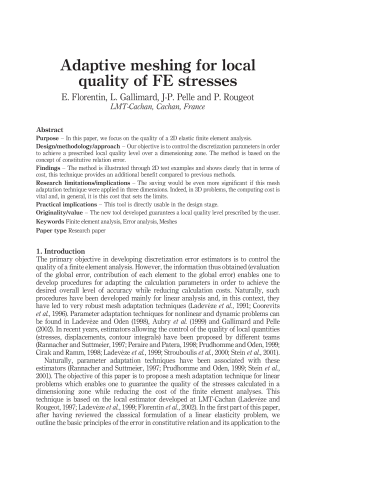
Adaptive meshing for local quality of FE stresses
- Type de publi. : Article dans une revue
- Date de publi. : 01/03/2005
-
Auteurs :
Éric FlorentinL. GallimardJean-Pierre PellePhilippe Rougeot
Fiche détaillée
Adaptive meshing for local quality of FE stresses
- Type de publi. : Article dans une revue
- Date de publi. : 01/03/2005
-
Auteurs :
Éric FlorentinL. GallimardJean-Pierre PellePhilippe Rougeot
-
Organismes :
Laboratoire de Mécanique et Technologie
Laboratoire de Mécanique et Technologie
Laboratoire de Mécanique et Technologie
Laboratoire de Mécanique et Technologie
- Publié dans Engineering Computations le 22/10/2020
Résumé : Purpose – In this paper, we focus on the quality of a 2D elastic finite element analysis. Design/methodology/approach – Our objective is to control the discretization parameters in order to achieve a prescribed local quality level over a dimensioning zone. The method is based on the concept of constitutive relation error. Findings – The method is illustrated through 2D test examples and shows clearly that in terms of cost, this technique provides an additional benefit compared to previous methods. Research limitations/implications – The saving would be even more significant if this mesh adaptation technique were applied in three dimensions. Indeed, in 3D problems, the computing cost is vital and, in general, it is this cost that sets the limits. Practical implications – This tool is directly usable in the design stage. Originality/value – The new tool developed guarantees a local quality level prescribed by the us
Fichiers liés :
2005-EC-Adaptive-meshing-local-quality-ef-lg-jpp-pr.pdf
Source