Professeur des universités en sciences de gestion
-

Model Based Spatial and Temporal Similarity Measures between Series of Functional Magnetic Resonance Images
- Type de publi. : Communication dans un congrès
- Date de publi. : 01/01/2002
-
Auteurs :
Ferath KherifGuillaume FlandinPhilippe CiuciuHabib BenaliOlivier SimonJean-Baptiste Poline
Fiche détaillée
Model Based Spatial and Temporal Similarity Measures between Series of Functional Magnetic Resonance Images
- Type de publi. : Communication dans un congrès
- Date de publi. : 01/01/2002
-
Auteurs :
Ferath KherifGuillaume FlandinPhilippe CiuciuHabib BenaliOlivier SimonJean-Baptiste Poline
-
Organismes :
Service Hospitalier Frédéric Joliot
Service NEUROSPIN
Medical imaging and robotics
Service Hospitalier Frédéric Joliot
Service NEUROSPIN
Laboratoire de Neuroimagerie Assistée par Ordinateur
Laboratoire des signaux et systèmes
Imagerie médicale et quantitative
Institut d'imagerie neurofonctionnelle
Unité de Neuroimagerie Fonctionnelle [Montréal]
Analyse lineaire de donnees multidimensionnelles
Laboratoire d'Imagerie Fonctionnelle
Digital image processing, modeling and communication
Institut d'imagerie neurofonctionnelle
Service Hospitalier Frédéric Joliot
Service NEUROSPIN
Laboratoire de Neuroimagerie Assistée par Ordinateur
Institut d'imagerie neurofonctionnelle
Résumé : no abstract
Source
-

Site-City Interaction through Modifications of Site Effects
- Type de publi. : Communication dans un congrès
- Date de publi. : 01/01/2002
-
Auteurs :
Jean-François SemblatMarc KhamPhilippe GuéguenPierre-Yves BardAnne-Marie Duval
Fiche détaillée
Site-City Interaction through Modifications of Site Effects
- Type de publi. : Communication dans un congrès
- Date de publi. : 01/01/2002
-
Auteurs :
Jean-François SemblatMarc KhamPhilippe GuéguenPierre-Yves BardAnne-Marie Duval
-
Organismes :
Division Mécanique des Sols des Roches et de la Géologie de l'Ingénieur
Laboratoire de Mécanique des Structures Industrielles Durables
Laboratoire de Géophysique Interne et Tectonophysique
Laboratoire de Géophysique Interne et Tectonophysique
ERA 6 Risque sismique
Résumé : The analysis of seismic site effects generally disregards the influence of surface structures on the free field motion in densely urbanized areas. This paper aims at investigating this particular problem called site-city interaction especially by comparison to the "free-field" amplification process. Several evidences (experimental, analytical, numerical) of the site-city interaction phenomenon have been given in previous work (Guéguen, Bard, Semblat 2000). The influence of site city-interaction could be large for structures having eigenfrequencies close to that of the surface soil layers. Furthermore, the density of structures is also an important governing parameter of the problem. Considering a specific site (Nice, France) where site-city interaction is supposed to be significant, we start from detailed experimental and numerical studies of seismic site effects giving both amplification levels and occuring frequencies, as well as the location of the maximum amplification areas. The influence of site-city interaction is then investigated through various numerical models considering the boundary element method. The effect of surface structures with variable urban densities is analysed to estimate the contribution of overall site-city interaction on surface motion distribution. The main goal of the paper is to estimate the influence of site-city interaction not only on amplification levels (the influence can be small), but also on the modification of both main amplification frequencies and location of the maximum amplification areas. The main conclusion of this work is to show the modifications of the free-field amplification due to site-city interaction and leading to a specific urban field amplification.
Fichiers liés :
7ncee_semblat_et_al.pdf
Source
-

Strain measurement in tests on fibre fabric by image correlation method
- Type de publi. : Article dans une revue
- Date de publi. : 01/01/2002
-
Auteurs :
Jean LaunayFathia LahmarP. BoissePierre Vacher
Fiche détaillée
Strain measurement in tests on fibre fabric by image correlation method
- Type de publi. : Article dans une revue
- Date de publi. : 01/01/2002
-
Auteurs :
Jean LaunayFathia LahmarP. BoissePierre Vacher
-
Organismes :
Laboratoire de Mécanique des Systèmes et des Procédés
Laboratoire de Mécanique des Systèmes et des Procédés
Laboratoire de Mécanique des Systèmes et des Procédés
Laboratoire SYstèmes et Matériaux pour la MEcatronique
- Publié dans Advanced composites letters le 31/10/2020
Résumé : Strain measurements are investigated by an image correlation method, for tensile tests, in order to analyse the non-linearities due to crimp. The interest of the method is the possibility to study the phenomena at different scales and so to contribute to a better understanding of the yarn interactions and of their influence on the fabric mechanical behaviour
Fichiers liés :
Launay2002.pdf
Source
-
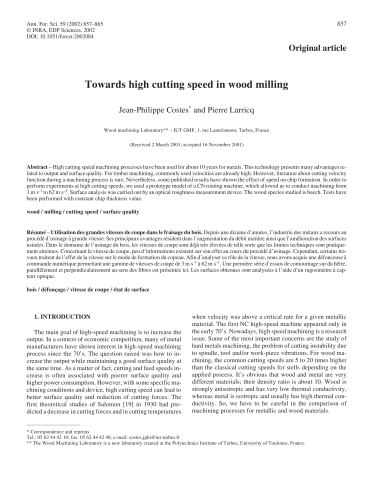
Towards high cutting speed in wood milling
- Type de publi. : Article dans une revue
- Date de publi. : 01/01/2002
-
Auteurs :
Jean-Philippe CostesPierre Larricq
Fiche détaillée
Towards high cutting speed in wood milling
- Type de publi. : Article dans une revue
- Date de publi. : 01/01/2002
-
Auteurs :
Jean-Philippe CostesPierre Larricq
-
Organismes :
- Publié dans Annals of Forest Science le 26/10/2020
Résumé : High cutting speed machining processes have been used for about 10 years for metals. This technology presents many advantages related to output and surface quality. For timber machining, commonly used velocities are already high. However, literature about cutting velocity function during a machining process is rare. Nevertheless, some published results have shown the effect of speed on chip formation. In order to perform experiments at high cutting speeds, we used a prototype model of a CN routing machine, which allowed us to conduct machining from 3 m s$^{-1}$ to 62 m s$^{-1}$. Surface analysis was carried out by an optical roughness measurement device. The wood species studied is beech. Tests have been performed with constant chip thickness value.
Fichiers liés :
hal-00881899.pdf
Source
-
Ces bone morphogenetic proteins qui règlent le quota ovulatoire
- Type de publi. : Article dans une revue
- Date de publi. : 01/01/2002
-
Auteurs :
A. PierreStéphane FabrePhilippe MulsantJean Michel J. M. ElsenC. PisseletDanielle MonniauxPhilippe Monget
Fiche détaillée
Ces bone morphogenetic proteins qui règlent le quota ovulatoire
- Type de publi. : Article dans une revue
- Date de publi. : 01/01/2002
-
Auteurs :
A. PierreStéphane FabrePhilippe MulsantJean Michel J. M. ElsenC. PisseletDanielle MonniauxPhilippe Monget
-
Organismes :
Physiologie de la reproduction et des comportements [Nouzilly]
Physiologie de la reproduction et des comportements [Nouzilly]
Physiologie de la reproduction et des comportements [Nouzilly]
Station d'Amélioration Génétique des Animaux
Physiologie de la reproduction et des comportements [Nouzilly]
Physiologie de la reproduction et des comportements [Nouzilly]
Physiologie de la reproduction et des comportements [Nouzilly]
- Publié dans Médecine/Sciences le 25/10/2020
Source
-

Segregation of a major gene influencing ovulation in progeny of Lacaune meat sheep
- Type de publi. : Article dans une revue
- Date de publi. : 01/01/2002
-
Auteurs :
Loys BodinMagali San CristobalFrédéric LecerfPhilippe MulsantBernard BibéDaniel LajousJean-Pierre BellocFrancis EychenneYves AmiguesJean-Michel Elsen
Fiche détaillée
Segregation of a major gene influencing ovulation in progeny of Lacaune meat sheep
- Type de publi. : Article dans une revue
- Date de publi. : 01/01/2002
-
Auteurs :
Loys BodinMagali San CristobalFrédéric LecerfPhilippe MulsantBernard BibéDaniel LajousJean-Pierre BellocFrancis EychenneYves AmiguesJean-Michel Elsen
-
Organismes :
- Publié dans Genetics Selection Evolution le 25/10/2020
Résumé : Inheritance of the ovulation rate (OR) in the Lacaune meat breed was studied through records from a small nucleus of 36 hyper-prolific ewes screened on farms on the basis of their natural litter size, and from progeny data of three selected Lacaune sires. These sires were chosen at the AI centre according to their breeding values estimated for the mean and the variability of their daughters' litter size. Non-carrier Lacaune dairy ewes were inseminated to produce 121 F1 daughters and 27 F1 sons. Twelve sons (four from each sire) were used in turn to inseminate non-carrier Lacaune dairy ewes providing 260 BC progeny ewes. F1 and BC progeny were brought from private farms and gathered after weaning on an experimental farm where ovulation rates were recorded in the first and second breeding seasons. With an average of 6.5 records each, the mean OR of hyper-prolific ewes was very high (5.34), and 38.4% of records showed a rate of 6 or more. F1 data showed high repeatability of OR ($r=0.54$) within ewe, with significant variability among ewes. High OR ($\geq 4$) were observed in each family. A segregation analysis provided a significant likelihood ratio and classified the three founders as heterozygous. BC ewes also displayed high repeatability of OR ($r=0.47$) and the mean OR varied considerably between families (from 1.24 to 1.78). Seven of the 12 BC families presented high-ovulating ewes (at least one record $\geq 4$) and segregation analysis yielded a highly significant likelihood ratio as compared to an empirical test distribution. The high variability of the mean ovulation rate shown by a small group of daughters of BC ewes inseminated by putative carrier F1 rams, and the very high ovulation rate observed for some of these ewe lambs, confirmed the segregation of a major gene with two co-dominant alleles borne by an autosome. The difference between homozygous non-carriers and heterozygous ewes was about one ovulation on the observed scale and 2.2 standard deviations on the underlying scale.
Fichiers liés :
hal-00894421.pdf
Source
-
GPS network monitors the Western Alp's deformation over a five-year period : 1993-1998.
- Type de publi. : Article dans une revue
- Date de publi. : 01/01/2002
-
Auteurs :
Christophe VignyJ. ChéryT. DuquesnoyF. JouanneJérôme AmmannM. AnzideiJean‐philippe AvouacF. BarlierR. BayerÉric Calais
Fiche détaillée
GPS network monitors the Western Alp's deformation over a five-year period : 1993-1998.
- Type de publi. : Article dans une revue
- Date de publi. : 01/01/2002
-
Auteurs :
Christophe VignyJ. ChéryT. DuquesnoyF. JouanneJérôme AmmannM. AnzideiJean‐philippe AvouacF. BarlierR. BayerÉric Calais
-
Organismes :
Groupe de Recherche de Géodésie Spatiale [Grasse]
Géoazur
- Publié dans Journal of Geodesy le 01/11/2020
Résumé : The Western Alps are among the best studied collisional belts with both detailed structural mapping and also crustal geophysical investigations such as the ECORS and EGT seismic profile. By contrast, the present-day kinematics of the belt is still largely unknown due to small relative motions and the insufficient accuracy of the triangulation data. As a consequence, several tectonic problems still remain to be solved, such as the amount of N-S convergence in the Occidental Alps, the repartition of the deformation between the Alpine tectonic units, and the relation between deformation and rotation across the Alpine arc. In order to address these problems, the GPS ALPES group, made up of French, Swiss and Italian research organizations, has achieved the first large-scale GPS surveys of the Western Alps. More than 60 sites were surveyed in 1993 and 1998 with a minimum observation of 3 days at each site. GPS data processing has been done by three independent teams using different software. The different solutions have horizontal repeatabilities (N-E) of 4-7 mm in 1993 and 2-3 mm in 1998 and compare at the 3-5-mm level in position and 2-mm/ yr level in velocity. A comparison of 1993 and 1998 coordinates shows that residual velocities of the GPS marks are generally smaller than 2 mm/yr, precluding a detailed tectonic interpretation of the differential motions. However, these data seem to suggest that the N-S compression of the Western Alps is quite mild (less than 2 mm/yr) compared to the global convergence between the African and Eurasian plate (6 mm/yr). This implies that the shortening must be accomodated elsewhere by the deformation of the Maghrebids and/ or by rotations of Mediterranean microplates. Also, E-W velocity components analysis supports the idea that E-W extension exists, as already suggested by recent structural and seismotectonic data interpretation.
Source
-

The infinite Brownian loop on a symmetric space
- Type de publi. : Article dans une revue
- Date de publi. : 01/01/2002
-
Auteurs :
Jean-Philippe AnkerPhilippe BougerolThierry Jeulin
Fiche détaillée
The infinite Brownian loop on a symmetric space
- Type de publi. : Article dans une revue
- Date de publi. : 01/01/2002
-
Auteurs :
Jean-Philippe AnkerPhilippe BougerolThierry Jeulin
-
Organismes :
Mathématiques - Analyse, Probabilités, Modélisation - Orléans
Laboratoire de Probabilités et Modèles Aléatoires
Laboratoire de Probabilités et Modèles Aléatoires
- Publié dans Revista Matemática Iberoamericana le 31/10/2020
Résumé : The infinite Brownian loop $\{B_t^0,t\ge 0\}$ on a Riemannian manifold $\mathbb M$ is the limit in distribution of the Brownian bridge of length $T$ around a fixed origin $0$, when $T\to+\infty$. It has no spectral gap. When $\mathbb M$ has nonnegative Ricci curvature, $B^0$ is the Brownian motion itself. When $\mathbb M=G/K$ is a noncompact symmetric space, $B^0$ is the relativized $\Phi_0$--process of the Brownian motion, where $\Phi_0$ denotes the basic spherical function of Harish--Chandra, i.e. the $K$--invariant ground state of the Laplacian. In this case, we consider the polar decomposition $B_t^0=(K_t,X_t)$, where $K_t\in K/M$ and $X_t\in\overline{\mathfrak a_+}$, the positive Weyl chamber. Then, as $t\to+\infty$, $K_t$ converges and $d(0,X_t)/t\to 0$ almost surely. Moreover the processes $\{X_{tT}/\sqrt{T},t\ge 0\}$ converge in distribution, as $T\to+\infty$, to the intrinsic Brownian motion of the Weyl chamber. This implies in particular that $d(0,X_{tT})/\sqrt{T}$ converges to a Bessel process of dimension $D=\operatorname{rank}\mathbb M+2j$, where $j$ denotes the number of positive indivisible roots. An ingredient of the proof is a new estimate on $\Phi_0$.
Fichiers liés :
ABJ.pdf
Source
-
Arc-continent collision in Taiwan: New marine observations and tectonic evolution
- Type de publi. : Chapître d'ouvrage
- Date de publi. : 01/01/2002
-
Auteurs :
Jacques MalavieilleSerge LallemandStephane DominguezAlexis DeschampsChia Yu LuChar-Shine LiuPhilippe SchnürleJ. AngelierJ.-Y. CollotBenoît DeffontainesMarc FournierS.-K. HsüJ.-P. Le FormalS.-Y. LiuJean-Claude SibuetNicolas ThareauT. Virdee
Fiche détaillée
Arc-continent collision in Taiwan: New marine observations and tectonic evolution
- Type de publi. : Chapître d'ouvrage
- Date de publi. : 01/01/2002
-
Auteurs :
Jacques MalavieilleSerge LallemandStephane DominguezAlexis DeschampsChia Yu LuChar-Shine LiuPhilippe SchnürleJ. AngelierJ.-Y. CollotBenoît DeffontainesMarc FournierS.-K. HsüJ.-P. Le FormalS.-Y. LiuJean-Claude SibuetNicolas ThareauT. Virdee
-
Organismes :
Laboratoire de Géophysique, Tectonique et Sédimentologie
Laboratoire de Géophysique, Tectonique et Sédimentologie
Laboratoire de Géophysique, Tectonique et Sédimentologie
Laboratoire de Géophysique, Tectonique et Sédimentologie
National Taiwan University
National Taiwan University
National Taiwan University
Géoazur
Géoazur
Institut Français de Recherche pour l'Exploitation de la Mer
Institut Français de Recherche pour l'Exploitation de la Mer
- Publié dans Geological Society of America Special Papers le 02/11/2020
Résumé : Marine observations offshore of Taiwan indicate intense deformation of the Luzon arc-forearc complex, with episodic eastward migration of the active deformation front across the complex. This active tectonic domain absorbs a significant amount of shortening between the Eurasia margin and the Philippine Sea Plate, which is moving towards N 310° E at about 8 cm/yr relative to Eurasia. Swath bathymetry and back-scattering data, together with seismic reflection and geopotential data obtained during the ACT (Active Collision in Taiwan) cruise onboard the R/V L'Atalante, showed major north to south changes in the tectonic style in both the indenting arc and the host margin. Structural observations show that the forearc basement of the Luzon arc no longer exists north of 22°30'N. To the south, only a small part of the forearc domain may remain beneath the Huatung Ridge (rear portion of the former Manila trench oceanic accretionary wedge including forearc and intra-arc sequences) and rear of the thrust wedge. A tectonic model involving the progressive underthrusting of large slices of the forearc basement may account for the contrasting styles of deformation encountered from south to north across the collisional orogen and apparent missing of the forearc region. The progressive subduction of the continental margin of China induces: 1) to the south, major eastward backthrusting and shortening of the forearc domain between the former oceanic accretionary wedge and the Luzon Arc volcanic edifice, 2) to the north, accretion of parts of the arc domain to the collisional belt associated with westward thrusting, eastward backthrusting at the base of the slope and block rotation.
Source
-
The alpha effect and its saturation in a turbulent swirling flow generated in the VKS experiment
- Type de publi. : Pré-publication, Document de travail
- Date de publi. : 01/01/2002
-
Auteurs :
François PétrélisMickaël BourgoinL. MarieJ. BurgueteA. ChiffaudelF. DaviaudStéphan FauvePhilippe OdierJean-François Pinton
Fiche détaillée
The alpha effect and its saturation in a turbulent swirling flow generated in the VKS experiment
- Type de publi. : Pré-publication, Document de travail
- Date de publi. : 01/01/2002
-
Auteurs :
François PétrélisMickaël BourgoinL. MarieJ. BurgueteA. ChiffaudelF. DaviaudStéphan FauvePhilippe OdierJean-François Pinton
-
Organismes :
Laboratoire de Physique Statistique de l'ENS
Laboratoire de Physique de l'ENS Lyon
Service de physique de l'état condensé
Service de physique de l'état condensé
Service de physique de l'état condensé
Service de physique de l'état condensé
Laboratoire de Physique Statistique de l'ENS
Laboratoire de Physique de l'ENS Lyon
Laboratoire de Physique de l'ENS Lyon
Résumé : We report the experimental observation of the alpha-effect. It consists in the generation of a current parallel to a magnetic field B0 applied to a turbulent swirling flow of liquid sodium. At low magnetic Reynolds number, Rm, we show that the magnitude of the alpha-effect increases like Rm2 and that its sign is determined by the flow helicity. It saturates and then decreases at large Rm, primarily because of the expulsion of the applied field B0 from the bulk of the flow. We show how this expulsion is affected by the flow geometry by varying the relative amplitudes of the azimuthal and axial flows.
Source