Professeur des universités en sciences de gestion
-

Limited Resection Versus Pancreaticoduodenectomy for Duodenal Gastrointestinal Stromal Tumors? Enucleation Interferes in the Debate: A European Multicenter Retrospective Cohort Study
- Type de publi. : Article dans une revue
- Date de publi. : 01/10/2021
-
Auteurs :
Clément DuboisFrederiek NuytensHélène BehalCaroline GronnierGilles ManceauMaxime WarlaumontAlain DuhamelQuentin DenostCharles HonoréOlivier FacyJean-Jacques TuechGuido TiberioCécile BrigandJean-Pierre BailEphrem SalaméBernard MeunierJérémie LefevreMuriel MathonnetMohamed Sbai IdrissiFlorence RenaudGuillaume PiessenFrançois BrowetCharles SabbaghJean-Marc RégimbeauEmilie LermiteAntoine HamyKevin KraftRichard DouardPhilippe WindHélène Gersen-CherdieuDenis ColletMagalie CabauChristophe LaurentEric RullierArianna ConiglioCharles-Henry GancelBogdan BadicGilbert OuedraogoMircea BeuranAude BramsMarc KanorChristophe LouisYves RussierYves PanisLéon MaggioriCamille CailleGéraud TuyerasSimon MsikaLuigi de MagistrisT. PerrinPatrick RatPablo Ortega DeballonPhilippe MeignieJean François BronnerJacques MolineClaude MondersertAndré CaamanoCatherine ArvieuxJean-Luc FaucheronChristian LetoublonAntoine GuillaudSégolène LardenoisJean-Michel NussPatrick ChevillotteEdouard VinatierWilliams TessierRobert CaiazzoFrançois PattouNicolas LamandeMehrdad JafariGauthier DecanterFrançois ParafMohamed AlyamiDelphine VaudoyerGuillaume PassotOlivier GlehenHassan DemianChristian DucerfJean-Yves MabrutMarc RivoireVincent GarbitThierry LeclercqJean LoireOlivier RaspadoRémy Le Huu NhoMehdi OuaïssiIgor SieleznefBernard SastreBernard PolManuela CampanileSami HamedJean HardwigsenYves-Patrice Le TreutGérard CarbonnelCharlotte de Saint RomanM. TréotPhilippe SockeelGhislain TourreauVasileios BaltzopoulosAnne MourregotPhilippe RouanetL. BreslerP. SenellartGuillaume MeurettePaul Antoine LehurNicolas RegenetVincent CasanovaAnne Sophie SchneckAntonio IanelliJean GugenheimMehdi KarouiJean Christophe VaillantJean Baptise BachetLaurent HannounRenato LupinacciFrancois MenegauxChristophe TresalletAntoine BrouquetStéphane BenoistChristophe PennaPierre BalladurYann ParcFrançois PayeNajim ChafaiEmmanuel TiretPierre CattanEmile SarfatiLeonor BenhaimF. SistaSidney HouryPascale MarianiBéatrice Ullua SeverinoBrice GayetThierry PerniceniJean-Pierre RicherJean-Pierre FaureJean Louis KraimpsSophie Deguelte-LardiereOlivier BoucheReza KianmaneschCharles Le Clec’hLaurent SulpiceBernard MeunierKarim BoudjemaEmmanuel HuetMichel ScotteFrancis MichotThomas SoleClément CostanzaCharlotte VermeschSantina BrunoJack PorcheronM. RaharimanantsoaPatrick PessauxSilvana PerrettaDidier MutterH. MercoliA. KlipfelE. TrikiB. RomainS. DragomirN. ChilintsevaJ. OlliernSerge RohrAlexandre RaultCharles Henri JulioMael Chalret Du RieuNicolas CarrèreBernard PradèrePerrine SenellartBaudoin ThébaultNicolo de ManziniChristophe HenrySylvie Bonvalot
Fiche détaillée
Limited Resection Versus Pancreaticoduodenectomy for Duodenal Gastrointestinal Stromal Tumors? Enucleation Interferes in the Debate: A European Multicenter Retrospective Cohort Study
- Type de publi. : Article dans une revue
- Date de publi. : 01/10/2021
-
Auteurs :
Clément DuboisFrederiek NuytensHélène BehalCaroline GronnierGilles ManceauMaxime WarlaumontAlain DuhamelQuentin DenostCharles HonoréOlivier FacyJean-Jacques TuechGuido TiberioCécile BrigandJean-Pierre BailEphrem SalaméBernard MeunierJérémie LefevreMuriel MathonnetMohamed Sbai IdrissiFlorence RenaudGuillaume PiessenFrançois BrowetCharles SabbaghJean-Marc RégimbeauEmilie LermiteAntoine HamyKevin KraftRichard DouardPhilippe WindHélène Gersen-CherdieuDenis ColletMagalie CabauChristophe LaurentEric RullierArianna ConiglioCharles-Henry GancelBogdan BadicGilbert OuedraogoMircea BeuranAude BramsMarc KanorChristophe LouisYves RussierYves PanisLéon MaggioriCamille CailleGéraud TuyerasSimon MsikaLuigi de MagistrisT. PerrinPatrick RatPablo Ortega DeballonPhilippe MeignieJean François BronnerJacques MolineClaude MondersertAndré CaamanoCatherine ArvieuxJean-Luc FaucheronChristian LetoublonAntoine GuillaudSégolène LardenoisJean-Michel NussPatrick ChevillotteEdouard VinatierWilliams TessierRobert CaiazzoFrançois PattouNicolas LamandeMehrdad JafariGauthier DecanterFrançois ParafMohamed AlyamiDelphine VaudoyerGuillaume PassotOlivier GlehenHassan DemianChristian DucerfJean-Yves MabrutMarc RivoireVincent GarbitThierry LeclercqJean LoireOlivier RaspadoRémy Le Huu NhoMehdi OuaïssiIgor SieleznefBernard SastreBernard PolManuela CampanileSami HamedJean HardwigsenYves-Patrice Le TreutGérard CarbonnelCharlotte de Saint RomanM. TréotPhilippe SockeelGhislain TourreauVasileios BaltzopoulosAnne MourregotPhilippe RouanetL. BreslerP. SenellartGuillaume MeurettePaul Antoine LehurNicolas RegenetVincent CasanovaAnne Sophie SchneckAntonio IanelliJean GugenheimMehdi KarouiJean Christophe VaillantJean Baptise BachetLaurent HannounRenato LupinacciFrancois MenegauxChristophe TresalletAntoine BrouquetStéphane BenoistChristophe PennaPierre BalladurYann ParcFrançois PayeNajim ChafaiEmmanuel TiretPierre CattanEmile SarfatiLeonor BenhaimF. SistaSidney HouryPascale MarianiBéatrice Ullua SeverinoBrice GayetThierry PerniceniJean-Pierre RicherJean-Pierre FaureJean Louis KraimpsSophie Deguelte-LardiereOlivier BoucheReza KianmaneschCharles Le Clec’hLaurent SulpiceBernard MeunierKarim BoudjemaEmmanuel HuetMichel ScotteFrancis MichotThomas SoleClément CostanzaCharlotte VermeschSantina BrunoJack PorcheronM. RaharimanantsoaPatrick PessauxSilvana PerrettaDidier MutterH. MercoliA. KlipfelE. TrikiB. RomainS. DragomirN. ChilintsevaJ. OlliernSerge RohrAlexandre RaultCharles Henri JulioMael Chalret Du RieuNicolas CarrèreBernard PradèrePerrine SenellartBaudoin ThébaultNicolo de ManziniChristophe HenrySylvie Bonvalot
-
Organismes :
Evaluation des technologies de santé et des pratiques médicales - ULR 2694
Evaluation des technologies de santé et des pratiques médicales - ULR 2694
Interface de Recherche Fondamentale et Appliquée en Cancérologie
Hétérogénéité, Plasticité et Résistance aux Thérapies des Cancers = Cancer Heterogeneity, Plasticity and Resistance to Therapies - UMR 9020 - U 1277
Hétérogénéité, Plasticité et Résistance aux Thérapies des Cancers = Cancer Heterogeneity, Plasticity and Resistance to Therapies - UMR 9020 - U 1277
- Publié dans Annals of Surgical Oncology le 26/10/2020
Source
-

Brief report of Anti-PD1 in HIV setting: relevant and breaking results in first-line Non Small Cell Lung Cancer therapy
- Type de publi. : Article dans une revue
- Date de publi. : 01/10/2021
-
Auteurs :
Lise BertinAnthony CanellasBaptiste AbbarMarianne VeyriJean-Philippe SpanoJacques CadranelArmelle Lavolé
Fiche détaillée
Brief report of Anti-PD1 in HIV setting: relevant and breaking results in first-line Non Small Cell Lung Cancer therapy
- Type de publi. : Article dans une revue
- Date de publi. : 01/10/2021
-
Auteurs :
Lise BertinAnthony CanellasBaptiste AbbarMarianne VeyriJean-Philippe SpanoJacques CadranelArmelle Lavolé
-
Organismes :
CHU Tenon [AP-HP]
Groupe de recherche clinique Biomarqueurs Théranostiques des Cancers Bronchiques Non à Petites Cellules
Groupe de recherche clinique Biomarqueurs Théranostiques des Cancers Bronchiques Non à Petites Cellules
CHU Tenon [AP-HP]
CHU Pitié-Salpêtrière [AP-HP]
Institut Universitaire de Cancérologie [Sorbonne Université]
Institut Pierre Louis d'Epidémiologie et de Santé Publique
CHU Pitié-Salpêtrière [AP-HP]
Institut Universitaire de Cancérologie [Sorbonne Université]
Institut Universitaire de Cancérologie [Sorbonne Université]
CHU Pitié-Salpêtrière [AP-HP]
Institut Pierre Louis d'Epidémiologie et de Santé Publique
CHU Tenon [AP-HP]
Groupe de recherche clinique Biomarqueurs Théranostiques des Cancers Bronchiques Non à Petites Cellules
CHU Tenon [AP-HP]
Groupe de recherche clinique Biomarqueurs Théranostiques des Cancers Bronchiques Non à Petites Cellules
- Publié dans JTO Clinical and Research Reports le 07/10/2021
Résumé : In the recent past, we observed an increased risk of cancer in the HIV population due to the development of antiretroviral therapies that decreased mortality caused by HIV-specific infections. This particularly fragile population is frequently excluded from clinical trials, and up-to-date recommendations for these patients are lacking. Only few cases of HIV patients suffering from cancer and undergoing first-line immunotherapy have been reported so far. Here we report the largest known study of HIV patients with non-small cell lung cancer (NSCLC) (5 patients) undergoing first-line immunotherapy by pembrolizumab, following CANCERVIH group selection. Our results are consistent with previous case reports concerning safety of immunotherapy in HIV patients, showing no severe or fatal toxicity, opportunistic infections, or immune reconstitution inflammatory syndrome (IRIS). Moreover, pembrolizumab did not seem to modify HIV viral parameters. We also assessed effectiveness of immunotherapy in these HIV-immunosuppressed patients: the average survival was 9.8 months, with three patients showing rapid progression and two partial response. However, as well as safety and drug-to-drug interactions, the effectiveness of first-line immunotherapy in people living with HIV (PLWHIV) needs to be supported by larger studies.
Fichiers liés :
1-s2.0-S2666364321001065-main.pdf
Source
-
Monocyte distribution width as a biomarker of resistance to corticosteroids in patients with sepsis: the MOCORSEP observational study
- Type de publi. : Article dans une revue
- Date de publi. : 01/10/2021
-
Auteurs :
Djillali AnnaneMartin RottmanNicholas HemingVéronique GodotJérôme FleurietJean Sébastien BlanchetPierre MoineLamiae GrimaldiSylvie ChevretAnnane DjillaliMoine PierreHeming NicholasMaxime VirginieClair BernardOrlikowski DavidBouneb RaniaMurg EleonoraAbdeladim LiliaFayssoil AbdallahBlanchet Jean-SébastienChevret SylvieDaniel ChristelDevillier PhilippeFleuriet JéromeFrançois BrunoGarchon Henri-JeanGodot VéroniqueGrassin-Delyle StanislasGrimaldi LamiaeKedad ZoubidaLassalle PhilippeU. Richly MaximilianRottman MartinRoux Anne-LaureTalini LucZeitouni KarineDjillali AnnaneValérie BardetXavier MonnetLamiae GrimaldiSylvie ChevretAnne-Laure RouxMartin RottmanStanislas Grassin DelyleHenri-Jean GarchonXavier MonnetAntoine Vieillard-BaronGuillaume GériZiad MassyJean-Claude AlvarezMarie EssigAmine LarabiValérie BardetBruno MégarbaneNicholas HemingPierre TissièresFrancois FayMarie-Anne Rameix-WeltiBruno MégarbanePierre MoineKarine ZeitouniLaurent DumasZaineb ChellyMartin RottmanAnne-Laure RouxLoïc JosseranMahmoud Zureik
Fiche détaillée
Monocyte distribution width as a biomarker of resistance to corticosteroids in patients with sepsis: the MOCORSEP observational study
- Type de publi. : Article dans une revue
- Date de publi. : 01/10/2021
-
Auteurs :
Djillali AnnaneMartin RottmanNicholas HemingVéronique GodotJérôme FleurietJean Sébastien BlanchetPierre MoineLamiae GrimaldiSylvie ChevretAnnane DjillaliMoine PierreHeming NicholasMaxime VirginieClair BernardOrlikowski DavidBouneb RaniaMurg EleonoraAbdeladim LiliaFayssoil AbdallahBlanchet Jean-SébastienChevret SylvieDaniel ChristelDevillier PhilippeFleuriet JéromeFrançois BrunoGarchon Henri-JeanGodot VéroniqueGrassin-Delyle StanislasGrimaldi LamiaeKedad ZoubidaLassalle PhilippeU. Richly MaximilianRottman MartinRoux Anne-LaureTalini LucZeitouni KarineDjillali AnnaneValérie BardetXavier MonnetLamiae GrimaldiSylvie ChevretAnne-Laure RouxMartin RottmanStanislas Grassin DelyleHenri-Jean GarchonXavier MonnetAntoine Vieillard-BaronGuillaume GériZiad MassyJean-Claude AlvarezMarie EssigAmine LarabiValérie BardetBruno MégarbaneNicholas HemingPierre TissièresFrancois FayMarie-Anne Rameix-WeltiBruno MégarbanePierre MoineKarine ZeitouniLaurent DumasZaineb ChellyMartin RottmanAnne-Laure RouxLoïc JosseranMahmoud Zureik
-
Organismes :
Optimisation thérapeutique en Neuropsychopharmacologie
- Publié dans Intensive Care Medicine le 27/10/2020
Source
-

Probability distributions for analog-to-target distances
- Type de publi. : Article dans une revue
- Date de publi. : 30/09/2021
-
Auteurs :
Paul PlatzerPascal YiouPhilippe NaveauJean-François FilipotMaxime ThiébautPierre Tandeo
Fiche détaillée
Probability distributions for analog-to-target distances
- Type de publi. : Article dans une revue
- Date de publi. : 30/09/2021
-
Auteurs :
Paul PlatzerPascal YiouPhilippe NaveauJean-François FilipotMaxime ThiébautPierre Tandeo
-
Organismes :
France Énergies Marines [Brest]
Département Mathematical and Electrical Engineering
Laboratoire des Sciences du Climat et de l'Environnement [Gif-sur-Yvette]
Laboratoire des sciences et techniques de l'information, de la communication et de la connaissance
Extrèmes : Statistiques, Impacts et Régionalisation
Extrèmes : Statistiques, Impacts et Régionalisation
France Énergies Marines [Brest]
France Énergies Marines [Brest]
Département Mathematical and Electrical Engineering
Laboratoire des sciences et techniques de l'information, de la communication et de la connaissance
- Publié dans Journal of the Atmospheric Sciences le 30/10/2020
Résumé : Some properties of chaotic dynamical systems can be probed through features of recurrences, also called analogs. In practice, analogs are nearest neighbours of the state of a system, taken from a large database called the catalog. Analogs have been used in many atmospheric applications including forecasts, downscaling, predictability estimation, and attribution of extreme events. The distances of the analogs to the target state condition the performances of analog applications. These distances can be viewed as random variables, and their probability distributions can be related to the catalog size and properties of the system at stake. A few studies have focused on the first moments of return time statistics for the best analog, fixing an objective of maximum distance from this analog to the target state. However, for practical use and to reduce estimation variance, applications usually require not just one, but many analogs. In this paper, we evaluate from a theoretical standpoint and with numerical experiments the probability distributions of the $K$-best analog-to-target distances. We show that dimensionality plays a role on the size of the catalog needed to find good analogs, and also on the relative means and variances of the $K$-best analogs. Our results are based on recently developed tools from dynamical systems theory. These findings are illustrated with numerical simulations of a well-known chaotic dynamical system and on 10m-wind reanalysis data in north-west France. A practical application of our derivations for the purpose of objective-based dimension reduction is shown using the same reanalysis data.
Fichiers liés :
Analog_Distances_Distributions__JAS_nolineno_compressed.pdf
Source
-

Actuators for MRE: New Perspectives With Flexible Electroactive Materials
- Type de publi. : Article dans une revue
- Date de publi. : 30/09/2021
-
Auteurs :
Jean-Lynce GnanagoJean-Fabien CapsalTony GergesPhilippe LombardVincent SemetPierre-Jean CottinetMichel CabreraSimon Auguste Lambert
Fiche détaillée
Actuators for MRE: New Perspectives With Flexible Electroactive Materials
- Type de publi. : Article dans une revue
- Date de publi. : 30/09/2021
-
Auteurs :
Jean-Lynce GnanagoJean-Fabien CapsalTony GergesPhilippe LombardVincent SemetPierre-Jean CottinetMichel CabreraSimon Auguste Lambert
-
Organismes :
Ampère, Département Bioingénierie
Laboratoire de Génie Electrique et Ferroélectricité
Ampère, Département Energie Electrique
Ampère, Département Energie Electrique
Ampère, Département Energie Electrique
Laboratoire de Génie Electrique et Ferroélectricité
Ampère, Département Energie Electrique
Ampère, Département Bioingénierie
- Publié dans Frontiers in Physics le 30/10/2020
Résumé : Since 1995, Magnetic Resonance Elastography (MRE) has been constantly developed as a non-invasive diagnostic tool for quantitative mapping of mechanical properties of biological tissues. Indeed, mechanical properties of tissues vary over five orders of magnitude (the shear stiffness is ranging from 10 2 Pa for fat to 10 7 Pa for bones). Additionally, these properties depend on the physiological state which explains the granted benefit of MRE for staging liver fibrosis and its potential in numerous medical and biological domains. In comparison to the other modalities used to perform such measurement, Magnetic Resonance (MR) techniques offer the advantages of acquiring 3D high spatial resolution images at high penetration depth. However, performing MRE tissue characterization requires low frequency shear waves propagating in the tissue. Inducing them is the role of a mechanical actuator specifically designed to operate under Magnetic Resonance Imaging (MRI) specific restrictions in terms of electromagnetic compatibility. Facing these restrictions, many different solutions have been proposed while keeping a common structure: a vibration generator, a coupling device transmitting the vibration and a piston responsible for the mechanical coupling of the actuator with the tissue. The following review details the MRI constraints and how they are shaping the existing actuators. An emphasis is put on piezoelectric solutions as they solve the main issues encountered with other actuator technologies. Finally, flexible electroactive materials are reviewed as they could open great perspectives to build new type of mechanical actuators with better adaptability, greater ease-of-use and more compactness of dedicated actuators for MRE of small soft samples and superficial organs such as skin, muscles or breast.
Fichiers liés :
MRE actuator.pdf
Source
-
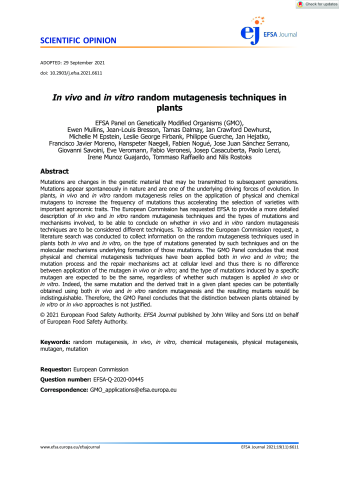
In vivo and in vitro random mutagenesis techniques in plants
- Type de publi. : Article dans une revue
- Date de publi. : 29/09/2021
-
Auteurs :
Ewen MullinsJean‐louis BressonTamas DalmayIan Crawford DewhurstMichelle M EpsteinLeslie George FirbankPhilippe GuercheJan HejatkoFrancisco Javier MorenoHanspeter NaegeliFabien NoguéJose Juan Sánchez SerranoGiovanni SavoiniEve VeromannFabio VeronesiJosep CasacubertaPaolo LenziIrene Munoz GuajardoTommaso RaffaelloNils Rostoks
Fiche détaillée
In vivo and in vitro random mutagenesis techniques in plants
- Type de publi. : Article dans une revue
- Date de publi. : 29/09/2021
-
Auteurs :
Ewen MullinsJean‐louis BressonTamas DalmayIan Crawford DewhurstMichelle M EpsteinLeslie George FirbankPhilippe GuercheJan HejatkoFrancisco Javier MorenoHanspeter NaegeliFabien NoguéJose Juan Sánchez SerranoGiovanni SavoiniEve VeromannFabio VeronesiJosep CasacubertaPaolo LenziIrene Munoz GuajardoTommaso RaffaelloNils Rostoks
-
Organismes :
Institut Jean-Pierre Bourgin - Sciences du végétal
Institut Jean-Pierre Bourgin - Sciences du végétal
- Publié dans EFSA Journal le 01/11/2020
Résumé : Mutations are changes in the genetic material that may be transmitted to subsequent generations. Mutations appear spontaneously in nature and are one of the underlying driving forces of evolution. In plants, in vivo and in vitro random mutagenesis relies on the application of physical and chemical mutagens to increase the frequency of mutations thus accelerating the selection of varieties with important agronomic traits. The European Commission has requested EFSA to provide a more detailed description of in vivo and in vitro random mutagenesis techniques and the types of mutations and mechanisms involved, to be able to conclude on whether in vivo and in vitro random mutagenesis techniques are to be considered different techniques. To address the European Commission request, a literature search was conducted to collect information on the random mutagenesis techniques used in plants both in vivo and in vitro, on the type of mutations generated by such techniques and on the molecular mechanisms underlying formation of those mutations. The GMO Panel concludes that most physical and chemical mutagenesis techniques have been applied both in vivo and in vitro; the mutation process and the repair mechanisms act at cellular level and thus there is no difference between application of the mutagen in vivo or in vitro; and the type of mutations induced by a specific mutagen are expected to be the same, regardless of whether such mutagen is applied in vivo or in vitro. Indeed, the same mutation and the derived trait in a given plant species can be potentially obtained using both in vivo and in vitro random mutagenesis and the resulting mutants would be indistinguishable. Therefore, the GMO Panel concludes that the distinction between plants obtained by in vitro or in vivo approaches is not justified.
Fichiers liés :
EFSA Journal - 2021 - - In vivo and in vitro random mutagenesis techniques in plants.pdf
Source
-

Evaluation of the Chemotherapy Drug Response Using Organotypic Cultures of Osteosarcoma Tumours from Mice Models and Canine Patients
- Type de publi. : Article dans une revue
- Date de publi. : 29/09/2021
-
Auteurs :
Bénédicte BrulinJohn C NolanTecla MarangonMilan KovacevicMathias ChatelaisPierre MeheustJérôme AbadieLouis-Romée Le NailPhilippe RossetMeadhbh Á BrennanPierre Layrolle
Fiche détaillée
Evaluation of the Chemotherapy Drug Response Using Organotypic Cultures of Osteosarcoma Tumours from Mice Models and Canine Patients
- Type de publi. : Article dans une revue
- Date de publi. : 29/09/2021
-
Auteurs :
Bénédicte BrulinJohn C NolanTecla MarangonMilan KovacevicMathias ChatelaisPierre MeheustJérôme AbadieLouis-Romée Le NailPhilippe RossetMeadhbh Á BrennanPierre Layrolle
-
Organismes :
Sarcomes osseux et remodelage des tissus calcifiés - Phy-Os [Nantes - INSERM U1238]
Toulouse NeuroImaging Center
National University of Ireland [Galway]
National University of Ireland [Galway]
National University of Ireland [Galway]
Sarcomes osseux et remodelage des tissus calcifiés - Phy-Os [Nantes - INSERM U1238]
Veteoceane
École nationale vétérinaire, agroalimentaire et de l'alimentation Nantes-Atlantique
Sarcomes osseux et remodelage des tissus calcifiés - Phy-Os [Nantes - INSERM U1238]
Centre Hospitalier Régional Universitaire de Tours
Centre Hospitalier Régional Universitaire de Tours
Université de Tours
Physiopathologie des Adaptations Nutritionnelles
Toulouse NeuroImaging Center
Sarcomes osseux et remodelage des tissus calcifiés - Phy-Os [Nantes - INSERM U1238]
- Publié dans Cancers le 21/10/2020
Résumé : Improvements in the clinical outcome of osteosarcoma have plateaued in recent decades with poor translation between preclinical testing and clinical efficacy. Organotypic cultures retain key features of patient tumours, such as a myriad of cell types organized within an extracellular matrix, thereby presenting a more realistic and personalised screening of chemotherapeutic agents ex vivo. To test this concept for the first time in osteosarcoma, murine and canine osteosarcoma organotypic models were maintained for up to 21 days and in-depth analysis identified proportions of immune and stromal cells present at levels comparable to that reported in vivo in the literature. Cytotoxicity testing of a range of chemotherapeutic drugs (mafosfamide, cisplatin, methotrexate, etoposide, and doxorubicin) on murine organotypic culture ex vivo found limited response to treatment, with immune and stromal cells demonstrating enhanced survival over the global tumour cell population. Furthermore, significantly decreased sensitivity to a range of chemotherapeutics in 3D organotypic culture relative to 2D monolayer was observed, with subsequent investigation confirming reduced sensitivity in 3D than in 2D, even at equivalent levels of drug uptake. Finally, as proof of concept for the application of this model to personalised drug screening, chemotherapy testing with doxorubicin was performed on biopsies obtained from canine osteosarcoma patients. Together, this study highlights the importance of recapitulating the 3D tumour multicellular microenvironment to better predict drug response and provides evidence for the utility and possibilities of organotypic culture for enhanced preclinical selection and evaluation of chemotherapeutics targeting osteosarcoma.
Fichiers liés :
Brulin_2021.pdf
Source
-
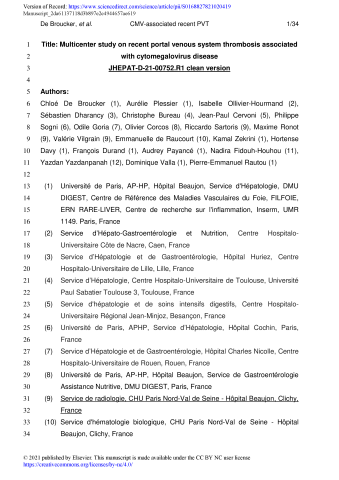
Multicenter study on recent portal venous system thrombosis associated with cytomegalovirus disease.
- Type de publi. : Article dans une revue
- Date de publi. : 28/09/2021
-
Auteurs :
Chloé de BrouckerAurélie PlessierIsabelle Ollivier-HourmandSebastien DharancyChristophe BureauJean-Paul CervoniPhilippe SogniOdile GoriaOlivier CorcosRiccardo SartorisMaxime RonotValérie VilgrainEmmanuelle de RaucourtKamal ZekriniHortense DavyFrançois DurandAudrey PayancéNadira Fidouh-HouhouYazdan YazdanpanahDominique VallaPierre-Emmanuel Rautou
Fiche détaillée
Multicenter study on recent portal venous system thrombosis associated with cytomegalovirus disease.
- Type de publi. : Article dans une revue
- Date de publi. : 28/09/2021
-
Auteurs :
Chloé de BrouckerAurélie PlessierIsabelle Ollivier-HourmandSebastien DharancyChristophe BureauJean-Paul CervoniPhilippe SogniOdile GoriaOlivier CorcosRiccardo SartorisMaxime RonotValérie VilgrainEmmanuelle de RaucourtKamal ZekriniHortense DavyFrançois DurandAudrey PayancéNadira Fidouh-HouhouYazdan YazdanpanahDominique VallaPierre-Emmanuel Rautou
-
Organismes :
Centre de recherche sur l'Inflammation
Centre de recherche sur l'Inflammation
Hôpital Côte de Nacre [CHU Caen]
Lille Inflammation Research International Center - U 995
Centre Hospitalier Universitaire de Toulouse
Centre Hospitalier Régional Universitaire de Besançon
Service d'hépatologie médicale [CHU Cochin]
Hôpital Charles Nicolle [Rouen]
Hôpital Beaujon [AP-HP]
Hôpital Beaujon [AP-HP]
Hôpital Beaujon [AP-HP]
Hôpital Beaujon [AP-HP]
Centre de recherche sur l'Inflammation
Centre de recherche sur l'Inflammation
Centre de recherche sur l'Inflammation
Centre de recherche sur l'Inflammation
Infection, Anti-microbiens, Modélisation, Evolution
Centre de recherche sur l'Inflammation
Centre de recherche sur l'Inflammation
- Publié dans Journal of Hepatology le 23/10/2020
Résumé : Background & AimsRecent non-malignant non-cirrhotic portal venous system thrombosis (PVT) is a rare condition. Among risk factors for PVT, cytomegalovirus (CMV) disease is usually listed based on a small number of reported cases. The aim of this study was to determine the characteristics and outcomes of PVT associated with CMV disease.MethodsWe conducted a French multicenter retrospective study comparing patients with recent PVT and CMV disease (“CMV positive”; n = 23) to patients with recent PVT for whom CMV testing was negative (“CMV negative”; n = 53) or unavailable (“CMV unknown”; n = 297).ResultsCompared to patients from the “CMV negative” and “CMV unknown” groups, patients from the “CMV positive” group were younger, more frequently had fever, and had higher heart rate, lymphocyte count and serum ALT levels (p ≤0.01 for all). The prevalence of immunosuppression did not differ between the 3 groups (4%, 4% and 6%, respectively). Extension of PVT was similar between the 3 groups. Thirteen out of 23 “CMV positive” patients had another risk factor for thrombosis. Besides CMV disease, the number of risk factors for thrombosis was similar between the 3 groups. Heterozygosity for the prothrombin G20210A gene variant was more frequent in “CMV positive” patients (22%) than in the “CMV negative” (4%, p = 0.01) and “CMV unknown” (8%, p = 0.03) groups. Recanalization rate was not influenced by CMV status.ConclusionsIn patients with recent PVT, features of mononucleosis syndrome should raise suspicion of CMV disease. CMV disease does not influence thrombosis extension nor recanalization. More than half of “CMV positive” patients have another risk factor for thrombosis, with a particular link to the prothrombin G20210A gene variant.Lay summaryPatients with cytomegalovirus (CMV)-associated portal venous system thrombosis have similar thrombosis extension and evolution as patients without CMV disease. However, patients with CMV-associated portal venous system thrombosis more frequently have the prothrombin G20210A gene variant, suggesting that these entities act synergistically to promote thrombosis.
Fichiers liés :
S0168827821020419.pdf
Source
-
Approches lipidiques du contenu des céramiques pour l’appréhension des ressources naturelles utilisées sur la côte atlantique de la France à la fin du Néolithique et au début de l’âge du Bronze
- Type de publi. : Communication dans un congrès
- Date de publi. : 28/09/2021
-
Auteurs :
Camielsa PrévostVincent ArdThierry BlascoPhilippe ForréNicolas FromontYvan PaillerAnne-Charlotte Philippe-LelongMartine RegertLudovic SolerAkshyeta Suryanarayan
Fiche détaillée
Approches lipidiques du contenu des céramiques pour l’appréhension des ressources naturelles utilisées sur la côte atlantique de la France à la fin du Néolithique et au début de l’âge du Bronze
- Type de publi. : Communication dans un congrès
- Date de publi. : 28/09/2021
-
Auteurs :
Camielsa PrévostVincent ArdThierry BlascoPhilippe ForréNicolas FromontYvan PaillerAnne-Charlotte Philippe-LelongMartine RegertLudovic SolerAkshyeta Suryanarayan
-
Organismes :
Culture et Environnements, Préhistoire, Antiquité, Moyen-Age
Université Côte d'Azur
Travaux et recherches archéologiques sur les cultures, les espaces et les sociétés
Université Toulouse - Jean Jaurès
Laboratoire d'océanographie de Villefranche
Institut national de recherches archéologiques préventives
Institut national de recherches archéologiques préventives
Littoral, Environnement, Télédétection, Géomatique UMR 6554
Culture et Environnements, Préhistoire, Antiquité, Moyen-Age
Centre National de la Recherche Scientifique
Service d’Archéologie Départementale de Charente-Maritime
De la Préhistoire à l'Actuel : Culture, Environnement et Anthropologie
Culture et Environnements, Préhistoire, Antiquité, Moyen-Age
Centre National de la Recherche Scientifique
Résumé : Depuis une trentaine d’années, il est devenu possible de déterminer le contenu et l’usage des poteries à partir de l’étude des lipides en lien avec ces céramiques. De nombreuses investigations ont été développées pour le nord de l'Europe et le pourtour méditerranéen, en particulier concernant le Néolithique ancien et l'apparition de l’agriculture. Le littoral atlantique, quant à lui, reste à ce jour peu exploré en matière d'approche lipidique, notamment pour la fin du Néolithique et le début de l’âge du Bronze. Afin d’estimer le degré de conservation des lipides et leur nature, un vaste échantillonnage a été entrepris dans des contextes littoraux (insulaires et continentaux), marécageux et intertidaux. Cette communication est l’occasion de présenter les résultats obtenus pour les sites des Caltières (Olonne-sur-mer, Vendée), Beg ar Loued (Molène, Finistère) et Ors Estran (Château d’Oléron, Charente-Maritime). Il s’agit d’un corpus de 313 échantillons (tessons et résidus issus de 220 vases), témoignant des relations Homme/Littoral pour trois contextes chrono-culturels différents. Afin d’évaluer l’impact des manipulations après la mise au jour du matériel céramique sur la conservation des lipides, un protocole original de prélèvement a été mis en place sur un des sites échantillonnés (Ors Estran). Utilisant une méthodologie reconnue, les échantillons ont été préparés pour être analysés en chromatographie (GC et GC-MS). Les résultats obtenus montrent une excellente préservation des lipides, tant quantitative que qualitative (66% de tests positifs avec une large gamme de familles chimiques), parfois comparable à celle des sites lacustres néolithiques de Chalain et Clairvaux (Jura). Les assemblages moléculaires démontrent l’exploitation d’une grande variété de substances naturelles, à mettre en lien avec des graisses animales sous-cutanées d’origine terrestre, des produits laitiers, des cires animales et végétales, mais aucun marqueur d'origine aquatique. Ces résultats ouvrent de nouvelles perspectives d’études et soulignent la nécessité de porter intérêt à ces vestiges ténus du littoral atlantique.
Source
-
Non-linear PGD Reduced-order model for industrial finite element software
- Type de publi. : Communication dans un congrès
- Date de publi. : 28/09/2021
-
Auteurs :
Ronan ScanffDavid NéronPierre LadevèzePhilippe BarabinotFrédéric CugnonJean-Pierre Delsemme
Fiche détaillée
Non-linear PGD Reduced-order model for industrial finite element software
- Type de publi. : Communication dans un congrès
- Date de publi. : 28/09/2021
-
Auteurs :
Ronan ScanffDavid NéronPierre LadevèzePhilippe BarabinotFrédéric CugnonJean-Pierre Delsemme
-
Organismes :
Siemens Industry Software SAS [Châtillon]
Laboratoire de mécanique et technologie
Laboratoire de mécanique et technologie
Laboratoire de mécanique et technologie
Siemens Industry Software SAS [Châtillon]
Samtech
Samtech
Source