Professeur des universités en sciences de gestion
-

Oral corticoid, aspirin, anticoagulant, colchicine, and furosemide to improve the outcome of hospitalized COVID-19 patients - the COCAA-COLA cohort study
- Type de publi. : Article dans une revue
- Date de publi. : 01/06/2021
-
Auteurs :
Jean-Philippe KevorkianAmanda LopesDamien SèneJean-Pierre RivelineClaire VandiedonckFlorine FéronKladoum NassarmadjiStéphane MoulyFranck Mauvais-JarvisJean-François GautierBruno Mégarbane
Fiche détaillée
Oral corticoid, aspirin, anticoagulant, colchicine, and furosemide to improve the outcome of hospitalized COVID-19 patients - the COCAA-COLA cohort study
- Type de publi. : Article dans une revue
- Date de publi. : 01/06/2021
-
Auteurs :
Jean-Philippe KevorkianAmanda LopesDamien SèneJean-Pierre RivelineClaire VandiedonckFlorine FéronKladoum NassarmadjiStéphane MoulyFranck Mauvais-JarvisJean-François GautierBruno Mégarbane
-
Organismes :
Hôpital Lariboisière-Fernand-Widal [APHP]
Hôpital Lariboisière-Fernand-Widal [APHP]
Hôpital Lariboisière-Fernand-Widal [APHP]
Immunologie humaine, physiopathologie & immunothérapie
Hôpital Lariboisière-Fernand-Widal [APHP]
Centre de Recherche des Cordeliers
Centre de Recherche des Cordeliers
Hôpital Lariboisière-Fernand-Widal [APHP]
Hôpital Lariboisière-Fernand-Widal [APHP]
Hôpital Lariboisière-Fernand-Widal [APHP]
Optimisation thérapeutique en Neuropsychopharmacologie
Tulane University
Hôpital Lariboisière-Fernand-Widal [APHP]
Centre de Recherche des Cordeliers
Service de Réanimation Médicale et Toxicologique [Hôpital Lariboisière]
Optimisation thérapeutique en Neuropsychopharmacologie
- Publié dans Journal of Infection le 23/10/2020
Source
-
History of tonsillectomy and risk of oropharyngeal cancer
- Type de publi. : Article dans une revue
- Date de publi. : 01/06/2021
-
Auteurs :
Jean-Damien CombesNicolas VoisinSophie PériéOlivier MalardFranck JegouxRitoungarte NadjingarGuillaume BuiretPierre PhilouzeRenaud GarrelS. VergezNicolas FakhryChristian A. RighiniHaitham MirghaniJustine LeratNicolas SaroulBenjamin VerillaudEmmanuel BartairePhilippe CeruseGary M. CliffordSilvia FranceschiJean Lacau St Guily
Fiche détaillée
History of tonsillectomy and risk of oropharyngeal cancer
- Type de publi. : Article dans une revue
- Date de publi. : 01/06/2021
-
Auteurs :
Jean-Damien CombesNicolas VoisinSophie PériéOlivier MalardFranck JegouxRitoungarte NadjingarGuillaume BuiretPierre PhilouzeRenaud GarrelS. VergezNicolas FakhryChristian A. RighiniHaitham MirghaniJustine LeratNicolas SaroulBenjamin VerillaudEmmanuel BartairePhilippe CeruseGary M. CliffordSilvia FranceschiJean Lacau St Guily
-
Organismes :
Centre International de Recherche contre le Cancer - International Agency for Research on Cancer
Centre International de Recherche contre le Cancer - International Agency for Research on Cancer
Hospices Civils de Lyon
Clinique Hartmann [Neuilly-sur-Seine]
Centre Hospitalier Universitaire de Nantes = Nantes University Hospital
Centre Hospitalier Universitaire de Rennes [CHU Rennes] = Rennes University Hospital [Pontchaillou]
Chemistry, Oncogenesis, Stress and Signaling
Centre hospitalier de Valence
Hospices Civils de Lyon
Centre Hospitalier Régional Universitaire [Montpellier]
Université de Montpellier
Centre Hospitalier Universitaire de Toulouse
Institut Universitaire du Cancer de Toulouse - Oncopole
Assistance Publique - Hôpitaux de Marseille
Centre Hospitalier Universitaire [CHU Grenoble]
Institut Gustave Roussy
Département de cancérologie cervico-faciale [Gustave Roussy]
CHU Limoges
CHU Clermont-Ferrand
Hôpital Lariboisière-Fernand-Widal [APHP]
Maladies neurodéveloppementales et neurovasculaires
Centre Hospitalier Régional Universitaire [CHU Lille]
Hospices Civils de Lyon
Centre International de Recherche contre le Cancer - International Agency for Research on Cancer
Istituti di Ricovero e Cura a Carattere Scientifico
CHU Rothschild [AP-HP]
- Publié dans Oral Oncology le 02/11/2020
Résumé : Objective: To investigate whether palatine tonsillectomy in youth influences the risk of oropharyngeal cancers (OPC) by assessing the association between history of tonsillectomy and risk of tonsillar, base of tongue (BOT) cancer, and other head and neck cancers (HNC). Materials and Methods: RACKAM was a case-case study comparing frequency of tonsillectomy history in individuals diagnosed with HNC from 2013 to 2018 in 15 centers across France. History of tonsillectomy was defined using combined assessment of patients and rsquo; recollections and surgeons and rsquo; visualizations of tonsil area. OPC subsite-specific odds ratios (OR) of tonsillectomy were calculated using multinomial logistic regression with nonoropharyngeal HNC as reference. Results: 1045 patients were included in the study. Frequency of tonsillectomy was 19.5% in patients with tonsillar cancer (N = 85), 49.3% in BOT (N = 76), 33.8% in other oropharyngeal cancers (N = 202) and 38.0% in non-oropharyngeal HNC (N = 682). History of tonsillectomy was inversely associated with tonsillar cancer (adjusted OR 0.4; 95% CI 0.2 and ndash;0.8), and positively associated with BOT cancer (adjusted OR 1.8; 95% CI 1.1 and ndash;3.1), but was not associated with all OPC combined (adjusted OR 1.1; 95% CI 0.8 and ndash;1.4). Sensitivity analyses considering only patients and rsquo; or surgeons and rsquo; assessments of tonsillectomy provided comparable results. Conclusion: We confirm the long-term protective effect of tonsillectomy performed in youth on future risk of tonsillar cancer, and our study is the second to report a concurrent increased risk of BOT cancer. Our data suggest that tonsillectomy in youth shifts the site of the first diagnosed oropharyngeal tumor and has a limited impact on overall risk of OPC.
Source
-
Impact psychologique de la pandémie de COVID-19 sur les soignants en réanimation
- Type de publi. : Article dans une revue
- Date de publi. : 01/06/2021
-
Auteurs :
A. LaurentAlicia FournierAnne-Laure PoujolVictoire DeltourFlorent LheureuxNicolas Meunier-BeillardMélanie LoiseauFiona EcarnotJean-Philippe RigaudC BinquetJean-Pierre Quenot
Fiche détaillée
Impact psychologique de la pandémie de COVID-19 sur les soignants en réanimation
- Type de publi. : Article dans une revue
- Date de publi. : 01/06/2021
-
Auteurs :
A. LaurentAlicia FournierAnne-Laure PoujolVictoire DeltourFlorent LheureuxNicolas Meunier-BeillardMélanie LoiseauFiona EcarnotJean-Philippe RigaudC BinquetJean-Pierre Quenot
-
Organismes :
Laboratoire de psychologie : dynamiques relationnelles et processus identitaires [Dijon]
Laboratoire de psychologie : dynamiques relationnelles et processus identitaires [Dijon]
École de Psychologues Praticiens
Laboratoire de psychologie : dynamiques relationnelles et processus identitaires [Dijon]
Laboratoire de Psychologie - UFC (UR 3188)
Institut National de la Santé et de la Recherche Médicale
Centre Ressources Autisme de Bourgogne (CHU de Dijon)
Service de médecine légale (Institut médico-légal et Unité médico-judiciaire) (CHU de Dijon)
Cellule d'urgence médico-psychologique
Centre Hospitalier Régional Universitaire de Besançon
Service de Médecine Intensive Réanimation (CH Dieppe)
Espace de réflexion éthique de Normandie
Centre d'Investigation Clinique 1432 (Dijon) - Epidemiologie Clinique/Essais Cliniques
Service de Réanimation Médicale (CHU de Dijon)
- Publié dans Médecine Intensive Réanimation le 23/10/2020
Résumé : Alors que l’infection à SARS-COV-2 s’est rapidement propagée au niveau mondial, on a assisté à une mobilisation massive des soignants auprès des personnes infectées. En réanimation, les conditions de travail déjà habituellement difficiles se sont durcies, avec une augmentation forte de la charge de travail, une nécessaire et indispensable réorganisation des soins, des décisions complexes relatives à l’admission des patients et une modification de l’accueil des familles. Le tout dans un climat d’incertitude générale et d’insécurité personnelle. Cet article propose une mise au point sur l’impact psychologique de cette crise sur les soignants en réanimation et les possibles dispositifs d’accompagnement à partir des données récentes de la littérature et notamment des données issues de l’étude PsyCOVID-ICU coordonnée par les auteurs de cet article.
Source
-

Comment promouvoir des pratiques agronomiques vertueuses dans la réforme de la PAC ?
- Type de publi. : Article dans une revue
- Date de publi. : 01/06/2021
-
Auteurs :
Antoine MesséanChristian BockstallerMichel DuruYves FrançoisBertrand OmonPhilippe PointereauChristine RawskiJean-Marie Séronie
Fiche détaillée
Comment promouvoir des pratiques agronomiques vertueuses dans la réforme de la PAC ?
- Type de publi. : Article dans une revue
- Date de publi. : 01/06/2021
-
Auteurs :
Antoine MesséanChristian BockstallerMichel DuruYves FrançoisBertrand OmonPhilippe PointereauChristine RawskiJean-Marie Séronie
-
Organismes :
Unité Impacts Ecologiques des Innovations en Production Végétale
Laboratoire Agronomie et Environnement
AGroécologie, Innovations, teRritoires
Observatoire océanologique de Banyuls
Chambre d'Agriculture de l'Eure
Association Solagro
Délégation à l’information scientifique et technique
Institut National Agronomique Paris-Grignon
- Publié dans Agronomie, Environnement & Sociétés le 29/10/2020
Résumé : Cette livraison de la revue de l’AFA s’inscrit dans le prolongement du débat agronomique « Comment promouvoir des pratiques agronomiques vertueuses dans la réforme de la PAC ? », organisé par l’Association Française d’Agronomie (Afa) en 2020 dans des conditions particulières. En raison de la crise sanitaire, ce débat a été réorganisé en une série de webinaires et d’ateliers qui se sont déroulés entre juin 2020 et janvier 2021. Pendant cette période, l’actualité autour de la réforme de la PAC a été riche, pour arriver à la conclusion d’un accord de principe en juin 2021.
Fichiers liés :
2021_DURU_aes_vol11_n1_02_edito.pdf
Source
-

Exploring the dew retting feasibility of hemp in very contrasting European environments: Influence on the tensile mechanical properties of fibres and composites
- Type de publi. : Article dans une revue
- Date de publi. : 01/06/2021
-
Auteurs :
Samuel RéquiléBrahim MazianMarie GrégoireSalvatore MusioMaxime GautreauLucile NuezArnaud DayPascal ThiébeauFlorian PhilippeBrigitte ChabbertAnne ChamussyDarshil ShahJohnny BeaugrandVincent PlacetJean-Charles BenezetAntoine Le DuigouMahadev BarLuc MalhautierEmmanuel de LuyckerStefano AmaducciChristophe BaleyAnne BergeretAlain BourmaudPierre Ouagne
Fiche détaillée
Exploring the dew retting feasibility of hemp in very contrasting European environments: Influence on the tensile mechanical properties of fibres and composites
- Type de publi. : Article dans une revue
- Date de publi. : 01/06/2021
-
Auteurs :
Samuel RéquiléBrahim MazianMarie GrégoireSalvatore MusioMaxime GautreauLucile NuezArnaud DayPascal ThiébeauFlorian PhilippeBrigitte ChabbertAnne ChamussyDarshil ShahJohnny BeaugrandVincent PlacetJean-Charles BenezetAntoine Le DuigouMahadev BarLuc MalhautierEmmanuel de LuyckerStefano AmaducciChristophe BaleyAnne BergeretAlain BourmaudPierre Ouagne
-
Organismes :
Université de Bretagne Sud
Polymères Composites et Hybrides
Laboratoire des Sciences des Risques
Laboratoire Génie de Production
Università cattolica del Sacro Cuore = Catholic University of the Sacred Heart [Roma]
Unité de recherche sur les Biopolymères, Interactions Assemblages
Université de Bretagne Sud
Technopôle de l’Aube en Champagne
Unité de Glycobiologie Structurale et Fonctionnelle - UMR 8576
Fractionnement des AgroRessources et Environnement
Fractionnement des AgroRessources et Environnement
Fractionnement des AgroRessources et Environnement
La chanvrière de l'Aube
University of Cambridge [Cambridge, UK]
Unité de recherche sur les Biopolymères, Interactions Assemblages
Franche-Comté Électronique Mécanique, Thermique et Optique - Sciences et Technologies (UMR 6174)
Polymères Composites et Hybrides
Université de Bretagne Sud
Laboratoire Génie de Production
Laboratoire des Sciences des Risques
Laboratoire Génie de Production
Università cattolica del Sacro Cuore = Catholic University of the Sacred Heart [Roma]
Institut de Recherche Dupuy de Lôme
Polymères Composites et Hybrides
Institut de Recherche Dupuy de Lôme
Laboratoire Génie de Production
- Publié dans Industrial Crops and Products le 27/10/2020
Résumé : Retting of fibrous plants such as flax is an essential step in the extraction of fibre bundles and their transformation into textiles and reinforcement fabrics for use in garments and composites. Dew-retting is traditionally performed from Northwest France to the Netherlands, as the climate is highly favourable for this process. Hemp is a plant that can be grown almost all over Europe with a low environmental impact. A retting step is also required to facilitate the separation of the hemp fibres before their transformation into textiles for garments or for 1D to 3D reinforcement composites, which requires thoroughly separated fibres. Dew-retting is currently used in flax production zones. The present work demonstrates that dew retting can be conducted under different climates on different soils, from dry Mediterranean environments up to the cooler regions of eastern France. If the ternary combination of moisture, temperature and solar radiation is appropriate, field retting (dew-retting) can be as short as about three weeks. In less favourable conditions, such as in dryer areas or when retting is performed late in the season after seed maturity (cooler temperatures), it lasts longer, but it can reach suitable levels. When conducted with care and with proper monitoring of the retting level, the dew-retting process does impact neither the tensile properties of elementary hemp fibres (by degrading crystalline cellulose I) nor the tensile properties of unidirectional and injected composite materials. Consequently, if extracted with a suitable process such as scutching and hackling, fibres suitable for load-bearing composites can be produced from dew-retted hemp stems produced in a wide range of climates and locations, therefore not limited to the conventional “dew retting zone” of flax production areas.
Fichiers liés :
exploring-the-dew-retting-feasibility.pdf
Source
-
Low-energy bandgap thermophotovoltaic cells for medium-grade heat sources
- Type de publi. : Communication dans un congrès
- Date de publi. : 31/05/2021
-
Auteurs :
Dilek CakirogluJean-Philippe PerezAxel EvirgenChristophe LucchesiPierre-Olivier ChapuisThierry TaliercioEric TourniéRodolphe Vaillon
Fiche détaillée
Low-energy bandgap thermophotovoltaic cells for medium-grade heat sources
- Type de publi. : Communication dans un congrès
- Date de publi. : 31/05/2021
-
Auteurs :
Dilek CakirogluJean-Philippe PerezAxel EvirgenChristophe LucchesiPierre-Olivier ChapuisThierry TaliercioEric TourniéRodolphe Vaillon
-
Organismes :
Institut d’Electronique et des Systèmes
Composants à Nanostructure pour le moyen infrarouge
Institut d’Electronique et des Systèmes
Composants à Nanostructure pour le moyen infrarouge
Institut d’Electronique et des Systèmes
Composants à Nanostructure pour le moyen infrarouge
Centre d'Energétique et de Thermique de Lyon
Centre d'Energétique et de Thermique de Lyon
Institut d’Electronique et des Systèmes
Composants à Nanostructure pour le moyen infrarouge
Institut d’Electronique et des Systèmes
Composants à Nanostructure pour le moyen infrarouge
Institut d’Electronique et des Systèmes
Micro électronique, Composants, Systèmes, Efficacité Energétique
Source
-
Efficient near-field thermophotovoltaic conversion with InSb cells
- Type de publi. : Communication dans un congrès
- Date de publi. : 31/05/2021
-
Auteurs :
Christophe LucchesiDilek CakirogluJean-Philippe PerezThierry TaliercioEric TourniéPierre-Olivier ChapuisRodolphe Vaillon
Fiche détaillée
Efficient near-field thermophotovoltaic conversion with InSb cells
- Type de publi. : Communication dans un congrès
- Date de publi. : 31/05/2021
-
Auteurs :
Christophe LucchesiDilek CakirogluJean-Philippe PerezThierry TaliercioEric TourniéPierre-Olivier ChapuisRodolphe Vaillon
-
Organismes :
Centre d'Energétique et de Thermique de Lyon
Institut d’Electronique et des Systèmes
Composants à Nanostructure pour le moyen infrarouge
Institut d’Electronique et des Systèmes
Composants à Nanostructure pour le moyen infrarouge
Institut d’Electronique et des Systèmes
Composants à Nanostructure pour le moyen infrarouge
Institut d’Electronique et des Systèmes
Composants à Nanostructure pour le moyen infrarouge
Photonique et Ondes
Centre d'Energétique et de Thermique de Lyon
Institut d’Electronique et des Systèmes
Micro électronique, Composants, Systèmes, Efficacité Energétique
Source
-
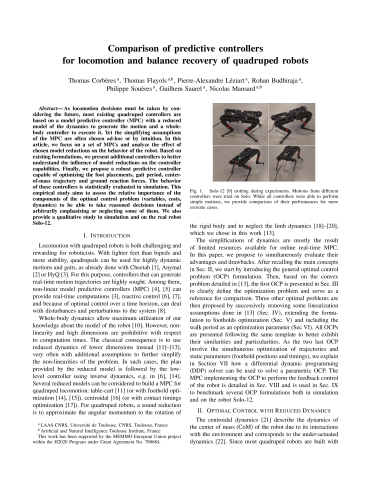
Comparison of predictive controllers for locomotion and balance recovery of quadruped robots
- Type de publi. : Communication dans un congrès
- Date de publi. : 30/05/2021
-
Auteurs :
Thomas CorbèresThomas FlayolsPierre-Alexandre LeziartRohan BudhirajaPhilippe SouèresGuilhem SaurelNicolas Mansard
Fiche détaillée
Comparison of predictive controllers for locomotion and balance recovery of quadruped robots
- Type de publi. : Communication dans un congrès
- Date de publi. : 30/05/2021
-
Auteurs :
Thomas CorbèresThomas FlayolsPierre-Alexandre LeziartRohan BudhirajaPhilippe SouèresGuilhem SaurelNicolas Mansard
-
Organismes :
Équipe Mouvement des Systèmes Anthropomorphes
Équipe Mouvement des Systèmes Anthropomorphes
Équipe Mouvement des Systèmes Anthropomorphes
Équipe Mouvement des Systèmes Anthropomorphes
Équipe Mouvement des Systèmes Anthropomorphes
Équipe Mouvement des Systèmes Anthropomorphes
Équipe Mouvement des Systèmes Anthropomorphes
Résumé : As locomotion decisions must be taken by considering the future, most existing quadruped controllers are based on a model predictive controller (MPC) with a reduced model of the dynamics to generate the motion, followed by a second whole-body controller to follow the movement. Yet the choice of the considered reduction in the MPC is often ad-hoc or decided by intuition. In this article, we focus on particular MPCs and analyze the effect of the reduced models on the robot behavior. Based on existing formulations, we offer additional controllers to better understand the influence of the reductions in the controller capabilities. Finally, we propose a robust predictive controller capable of optimizing the foot placements, gait period, center-of-mass trajectory and corresponding ground reaction forces. The behavior of these controllers is statistically evaluated in simulation. This empirical study is a basis for understanding the relative importance of the components of the optimal control problem (variables, costs, dynamics), that are sometimes arbitrarily emphasized or neglected. We also provide a qualitative study in simulation and on the real robot Solo.
Fichiers liés :
Comparison_of_predictive_controllers_for_locomotion_and_balance_recovery_of_quadruped_robots.pdf
Source
-
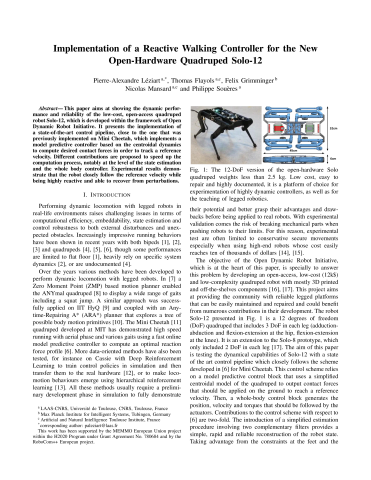
Implementation of a Reactive Walking Controller for the New Open-Hardware Quadruped Solo-12
- Type de publi. : Communication dans un congrès
- Date de publi. : 30/05/2021
-
Auteurs :
Pierre-Alexandre LeziartThomas FlayolsFelix GrimmingerNicolas MansardPhilippe Souères
Fiche détaillée
Implementation of a Reactive Walking Controller for the New Open-Hardware Quadruped Solo-12
- Type de publi. : Communication dans un congrès
- Date de publi. : 30/05/2021
-
Auteurs :
Pierre-Alexandre LeziartThomas FlayolsFelix GrimmingerNicolas MansardPhilippe Souères
-
Organismes :
Équipe Mouvement des Systèmes Anthropomorphes
Équipe Mouvement des Systèmes Anthropomorphes
Communauté d'universités et établissements de Toulouse
Max Planck Institute for Intelligent Systems [Tübingen]
Équipe Mouvement des Systèmes Anthropomorphes
Communauté d'universités et établissements de Toulouse
Équipe Mouvement des Systèmes Anthropomorphes
Résumé : This paper aims at showing the dynamic performance and reliability of the low-cost, open-access quadruped robot Solo-12, which is developed within the framework of Open Dynamic Robot Initiative. It presents the implementation of a state-of-the-art control pipeline, close to the one that was previously implemented on Mini Cheetah, which implements a model predictive controller based on the centroidal dynamics to compute desired contact forces in order to track a reference velocity. Different contributions are proposed to speed up the computation process, notably at the level of the state estimation and the whole body controller. Experimental results demonstrate that the robot closely follow the reference velocity while being highly reactive and able to recover from perturbations.
Fichiers liés :
leziart2021_Reactive_Walking_Controller_Solo12.pdf
Source
-
Assessment of genetically modified cotton GHB614 for renewal authorisation under Regulation (EC) No 1829/2003 (application EFSA–GMO–RX–018)
- Type de publi. : Article dans une revue
- Date de publi. : 28/05/2021
-
Auteurs :
Hanspeter NaegeliJean‐louis BressonTamas DalmayIan Crawford DewhurstMichelle M EpsteinLeslie George FirbankPhilippe GuercheJan HejatkoFrancisco Javier MorenoEwen MullinsFabien NoguéNils RostoksJose Juan Sánchez SerranoGiovanni SavoiniEve VeromannFabio VeronesiFernando ÁlvarezMichele ArdizzoneTommaso Raffaello
Fiche détaillée
Assessment of genetically modified cotton GHB614 for renewal authorisation under Regulation (EC) No 1829/2003 (application EFSA–GMO–RX–018)
- Type de publi. : Article dans une revue
- Date de publi. : 28/05/2021
-
Auteurs :
Hanspeter NaegeliJean‐louis BressonTamas DalmayIan Crawford DewhurstMichelle M EpsteinLeslie George FirbankPhilippe GuercheJan HejatkoFrancisco Javier MorenoEwen MullinsFabien NoguéNils RostoksJose Juan Sánchez SerranoGiovanni SavoiniEve VeromannFabio VeronesiFernando ÁlvarezMichele ArdizzoneTommaso Raffaello
-
Organismes :
Institut Jean-Pierre Bourgin - Sciences du végétal
Institut Jean-Pierre Bourgin - Sciences du végétal
- Publié dans EFSA Journal le 01/11/2020
Résumé : Following the submission of application EFSA-GMO-RX-018 under Regulation (EC) No 1829/2003 from BASF Agricultural Solutions Seed US LLC, the Panel on Genetically Modified Organisms of the European Food Safety Authority was asked to deliver a scientific risk assessment on the data submitted in the context of the renewal of authorisation application for the herbicide-tolerant genetically modified cotton GHB614, for food and feed uses, excluding cultivation within the European Union. The data received in the context of this renewal application contained post-market environmental monitoring reports, a systematic search and evaluation of literature, updated bioinformatic analyses, and additional documents or studies performed by or on behalf of the applicant. The GMO Panel assessed these data for possible new hazards, modified exposure or new scientific uncertainties identified during the authorisation period and not previously assessed in the context of the original application. The GMO Panel concludes that there is no evidence in renewal application EFSA-GMO-RX-018 for new hazards, modified exposure or scientific uncertainties that would change the conclusions of the original risk assessment on cotton GHB614.
Fichiers liés :
EFSA Journal - 2021 - - Assessment of genetically modified cotton GHB614 for renewal authorisation under Regulation EC .pdf
Source