Professeur des universités en sciences de gestion
-

The ExoGRAVITY project: using single mode interferometry to characterize exoplanets
- Type de publi. : Communication dans un congrès
- Date de publi. : 14/12/2020
-
Auteurs :
Sylvestre LacourJason WangMathias NowakLaurent PueyoFrank EisenhauerA-M LagrangePaul MollièreRoberto AbuterAntónio AmorinR Asensio-TorresMichi BaubockMyriam BenistyJean-Philippe BergerHervé BeustSarah BluntAnthony BoccalettiAlexander BohnMickael BonnefoyHenri BonnetWolfgang BrandnerFaustine CantalloubePaola CaselliBenjamin CharnayGaël ChauvinElodie ChoquetValentin ChristiaensYann ClénetAlex CridlandTim de ZeeuwRoderick DembetJason DexterAntonia DrescherGilles DuvertFeng GaoPaulo GarciaRebeca Garcia-LopezTyler GardnerÉric GendronReinhard GenzelStefan GillessenJulien H. GirardXavier HauboisGernot HeisselThomas HenningSasha HinkleyStefan HipplerMatthew HorrobinMatthis HoulleZoltan HubertA. Jimenez RosalesLaurent JocouJens KammererMiriam KepplerPierre KervellaLaura KreidbergVincent LapeyrereJean-Baptiste Le BouquinPierre LénaDieter LutzAnne-Lise MaireAntoine MérandJohn MonnierDavid MouilletAndré MullerE. NasedkinThomas OttGilles OttenClaudia PaladiniThibaut PaumardKarine Rousselet-PerrautGuy PerrinOliver PfuhlJulien RameauLaetitia RodetGustavo Rodriguez-CoiraGerard RoussetJinyi ShangguanTaro ShimizuJulia StadlerOdele StraubChristian StraubmeierEckhard SturmTomas StolkerEwine van DishoeckArthur ViganFrederic VincentSebastiano von FellenbergKim Ward DuongFelix WidmannEkkehard WieprechtErich WiezorrekJulien Woillez
Fiche détaillée
The ExoGRAVITY project: using single mode interferometry to characterize exoplanets
- Type de publi. : Communication dans un congrès
- Date de publi. : 14/12/2020
-
Auteurs :
Sylvestre LacourJason WangMathias NowakLaurent PueyoFrank EisenhauerA-M LagrangePaul MollièreRoberto AbuterAntónio AmorinR Asensio-TorresMichi BaubockMyriam BenistyJean-Philippe BergerHervé BeustSarah BluntAnthony BoccalettiAlexander BohnMickael BonnefoyHenri BonnetWolfgang BrandnerFaustine CantalloubePaola CaselliBenjamin CharnayGaël ChauvinElodie ChoquetValentin ChristiaensYann ClénetAlex CridlandTim de ZeeuwRoderick DembetJason DexterAntonia DrescherGilles DuvertFeng GaoPaulo GarciaRebeca Garcia-LopezTyler GardnerÉric GendronReinhard GenzelStefan GillessenJulien H. GirardXavier HauboisGernot HeisselThomas HenningSasha HinkleyStefan HipplerMatthew HorrobinMatthis HoulleZoltan HubertA. Jimenez RosalesLaurent JocouJens KammererMiriam KepplerPierre KervellaLaura KreidbergVincent LapeyrereJean-Baptiste Le BouquinPierre LénaDieter LutzAnne-Lise MaireAntoine MérandJohn MonnierDavid MouilletAndré MullerE. NasedkinThomas OttGilles OttenClaudia PaladiniThibaut PaumardKarine Rousselet-PerrautGuy PerrinOliver PfuhlJulien RameauLaetitia RodetGustavo Rodriguez-CoiraGerard RoussetJinyi ShangguanTaro ShimizuJulia StadlerOdele StraubChristian StraubmeierEckhard SturmTomas StolkerEwine van DishoeckArthur ViganFrederic VincentSebastiano von FellenbergKim Ward DuongFelix WidmannEkkehard WieprechtErich WiezorrekJulien Woillez
-
Organismes :
Laboratoire d'études spatiales et d'instrumentation en astrophysique = Laboratory of Space Studies and Instrumentation in Astrophysics
Laboratoire d'Astrophysique de Marseille
Laboratoire d'Astrophysique de Marseille
Fichiers liés :
2101.07098-2.pdf
Source
-

The power spectrum extended technique applied to images of binary stars in the infrared
- Type de publi. : Communication dans un congrès
- Date de publi. : 14/12/2020
-
Auteurs :
Eric AristidiEric CottalordaMarcel CarbilletLyu AbeKarim MakkiJean-Pierre RivetDavid VernetPhilippe Bendjoya
Fiche détaillée
The power spectrum extended technique applied to images of binary stars in the infrared
- Type de publi. : Communication dans un congrès
- Date de publi. : 14/12/2020
-
Auteurs :
Eric AristidiEric CottalordaMarcel CarbilletLyu AbeKarim MakkiJean-Pierre RivetDavid VernetPhilippe Bendjoya
-
Organismes :
Joseph Louis LAGRANGE
Joseph Louis LAGRANGE
ArianeGroup
Joseph Louis LAGRANGE
Joseph Louis LAGRANGE
Laboratoire d'Informatique et des Systèmes (LIS) (Marseille, Toulon)
Joseph Louis LAGRANGE
Observatoire de la Côte d'Azur
Joseph Louis LAGRANGE
Résumé : We recently proposed a new lucky imaging technique, the Power Spectrum Extended (PSE), adapted for image reconstruction of short-exposure astronomical images in case of weak turbulence or partial adaptive optics correction. In this communication we show applications of this technique to observations of about 30 binary stars in H band with the 1m telescope of the Calern C2PU observatory. We show some images reconstructed at the diffraction limit of the telescope and provide measurements of relative astrometry and photometry of observed couples.
Fichiers liés :
aristidi_pse_spie2020.pdf
Source
-
Anti-Inflammatory Effects of Analogues of N-Acyl Homoserine Lactones on Eukaryotic Cells
- Type de publi. : Article dans une revue
- Date de publi. : 11/12/2020
-
Auteurs :
Agathe PeyrottesGarance CoquantLoïc BrotDominique RainteauPhilippe Philippe SeksikJean-Pierre GrillJean-Maurice Mallet
Fiche détaillée
Anti-Inflammatory Effects of Analogues of N-Acyl Homoserine Lactones on Eukaryotic Cells
- Type de publi. : Article dans une revue
- Date de publi. : 11/12/2020
-
Auteurs :
Agathe PeyrottesGarance CoquantLoïc BrotDominique RainteauPhilippe Philippe SeksikJean-Pierre GrillJean-Maurice Mallet
-
Organismes :
Laboratoire des biomolécules
Centre de Recherche Saint-Antoine
Centre de Recherche Saint-Antoine
Centre de Recherche Saint-Antoine
Centre de Recherche Saint-Antoine
Centre de Recherche Saint-Antoine
CHU Saint-Antoine [AP-HP]
Centre de Recherche Saint-Antoine
Laboratoire des biomolécules
- Publié dans International Journal of Molecular Sciences le 03/05/2024
Résumé : Background: Since acyl-homoserine lactone (AHL) profiling has been described in the gut of healthy subjects and patients with inflammatory bowel disease (IBD), the potential effects of these molecules on host cells have raised interest in the medical community. In particular, natural AHLs such as the 3-oxo-C12-HSL exhibit anti-inflammatory properties. Our study aimed at finding stable 3-oxo-C12-HSL-derived analogues with improved anti-inflammatory effects on epithelial and immune cells. Methods: We first studied the stability and biological properties of the natural 3-oxo-C12-HSL on eukaryotic cells and a bacterial reporter strain. We then constructed and screened a library of 22 AHL-derived molecules. Anti-inflammatory effects were assessed by cytokine release in an epithelial cell model, Caco-2, and a murine macrophage cell line, RAW264.7, (respectively, IL-8 and IL-6) upon exposure to the molecule and after appropriate stimulation (respectively, TNF-α 50 ng/mL and IFN-γ 50 ng/mL, and LPS 10 ng/mL and IFN-γ 20 U/mL). Results: We found two molecules of interest with amplified anti-inflammatory effects on mammalian cells without bacterial-activating properties in the reporter strain. The molecules furthermore showed improved stability in biological medium compared to the native 3-oxo-C12-HSL. Conclusions: We provide new bio-inspired AHL analogues with strong anti-inflammatory properties that will need further study from a therapeutic perspective.
Fichiers liés :
ijms-21-09448.pdf
Source
-
Acute and Chronic Sarcoid Arthropathies: Characteristics and Treatments From a Retrospective Nationwide French Study
- Type de publi. : Article dans une revue
- Date de publi. : 10/12/2020
-
Auteurs :
Carlotta CacciatorePierre BelnouSara ThietartCarole DesthieuxMathilde VersiniNoémie AbisrorSébastien OttavianiGregoire CormierAlban DerouxAzeddine DellalNicolas BelhommeNathalie Saidenberg Kermanac'HPhilippe KhafagyMartin MichaudSylvain LanotFabrice CarratOlivier FainArsène Mékinian
Fiche détaillée
Acute and Chronic Sarcoid Arthropathies: Characteristics and Treatments From a Retrospective Nationwide French Study
- Type de publi. : Article dans une revue
- Date de publi. : 10/12/2020
-
Auteurs :
Carlotta CacciatorePierre BelnouSara ThietartCarole DesthieuxMathilde VersiniNoémie AbisrorSébastien OttavianiGregoire CormierAlban DerouxAzeddine DellalNicolas BelhommeNathalie Saidenberg Kermanac'HPhilippe KhafagyMartin MichaudSylvain LanotFabrice CarratOlivier FainArsène Mékinian
-
Organismes :
CHU Saint-Antoine [AP-HP]
CHU Saint-Antoine [AP-HP]
CHU Saint-Antoine [AP-HP]
CHU Saint-Antoine [AP-HP]
Centre Hospitalier Universitaire de Nice
CHU Saint-Antoine [AP-HP]
AP-HP - Hôpital Bichat - Claude Bernard [Paris]
Centre Hospitalier Départemental - Hôpital de La Roche-sur-Yon
Centre Hospitalier Universitaire [CHU Grenoble]
Groupe Hospitalier Intercommunal Le Raincy-Montfermeil
Centre Hospitalier Universitaire de Rennes [CHU Rennes] = Rennes University Hospital [Pontchaillou]
Groupe Hospitalier Avicenne-Jean Verdier-René Muret
Centre for Research in Epidemiology and Statistics | Centre de Recherche Épidémiologie et Statistiques
Groupe Hospitalier Intercommunal Le Raincy-Montfermeil
Hôpital Joseph Ducuing - Varsovie [Toulouse]
Centre Hospitalier Intercommunal Alençon-Mamers
Institut Pierre Louis d'Epidémiologie et de Santé Publique
CHU Saint-Antoine [AP-HP]
CHU Saint-Antoine [AP-HP]
CHU Saint-Antoine [AP-HP]
- Publié dans Frontiers in Medicine le 01/11/2020
Résumé : Introduction: We aimed to analyze patients with acute and chronic joint involvements in sarcoidosis. Methods: This is a retrospective multicenter analysis of patients with proven sarcoidosis, as defined by clinical, radiological, and histological criteria, with at least one clinical and/or ultrasonographic synovitis. Results: Thirty-nine patients with sarcoid arthropathy were included, and among them 19 had acute sarcoidosis (Lofgren's syndrome). Joint involvement and DAS44-CRP were not significantly different in acute and chronic sarcoid arthropathies. Acute forms were more frequent than chronic sarcoid arthropathy in Caucasians, without any difference of sex or age between these 2 forms. Joint involvement was frequently more symmetrical in acute than chronic forms (100 vs. 70%; p < 0.05), with a more frequent involvement in wrists and ankles in acute forms, whereas the tender and swollen joint counts and the DAS44-CRP were similar between the 2 groups. Skin lesions were significantly more frequent in patients with acute forms [17 (89%) vs. 5 (25%); p < 0.05] and were erythema nodosum in all patients with Löfgren's syndrome and sarcoid skin lesions in those with chronic sarcoidosis. Among 20 patients with chronic sarcoidosis, treatment was used in 17 (85%) cases, and consisted in NSAIDs alone (n = 5; 25%), steroids alone (n = 5; 25%), hydroxychloroquine (n = 2; 20%), methotrexate (n = 3; 15%), and TNF inhibitors (n = 2; 10%). A complete/partial joint response was noted in 14 (70%) cases with a DAS44-CRP reduction of 2.07 [1.85–2.44] (from 3.13 [2.76–3.42] to 1.06 [0.9–1.17]; p < 0.05). Conclusion: Sarcoid arthropathies have different clinical phenotypes in acute and chronic forms and various treatment regimens such as hydroxychloroquine and methotrexate could be used in chronic forms.
Fichiers liés :
fmed-07-565420.pdf
Source
-
Assessment of genetically modified maize MON 88017 × MON 810 for renewal authorisation under Regulation (EC) No 1829/2003 (application EFSA‐GMO‐RX‐017)
- Type de publi. : Article dans une revue
- Date de publi. : 09/12/2020
-
Auteurs :
Hanspeter NaegeliJean‐louis BressonTamas DalmayIan Crawford DewhurstMichelle M EpsteinLeslie George FirbankPhilippe GuercheJan HejatkoFrancisco Javier MorenoEwen MullinsFabien NoguéNils RostoksJose Juan Sánchez SerranoGiovanni SavoiniEve VeromannFabio VeronesiFernando ÁlvarezMichele ArdizzoneTommaso Raffaello. GMO EFSA Panel on Genetically Modified Organisms
Fiche détaillée
Assessment of genetically modified maize MON 88017 × MON 810 for renewal authorisation under Regulation (EC) No 1829/2003 (application EFSA‐GMO‐RX‐017)
- Type de publi. : Article dans une revue
- Date de publi. : 09/12/2020
-
Auteurs :
Hanspeter NaegeliJean‐louis BressonTamas DalmayIan Crawford DewhurstMichelle M EpsteinLeslie George FirbankPhilippe GuercheJan HejatkoFrancisco Javier MorenoEwen MullinsFabien NoguéNils RostoksJose Juan Sánchez SerranoGiovanni SavoiniEve VeromannFabio VeronesiFernando ÁlvarezMichele ArdizzoneTommaso Raffaello. GMO EFSA Panel on Genetically Modified Organisms
-
Organismes :
Institute of Pharmacology and Toxicology [Zurich]
Earlham Institute [Norwich]
Department of Dermatology Division of Immunology, Allergy and Infectious Diseases
Medical University of Vienna = Medizinische Universität Wien
Centre for Ecology and Hydrology [Bangor]
Institut Jean-Pierre Bourgin - Sciences du végétal
Institut Jean-Pierre Bourgin - Sciences du végétal
Estonian University of Life Sciences
Centre for Water Research
Instituto de Fisica "Gleb Wataghin"
Helsingin yliopisto = Helsingfors universitet = University of Helsinki
European Food Safety Authority
- Publié dans EFSA Journal le 01/11/2020
Résumé : Following the submission of application EFSA-GMO-RX-017 under Regulation (EC) No 1829/2003 from Bayer Agriculture BVBA the Panel on Genetically Modified Organisms of the European Food Safety Authority was asked to deliver a scientific risk assessment on the data submitted in the context of the renewal of authorisation application for the insect-resistant and herbicide-tolerant genetically modified maize MON 88017 9 MON 810, for food and feed uses, excluding cultivation within the European Union. The data received in the context of this renewal application contained post-market environmental monitoring reports, a systematic search and evaluation of literature, and updated bioinformatic analysis. The GMO Panel assessed these data for possible new hazards, modified exposure or new scientific uncertainties identified during the authorisation period and not previously assessed in the context of the original application. Under the assumption that the DNA sequences of the events in maize MON 88017 9 MON 810 considered for renewal are identical to the sequence of the originally assessed events, the GMO Panel concludes that there is no evidence in renewal application EFSA-GMO-RX-017 for new hazards, modified exposure or scientific uncertainties that would change the conclusions of the original risk assessment on maize MON 88017 9 MON 810.
Fichiers liés :
EFSA-GMO-RX-017.pdf
Source
-

Journées Chevreul 2020 : Les lipides au cœur d'enjeux de transition
- Type de publi. : Ouvrage (y compris édition critique et traduction)
- Date de publi. : 08/12/2020
-
Auteurs :
Claire Bourlieu-LacanalClaire Berton-CarabinJean-David RodierPierre VilleneuvePhilippe P. GuesnetBernadette DelplanqueFrédéric Fine
Fiche détaillée
Journées Chevreul 2020 : Les lipides au cœur d'enjeux de transition
- Type de publi. : Ouvrage (y compris édition critique et traduction)
- Date de publi. : 08/12/2020
-
Auteurs :
Claire Bourlieu-LacanalClaire Berton-CarabinJean-David RodierPierre VilleneuvePhilippe P. GuesnetBernadette DelplanqueFrédéric Fine
-
Organismes :
Ingénierie des Agro-polymères et Technologies Émergentes
Unité de recherche sur les Biopolymères, Interactions Assemblages
Gattefossé SAS
Ingénierie des Agro-polymères et Technologies Émergentes
Source
-

Improvements of Algebraic Attacks for Solving the Rank Decoding and MinRank Problems
- Type de publi. : Communication dans un congrès
- Date de publi. : 07/12/2020
-
Auteurs :
Magali BardetMaxime BrosDaniel CabarcasPhilippe GaboritRay PerlnerDaniel Smith-ToneJean-Pierre TillichJavier Verbel
Fiche détaillée
Improvements of Algebraic Attacks for Solving the Rank Decoding and MinRank Problems
- Type de publi. : Communication dans un congrès
- Date de publi. : 07/12/2020
-
Auteurs :
Magali BardetMaxime BrosDaniel CabarcasPhilippe GaboritRay PerlnerDaniel Smith-ToneJean-Pierre TillichJavier Verbel
-
Organismes :
Laboratoire d'Informatique, de Traitement de l'Information et des Systèmes
Cryptologie symétrique, cryptologie fondée sur les codes et information quantique
XLIM
Universidad Nacional de Colombia Sede Medellín
XLIM
Computer Security Division
Computer Security Division
University of Louisville
Cryptologie symétrique, cryptologie fondée sur les codes et information quantique
Universidad Nacional de Colombia Sede Medellín
Résumé : In this paper, we show how to significantly improve algebraic techniques for solving the MinRank problem, which is ubiquitous in multivariate and rank metric code based cryptography. In the case of the structured MinRank instances arising in the latter, we build upon a recent breakthrough [11] showing that algebraic attacks outperform the combinatorial ones that were considered state of the art up until now. Through a slight modification of this approach, we completely avoid Gr¨obner bases computations for certain parameters and are left only with solving linear systems. This does not only substantially improve the complexity, but also gives a convincing argument as to why algebraic techniques work in this case. When used against the second round NIST-PQC candidates ROLLO-I-128/192/256, our new attack has bit complexity respectively 71, 87, and 151, to be compared to 117, 144, and 197 as obtained in [11]. The linear systems arise from the nullity of the maximal minors of a certain matrix associated to the algebraic modeling. We also use a similar approach to improve the algebraic MinRank solvers for the usual MinRank problem. When applied against the second round NIST-PQC candidates GeMSS and Rainbow, our attack has a complexity that is very close to or even slightly better than those of the best known attacks so far. Note that these latter attacks did not rely on MinRank techniques since the MinRank approach used to give complexities that were far away from classical security levels.
Fichiers liés :
articlev2.pdf
Source
-
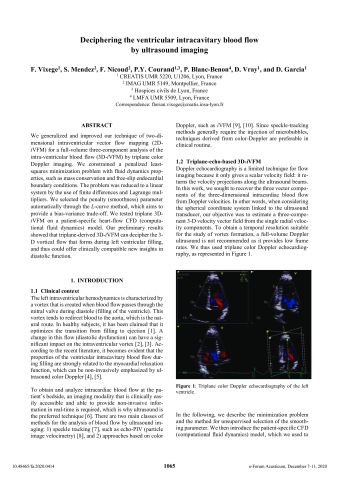
Deciphering the ventricular intracavitary blood flow by ultrasound imaging
- Type de publi. : Communication dans un congrès
- Date de publi. : 07/12/2020
-
Auteurs :
Florian VixegeSimon MendezFranck NicoudPierre-Yves CourandPhilippe Blanc-BenonDidier VrayDamien Garcia
Fiche détaillée
Deciphering the ventricular intracavitary blood flow by ultrasound imaging
- Type de publi. : Communication dans un congrès
- Date de publi. : 07/12/2020
-
Auteurs :
Florian VixegeSimon MendezFranck NicoudPierre-Yves CourandPhilippe Blanc-BenonDidier VrayDamien Garcia
-
Organismes :
Centre de Recherche en Acquisition et Traitement de l'Image pour la Santé
Centre National de la Recherche Scientifique
Université de Montpellier
Institut Montpelliérain Alexander Grothendieck
Institut Montpelliérain Alexander Grothendieck
Université Claude Bernard Lyon 1
Centre de Recherche en Acquisition et Traitement de l'Image pour la Santé
Laboratoire de Mecanique des Fluides et d'Acoustique
Imagerie Ultrasonore
Centre de Recherche en Acquisition et Traitement de l'Image pour la Santé
Institut National de la Santé et de la Recherche Médicale
Résumé : The accessibility of echocardiography and its ability to provide non-invasive information in real time make ultrasound the essential technique for evaluating diastolic function of the left ventricle. However, the diagnosis of diastolic dysfunction remains uncertain because echocardiographic indices may lead to divergent conclusions. During diastole, the mitral valve forces the left intraventricular flow to create a vortex. In healthy subjects, this vortex naturally redirects blood flow to the left ventricular outflow tract and helps the transition from filling to ejection. When the filling is impaired (diastolic dysfunction), a change in blood flow occurs, with a significant impact on the intraventricular vortex. The aim of this study is to reconstruct the 3D intraventricular blood flow to assist in the diagnosis of diastolic dysfunction. Color Doppler mode provides partial information of the velocity field since only the velocity components projected along the ultrasonic beams are available. To reconstruct the 3D intraventricular flow, we propose to generalize the method previously developed in 2D by [Assi et al, Physics in Medicine and Biology, 2017] which enables the reconstruction of a 2D flow through an optimization method based on fluid mechanics equations (continuity equation, boundary conditions?). From echocardiographic B-mode and color Doppler images acquired in tri-plane mode, volumetric three-component velocities can be reconstructed. Our algorithm was validated on a simulated three-dimensional Hill?s vortex ring. The 3D vertical flows were adequately recovered. The normalized velocity errors were ranged between 8 and 20% for acquisition angles in [-15°, 15°]. The next step is to validate the proposed method on a realistic patient-specific model of the intraventricular blood flow developed by the team [Chnafa et al, Computers & Fluids, 2014].
Fichiers liés :
000414.pdf
Source
-
Avis de l'Anses relatif à « l’utilisation d’huiles essentielles de Melaleuca dans la composition des compléments alimentaires »
- Type de publi. : Rapport
- Date de publi. : 03/12/2020
-
Auteurs :
Bernard WenigerSabrina BoutefnouchetPierre ChampyHanh DufatMohamed HaddadThierry HennebelleSerge MichaletClaude MoulisCéline RivièreCatherine Vonthron-SénécheauFabrice NesslanySabrina BoutefnouchetMarion GirardotMarie-Aleth Lacaille-DuboisFlorence SouardDominique Angèle VuittonClaude AtgieSébastien AnthérieuElmira Arab-TehranyMichel BaccaunaudJalloul BouajilaNicolas J. CabatonRonan CariouMarie-Christine ChagnonDany ChevalierFranck CleymandVéronique ComaFlorence LacosteMichel LinderGeorges C LognayEric MarchioniDidier MontetAnne PlatelPhilippe SaillardPatrick P. SauvegrainFrançois ZuberFernando AguilarFanny HuretAymeric DopterYoussef El OuadrhiriIrène Margaritis
Fiche détaillée
Avis de l'Anses relatif à « l’utilisation d’huiles essentielles de Melaleuca dans la composition des compléments alimentaires »
- Type de publi. : Rapport
- Date de publi. : 03/12/2020
-
Auteurs :
Bernard WenigerSabrina BoutefnouchetPierre ChampyHanh DufatMohamed HaddadThierry HennebelleSerge MichaletClaude MoulisCéline RivièreCatherine Vonthron-SénécheauFabrice NesslanySabrina BoutefnouchetMarion GirardotMarie-Aleth Lacaille-DuboisFlorence SouardDominique Angèle VuittonClaude AtgieSébastien AnthérieuElmira Arab-TehranyMichel BaccaunaudJalloul BouajilaNicolas J. CabatonRonan CariouMarie-Christine ChagnonDany ChevalierFranck CleymandVéronique ComaFlorence LacosteMichel LinderGeorges C LognayEric MarchioniDidier MontetAnne PlatelPhilippe SaillardPatrick P. SauvegrainFrançois ZuberFernando AguilarFanny HuretAymeric DopterYoussef El OuadrhiriIrène Margaritis
-
Organismes :
Université de Strasbourg
Chimie Organique, Médicinale et Extractive et Toxicologie Expérimentale
Université Paris-Sud - Paris 11
Cibles Thérapeutiques et conception de médicaments
Pharmacochimie et Biologie pour le Développement
BioEcoAgro - Equipe 5 - Specialized Metabolites of Plant Origin
Laboratoire d'Ecologie Microbienne - UMR 5557
Pharmacochimie et Biologie pour le Développement
Faculté de Médecine Henri Warembourg - Université de Lille
Laboratoire d'Innovation Thérapeutique
Institut Pasteur de Lille
Chimie Organique, Médicinale et Extractive et Toxicologie Expérimentale
Écologie et biologie des interactions [UMR 7267]
Microorganismes, Hôtes, Environnements [Équipe du laboratoire EBI Poitiers]
Université Bourgogne Franche-Comté [COMUE]
Université Grenoble Alpes - UFR Pharmacie
Department of Parasitology-Mycology, National Reference Centre for Echinococcoses, University Hospital of Besançon, 25030 Besançon, France
Université de Bordeaux
Impact de l'environnement chimique sur la santé humaine - ULR 4483
Laboratoire d'Ingénierie des Biomolécules
Retraité
Laboratoire de Génie Chimique
Métabolisme et Xénobiotiques
Laboratoire d'étude des Résidus et Contaminants dans les Aliments
Equipe NuTox (LNC - U1231)
Université de Lille
Institut Jean Lamour
Laboratoire de Chimie des Polymères Organiques
Team 2 LCPO : Biopolymers & Bio-sourced Polymers
Equipe Nutrition, Santé et Biochimie des Lipides
Laboratoire d'Ingénierie des Biomolécules
Gembloux Agro-Bio Tech [Faculté universitaire des sciences agronomiques de Gembloux]
Institut Pluridisciplinaire Hubert Curien
Démarche intégrée pour l'obtention d'aliments de qualité
Département Performances des systèmes de production et de transformation tropicaux
Institut Pasteur de Lille
Centre Technique de la Conservation des Produits Agricole, Site Agroparc
Retraité
Centre Technique de la Conservation des Produits Agricole, Site Agroparc
Direction de l'Evaluation des Risques
Direction de l'Evaluation des Risques
Direction de l'Evaluation des Risques
Direction de l'Evaluation des Risques
Direction de l'Evaluation des Risques
Résumé : L’utilisation des compléments alimentaires en France est encadrée par le décret n°2006-352 du 20 mars 20062 qui décrit dans son article 16 le principe de reconnaissance mutuelle, permettant la déclaration de mise sur le marché d’un complément alimentaire fabriqué ou commercialisé dans un autre Etat-membre de la Communauté européenne. Dans ce cadre, des demandes d’utilisation d’huiles essentielles de Melaleuca dans la composition de compléments alimentaires ont été déposées auprès des services compétents de la DGCCRF. En Italie, les huiles essentielles des espèces suivantes sont autorisées : Melaleuca alternifolia (Maiden & Betche) Cheel, Melaleuca cajuputi Powell, Melaleuca leucadendra (L.) L., Melaleuca viridiflora Sol. ex Gaertn. La Belgique les interdit formellement depuis le mois de janvier 2017. Le groupe Belfrit3 a émis des réserves quant à l’usage oral de ces huiles essentielles, en dehors de l’usage connu en tant qu’arômes alimentaires (Conseil de l'Europe 1981). La monographie de l’Agence européenne des médicaments (EMA) contre-indique également l’usage oral de ces huiles essentielles (EMA 2015). Ces réserves semblent résulter des atteintes neurologiques que peuvent provoquer ces huiles chez les jeunes enfants (ataxie, troubles moteurs, stupeur). Toutefois, les opérateurs commercialisant ces huiles essentielles font valoir que les doses impliquées dans les accidents sont très élevées (10 mL soit 9 g), loin des doses préconisées (100 mg) et relèvent de mésusages.
Source
-
Coffee Microbiota and Its Potential Use in Sustainable Crop Management. A Review
- Type de publi. : Article dans une revue
- Date de publi. : 03/12/2020
-
Auteurs :
Duong BenoitPierre MarracciniJean Luc MaeghtP. VaastRobin Duponnois
Fiche détaillée
Coffee Microbiota and Its Potential Use in Sustainable Crop Management. A Review
- Type de publi. : Article dans une revue
- Date de publi. : 03/12/2020
-
Auteurs :
Duong BenoitPierre MarracciniJean Luc MaeghtP. VaastRobin Duponnois
-
Organismes :
Laboratoire des symbioses tropicales et méditerranéennes
LMI RICE, Agricultural Genetics Institute
UMR - Interactions Plantes Microorganismes Environnement
LMI RICE, Agricultural Genetics Institute
Département Systèmes Biologiques
Botanique et Modélisation de l'Architecture des Plantes et des Végétations
Institut d'écologie et des sciences de l'environnement de Paris
Ecologie fonctionnelle et biogéochimie des sols et des agro-écosystèmes
Département Performances des systèmes de production et de transformation tropicaux
Laboratoire des symbioses tropicales et méditerranéennes
- Publié dans Frontiers in Sustainable Food Systems le 01/11/2020
Résumé : Intensive coffee production is accompanied by several environmental issues, including soil degradation, biodiversity loss, and pollution due to the wide use of agrochemical inputs and wastes generated by processing. In addition, climate change is expected to decrease the suitability of cultivated areas while potentially increasing the distribution and impact of pests and diseases. In this context, the coffee microbiota has been increasingly studied over the past decades in order to improve the sustainability of the coffee production. Therefore, coffee associated microorganisms have been isolated and characterized in order to highlight their useful characteristics and study their potential use as sustainable alternatives to agrochemical inputs. Indeed, several microorganisms (including bacteria and fungi) are able to display plant growth-promoting capacities and/or biocontrol abilities toward coffee pests and diseases. Despite that numerous studies emphasized the potential of coffee-associated microorganisms under controlled environments, the present review highlights the lack of confirmation of such beneficial effects under field conditions. Nowadays, next-generation sequencing technologies allow to study coffee associated microorganisms with a metabarcoding/metagenomic approach. This strategy, which does not require cultivating microorganisms, now provides a deeper insight in the coffee-associated microbial communities and their implication not only in the coffee plant fitness but also in the quality of the final product. The present review aims at (i) providing an extensive description of coffee microbiota diversity both at the farming and processing levels, (ii) identifying the “coffee core microbiota,” (iii) making an overview of microbiota ability to promote coffee plant growth and to control its pests and diseases, and (iv) highlighting the microbiota potential to improve coffee quality and waste management sustainability.
Fichiers liés :
fsufs-04-607935.pdf
Source