Professeur des universités en sciences de gestion
-

A decomposition method by component for the optimization of maintenance scheduling
- Type de publi. : Communication dans un congrès
- Date de publi. : 13/10/2020
-
Auteurs :
Thomas BittarJean-Philippe ChancelierPierre CarpentierJérôme Lonchampt
Fiche détaillée
A decomposition method by component for the optimization of maintenance scheduling
- Type de publi. : Communication dans un congrès
- Date de publi. : 13/10/2020
-
Auteurs :
Thomas BittarJean-Philippe ChancelierPierre CarpentierJérôme Lonchampt
-
Organismes :
Performance, Risque Industriel, Surveillance pour la Maintenance et l’Exploitation
Centre d'Enseignement et de Recherche en Mathématiques et Calcul Scientifique
Optimisation et commande
Performance, Risque Industriel, Surveillance pour la Maintenance et l’Exploitation
Résumé : We present a decomposition method based on the Auxiliary Problem Principle to design optimal maintenance scheduling policies for systems of physical components (turbines, generators, transformers) sharing a common stock of spare parts. The method outperforms a reference blackbox method on a system with 80 components.
Fichiers liés :
LM22_COM_FULL_482722_Thomas_Bittar_20200709_311454.pdf
Source
-

Plasmacytoid dendritic cells proliferation associated with acute myeloid leukemia: phenotype profile and mutation landscape
- Type de publi. : Article dans une revue
- Date de publi. : 13/10/2020
-
Auteurs :
Loria ZalmaïPierre-Julien ViaillySabeha BiichleMeyling CheokLou SoretFanny Angelot-DelettreTony PetrellaMarie-Agnès Collonge-RameEstelle SeillesSandrine GeffroyEric DeconinckEtienne DaguindauSabrina BouyerElodie DindinaudVictor BauninMagali Le Garff-TavernierDamien Roos-WeilOrianne Wagner-BallonVéronique SalaunJean FeuillardSophie BrunBernard DrenouCaroline Mayeur-RoussePatricia OkambaVéronique DorvauxMichel TichionniJohann RoseMarie-Thérèse RubioMarie Christine JacobVictoria RaggueneauClaude PreudhommePhilippe SaasChristophe FerrandOlivier AdoteviChristophe RoumierFabrice JardinFrancine Garnache-OttouFlorian Renosi
Fiche détaillée
Plasmacytoid dendritic cells proliferation associated with acute myeloid leukemia: phenotype profile and mutation landscape
- Type de publi. : Article dans une revue
- Date de publi. : 13/10/2020
-
Auteurs :
Loria ZalmaïPierre-Julien ViaillySabeha BiichleMeyling CheokLou SoretFanny Angelot-DelettreTony PetrellaMarie-Agnès Collonge-RameEstelle SeillesSandrine GeffroyEric DeconinckEtienne DaguindauSabrina BouyerElodie DindinaudVictor BauninMagali Le Garff-TavernierDamien Roos-WeilOrianne Wagner-BallonVéronique SalaunJean FeuillardSophie BrunBernard DrenouCaroline Mayeur-RoussePatricia OkambaVéronique DorvauxMichel TichionniJohann RoseMarie-Thérèse RubioMarie Christine JacobVictoria RaggueneauClaude PreudhommePhilippe SaasChristophe FerrandOlivier AdoteviChristophe RoumierFabrice JardinFrancine Garnache-OttouFlorian Renosi
-
Organismes :
Hétérogénéité, Plasticité et Résistance aux Thérapies des Cancers = Cancer Heterogeneity, Plasticity and Resistance to Therapies - UMR 9020 - U 1277
Hétérogénéité, Plasticité et Résistance aux Thérapies des Cancers = Cancer Heterogeneity, Plasticity and Resistance to Therapies - UMR 9020 - U 1277
Institut de Pathologie [CHU Lille]
Hétérogénéité, Plasticité et Résistance aux Thérapies des Cancers = Cancer Heterogeneity, Plasticity and Resistance to Therapies - UMR 9020 - U 1277
Institut de Pathologie [CHU Lille]
Hétérogénéité, Plasticité et Résistance aux Thérapies des Cancers = Cancer Heterogeneity, Plasticity and Resistance to Therapies - UMR 9020 - U 1277
Service de pathologie [CHU Lille]
- Publié dans Haematologica le 30/10/2020
Résumé : Neoplasms involving plasmacytoid dendritic cells (pDC) include blastic pDC neoplasms (BPDCN) and other pDC proliferations, where pDC are associated with myeloid malignancies: most frequently chronic myelomonocytic leukemia (CMML) but also acute myeloid leukemia (AML), hereafter named pDC-AML. We aimed to determine the reactive or neoplastic origin of pDC in pDC-AML, and their link with the CD34+ blasts, monocytes or conventional DC (cDC) associated in the same sample, by phenotypic and molecular analyses (targeted next-generation sequencing, 70 genes). We compared 15 pDCAML at diagnosis with 21 BPDCN and 11 normal pDC from healthy donors. CD45low CD34+ blasts were found in all cases (10-80% of medullar cells), associated with pDC (4-36%), monocytes in 14 cases (1-10%) and cDC (two cases, 4.8-19%). pDC in pDC-AML harbor a clearly different phenotype from BPDCN: CD4+ CD56– in 100% of cases, most frequently CD303+, CD304+ and CD34+; lower expression of cTCL1 and CD123 with isolated lymphoid markers (CD22/CD7/CD5) in some cases, suggesting a prepDC stage. In all cases, pDC, monocytes and cDC are neoplastic since they harbor the same mutations as CD34+ blasts. RUNX1 is the most commonly mutated gene: detected in all AML with minimal differentiation (M0-AML) but not in the other cases. Despite the low number of cases, the systematic association between M0-AML, RUNX1 mutations and an excess of pDC is puzzling. Further evaluation in a larger cohort is required to confirm RUNX1 mutations in pDC-AML with minimal differentiation and to investigate whether it represents a proliferation of blasts with macrophage and DC progenitor potential.
Source
-
LMAIR : an innovative network of instrumented platforms for marine and underwater technologies
- Type de publi. : Communication dans un congrès
- Date de publi. : 12/10/2020
-
Auteurs :
Pierre-Jean BouvetPhilippe ForjonelYves Auffret
Fiche détaillée
LMAIR : an innovative network of instrumented platforms for marine and underwater technologies
- Type de publi. : Communication dans un congrès
- Date de publi. : 12/10/2020
-
Auteurs :
Pierre-Jean BouvetPhilippe ForjonelYves Auffret
-
Organismes :
Systèmes Embarqués, Acoustique et Télécommunications
Systèmes Embarqués, Acoustique et Télécommunications
Systèmes Embarqués, Acoustique et Télécommunications
Source
-
Scedosporiosis/lomentosporiosis observational study (SOS): Clinical significance of Scedosporium species identification
- Type de publi. : Article dans une revue
- Date de publi. : 09/10/2020
-
Auteurs :
Didier BronnimannDea Garcia-HermosoFrançoise DromerFanny LanternierLaurence MaulinYves LeprinceNathalie BrieuBérengère GrusonYoussef El SamadTaieb ChouakiSophie BayleCécile JensenStéphanie BrangerGrégoire LeclercLaurent Hustache-MathieuFabrice LarosaFrédéric GrenouilletDiane BouvryFrédéric MechaiSophie BrunFrédéric VillegaHervé DutroncJean-François VellyLaurence DelhaesFrederic GabrielNicolas PaleironLaurence Di Costanzo PougnetAnne de TinteniacLuc QuaesaetLiana CarausuGaelle GuillermLenaïg Le ClechGilles NevezJulie BonhommeCécile Molucon-ChabrotJacques-Olivier BayCéline NourrissonPhilippe PoirierAgnès LefortVéronique Leflon-GuiboutCatherine CordonnierNicolas LimalFrançoise BotterelHôpital Henri MondorPhilippe ZannBenoit RozeNicole DesboisLelia EscautJean-François PaponAdela AngoulvantKamel LaribiPascale PennPascal TurlureThomas DaixBoris MelloniBernard BouteilleThomas PerpointFlorence AderMarie BalsatFlorence PersatJean-Marie ForelValérie MoalStephane RanqueCristina AudolyDelphine LancementCaroline FritzJoséphine DorinMarie MachouartDavid BoutoilleJérémie OrainDelphine Horeau-LanglardFlorent MorioOlivier MoquetViviane Queyrel-MoranneLionel MannonePierre-Marie RogerMartine Gari-ToussaintLilia HasseineGiovanna IngenuoNicolas DurrlemanNina Arakelyan-LaboureDidier PoissonMarine PaulFrederic PeneAndré PaugamValérie ZellerBeate HeymRomain GuillemainYoann PrevotEric DannaouiPierre FrangeStéphane BlancheFelipe SuarezAnne ScemlaRomain GueryOlivier LortholaryMarie-Elisabeth BougnouxThomas SimilowskiEric CaumesArnaud FekkarAna PresedoPatricia MarianiNicolas EngrandFlore Sicre de FontbrunePhilippe HermanAlexandre AlanioStéphane BretagneRachel BraultBlandine RammaertCatherine Kauffmann-LacroixAlain DelmerViolaine NoelDominique ToubasAntoine HugueninMatthieu RevestSorya BelazJean-Pierre GangneuxCéline DievalIsabelle DegasneNicolas TraversierClaire Briere-BellierPatrick LutzFrançoise UettwillerRaoul HerbrechtValérie BruEmilie CatherinotLouis-Jean CoudercElizabeth RivaudPierre CahenFrançois BissuelMuriel AlvarezGuillaume Martin-BlondelMorgane MourguetEmmanuelle MouchonAnne HuynhNoémie GadaudJoelle GuitardXavier IriartSophie CassaingChristophe JoubertFrédéric JanvierAudrey BerricJacques GrillFlorence PasquierStéphane de BottonElisabeth ChachatyAnne BoulliéCécile GautierAudrey HesselDamien HoinardDorothée Raoux-BarbotThe French Mycoses Study Group
Fiche détaillée
Scedosporiosis/lomentosporiosis observational study (SOS): Clinical significance of Scedosporium species identification
- Type de publi. : Article dans une revue
- Date de publi. : 09/10/2020
-
Auteurs :
Didier BronnimannDea Garcia-HermosoFrançoise DromerFanny LanternierLaurence MaulinYves LeprinceNathalie BrieuBérengère GrusonYoussef El SamadTaieb ChouakiSophie BayleCécile JensenStéphanie BrangerGrégoire LeclercLaurent Hustache-MathieuFabrice LarosaFrédéric GrenouilletDiane BouvryFrédéric MechaiSophie BrunFrédéric VillegaHervé DutroncJean-François VellyLaurence DelhaesFrederic GabrielNicolas PaleironLaurence Di Costanzo PougnetAnne de TinteniacLuc QuaesaetLiana CarausuGaelle GuillermLenaïg Le ClechGilles NevezJulie BonhommeCécile Molucon-ChabrotJacques-Olivier BayCéline NourrissonPhilippe PoirierAgnès LefortVéronique Leflon-GuiboutCatherine CordonnierNicolas LimalFrançoise BotterelHôpital Henri MondorPhilippe ZannBenoit RozeNicole DesboisLelia EscautJean-François PaponAdela AngoulvantKamel LaribiPascale PennPascal TurlureThomas DaixBoris MelloniBernard BouteilleThomas PerpointFlorence AderMarie BalsatFlorence PersatJean-Marie ForelValérie MoalStephane RanqueCristina AudolyDelphine LancementCaroline FritzJoséphine DorinMarie MachouartDavid BoutoilleJérémie OrainDelphine Horeau-LanglardFlorent MorioOlivier MoquetViviane Queyrel-MoranneLionel MannonePierre-Marie RogerMartine Gari-ToussaintLilia HasseineGiovanna IngenuoNicolas DurrlemanNina Arakelyan-LaboureDidier PoissonMarine PaulFrederic PeneAndré PaugamValérie ZellerBeate HeymRomain GuillemainYoann PrevotEric DannaouiPierre FrangeStéphane BlancheFelipe SuarezAnne ScemlaRomain GueryOlivier LortholaryMarie-Elisabeth BougnouxThomas SimilowskiEric CaumesArnaud FekkarAna PresedoPatricia MarianiNicolas EngrandFlore Sicre de FontbrunePhilippe HermanAlexandre AlanioStéphane BretagneRachel BraultBlandine RammaertCatherine Kauffmann-LacroixAlain DelmerViolaine NoelDominique ToubasAntoine HugueninMatthieu RevestSorya BelazJean-Pierre GangneuxCéline DievalIsabelle DegasneNicolas TraversierClaire Briere-BellierPatrick LutzFrançoise UettwillerRaoul HerbrechtValérie BruEmilie CatherinotLouis-Jean CoudercElizabeth RivaudPierre CahenFrançois BissuelMuriel AlvarezGuillaume Martin-BlondelMorgane MourguetEmmanuelle MouchonAnne HuynhNoémie GadaudJoelle GuitardXavier IriartSophie CassaingChristophe JoubertFrédéric JanvierAudrey BerricJacques GrillFlorence PasquierStéphane de BottonElisabeth ChachatyAnne BoulliéCécile GautierAudrey HesselDamien HoinardDorothée Raoux-BarbotThe French Mycoses Study Group
-
Organismes :
Hôpital Necker - Enfants Malades [AP-HP]
Université Victor Segalen - Bordeaux 2
Université Paris Cité
Mycologie moléculaire - Molecular Mycology
Centre National de Référence Mycoses Invasives et Antifongiques - National Reference Center Invasive Mycoses & Antifungals
Mycologie moléculaire - Molecular Mycology
Centre National de Référence Mycoses Invasives et Antifongiques - National Reference Center Invasive Mycoses & Antifungals
Centre d'infectiologie Necker-Pasteur [CHU Necker]
Mycologie moléculaire - Molecular Mycology
Université Paris Cité
Centre National de Référence Mycoses Invasives et Antifongiques - National Reference Center Invasive Mycoses & Antifungals
Centre Hospitalier du Pays d'Aix
CHU Amiens-Picardie
Aliments Bioprocédés Toxicologie Environnements
CHU Caen Normandie – Centre Hospitalier Universitaire de Caen Normandie
- Publié dans Medical Mycology le 28/10/2020
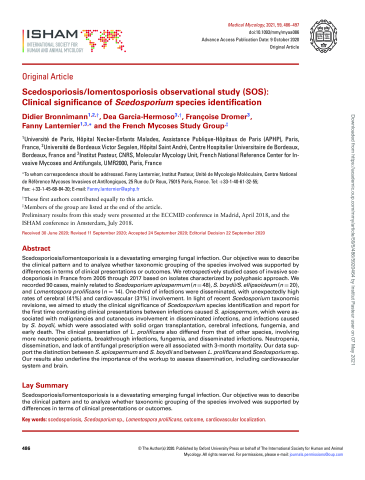
Résumé : Scedosporiosis/lomentosporiosis is a devastating emerging fungal infection. Our objective was to describe the clinical pattern and to analyze whether taxonomic grouping of the species involved was supported by differences in terms of clinical presentations or outcomes. We retrospectively studied cases of invasive scedosporiosis in France from 2005 through 2017 based on isolates characterized by polyphasic approach. We recorded 90 cases, mainly related to Scedosporium apiospermum (n = 48), S. boydii/S. ellipsoideum (n = 20), and Lomentospora prolificans (n = 14). One-third of infections were disseminated, with unexpectedly high rates of cerebral (41%) and cardiovascular (31%) involvement. In light of recent Scedosporium taxonomic revisions, we aimed to study the clinical significance of Scedosporium species identification and report for the first time contrasting clinical presentations between infections caused S. apiospermum, which were associated with malignancies and cutaneous involvement in disseminated infections, and infections caused by S. boydii, which were associated with solid organ transplantation, cerebral infections, fungemia, and early death. The clinical presentation of L. prolificans also differed from that of other species, involving more neutropenic patients, breakthrough infections, fungemia, and disseminated infections. Neutropenia, dissemination, and lack of antifungal prescription were all associated with 3-month mortality. Our data support the distinction between S. apiospermum and S. boydii and between L. prolificans and Scedosporium sp. Our results also underline the importance of the workup to assess dissemination, including cardiovascular system and brain. Lay Summary Scedosporiosis/lomentosporiosis is a devastating emerging fungal infection. Our objective was to describe the clinical pattern and to analyze whether taxonomic grouping of the species involved was supported by differences in terms of clinical presentations or outcomes.
Fichiers liés :
Bronnimann D, GarciaHermosoMEdicalMycology2021.pdf
Source
-

Risk factors for Coronavirus Disease 2019 (COVID-19) severity and mortality among solid cancer patients and impact of the disease on anticancer treatment: A French nationwide cohort study (GCO-002 CACOVID-19).
- Type de publi. : Article dans une revue
- Date de publi. : 08/10/2020
-
Auteurs :
Astrid LièvreAnthony TurpinIsabelle Ray-CoquardKarine Le MalicotJuliette ThariatGuido AhleCindy NeuzilletXavier PaolettiOlivier BouchéKais AldabbaghPierre MichelDidier DebieuvreAnthony CanellasMarie WislezLucie LaurentMay MabroRaphael ColleAnne-Claire Hardy-BessardLaura MansiEmeline ColombaJean BourhisPhilippe GorpheYoann PointreauAhmed IdbaihRenata UrsuAnna Luisa Di StefanoGérard ZalcmanThomas Aparicio
Fiche détaillée
Risk factors for Coronavirus Disease 2019 (COVID-19) severity and mortality among solid cancer patients and impact of the disease on anticancer treatment: A French nationwide cohort study (GCO-002 CACOVID-19).
- Type de publi. : Article dans une revue
- Date de publi. : 08/10/2020
-
Auteurs :
Astrid LièvreAnthony TurpinIsabelle Ray-CoquardKarine Le MalicotJuliette ThariatGuido AhleCindy NeuzilletXavier PaolettiOlivier BouchéKais AldabbaghPierre MichelDidier DebieuvreAnthony CanellasMarie WislezLucie LaurentMay MabroRaphael ColleAnne-Claire Hardy-BessardLaura MansiEmeline ColombaJean BourhisPhilippe GorpheYoann PointreauAhmed IdbaihRenata UrsuAnna Luisa Di StefanoGérard ZalcmanThomas Aparicio
-
Organismes :
Chemistry, Oncogenesis, Stress and Signaling
Centre Hospitalier Universitaire de Rennes [CHU Rennes] = Rennes University Hospital [Pontchaillou]
Hétérogénéité, Plasticité et Résistance aux Thérapies des Cancers = Cancer Heterogeneity, Plasticity and Resistance to Therapies - UMR 9020 - U 1277
Centre Léon Bérard [Lyon]
Lipides - Nutrition - Cancer [Dijon - U1231]
Centre Régional de Lutte contre le Cancer François Baclesse [Caen]
CH Colmar
Institut Curie [Paris]
Institut Curie [Paris]
Hôpital universitaire Robert Debré [Reims]
Génomique et Médecine Personnalisée du Cancer et des Maladies Neuropsychiatriques
Centre Hospitalier Emile Muller [Mulhouse]
CHU Tenon [AP-HP]
AP-HP - Hôpital Cochin Broca Hôtel Dieu [Paris]
Hôpital Beaujon
Hôpital Foch [Suresnes]
CHU Saint-Antoine [AP-HP]
ARCAGY-GINECO
Interactions hôte-greffon-tumeur, ingénierie cellulaire et génique - UFC (UMR INSERM 1098)
Institut Gustave Roussy
Département de médecine nucléaire [Rennes]
Institut Gustave Roussy
Département de médecine oncologique [Gustave Roussy]
Institut Gustave Roussy
Département de cancérologie cervico-faciale [Gustave Roussy]
Centre Jean Bernard [Institut Inter-régional de Cancérologie - Le Mans]
Institut du Cerveau = Paris Brain Institute
Hopital Saint-Louis [AP-HP]
Hôpital Foch [Suresnes]
Unité de génétique et biologie des cancers
Hopital Saint-Louis [AP-HP]
- Publié dans European Journal of Cancer le 22/10/2020
Résumé : BACKGROUND: Cancer patients are thought to have an increased risk of developing severe Coronavirus Disease 2019 (COVID-19) infection and of dying from the disease. In this work, predictive factors for COVID-19 severity and mortality in cancer patients were investigated. PATIENTS AND METHODS: In this large nationwide retro-prospective cohort study, we collected data on patients with solid tumours and COVID-19 diagnosed between March 1 and 11th June 2020. The primary end-point was all-cause mortality and COVID-19 severity, defined as admission to an intensive care unit (ICU) and/or mechanical ventilation and/or death, was one of the secondary end-points. RESULTS: From April 4 to 11th June 2020, 1289 patients were analysed. The most frequent cancers were digestive and thoracic. Altogether, 424 (33%) patients had a severe form of COVID-19 and 370 (29%) patients died. In multivariate analysis, independent factors associated with death were male sex (odds ratio 1.73, 95%CI: 1.18-2.52), The Eastern Cooperative Oncology Group Performance Scale (ECOG PS) ≥ 2 (OR 3.23, 95%CI: 2.27-4.61), updated Charlson comorbidity index (OR 1.08, 95%CI: 1.01-1.16) and admission to ICU (OR 3.62, 95%CI 2.14-6.11). The same factors, age along with corticosteroids before COVID-19 diagnosis, and thoracic primary tumour site were independently associated with COVID-19 severity. None of the anticancer treatments administered within the previous 3 months had any effect on mortality or COVID-19 severity, except for cytotoxic chemotherapy in the subgroup of patients with detectable severe acute respiratory syndrome coronavirus 2 (SARS-CoV-2) by reverse transcriptase polymerase chain reaction (RT-PCR), which was associated with a slight increase of the risk of death (OR 1.53; 95%CI: 1.00-2.34; p = 0.05). A total of 431 (39%) patients had their systemic anticancer treatment (such as chemotherapy, targeted or immune therapy) interrupted or stopped following diagnosis of COVID-19. CONCLUSIONS: Mortality and COVID-19 severity in cancer patients are high and are associated with general characteristics of patients. We found no deleterious effects of recent anticancer treatments, except for cytotoxic chemotherapy in the RT-PCR-confirmed subgroup of patients. In almost 40% of patients, the systemic anticancer therapy was interrupted or stopped after COVID-19 diagnosis.
Fichiers liés :
Lièvre et al. - 2020 - Risk factors for COVID-19 severity and mortality a.pdf
Source
-

A randomised, double-blind, placebo-controlled, multi-centre, dose-range, proof-of-concept, 24-week treatment study of lanifibranor in adult subjects with non-alcoholic steatohepatitis: Design of the NATIVE study
- Type de publi. : Article dans une revue
- Date de publi. : 08/10/2020
-
Auteurs :
Francque Sven MBedossa PierreAbdelmalek Manal FAnstee Quentin MBugianesi ElisabettaRatziu VladHuot-Marchand PhilippeScherrer BrunoJunien Jean-LouisBroqua PierreAbitbol Jean-Louis
Fiche détaillée
A randomised, double-blind, placebo-controlled, multi-centre, dose-range, proof-of-concept, 24-week treatment study of lanifibranor in adult subjects with non-alcoholic steatohepatitis: Design of the NATIVE study
- Type de publi. : Article dans une revue
- Date de publi. : 08/10/2020
-
Auteurs :
Francque Sven MBedossa PierreAbdelmalek Manal FAnstee Quentin MBugianesi ElisabettaRatziu VladHuot-Marchand PhilippeScherrer BrunoJunien Jean-LouisBroqua PierreAbitbol Jean-Louis
-
Organismes :
Antwerp University Hospital [Edegem]
Duke University [Durham]
Duke University [Durham]
Newcastle University [Newcastle]
Università degli studi di Torino = University of Turin
CHU Pitié-Salpêtrière [AP-HP]
Chercheur indépendant
- Publié dans Contemporary Clinical Trials le 31/10/2020
Résumé : Background Non-alcoholic steatohepatitis (NASH), a multifactorial disease, can progress to hepatic fibrosis and cirrhosis. The Peroxysomal Proliferator-Activated Receptors, PPARα, β/δ and γ, play a central role in the regulation of glucose and lipid metabolism and of the inflammatory and fibrogenic pathways in liver and in other organs that all contribute to NASH pathogenesis. Lanifibranor (IVA337), a panPPAR agonist, by acting on these three different PPAR isotypes, combines pharmacological effects that could address the different components of the disease as demonstrated in preclinical models. Objectives NATIVE study (EudraCT: 2016–001979-70, NCT: NCT03008070) aims to assess the safety and the efficacy of a 24-week treatment with lanifibranor (800 and 1200 mg/day) in adult non-cirrhotic NASH patients. The primary efficacy endpoint is a 2-point reduction in the activity part of the Steatosis Activity Fibrosis (SAF) histological score (combining inflammation and ballooning) without worsening of fibrosis. Design NATIVE is a Phase 2b randomised, placebo-controlled, double-blind, parallel-assignment, dose-range study. Eligible adult patients with a confirmed histological diagnosis of NASH should have a SAF Activity score of 3 or 4 (>2) and a SAF Steatosis score ≥ 1. There is no specific criterion related to the fibrosis score except that patients with cirrhosis (F4) were excluded.
Fichiers liés :
1-s2.0-S1551714420302482-main.pdf
Source
-
Sensory characterisation of Bordeaux red wines produced without added sulfites
- Type de publi. : Article dans une revue
- Date de publi. : 05/10/2020
-
Auteurs :
Edouard Pelonnier-MagimelPinelopi MangiorouDarriet PhilippeGilles de RevelMichael JourdesAxel MarchalStéphanie Marchand-MarionAlexandre PonsLaurent RiquierPierre-Louis TesseidreCécile ThibonGeorgia LytraSophie TempèreJean-Christophe Barbe
Fiche détaillée
Sensory characterisation of Bordeaux red wines produced without added sulfites
- Type de publi. : Article dans une revue
- Date de publi. : 05/10/2020
-
Auteurs :
Edouard Pelonnier-MagimelPinelopi MangiorouDarriet PhilippeGilles de RevelMichael JourdesAxel MarchalStéphanie Marchand-MarionAlexandre PonsLaurent RiquierPierre-Louis TesseidreCécile ThibonGeorgia LytraSophie TempèreJean-Christophe Barbe
-
Organismes :
Unité de Recherche Oenologie [Villenave d'Ornon]
Unité de Recherche Oenologie [Villenave d'Ornon]
Unité de Recherche Oenologie [Villenave d'Ornon]
Unité de Recherche Oenologie [Villenave d'Ornon]
Unité de Recherche Oenologie [Villenave d'Ornon]
Unité de Recherche Oenologie [Villenave d'Ornon]
Unité de Recherche Oenologie [Villenave d'Ornon]
Unité de Recherche Oenologie [Villenave d'Ornon]
Unité de Recherche Oenologie [Villenave d'Ornon]
Unité de Recherche Oenologie [Villenave d'Ornon]
Unité de Recherche Oenologie [Villenave d'Ornon]
Unité de Recherche Oenologie [Villenave d'Ornon]
Unité de Recherche Oenologie [Villenave d'Ornon]
Unité de Recherche Oenologie [Villenave d'Ornon]
- Publié dans OENO One le 28/10/2020
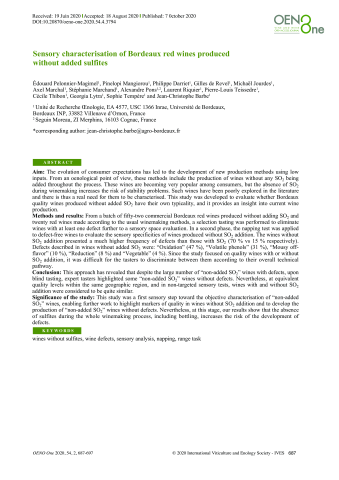
Résumé : Aim: The evolution of consumer expectations has led to the development of new production methods using low inputs. From an oenological point of view, these methods include the production of wines without any SO2 being added throughout the process. These wines are becoming very popular among consumers, but the absence of SO2 during winemaking increases the risk of stability problems. Such wines have been poorly explored in the literature and there is thus a real need for them to be characterised. This study was developed to evaluate whether Bordeaux quality wines produced without added SO2 have their own typicality, and it provides an insight into current wine production.Methods and results: From a batch of fifty-two commercial Bordeaux red wines produced without adding SO2 and twenty red wines made according to the usual winemaking methods, a selection tasting was performed to eliminate wines with at least one defect further to a sensory space evaluation. In a second phase, the Napping test was applied to defect-free wines to evaluate the sensory specificities of wines produced without SO2 addition. The wines without SO2 addition presented a much higher frequency of defects than those with SO2 (70 % vs 15 % respectively). Defects described in wines without added SO2 were: “Oxidation” (47 %), “Volatile phenols” (31 %), “Mousy off-flavor” (10 %), “Reduction” (8 %) and “Vegetable” (4 %). Since the study focused on quality wines with or without SO2 addition, it was difficult for the tasters to discriminate between them according to their overall technical pathway.Conclusion: This approach has revealed that despite the large number of “non-added SO2” wines with defects, upon blind tasting, expert tasters highlighted some “non-added SO2” wines without defects. Nevertheless, at equivalent quality levels within the same geographic region, and in non-targeted sensory tests, wines with and without SO2 addition were considered to be quite similar.Significance of the study: This study was a first sensory step toward the objective characterisation of “non-added SO2” wines, enabling further work to highlight markers of quality in wines without SO2 addition and to develop the production of “non-added SO2” wines without defects. Nevertheless, at this stage, our results show that the absence of sulfites during the whole winemaking process, including bottling, increases the risk of the development of defects.
Fichiers liés :
2020-Pelonnier-Magimel-Oenoone.pdf
Source
-
The intestinal quorum sensing 3-oxo-C12:2 Acyl homoserine lactone limits cytokine-induced tight junction disruption
- Type de publi. : Article dans une revue
- Date de publi. : 01/10/2020
-
Auteurs :
Doriane AguannoGarance CoquantBarbara G PostalCéline OsinskiMargaux WieckowskiDaniel StockholmJean-Pierre GrillVéronique CarrièrePhilippe SeksikSophie Thenet
Fiche détaillée
The intestinal quorum sensing 3-oxo-C12:2 Acyl homoserine lactone limits cytokine-induced tight junction disruption
- Type de publi. : Article dans une revue
- Date de publi. : 01/10/2020
-
Auteurs :
Doriane AguannoGarance CoquantBarbara G PostalCéline OsinskiMargaux WieckowskiDaniel StockholmJean-Pierre GrillVéronique CarrièrePhilippe SeksikSophie Thenet
-
Organismes :
Centre de Recherche Saint-Antoine
Centre de Recherche Saint-Antoine
Centre de Recherche Saint-Antoine
Centre de recherche sur l'Inflammation
Nutrition et obésités: approches systémiques (UMR-S 1269)
Centre de Recherche Saint-Antoine
Centre de Recherche Saint-Antoine
École Pratique des Hautes Études
Centre de Recherche Saint-Antoine
Centre de Recherche Saint-Antoine
Centre de Recherche Saint-Antoine
CHU Saint-Antoine [AP-HP]
École Pratique des Hautes Études
Centre de Recherche Saint-Antoine
- Publié dans Tissue Barriers le 02/10/2017
Fichiers liés :
The intestinal quorum sensing 3 oxo C12 2 Acyl homoserine lactone limits cytokine induced tight junction disruption(6).pdf
Source
-

Circulating tumor DNA is prognostic and potentially predictive of eryaspase efficacy in second-line in patients with advanced pancreatic adenocarcinoma
- Type de publi. : Article dans une revue
- Date de publi. : 01/10/2020
-
Auteurs :
Jean-Baptiste BachetHélène BlonsPascal HammelIman El HariryFabienne PortalesLaurent MineurJean-Philippe MetgesClaire MulotCamille BourreauJason CainJérôme CrosPierre Laurent-Puig
Fiche détaillée
Circulating tumor DNA is prognostic and potentially predictive of eryaspase efficacy in second-line in patients with advanced pancreatic adenocarcinoma
- Type de publi. : Article dans une revue
- Date de publi. : 01/10/2020
-
Auteurs :
Jean-Baptiste BachetHélène BlonsPascal HammelIman El HariryFabienne PortalesLaurent MineurJean-Philippe MetgesClaire MulotCamille BourreauJason CainJérôme CrosPierre Laurent-Puig
-
Organismes :
Centre de Recherche des Cordeliers
CHU Pitié-Salpêtrière [AP-HP]
Centre de Recherche des Cordeliers
Hôpital Européen Georges Pompidou [APHP]
Cooperator Multidisciplinary Oncology Group
Hôpital Beaujon [AP-HP]
ERYTECH Pharma
CRLCC Val d'Aurelle - Paul Lamarque
Institut Sainte Catherine [Avignon]
Centre Hospitalier Régional Universitaire de Brest
Centre de Recherche des Cordeliers
Centre de Recherche des Cordeliers
ERYTECH Pharma
Service d’Anatomie Pathologique [CHU Beaujon]
Hôpital Européen Georges Pompidou [APHP]
Centre de Recherche des Cordeliers
- Publié dans Clinical Cancer Research le 30/10/2020
Résumé : Purpose: Eryaspase is composed of l-asparaginase encapsulated in erythrocytes and has demonstrated significant efficacy in a randomized phase II trial. We assessed the prognostic and predictive value of circulating tumor DNA (ctDNA) in patients, plasma included in this trial.Experimental Design: Samples prospectively collected pretreatment were centrally analyzed by next-generation sequencing. Prognostic values of baseline ctDNA and ctDNA early changes between day 0 and 28 were assessed in both arms combined on objective response rate (ORR), progression-free survival (PFS), and overall survival (OS); three groups were defined: negative ctDNA (Neg), ctDNA responders (Resp), and ctDNA nonresponders (NResp). Predictive value of ctDNA for eryaspase efficacy was investigated.Results: ctDNA was positive at baseline in 77 patients of the 113 tested patients (68%). Detectable ctDNA was an independent negative prognostic factor for OS (4.6 vs. 8.8 months; P = 0.0025) and PFS (1.6 vs. 3.3 months; P = 0.00043). Early change in ctDNA levels was correlated with ORR (20%, 26%, 0%; P < 0.04), PFS (3.7, 3.4, 1.6 months; P < 0.0001), and OS (11.7, 6.5, 4.3 months; P < 0.0001) according to the three defined groups (Neg, Res, NResp, respectively). In patients with ctDNA detectable at baseline, eryaspase was associated with better PFS [HR = 0.53; 95% confidence interval (CI): 0.3–0.94)] and OS (HR = 0.52; 95% CI: 0.29–0.91).Conclusions: We confirm from a prospective randomized trial that: (i) the presence of ctDNA at baseline is a major prognostic factor, (ii) the early change of ctDNA correlates with treatment outcome, and (iii) the ctDNA could be a predictive biomarker of eryaspase efficacy.
Fichiers liés :
Bachet et al. - 2020 - Circulating tumor DNA is prognostic and potentiall.pdf
Source
-
Tubular optical microcavities based on rolled-up photonic crystals
- Type de publi. : Article dans une revue
- Date de publi. : 01/10/2020
-
Auteurs :
Rémi BricheAziz BenamrouchePierre CremillieuPhilippe RegrenyJean -Louis LeclercqXavier LetartreAlexandre DanescuSégolène Callard
Fiche détaillée
Tubular optical microcavities based on rolled-up photonic crystals
- Type de publi. : Article dans une revue
- Date de publi. : 01/10/2020
-
Auteurs :
Rémi BricheAziz BenamrouchePierre CremillieuPhilippe RegrenyJean -Louis LeclercqXavier LetartreAlexandre DanescuSégolène Callard
-
Organismes :
INL - Ingénierie et conversion de lumière (i-Lum)
INL - Plateforme Technologique Nanolyon
INL - Plateforme Technologique Nanolyon
INL - Matériaux Fonctionnels et Nanostructures
INL - Ingénierie et conversion de lumière (i-Lum)
INL - Ingénierie et conversion de lumière (i-Lum)
INL - Matériaux Fonctionnels et Nanostructures
INL - Ingénierie et conversion de lumière (i-Lum)
- Publié dans APL Photonics le 31/10/2017
Fichiers liés :
5.0022862.pdf
Source