Professeur des universités en sciences de gestion
-

Patient blood management in elective bypass cardiac surgery: A 2-step single-centre interventional trial to analyse the impact of an educational programme and erythropoiesis stimulation on red blood cell transfusion
- Type de publi. : Article dans une revue
- Date de publi. : 01/09/2020
-
Auteurs :
Hélène CharbonneauMarie PasquiéPierre BerthoumieuNicolas SavyGérard AutonesOlivier AnglèsAnne Laure BerthelotMadeleine Croute-BayleIsabelle DecramerDavid DuterqueYannick GabiacheValérie JulienLaurent MalletMimoun M'RiniJean François QuedreuxBenoit RichardLaurent SidobreLaurence TailleferPhilippe SoulaOlivier GarciaIssam AbouliatimOlivier VahdatMarc BousquetJean Marc FerradouYves JansouPierre BrunelClaude BreilNicolas Mayeur
Fiche détaillée
Patient blood management in elective bypass cardiac surgery: A 2-step single-centre interventional trial to analyse the impact of an educational programme and erythropoiesis stimulation on red blood cell transfusion
- Type de publi. : Article dans une revue
- Date de publi. : 01/09/2020
-
Auteurs :
Hélène CharbonneauMarie PasquiéPierre BerthoumieuNicolas SavyGérard AutonesOlivier AnglèsAnne Laure BerthelotMadeleine Croute-BayleIsabelle DecramerDavid DuterqueYannick GabiacheValérie JulienLaurent MalletMimoun M'RiniJean François QuedreuxBenoit RichardLaurent SidobreLaurence TailleferPhilippe SoulaOlivier GarciaIssam AbouliatimOlivier VahdatMarc BousquetJean Marc FerradouYves JansouPierre BrunelClaude BreilNicolas Mayeur
-
Organismes :
Institut de Mathématiques de Toulouse UMR5219
- Publié dans Contemporary Clinical Trials Communications le 31/10/2020
Résumé : UNLABELLED : Anaemia and iron deficiency are frequent in patients scheduled for cardiac surgery. Perioperative patient blood management (PBM) is widely recommended in current practice guidelines. The aim of this protocol is to analyse the effect of a global perioperative PBM programme on the red blood cell (RBC) transfusion ratio, morbidities and rehabilitation score in elective cardiac surgery.This study is a prospective, single-centre trial with a 2-step protocol, A and B, as follows: A: non-drug intervention: the caregiver is given a blood management educational programme; B: drug intervention: systematic correction of perioperative iron, vitamin deficiencies, and anaemia. This study was designed to enrol 900 patients (500 in group A and 400 in group B) in a rolling period starting at anaesthesia consultation and ending 3 months after surgery. The primary objective was a 20% reduction in RBC transfusion after implementation of PBM programmes (protocol A + B) when compared to our previous transfusion ratio in the first half of 2018 (30.4% vs 38%). The secondary objectives were to evaluate the impact for each step of the study on the RBC transfusion rate, morbidity and the quality of postoperative rehabilitation.The strength of this study is its evaluation of the effect of a global PBM programme on RBC transfusion in cardiac surgery through a 2-step protocol. We aim to assess for the first time the impact of non-drug and drug interventions on RBC transfusion, comorbidities and delayed rehabilitation parameters. TRIALS REGISTRATIONS : ClinicalTrials.gov, NCT04040023: registered 29 July 2019. © 2020 Published by Elsevier Inc.
Fichiers liés :
main.pdf
Source
-

Mixed Spatial and Temporal Decompositions for Large-Scale Multistage Stochastic Optimization Problems
- Type de publi. : Article dans une revue
- Date de publi. : 01/09/2020
-
Auteurs :
Pierre CarpentierJean-Philippe ChancelierMichel de LaraFrançois Pacaud
Fiche détaillée
Mixed Spatial and Temporal Decompositions for Large-Scale Multistage Stochastic Optimization Problems
- Type de publi. : Article dans une revue
- Date de publi. : 01/09/2020
-
Auteurs :
Pierre CarpentierJean-Philippe ChancelierMichel de LaraFrançois Pacaud
-
Organismes :
Optimisation et commande
- Publié dans Journal of Optimization Theory and Applications le 25/10/2020
Source
-
Outcomes of Patients With Advanced NSCLC From the Intergroupe Francophone de Cancérologie Thoracique Biomarkers France Study by KRAS Mutation Subtypes
- Type de publi. : Article dans une revue
- Date de publi. : 01/09/2020
-
Auteurs :
Anne-Marie RuppertMichèle Beau-FallerDidier DebieuvreL'Houcine OuafikVirginie WesteelIsabelle RouquetteJulien MazièresPierre-Paul BringuierIsabelle MonnetFabienne EscandeCharles RicordelJean-Philippe MerlioHenri JanicotAntoinette LemoinePascal FoucherMichel PoudenxFranck MorinAlexandra LanglaisPierre-Jean SouquetFabrice BarlésiMarie Wislez
Fiche détaillée
Outcomes of Patients With Advanced NSCLC From the Intergroupe Francophone de Cancérologie Thoracique Biomarkers France Study by KRAS Mutation Subtypes
- Type de publi. : Article dans une revue
- Date de publi. : 01/09/2020
-
Auteurs :
Anne-Marie RuppertMichèle Beau-FallerDidier DebieuvreL'Houcine OuafikVirginie WesteelIsabelle RouquetteJulien MazièresPierre-Paul BringuierIsabelle MonnetFabienne EscandeCharles RicordelJean-Philippe MerlioHenri JanicotAntoinette LemoinePascal FoucherMichel PoudenxFranck MorinAlexandra LanglaisPierre-Jean SouquetFabrice BarlésiMarie Wislez
-
Organismes :
Groupe de recherche clinique Biomarqueurs Théranostiques des Cancers Bronchiques Non à Petites Cellules
CHU Tenon [AP-HP]
Hôpitaux Universitaires de Strasbourg
Interface de Recherche Fondamentale et Appliquée en Cancérologie
Nanomédecine Régénérative
Groupe hospitalier de la région de Mulhouse Sud-Alsace
Institut de neurophysiopathologie
Laboratoire de Transfert d'Oncologie Biologique [Hôpital Nord - APHM]
Centre Hospitalier Régional Universitaire de Besançon
Interactions hôte-greffon-tumeur, ingénierie cellulaire et génique - UFC (UMR INSERM 1098)
Institut Universitaire du Cancer de Toulouse - Oncopole
Service Pneumologie-Allergologie [CHU Toulouse]
Groupement Hospitalier Lyon-Est
Centre Hospitalier Intercommunal de Créteil
Institut de Biochimie et Biologie Moléculaire [CHRU Lille]
Oncogenesis, Stress, Signaling
Centre Hospitalier Universitaire de Rennes [CHU Rennes] = Rennes University Hospital [Pontchaillou]
INSERM U1053, Université Bordeaux, Bordeaux, France.
CHU Clermont-Ferrand
INSERM UMR S1193
Centre Hospitalier Universitaire de Dijon - Hôpital François Mitterrand
Centre de Lutte contre le Cancer Antoine Lacassagne [Nice]
Intergroupe Francophone de Cancérologie Thoracique [Paris]
Intergroupe Francophone de Cancérologie Thoracique [Paris]
Service de pneumologie [Centre Hospitalier Lyon Sud - HCL]
Service d'oncologie multidisciplinaire innovations thérapeutiques [Hôpital Nord - APHM]
Service de pneumologie [CHU Cochin]
Centre de Recherche des Cordeliers
- Publié dans JTO Clinical and Research Reports le 07/10/2021
Résumé : Introduction - Methods - In the Biomarkers France study, 4894 mutations (26.2%) were detected in 4634 patients from the 17,664 enrolled patients with NSCLC. Survival and treatment data on noncurative stage III to IV NSCLC were available for 901 patients. First- and second-line treatment effects on progression-free survival and overall survival were analyzed according to the mutations subtype. Results - Over 95% of patients with mutation were smokers or former smokers who were white (99.5%), presenting with adenocarcinoma (82.5%). The most common mutation subtype was G12C (374 patients; 41.5%), followed by G12V (168; 18.6%), G12D (131; 14.5%), G12A (62; 6.9%), G13C (45; 5.0%), G13D (31; 3.4%), and others (10; 1%). Approximately 21% of patients had transition mutation and 68.2% had a transversion mutation. G12D and transition mutations were predominant in never-smokers. The median overall survival for patients with -mutated NSCLC was 8.1 months (95% confidence interval [CI]: 7.5-9.5), without any differences according to the different subtypes mutations. The median progression-free survival was 4.6 months (95% CI: 4.2-5.1) for first-line treatment and 4.8 months (95% CI: 4.3-6.8) for second-line treatment, without any differences according to the different subtypes mutations. Conclusions
Fichiers liés :
PIIS2666364320300576.pdf
Source
-
Dynamic single-cell phenotyping of immune cells using the microfluidic platform DropMap
- Type de publi. : Article dans une revue
- Date de publi. : 01/09/2020
-
Auteurs :
Yacine BounabKlaus EyerSophie DixneufMagda RybczynskaCécile ChauvelMaxime MistrettaTrang TranNathan AymerichGuilhem ChenonJean-François LlitjosFabienne VenetGuillaume MonneretIain GillespiePierre CortezVirginie MoucadelAlexandre PachotAlain TroeschPhilippe LeissnerJulien TextorisJérôme BibetteCyril GuyardJean BaudryAndrew D. GriffithsChristophe Védrine
Fiche détaillée
Dynamic single-cell phenotyping of immune cells using the microfluidic platform DropMap
- Type de publi. : Article dans une revue
- Date de publi. : 01/09/2020
-
Auteurs :
Yacine BounabKlaus EyerSophie DixneufMagda RybczynskaCécile ChauvelMaxime MistrettaTrang TranNathan AymerichGuilhem ChenonJean-François LlitjosFabienne VenetGuillaume MonneretIain GillespiePierre CortezVirginie MoucadelAlexandre PachotAlain TroeschPhilippe LeissnerJulien TextorisJérôme BibetteCyril GuyardJean BaudryAndrew D. GriffithsChristophe Védrine
-
Organismes :
Chimie-Biologie-Innovation (UMR 8231)
Chimie-Biologie-Innovation (UMR 8231)
BIOASTER Microbiology Technology Institute [Lyon]
- Publié dans Nature Protocols le 01/11/2020
Résumé : This protocol describes a microfluidic platform for dynamic high-throughput analysis the phenotype of single cells. Cell-surface markers and secreted proteins are quantified and characterized by fluorescence detection using tailored immunoassays, simultaneously with measurement of other cellular characteristics, including endocytosis activity and viability. TWEET A new protocol describes a microfluidics-based assay for high-throughput interrogation of protein secretion kinetics in single cells. @BIOASTER @EyerFira @ETH_DCHAB COVER TEASER Microfluidics-based analysis of protein secretion Up to three primary research articles where the protocol has been used and/or developed.
Fichiers liés :
Bounab version postprint.pdf
Source
-
Pregnancy after oocyte donation in a patient with NLRP7 gene mutations and recurrent molar hydatidiform pregnancies
- Type de publi. : Article dans une revue
- Date de publi. : 01/09/2020
-
Auteurs :
Claire CozetteFlorence Scheffler-GharieniMelyne LombartJerome MassardierPierre-Adrien BolzeTouria HajriFrancois GolfierIsabelle TouitouCecile RittoreJean GondryPhilippe MervielMoncef Ben KhalifaRosalie Cabry
Fiche détaillée
Pregnancy after oocyte donation in a patient with NLRP7 gene mutations and recurrent molar hydatidiform pregnancies
- Type de publi. : Article dans une revue
- Date de publi. : 01/09/2020
-
Auteurs :
Claire CozetteFlorence Scheffler-GharieniMelyne LombartJerome MassardierPierre-Adrien BolzeTouria HajriFrancois GolfierIsabelle TouitouCecile RittoreJean GondryPhilippe MervielMoncef Ben KhalifaRosalie Cabry
-
Organismes :
Université de Picardie Jules Verne
CHU Amiens-Picardie
Périnatalité et Risques Toxiques - UMR INERIS_I 1 UPJV
CHU Amiens-Picardie
Service de gynécologie obstétrique
Université Claude Bernard Lyon 1
Centre Hospitalier Lyon Sud [CHU - HCL]
Centre Hospitalier Lyon Sud [CHU - HCL]
Hospices Civils de Lyon
Centre Hospitalier Régional Universitaire [Montpellier]
Cellules Souches, Plasticité Cellulaire, Médecine Régénératrice et Immunothérapies (IRMB)
Laboratoire de génétique des maladies rares. Pathologie moleculaire, etudes fonctionnelles et banque de données génétiques
Cellules Souches, Plasticité Cellulaire, Médecine Régénératrice et Immunothérapies (IRMB)
Centre Hospitalier Régional Universitaire [Montpellier]
CHU Amiens-Picardie
CHU Amiens-Picardie
Périnatalité et Risques Toxiques - UMR INERIS_I 1 UPJV
CHU Amiens-Picardie
Périnatalité et Risques Toxiques - UMR INERIS_I 1 UPJV
- Publié dans Journal of Assisted Reproduction and Genetics le 28/10/2020
Résumé : Molar pregnancies are benign trophoblastic diseases associated with a risk of malignant transformation. If aetiology remains mostly unknown, the risk of recurrent molar pregnancy is around 1.5% after one molar pregnancy and around 25% after 2 molar pregnancies. In the later situation, genetic mutations have been described, increasing hugely this risk. In case of mutations, probability to obtain a normal pregnancy is estimated around 1.8%. We report the case of a Caucasian 30-year-old woman whose previous five spontaneous pregnancies had a negative outcome: a spontaneous miscarriage and then 4 complete hydatidiform moles. Genetic testing revealed that the patient carried two heterozygous mutations in theNLRP7gene (c.2982-2A > G and Y318CfsX7). According to this, counselling was conducted to advocate for oocyte donation in order to obtain a normal pregnancy. This technique enabled a complication-free, singleton pregnancy that resulted in a healthy term live birth of a 2900 g female. Few months after delivery, the patient presented a new complete hydatidiform mole. Women presented with mutations in theNLRP7, KHDC3LorPADI6genes are unlikely to obtain normal pregnancies, with a major risk of reproductive failure. In such a context, oocyte donation may be the best option. Only 4 normal pregnancies and deliveries have been published in this situation through this technique to our knowledge.
Fichiers liés :
2020 Cozette et al., Pregnancy.pdf
Source
-

Stroke care and outcomes in the Department of Neurology in Parakou, Benin: Retrospective cohort study
- Type de publi. : Article dans une revue
- Date de publi. : 01/09/2020
-
Auteurs :
Adoukonou ThierryMendinatou AgbétouArlos SowanouOyéné KossiPervenche FotsoCorine HouéhanouJean-Michel VallatDismand Stephan HouinatoPierre-Marie PreuxPhilippe Lacroix
Fiche détaillée
Stroke care and outcomes in the Department of Neurology in Parakou, Benin: Retrospective cohort study
- Type de publi. : Article dans une revue
- Date de publi. : 01/09/2020
-
Auteurs :
Adoukonou ThierryMendinatou AgbétouArlos SowanouOyéné KossiPervenche FotsoCorine HouéhanouJean-Michel VallatDismand Stephan HouinatoPierre-Marie PreuxPhilippe Lacroix
-
Organismes :
Neuroépidémiologie Tropicale
Service de Neurologie [CHU Limoges]
Neuroépidémiologie Tropicale
Service de Neurologie [CHU Limoges]
Centre de référence national neuropathies périphériques rares [CHU Limoges]
Neuroépidémiologie Tropicale
Neuroépidémiologie Tropicale
Service de l'Information Médicale et de l'Évaluation [CHU Limoges]
Laboratoire de Biostatistique et d'Informatique Médicale
Neuroépidémiologie Tropicale
Service de Chirurgie Thoracique et Vasculaire - Médecine vasculaire [CHU Limoges]
- Publié dans Annals of Medicine and Surgery le 29/10/2020
Résumé : Introduction: Stroke is one of the most common causes of high mortality rates in Africa with many unknownaspects around its prognosis. In this study we aim to describe stroke characteristics and in-hospital mortality ofstroke in Parakou.Methods: This is a retrospective cohort study including all stroke patients admitted to the Department ofNeurology at Parakou Teaching Hospital from January 1, 2013 through to December 31, 2019. Clinical data,vascular risk factors, stroke subtype and outcome data were recorded. The in-hospital case-fatality and itsassociated factors were determined. The study was approved by the Local Ethics Committee of Biomedicalresearch and has been registered under the unique indentifying number researchregistry5687 and is available athttps://www.researchregistry.com/browse-the-registry#home/Results: Stroke cases represented 51.5% of all patients. There were 372 patients included in the study with a meanage of 58.2 +/- 14.2 years. The sex ratio was 1:3. Ischemic stroke accounted for 40.3%, intracerebral hemorrhage30.4%, and unknown 29.3%. The main vascular risk factors were hypertension (69.1%), alcoholism (23.9%) anddiabetes mellitus (16.9%). The mean NIHSS at admission was 9.4 +/- 5.7 and the length of hospital stay was 9.0 +/- 7.3. The most common complications recorded during the acute phase were swallowing disorders (10.2%),pneumonia (9.1%) and urinary tract infections (8.3%). The in-hospital case fatality was 6.2% and was associatedwith loss of consciousness (p ¼ 0.0001), high NIHSS on admission (p ¼ 0.001), fever (p ¼ 0.0001), swallowingdisorders (p ¼ 0.001) and leukocytosis (p ¼ 0.021). On discharge, 27.6% were independent and 97.8% were onantihypertensive drugs.Conclusion: The in-hospital stroke mortality was close to that reported by other studies in Africa.
Fichiers liés :
S2049080120302235.pdf
Source
-
Amygdalar nuclei and hippocampal subfields on MRI: Test-retest reliability of automated volumetry across different MRI sites and vendors
- Type de publi. : Article dans une revue
- Date de publi. : 01/09/2020
-
Auteurs :
Giulia QuattriniMichela PievaniJorge JovicichMarco AielloNúria BargallóFrederik BarkhofDavid Bartres-FazAlberto BeltramelloFrancesca PizziniOlivier BlinRégis BordetMassimo CauloManos ConstantinidesMira DidicAntonios DrevelegasAntonio FerrettiUte FiedlerPiero FloridiHélène Gros-DagnacTilman HenschKarl-Titus HoffmannJoost KuijerRenaud LopesCamillo MarraBernhard MüllerFlavio NobiliLucilla ParnettiPierre PayouxAgnese PiccoJean‐philippe RanjevaLuca RoccatagliataPaolo RossiniMarco SalvatorePeter SchonknechtBjörn SchottJulien SeinAndrea SoricelliRoberto TarducciMagda TsolakiPieter VisserJens WiltfangJill RichardsonGiovanni FrisoniMoira Marizzoni
Fiche détaillée
Amygdalar nuclei and hippocampal subfields on MRI: Test-retest reliability of automated volumetry across different MRI sites and vendors
- Type de publi. : Article dans une revue
- Date de publi. : 01/09/2020
-
Auteurs :
Giulia QuattriniMichela PievaniJorge JovicichMarco AielloNúria BargallóFrederik BarkhofDavid Bartres-FazAlberto BeltramelloFrancesca PizziniOlivier BlinRégis BordetMassimo CauloManos ConstantinidesMira DidicAntonios DrevelegasAntonio FerrettiUte FiedlerPiero FloridiHélène Gros-DagnacTilman HenschKarl-Titus HoffmannJoost KuijerRenaud LopesCamillo MarraBernhard MüllerFlavio NobiliLucilla ParnettiPierre PayouxAgnese PiccoJean‐philippe RanjevaLuca RoccatagliataPaolo RossiniMarco SalvatorePeter SchonknechtBjörn SchottJulien SeinAndrea SoricelliRoberto TarducciMagda TsolakiPieter VisserJens WiltfangJill RichardsonGiovanni FrisoniMoira Marizzoni
-
Organismes :
Centro San Giovanni di Dio, Fatebenefratelli, Brescia
Laboratory of Alzheimer’s Neuroimaging and Epidemiology
Centro San Giovanni di Dio, Fatebenefratelli, Brescia
Laboratory of Alzheimer’s Neuroimaging and Epidemiology
Università degli Studi di Trento = University of Trento
IRCCS SDN Napoli
Institut d'Investigacions Biomèdiques August Pi i Sunyer (IDIBAPS)
VU University Medical Center [Amsterdam]
UCL Queen Square Institute of Neurology
Clinical and experimental neuroimmunology [IDIBAPS]
Department of Radiology, IRCCS "Sacro Cuore-Don Calabria", Negrar, Verona
Università degli studi di Verona = University of Verona
Institut de Neurosciences des Systèmes
Institut de Neurosciences des Systèmes
Universita' degli Studi "G. d'Annunzio" Chieti-Pescara
Interbalkan Medical Center of Thessaloniki
Institut de Neurosciences des Systèmes
Interbalkan Medical Center of Thessaloniki
Universita' degli Studi "G. d'Annunzio" Chieti-Pescara
Universität Duisburg-Essen = University of Duisburg-Essen [Essen]
Perugia General Hospital
Toulouse NeuroImaging Center
Leipzig University / Universität Leipzig
Leipzig University / Universität Leipzig
Department of Radiology and Nuclear Medicine [Amsterdam]
Lille Neurosciences & Cognition - U 1172
Department of Psychiatry and Psychotherapy, Faculty of Medicine
Department of Psychiatry and Psychotherapy, Faculty of Medicine
Università degli studi di Genova = University of Genoa = Université de Gênes
Università degli Studi di Perugia = University of Perugia
Toulouse NeuroImaging Center
Università degli studi di Genova = University of Genoa = Université de Gênes
Centre de résonance magnétique biologique et médicale
Centre d'Exploration Métabolique par Résonance Magnétique [Hôpital de la Timone - APHM]
Università degli studi di Genova = University of Genoa = Université de Gênes
Istituto di Ricovero e Cura a Carattere Scientifico San Raffaele [Roma]
IRCCS SDN Napoli
Leipzig University / Universität Leipzig
University Medical Center Göttingen
Leibniz Institute for Neurobiology [Magdeburg]
Deutsches Zentrum für Neurodegenerative Erkrankungen [Ulm]
Centre d'Exploration Métabolique par Résonance Magnétique [Hôpital de la Timone - APHM]
IRCCS SDN Napoli
Perugia General Hospital
Aristotle University of Thessaloniki
Maastricht University [Maastricht]
University Medical Center Göttingen
Universidade de Aveiro = University of Aveiro
Deutsches Zentrum für Neurodegenerative Erkrankungen [Ulm]
GlaxoSmithKline [Stevenage, UK]
Laboratory of Neuroimaging of aging, Memory clinic and LANVIE
Centro San Giovanni di Dio, Fatebenefratelli, Brescia
- Publié dans NeuroImage le 01/11/2020
Résumé : Background: The amygdala and the hippocampus are two limbic structures that play a critical role in cognition and behavior, however their manual segmentation and that of their smaller nuclei/subfields in multicenter datasets is time consuming and difficult due to the low contrast of standard MRI. Here, we assessed the reliability of the automated segmentation of amygdalar nuclei and hippocampal subfields across sites and vendors using FreeSurfer in two independent cohorts of older and younger healthy adults. Methods: Sixty-five healthy older (cohort 1) and 68 younger subjects (cohort 2), from the PharmaCog and CoRR consortia, underwent repeated 3D-T1 MRI (interval 1-90 days). Segmentation was performed using FreeSurfer v6.0. Reliability was assessed using volume reproducibility error (ε) and spatial overlapping coefficient (DICE) between test and retest session. Results: Significant MRI site and vendor effects (p < .05) were found in a few subfields/nuclei for the ε, while extensive effects were found for the DICE score of most subfields/nuclei. Reliability was strongly influenced by volume, as ε correlated negatively and DICE correlated positively with volume size of structures (absolute value of Spearman's r correlations >0.43, p < 1.39E-36). In particular, volumes larger than 200 mm3 (for amygdalar nuclei) and 300 mm3 (for hippocampal subfields, except for molecular layer) had the best test-retest reproducibility (ε < 5% and DICE > 0.80). Conclusion: Our results support the use of volumetric measures of larger amygdalar nuclei and hippocampal subfields in multisite MRI studies. These measures could be useful for disease tracking and assessment of efficacy in drug trials.
Fichiers liés :
Quattrini_2020.pdf
Source
-
New KNbTeO6 transparent tellurate ceramics
- Type de publi. : Article dans une revue
- Date de publi. : 01/09/2020
-
Auteurs :
Morgane DolhenJulie CarreaudGaelle DelaizirJ.-R. DuclèreMarion VandenhendeNicolas Tessier-DoyenOlivier TantotDamien PasserieuxPierre-Eugène CoulonPhilippe ThomasMathieu AllixSébastien Chenu
Fiche détaillée
New KNbTeO6 transparent tellurate ceramics
- Type de publi. : Article dans une revue
- Date de publi. : 01/09/2020
-
Auteurs :
Morgane DolhenJulie CarreaudGaelle DelaizirJ.-R. DuclèreMarion VandenhendeNicolas Tessier-DoyenOlivier TantotDamien PasserieuxPierre-Eugène CoulonPhilippe ThomasMathieu AllixSébastien Chenu
-
Organismes :
XLIM
XLIM
Institut de Recherche sur les CERamiques
Conditions Extrêmes et Matériaux : Haute Température et Irradiation
Institut de Recherche sur les CERamiques
- Publié dans Journal of the European Ceramic Society le 27/10/2020
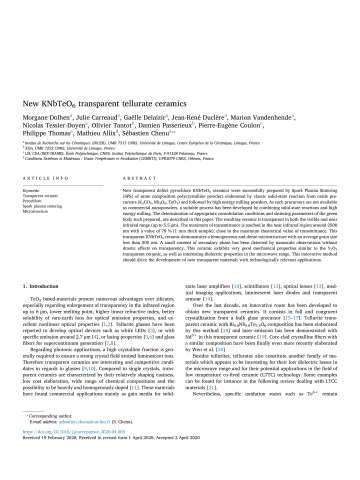
Résumé : New transparent defect pyrochlore KNbTeO 6 ceramics were successfully prepared by Spark Plasma Sintering (SPS) of same composition polycrystalline powders elaborated by classic solid-state reaction from oxide precursors (K 2 CO 3 , Nb 2 O 5 , TeO 2) and followed by high energy milling powders. As such precursors are not available as commercial nanopowders, a suitable process has been developed by combining solid-state reactions and high energy milling. The determination of appropriate consolidation conditions and sintering parameters of the green body such prepared, are described in this paper. The resulting ceramic is transparent in both the visible and near infrared range (up to 5.5 μm). The maximum of transmittance is reached in the near infrared region around 2500 nm with a value of 78 % (1 mm thick sample), close to the maximum theoretical value of transmittance. This transparent KNbTeO 6 ceramic demonstrates a homogeneous and dense microstructure with an average grain size less than 500 nm. A small content of secondary phase has been detected by nanoscale observations without drastic effects on transparency. This ceramic exhibits very good mechanical properties similar to the Y 2 O 3 transparent ceramic, as well as interesting dielectric properties in the microwave range. This innovative method should drive the development of new transparent materials with technologically relevant applications.
Fichiers liés :
119-KNbTeO6_Dolhen_JECS_2020_HAL.pdf
Source
-
Septuagenarian population has similar survival and outcomes to younger patients after left ventricular assist device implantation
- Type de publi. : Article dans une revue
- Date de publi. : 01/09/2020
-
Auteurs :
Vincent GalandErwan FlécherCéline ChabanneBernard LelongCéline GoéminneAndré VincentelliClément DelmasCamille DambrinKarine NubretMathieu PernotMichel KindoTam Hoang MinhPhilippe GaudardJean Marc FrapierMagali MichelThomas SénageAude BoignardOlivier ChavanonConstance VerdonkMarylou ParaEdeline PelcéVlad GariboldiMatteo PozziJean-François ObadiaPierre Yves LitlzerFrédéric AnselmeGerard BabatasiAnne Flore PlaneFabien GarnierMarie BielefeldDavid HamonCostin RaduThierry BourguignonThibaud GenetRomain EschalierNicolas D’ostrevyMarie-Cécile BoriesEloi MarijonFabrice VanhuyseHugues BlangyChristophe LeclercqRaphaël P Martins
Fiche détaillée
Septuagenarian population has similar survival and outcomes to younger patients after left ventricular assist device implantation
- Type de publi. : Article dans une revue
- Date de publi. : 01/09/2020
-
Auteurs :
Vincent GalandErwan FlécherCéline ChabanneBernard LelongCéline GoéminneAndré VincentelliClément DelmasCamille DambrinKarine NubretMathieu PernotMichel KindoTam Hoang MinhPhilippe GaudardJean Marc FrapierMagali MichelThomas SénageAude BoignardOlivier ChavanonConstance VerdonkMarylou ParaEdeline PelcéVlad GariboldiMatteo PozziJean-François ObadiaPierre Yves LitlzerFrédéric AnselmeGerard BabatasiAnne Flore PlaneFabien GarnierMarie BielefeldDavid HamonCostin RaduThierry BourguignonThibaud GenetRomain EschalierNicolas D’ostrevyMarie-Cécile BoriesEloi MarijonFabrice VanhuyseHugues BlangyChristophe LeclercqRaphaël P Martins
-
Organismes :
Laboratoire Traitement du Signal et de l'Image
Centre Hospitalier Universitaire de Rennes [CHU Rennes] = Rennes University Hospital [Pontchaillou]
Laboratoire Traitement du Signal et de l'Image
Centre Hospitalier Universitaire de Rennes [CHU Rennes] = Rennes University Hospital [Pontchaillou]
Laboratoire Traitement du Signal et de l'Image
Centre Hospitalier Universitaire de Rennes [CHU Rennes] = Rennes University Hospital [Pontchaillou]
Laboratoire Traitement du Signal et de l'Image
Centre Hospitalier Universitaire de Rennes [CHU Rennes] = Rennes University Hospital [Pontchaillou]
Centre Hospitalier Régional Universitaire [CHU Lille]
Institut Coeur Poumon [CHU Lille]
Physiologie & médecine expérimentale du Cœur et des Muscles [U 1046]
Centre Hospitalier Régional Universitaire [Montpellier]
Physiologie & médecine expérimentale du Cœur et des Muscles [U 1046]
Centre Hospitalier Régional Universitaire [Montpellier]
Hôpital de la Timone [CHU - APHM]
Hôpital de la Timone [CHU - APHM]
Hôpital Louis Pradel [CHU - HCL]
Centre Hospitalier Régional Universitaire de Nancy
Centre Hospitalier Régional Universitaire de Nancy
Laboratoire Traitement du Signal et de l'Image
Centre Hospitalier Universitaire de Rennes [CHU Rennes] = Rennes University Hospital [Pontchaillou]
Laboratoire Traitement du Signal et de l'Image
Centre Hospitalier Universitaire de Rennes [CHU Rennes] = Rennes University Hospital [Pontchaillou]
- Publié dans Archives of cardiovascular diseases le 30/10/2020
Résumé : Background: Left ventricular assist device (LVAD) implantation may be an attractive alternative therapeutic option for elderly patients with heart failure who are ineligible for heart transplantation.Aim: We aimed to describe the characteristics and outcomes of elderly patients (i.e. aged ≥ 70 years) receiving an LVAD.Methods; This observational study was conducted in 19 centres between 2006 and 2016. Patients were divided into two groups–younger (aged < 70 years) and elderly (aged ≥ 70 years), based on age at time of LVAD implantation.Results: A total of 652 patients were included in the final analysis, and 74 patients (11.3%) were aged ≥ 70 years at the time of LVAD implantation (maximal age 77.6 years). The proportion of elderly patients receiving an LVAD each year was constant, with a median of 10.6% (interquartile range 8.0–15.4%) per year, and all were implanted as destination therapy. Elderly and younger patients had similar durations of hospitalization in intensive care units and total lengths of hospital stays. Both age groups experienced similar rates of LVAD-related complications (i.e. stroke, bleeding, driveline infection and LVAD exchange), and the occurrence of LVAD complications did not impact survival in the elderly group compared with the younger group. Lastly, when compared with younger patients implanted as destination therapy, the elderly group also exhibited similar mid-term survival.Conclusion:This work strongly suggests that selected elderly adults can be scheduled for LVAD implantation.
Fichiers liés :
2020 Galand et al., Septuagenarian.pdf
Source
-

3D variable-density SPARKLING trajectories for high-resolution T2*-weighted Magnetic Resonance imaging
- Type de publi. : Article dans une revue
- Date de publi. : 01/09/2020
-
Auteurs :
Carole LazarusPierre WeissLoubna El GueddariFranck MauconduitAurélien MassireMathile RipartAlexandre VignaudPhilippe Ciuciu
Fiche détaillée
3D variable-density SPARKLING trajectories for high-resolution T2*-weighted Magnetic Resonance imaging
- Type de publi. : Article dans une revue
- Date de publi. : 01/09/2020
-
Auteurs :
Carole LazarusPierre WeissLoubna El GueddariFranck MauconduitAurélien MassireMathile RipartAlexandre VignaudPhilippe Ciuciu
-
Organismes :
Service NEUROSPIN
Modelling brain structure, function and variability based on high-field MRI data
PRIMO (ITAV)
Institut de Mathématiques de Toulouse UMR5219
Service NEUROSPIN
Modelling brain structure, function and variability based on high-field MRI data
Siemens Healthineers [Saint-Denis]
Service NEUROSPIN
Service NEUROSPIN
Service NEUROSPIN
Service NEUROSPIN
Modelling brain structure, function and variability based on high-field MRI data
- Publié dans NMR in Biomedicine le 01/11/2020
Résumé : We have recently proposed a new optimization algorithm called SPARKLING (Spreading Projection Algorithm for Rapid K-space sampLING) to design efficient Com-pressive Sampling patterns for Magnetic Resonance Imaging. This method has a few advantages over conventional non-Cartesian trajectories such as radial lines or spirals: i) it allows to sample the k-space along any arbitrary density while the other two are restricted to radial densities and ii) it optimizes the gradient waveforms for a given readout time. Here, we introduce an extension of the SPARKLING method for 3D imaging by considering both stacks-of-SPARKLING and fully 3D SPARKLING trajectories. Our method allowed to achieve an isotropic resolution of 600 µm in just 45 seconds for T2*-weighted ex vivo brain imaging at 7 Tesla over a field-of-view of 200 × 200 × 140 mm3. Preliminary human brain data shows that a stack-of-SPARKLING is less subject to off-resonance artifacts than a stack-of-spirals.
Fichiers liés :
main_sparkling3D_2020May18.pdf
Source