Professeur des universités en sciences de gestion
-

Étude du cerveau humain à l’échelle nanoscopique par microscopie Super-Résolutive STORM
- Type de publi. : Article dans une revue
- Date de publi. : 01/09/2020
-
Auteurs :
Philippe CodronFranck LetournelSerge MartyMathilde DuchesneChristophe VernyGuy LenaersCharles DuyckaertsJean-Pierre JulienJulien CassereauArnaud Chevrollier
Fiche détaillée
Étude du cerveau humain à l’échelle nanoscopique par microscopie Super-Résolutive STORM
- Type de publi. : Article dans une revue
- Date de publi. : 01/09/2020
-
Auteurs :
Philippe CodronFranck LetournelSerge MartyMathilde DuchesneChristophe VernyGuy LenaersCharles DuyckaertsJean-Pierre JulienJulien CassereauArnaud Chevrollier
-
Organismes :
MitoVasc - Physiopathologie Cardiovasculaire et Mitochondriale
- Publié dans Revue Neurologique le 31/10/2020
Source
-

Prognostic Impact of pT3 Subclassification in a Multicentre Cohort of Patients with Urothelial Carcinoma of the Renal Pelvicalyceal System Undergoing Radical Nephroureterectomy: A Propensity Score-weighted Analysis After Central Pathology Review
- Type de publi. : Article dans une revue
- Date de publi. : 01/09/2020
-
Auteurs :
Thomas SeisenAndrea MariRiccardo CampiBenoit PeyronnetKarim BensalahNathalie Rioux-LeclercqChristian PfisterFrançoise GobetAlexandre de La TailleYves AlloryEvanguelos XylinasYann NeuzilletCamelia RadulescuJean-Luc DescotesGéraldine Saada-SebagJacques IraniCéline Debiais-DelpechPierre BigotCaroline EymeritSébastien CrouzetFlorence Mege-LechevallierAlain RuffionMyriam Decaussin-PetrucciStéphane DroupyPascal RogerXavier DurandPhilippe CamparoOlivier CussenotEva CompératMorgan Rouprêt
Fiche détaillée
Prognostic Impact of pT3 Subclassification in a Multicentre Cohort of Patients with Urothelial Carcinoma of the Renal Pelvicalyceal System Undergoing Radical Nephroureterectomy: A Propensity Score-weighted Analysis After Central Pathology Review
- Type de publi. : Article dans une revue
- Date de publi. : 01/09/2020
-
Auteurs :
Thomas SeisenAndrea MariRiccardo CampiBenoit PeyronnetKarim BensalahNathalie Rioux-LeclercqChristian PfisterFrançoise GobetAlexandre de La TailleYves AlloryEvanguelos XylinasYann NeuzilletCamelia RadulescuJean-Luc DescotesGéraldine Saada-SebagJacques IraniCéline Debiais-DelpechPierre BigotCaroline EymeritSébastien CrouzetFlorence Mege-LechevallierAlain RuffionMyriam Decaussin-PetrucciStéphane DroupyPascal RogerXavier DurandPhilippe CamparoOlivier CussenotEva CompératMorgan Rouprêt
-
Organismes :
Groupe de Recherche Clinique Onco-Urologie Prédictive
Azienda Ospedaliero Universitaria Careggi [Firenze] = Careggi University Hospital [Florence, Italy]
Azienda Ospedaliero Universitaria Careggi [Firenze] = Careggi University Hospital [Florence, Italy]
Centre Hospitalier Universitaire de Rennes [CHU Rennes] = Rennes University Hospital [Pontchaillou]
Centre Hospitalier Universitaire de Rennes [CHU Rennes] = Rennes University Hospital [Pontchaillou]
Centre Hospitalier Universitaire de Rennes [CHU Rennes] = Rennes University Hospital [Pontchaillou]
Department of Urology [Rouen]
Département de Pathologie [CHU Rouen]
CHU Henri Mondor [Créteil]
Assistance Publique-Hôpitaux de Paris, Department of Pathology, Centre hospitalier universitaire Henri Mondor, F-94000 Créteil, France
Service d'urologie [CHU Cochin]
Hôpital Foch [Suresnes]
Hôpital Foch [Suresnes]
Centre Hospitalier Universitaire [CHU Grenoble]
Centre Hospitalier Universitaire [CHU Grenoble]
Centre hospitalier universitaire de Poitiers = Poitiers University Hospital
Centre hospitalier universitaire de Poitiers = Poitiers University Hospital
Centre Hospitalier Universitaire d'Angers
Centre Hospitalier Universitaire d'Angers
Hôpital Edouard Herriot [CHU - HCL]
Hôpital Edouard Herriot [CHU - HCL]
Service d'urologie [Centre Hospitalier Lyon Sud - HCL]
Service d'Anatomo-Pathologie [Hôpital de la Croix-Rousse - HCL]
Centre Hospitalier Universitaire de Nîmes
Centre Hospitalier Universitaire de Nîmes
Hôpital d'Instruction des Armées du Val de Grâce
Hôpital d'Instruction des Armées du Val de Grâce
CHU Tenon [AP-HP]
CHU Tenon [AP-HP]
Groupe de Recherche Clinique Onco-Urologie Prédictive
- Publié dans European Urology Focus le 24/10/2020
Résumé : BackgroundThe current pathological tumour-node-metastasis (pTNM) classification for upper tract urothelial carcinoma (UTUC) does not include any risk stratification of pT3 renal pelvicalyceal tumours.ObjectiveTo assess the prognostic impact of pT3 subclassification in a multicentre cohort of patients with UTUC of the renal pelvicalyceal system undergoing radical nephroureterectomy (RNU).Design, setting, and participantsData from all consecutive patients treated with RNU for pT3 renal pelvicalyceal UTUC at 14 French centres from 1995 to 2013 were reviewed retrospectively.InterventionA central pathology review (CPR) was used to stratify pT3 patients into those with infiltration of the renal parenchyma on a microscopic level (pT3a) versus those with infiltration of the renal parenchyma visible on gross inspection of the resection specimen and/or invasion of peripelvic fat (pT3b).Outcome measurements and statistical analysisInverse probability weighting (IPW)-adjusted Cox regression analyses were used to compare recurrence-free survival (RFS) and cancer-specific survival (CSS) between pT3a and pT3b patients.Results and limitationsOverall, 202 patients were included and further stratified into pT3a (n = 98; 48.5%) and pT3b (n = 104; 51.5%) subgroups. Median time to follow-up in the weighted population was 68 (interquartile range, 50–95) mo. In IPW-adjusted Cox regression analyses, pT3b versus pT3a substage was associated with a significant adverse effect on RFS (hazard ratio [HR] = 2.02; 95% confidence interval [CI] = [1.36–3.01]; p < 0.001) and CSS (HR = 1.84; 95% CI = [1.20–2.82]; p = 0.005). The study is limited by its retrospective design.ConclusionsUsing IPW-adjusted analyses after the CPR, we observed that RNU patients with pT3b renal pelvicalyceal UTUC had adverse prognosis as compared with those with pT3a disease. As such, this subclassification could help refine the current pTNM system for UTUC.
Fichiers liés :
S2405456920302881.pdf
Source
-

High mortality rate in cancer patients with symptoms of COVID-19 with or without detectable SARS-COV-2 on RT-PCR
- Type de publi. : Article dans une revue
- Date de publi. : 31/08/2020
-
Auteurs :
Souad AssaadVirginie AvrillonMarie-Line FournierBenedicte MastroianniBruno RussiasAurélie SwalduzPhilippe CassierLauriane EberstMarie-Pierre SteineurMarianne KazesMaurice PérolAnne-Sophie MichalletPhilippe ReyAnne-Sophie Erena-PenetAstrid MorelMehdi BrahmiArmelle DufresneOlivier TredanGisèle ChvetzoffJérome FayetteChristelle de La FouchardiereIsabelle Ray-CoquardThomas BachelotPierre SaintignyMayeul TabutinAurélien DupréEmmanuelle Nicolas-VirelizierAmine BelhabriPierre-Eric RouxChristine FuhrmannFranck PilleulAlexandre BasleAmine BouhamamaChristelle GalvezAndrée-Laure HerrJulien GautierSylvie ChabaudPhilippe ZrounbaDavid PérolJean-Yves Blay
Fiche détaillée
High mortality rate in cancer patients with symptoms of COVID-19 with or without detectable SARS-COV-2 on RT-PCR
- Type de publi. : Article dans une revue
- Date de publi. : 31/08/2020
-
Auteurs :
Souad AssaadVirginie AvrillonMarie-Line FournierBenedicte MastroianniBruno RussiasAurélie SwalduzPhilippe CassierLauriane EberstMarie-Pierre SteineurMarianne KazesMaurice PérolAnne-Sophie MichalletPhilippe ReyAnne-Sophie Erena-PenetAstrid MorelMehdi BrahmiArmelle DufresneOlivier TredanGisèle ChvetzoffJérome FayetteChristelle de La FouchardiereIsabelle Ray-CoquardThomas BachelotPierre SaintignyMayeul TabutinAurélien DupréEmmanuelle Nicolas-VirelizierAmine BelhabriPierre-Eric RouxChristine FuhrmannFranck PilleulAlexandre BasleAmine BouhamamaChristelle GalvezAndrée-Laure HerrJulien GautierSylvie ChabaudPhilippe ZrounbaDavid PérolJean-Yves Blay
-
Organismes :
Centre Léon Bérard [Lyon]
UNICANCER
Centre Léon Bérard [Lyon]
UNICANCER
Centre Léon Bérard [Lyon]
UNICANCER
Centre Léon Bérard [Lyon]
UNICANCER
Centre Léon Bérard [Lyon]
UNICANCER
Centre Léon Bérard [Lyon]
UNICANCER
Centre Léon Bérard [Lyon]
UNICANCER
Centre de Recherche en Cancérologie de Lyon
Centre Léon Bérard [Lyon]
UNICANCER
Centre Léon Bérard [Lyon]
UNICANCER
Centre Léon Bérard [Lyon]
UNICANCER
Centre Léon Bérard [Lyon]
UNICANCER
Centre Léon Bérard [Lyon]
UNICANCER
Centre Léon Bérard [Lyon]
UNICANCER
Centre Léon Bérard [Lyon]
UNICANCER
Centre Léon Bérard [Lyon]
UNICANCER
Centre Léon Bérard [Lyon]
UNICANCER
Centre Léon Bérard [Lyon]
UNICANCER
Centre Léon Bérard [Lyon]
UNICANCER
Centre de Recherche en Cancérologie de Lyon
Centre Léon Bérard [Lyon]
UNICANCER
Centre Léon Bérard [Lyon]
UNICANCER
Centre Léon Bérard [Lyon]
UNICANCER
Centre Léon Bérard [Lyon]
UNICANCER
Centre Léon Bérard [Lyon]
UNICANCER
Centre Léon Bérard [Lyon]
UNICANCER
Centre de Recherche en Cancérologie de Lyon
Centre Léon Bérard [Lyon]
UNICANCER
Centre Léon Bérard [Lyon]
UNICANCER
Centre Léon Bérard [Lyon]
UNICANCER
Centre Léon Bérard [Lyon]
UNICANCER
Centre Léon Bérard [Lyon]
UNICANCER
Centre Léon Bérard [Lyon]
UNICANCER
Centre Léon Bérard [Lyon]
UNICANCER
Centre Léon Bérard [Lyon]
UNICANCER
Centre Léon Bérard [Lyon]
UNICANCER
Centre Léon Bérard [Lyon]
UNICANCER
Centre Léon Bérard [Lyon]
UNICANCER
Centre Léon Bérard [Lyon]
UNICANCER
Centre Léon Bérard [Lyon]
UNICANCER
Centre Léon Bérard [Lyon]
UNICANCER
Centre Léon Bérard [Lyon]
UNICANCER
Centre Léon Bérard [Lyon]
UNICANCER
- Publié dans European Journal of Cancer le 22/10/2020
Fichiers liés :
S0959804920303142.pdf
Source
-
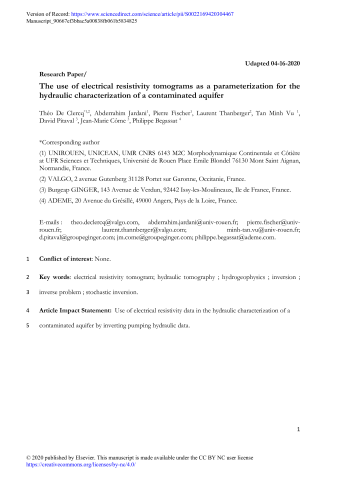
The use of electrical resistivity tomograms as a parameterization for the hydraulic characterization of a contaminated aquifer
- Type de publi. : Article dans une revue
- Date de publi. : 31/08/2020
-
Auteurs :
Théo de ClercqAbderrahim JardaniPierre FischerLaurent ThanbergerTan Minh VuDavid PitavalJean-Marie CômePhilippe Begassat
Fiche détaillée
The use of electrical resistivity tomograms as a parameterization for the hydraulic characterization of a contaminated aquifer
- Type de publi. : Article dans une revue
- Date de publi. : 31/08/2020
-
Auteurs :
Théo de ClercqAbderrahim JardaniPierre FischerLaurent ThanbergerTan Minh VuDavid PitavalJean-Marie CômePhilippe Begassat
-
Organismes :
Morphodynamique Continentale et Côtière
Morphodynamique Continentale et Côtière
Morphodynamique Continentale et Côtière
Valgo
Morphodynamique Continentale et Côtière
Ginger BURGEAP
Ginger BURGEAP
Agence de l'Environnement et de la Maîtrise de l'Énergie
- Publié dans Journal of Hydrology le 23/10/2020
Résumé : Hydraulic characterization of a contaminated aquifer is an important step in depollution processes because its hydraulic parameters control the choice and efficiency of the depollution protocol to be adopted. The characterization presented in this article uses a 3D electrical resistivity imagery to identify the spatial heterogeneities of a contaminated aquifer under tidal influence. Indeed, we use a 3D resistivity model as a source of information to parameterize the reconstruction of the hydraulic conductivity in 3D by inverting a set of hydraulic data acquired on the 13 monitored wells in response to two pumping tests. This parameterization relies on the identification of the main electro-facies in the resistivity model in the saturated zone, which will then be exploited in the hydraulic characterization to find their corresponding hydraulic conductivity values.This strategy of parameterization permits to reduce the number of the hydraulic conductivity parameters to be identified to eight hydro-facies, with a stochastic algorithm called the Adaptive Metropolis Algorithm. The hydraulic responses associated with the pumping tests are obtained once the natural effect of the tide is removed. The hydraulic conductivity model has permitted to highlight the main heterogeneities in the aquifer in which the hydraulic conductivity is ranging between [10-4.6, 10-2.8 m/s]. This range of variability reveals the permeable and smooth character of the aquifer in which the presence of coarse sand and flint blocks enhances its transmissivity. These permeable zones are electrically identified by resistive anomalies in the 3D electrical resistivity imaging.
Fichiers liés :
S0022169420304467.pdf
Source
-
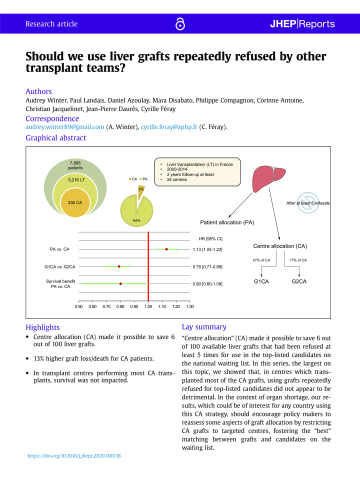
Should we use liver grafts repeatedly refused by other transplant teams?
- Type de publi. : Article dans une revue
- Date de publi. : 31/08/2020
-
Auteurs :
Audrey WinterPaul LandaisDaniel AzoulayMara DisabatoPhilippe CompagnonCorinne AntoineChristian JacquelinetJean-Pierre DaurèsCyrille Féray
Fiche détaillée
Should we use liver grafts repeatedly refused by other transplant teams?
- Type de publi. : Article dans une revue
- Date de publi. : 31/08/2020
-
Auteurs :
Audrey WinterPaul LandaisDaniel AzoulayMara DisabatoPhilippe CompagnonCorinne AntoineChristian JacquelinetJean-Pierre DaurèsCyrille Féray
-
Organismes :
Aide à la Décision pour une Médecine Personnalisé - Laboratoire de Biostatistique, Epidémiologie et Recherche Clinique - EA 2415
Clinique Beau Soleil [Montpellier]
University of California
Aide à la Décision pour une Médecine Personnalisé - Laboratoire de Biostatistique, Epidémiologie et Recherche Clinique - EA 2415
Hôpital Paul Brousse
Hôpital Henri Mondor
Hôpital Henri Mondor
Aide à la Décision pour une Médecine Personnalisé - Laboratoire de Biostatistique, Epidémiologie et Recherche Clinique - EA 2415
Clinique Beau Soleil [Montpellier]
Hôpital Paul Brousse
- Publié dans JHEP Reports Innovation in Hepatology le 07/09/2020
Résumé : Background & aims: In France, liver grafts that have been refused at least 5 times can be "rescued" and allocated to a centre which chooses a recipient from its own waiting list, outside the patient-based allocation framework. We explored whether these "rescued" grafts were associated with worse graft/patient survival, as well as assessing their effect on survival benefit. Methods: Among 7,895 candidates, 5,218 were transplanted between 2009 and 2014 (336 centre-allocated). We compared recipient/graft survival between patient allocation and centre allocation, considering a selection bias and the distribution of centre-allocation recipients among the transplant teams. We used a propensity score approach and a weighted Cox model using the inverse probability of treatment weighting method. We also explored the survival benefit associated with centre-allocation grafts. Results: There was a significantly higher risk of graft loss/death in the centre allocation group compared to the patient allocation group (hazard ratio 1.13; 95% CI 1.05-1.22). However, this difference was no longer significant for teams that performed more than 7% of the centre-allocation transplantations. Moreover, receiving a centre-allocation graft, compared to remaining on the waiting list and possibly later receiving a patient-allocation graft, did not convey a poorer survival benefit (hazard ratio 0.80; 95% CI 0.60-1.08). Conclusions: In centres which transplanted most of the centre-allocation grafts, using grafts repeatedly refused for top-listed candidates was not detrimental. Given the organ shortage, our findings should encourage policy makers to restrict centre-allocation grafts to targeted centres. Lay summary: "Centre allocation" (CA) made it possible to save 6 out of 100 available liver grafts that had been refused at least 5 times for use in the top-listed candidates on the national waiting list. In this series, the largest on this topic, we showed that, in centres which transplanted most of the CA grafts, using grafts repeatedly refused for top-listed candidates did not appear to be detrimental. In the context of organ shortage, our results, which could be of interest for any country using this CA strategy, should encourage policy makers to reassess some aspects of graft allocation by restricting CA grafts to targeted centres, fostering the "best" matching between grafts and candidates on the waiting list.
Fichiers liés :
1-s2.0-S2589555920300525-main.pdf
Source
-
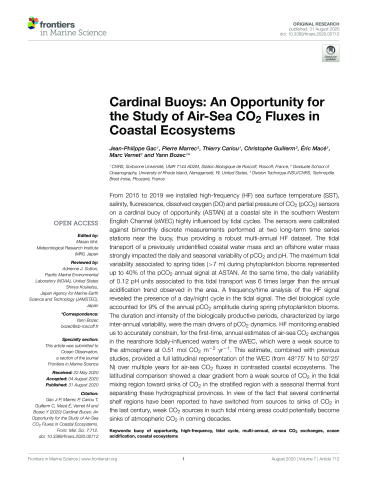
Cardinal Buoys: An Opportunity for the Study of Air-Sea CO 2 Fluxes in Coastal Ecosystems
- Type de publi. : Article dans une revue
- Date de publi. : 31/08/2020
-
Auteurs :
Jean-Philippe GacPierre MarrecThierry CariouChristophe GuillermÉric MacéMarc VernetYann Bozec
Fiche détaillée
Cardinal Buoys: An Opportunity for the Study of Air-Sea CO 2 Fluxes in Coastal Ecosystems
- Type de publi. : Article dans une revue
- Date de publi. : 31/08/2020
-
Auteurs :
Jean-Philippe GacPierre MarrecThierry CariouChristophe GuillermÉric MacéMarc VernetYann Bozec
-
Organismes :
Adaptation et diversité en milieu marin
Graduate School of Oceanography [Narragansett]
Adaptation et diversité en milieu marin
Fédération de recherche de Roscoff
Station biologique de Roscoff = Roscoff Marine Station
Division technique INSU/SDU
Adaptation et diversité en milieu marin
Adaptation et diversité en milieu marin
Adaptation et diversité en milieu marin
- Publié dans Frontiers in Marine Science le 29/10/2020
Résumé : From 2015 to 2019 we installed high-frequency (HF) sea surface temperature (SST), salinity, fluorescence, dissolved oxygen (DO) and partial pressure of CO 2 (pCO 2) sensors on a cardinal buoy of opportunity (ASTAN) at a coastal site in the southern Western English Channel (sWEC) highly influenced by tidal cycles. The sensors were calibrated against bimonthly discrete measurements performed at two long-term time series stations near the buoy, thus providing a robust multi-annual HF dataset. The tidal transport of a previously unidentified coastal water mass and an offshore water mass strongly impacted the daily and seasonal variability of pCO 2 and pH. The maximum tidal variability associated to spring tides (>7 m) during phytoplankton blooms represented up to 40% of the pCO 2 annual signal at ASTAN. At the same time, the daily variability of 0.12 pH units associated to this tidal transport was 6 times larger than the annual acidification trend observed in the area. A frequency/time analysis of the HF signal revealed the presence of a day/night cycle in the tidal signal. The diel biological cycle accounted for 9% of the annual pCO 2 amplitude during spring phytoplankton blooms. The duration and intensity of the biologically productive periods, characterized by large inter-annual variability, were the main drivers of pCO 2 dynamics. HF monitoring enabled us to accurately constrain, for the first-time, annual estimates of air-sea CO 2 exchanges in the nearshore tidally-influenced waters of the sWEC, which were a weak source to the atmosphere at 0.51 mol CO 2 m −2 yr −1. This estimate, combined with previous studies, provided a full latitudinal representation of the WEC (from 48 • 75 N to 50 • 25 N) over multiple years for air-sea CO 2 fluxes in contrasted coastal ecosystems. The latitudinal comparison showed a clear gradient from a weak source of CO 2 in the tidal mixing region toward sinks of CO 2 in the stratified region with a seasonal thermal front separating these hydrographical provinces. In view of the fact that several continental shelf regions have been reported to have switched from sources to sinks of CO 2 in the last century, weak CO 2 sources in such tidal mixing areas could potentially become sinks of atmospheric CO 2 in coming decades.
Fichiers liés :
fmars-07-00712.pdf
Source
-
Chilblains is a common cutaneous finding during the COVID-19 pandemic: A retrospective nationwide study from France
- Type de publi. : Article dans une revue
- Date de publi. : 31/08/2020
-
Auteurs :
Adèle de MassonJean-David BouazizLuc SulimovicCharles CassiusMarie JachietMarius-Anton IonescuMichel RybojadMartine BagotTu-Anh DuongDominique DenjeanMarie-Pierre LabartheMaud BézierMarie RisbourgGeneviève PayanSabrina AlainFrédéric MathivonAnny Cohen-LetessierDelphine KerobJean-Philippe HellierChristelle ComteFabielle KellerCaroline BruePaul LestangLaurence AllanoreEliane Pierkarski-CarpAnne AmoricHervé SerpierPhilippe PruvostFabien GuibalDamien GiaccheroElisa Funck-BrentanoSandrine Sierra FortunyIsabelle GallayAgnès ZavarroCaroline Bider-ValleSylvie LagrangeEtty GrynbergFlorence WeillDominique PensoMarie GomelJean SchneiderAnne LarabellePhilippe BonhommeMarie-Sophie GautierJean HatchuelImane MourtadaCharlotte FiteCatherine Oliveres-GhoutiElisabeth DomergueSabrina Fourcade-RochSylvie LecanuNathalie SebbanBruno HaliouaAnne BellutFabienne KellerIsabelle BaratteFrançoise LejoyeuxLaurence OllivaudGeorges AbirachedMarielle BurnoufBeatrix Reynayd-MendelJean-Noël DauendorfferJoëlle SebaounHervé GarratMarie-Martine PomperAnne-Marie HeudesIsabelle BeaulieuHugues CartierAmélie ArsouzeDominique Lons-DanicMichèle PelletierValérie GallaisValérie PiantadeMarlène RisbourgGeorges ReuterSerge DahanMurielle CreusotAbdallah KolliIsabelle Egasse-BrocaJean-Luc RigonPascale SabbanHélène FlacherBenoît JaillardPierre AndréDominique DebjouxElodie PoirierBénédicte SolygaMarc PerrusselSabrina MakhloufiBertrand MargnierClotilde HuzarLaetitia VandameHortense TheluAnne-Claire CholletFrédérique MarchalMichael NaouriMarion NadaudElodie BoissyAbdelhamid LamecheCharles BerdougoAudrey RollandMarie-Laure FléchetGabriel ColonnaDelphine JouannetIsabelle BerdahFrançoise TruchotIsabelle Lavallée
Fiche détaillée
Chilblains is a common cutaneous finding during the COVID-19 pandemic: A retrospective nationwide study from France
- Type de publi. : Article dans une revue
- Date de publi. : 31/08/2020
-
Auteurs :
Adèle de MassonJean-David BouazizLuc SulimovicCharles CassiusMarie JachietMarius-Anton IonescuMichel RybojadMartine BagotTu-Anh DuongDominique DenjeanMarie-Pierre LabartheMaud BézierMarie RisbourgGeneviève PayanSabrina AlainFrédéric MathivonAnny Cohen-LetessierDelphine KerobJean-Philippe HellierChristelle ComteFabielle KellerCaroline BruePaul LestangLaurence AllanoreEliane Pierkarski-CarpAnne AmoricHervé SerpierPhilippe PruvostFabien GuibalDamien GiaccheroElisa Funck-BrentanoSandrine Sierra FortunyIsabelle GallayAgnès ZavarroCaroline Bider-ValleSylvie LagrangeEtty GrynbergFlorence WeillDominique PensoMarie GomelJean SchneiderAnne LarabellePhilippe BonhommeMarie-Sophie GautierJean HatchuelImane MourtadaCharlotte FiteCatherine Oliveres-GhoutiElisabeth DomergueSabrina Fourcade-RochSylvie LecanuNathalie SebbanBruno HaliouaAnne BellutFabienne KellerIsabelle BaratteFrançoise LejoyeuxLaurence OllivaudGeorges AbirachedMarielle BurnoufBeatrix Reynayd-MendelJean-Noël DauendorfferJoëlle SebaounHervé GarratMarie-Martine PomperAnne-Marie HeudesIsabelle BeaulieuHugues CartierAmélie ArsouzeDominique Lons-DanicMichèle PelletierValérie GallaisValérie PiantadeMarlène RisbourgGeorges ReuterSerge DahanMurielle CreusotAbdallah KolliIsabelle Egasse-BrocaJean-Luc RigonPascale SabbanHélène FlacherBenoît JaillardPierre AndréDominique DebjouxElodie PoirierBénédicte SolygaMarc PerrusselSabrina MakhloufiBertrand MargnierClotilde HuzarLaetitia VandameHortense TheluAnne-Claire CholletFrédérique MarchalMichael NaouriMarion NadaudElodie BoissyAbdelhamid LamecheCharles BerdougoAudrey RollandMarie-Laure FléchetGabriel ColonnaDelphine JouannetIsabelle BerdahFrançoise TruchotIsabelle Lavallée
-
Organismes :
Immunologie humaine, physiopathologie & immunothérapie
Immunologie humaine, physiopathologie & immunothérapie
Immunologie humaine, physiopathologie & immunothérapie
Immunologie humaine, physiopathologie & immunothérapie
Institut Mondor de Recherche Biomédicale
- Publié dans Journal of The American Academy of Dermatology le 26/10/2020
Fichiers liés :
S0190962220307891.pdf
Source
-
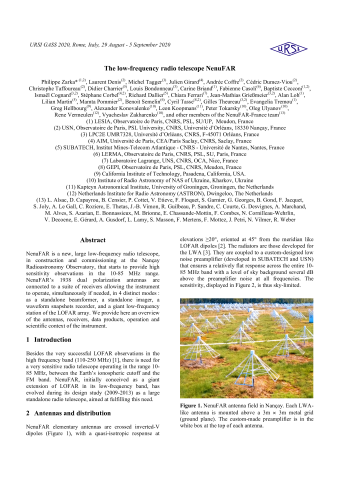
The low-frequency radio telescope NenuFAR
- Type de publi. : Communication dans un congrès
- Date de publi. : 29/08/2020
-
Auteurs :
Philippe ZarkaLaurent DenisMichel TaggerJulien GirardAndrée CoffreCédric Dumez-ViouChristophe TaffoureauDidier CharrierLouis BondonneauCarine BriandFabienne CasoliBaptiste CecconiIsmaël CognardStéphane CorbelRichard DallierChiara FerrariJean-Mathias GriessmeierAlan LohLilian MartinMamta PommierSemelin BenoitCyril TasseG TheureauEvangelia TremouD CapayrouB CensierP CottetV EtieveF FloquetS GarnierG GeorgesB GondF JacquetS JolyA Le GallC RoziereE ThetasJ.-B VimonR GuilbeauP SandreC CourteG DesvignesA MarchandM AlvesSylvain AzarianEtienne BonnassieuxMark BrionneEric Chassande-MottinF CombesN Cornilleau-WehrlinV DecoeneE GérardA GusdorfL LamyS MassonF MertensF MottezJérôme PétriNicole VilmerR WeberGreg HellbourgAlexander KonovalenkoLeon KoopmansPeter TokarskyOleg UlyanovRene VermeulenVyacheslav Zakharenko
Fiche détaillée
The low-frequency radio telescope NenuFAR
- Type de publi. : Communication dans un congrès
- Date de publi. : 29/08/2020
-
Auteurs :
Philippe ZarkaLaurent DenisMichel TaggerJulien GirardAndrée CoffreCédric Dumez-ViouChristophe TaffoureauDidier CharrierLouis BondonneauCarine BriandFabienne CasoliBaptiste CecconiIsmaël CognardStéphane CorbelRichard DallierChiara FerrariJean-Mathias GriessmeierAlan LohLilian MartinMamta PommierSemelin BenoitCyril TasseG TheureauEvangelia TremouD CapayrouB CensierP CottetV EtieveF FloquetS GarnierG GeorgesB GondF JacquetS JolyA Le GallC RoziereE ThetasJ.-B VimonR GuilbeauP SandreC CourteG DesvignesA MarchandM AlvesSylvain AzarianEtienne BonnassieuxMark BrionneEric Chassande-MottinF CombesN Cornilleau-WehrlinV DecoeneE GérardA GusdorfL LamyS MassonF MertensF MottezJérôme PétriNicole VilmerR WeberGreg HellbourgAlexander KonovalenkoLeon KoopmansPeter TokarskyOleg UlyanovRene VermeulenVyacheslav Zakharenko
-
Organismes :
Laboratoire d'études spatiales et d'instrumentation en astrophysique = Laboratory of Space Studies and Instrumentation in Astrophysics
Unité Scientifique de la Station de Nançay
Unité Scientifique de la Station de Nançay
Laboratoire de Physique et Chimie de l'Environnement et de l'Espace
Astrophysique Interprétation Modélisation
Unité Scientifique de la Station de Nançay
Unité Scientifique de la Station de Nançay
Unité Scientifique de la Station de Nançay
Laboratoire de physique subatomique et des technologies associées
Laboratoire de Physique et Chimie de l'Environnement et de l'Espace
Laboratoire d'études spatiales et d'instrumentation en astrophysique
Laboratoire d'Etude du Rayonnement et de la Matière en Astrophysique
Laboratoire d'études spatiales et d'instrumentation en astrophysique = Laboratory of Space Studies and Instrumentation in Astrophysics
Unité Scientifique de la Station de Nançay
Laboratoire de Physique et Chimie de l'Environnement et de l'Espace
Unité Scientifique de la Station de Nançay
Astrophysique Interprétation Modélisation
Unité Scientifique de la Station de Nançay
Laboratoire de physique subatomique et des technologies associées
Joseph Louis LAGRANGE
Laboratoire de Physique et Chimie de l'Environnement et de l'Espace
Unité Scientifique de la Station de Nançay
Laboratoire d'études spatiales et d'instrumentation en astrophysique = Laboratory of Space Studies and Instrumentation in Astrophysics
Laboratoire de physique subatomique et des technologies associées
Laboratoire d'Etude du Rayonnement et de la Matière en Astrophysique et Atmosphères = Laboratory for Studies of Radiation and Matter in Astrophysics and Atmospheres
Galaxies, Etoiles, Physique, Instrumentation
Laboratoire de Physique et Chimie de l'Environnement et de l'Espace
Unité Scientifique de la Station de Nançay
Laboratoire d'études spatiales et d'instrumentation en astrophysique = Laboratory of Space Studies and Instrumentation in Astrophysics
Unité Scientifique de la Station de Nançay
Unité Scientifique de la Station de Nançay
Unité Scientifique de la Station de Nançay
Laboratoire d'Etude du Rayonnement et de la Matière en Astrophysique et Atmosphères = Laboratory for Studies of Radiation and Matter in Astrophysics and Atmospheres
Laboratoire d'études spatiales et d'instrumentation en astrophysique = Laboratory of Space Studies and Instrumentation in Astrophysics
Institut d'Astrophysique de Paris
Laboratoire d'Etude du Rayonnement et de la Matière en Astrophysique
Laboratoire d'études spatiales et d'instrumentation en astrophysique = Laboratory of Space Studies and Instrumentation in Astrophysics
Laboratoire d'études spatiales et d'instrumentation en astrophysique
Laboratoire d'Etude du Rayonnement et de la Matière en Astrophysique et Atmosphères = Laboratory for Studies of Radiation and Matter in Astrophysics and Atmospheres
Galaxies, Etoiles, Physique, Instrumentation
Observatoire astronomique de Strasbourg
Laboratoire d'études spatiales et d'instrumentation en astrophysique = Laboratory of Space Studies and Instrumentation in Astrophysics
Résumé : NenuFAR is a new, large low-frequency radio telescope, in construction and commissioning at the Nançay Radioastronomy Observatory, that starts to provide high sensitivity observations in the 10-85 MHz range. NenuFAR’s 1938 dual polarization antennas are connected to a suite of receivers allowing the instrument to operate, simultaneously if needed, in 4 distinct modes : as a standalone beamformer, a standalone imager, a waveform snapshots recorder, and a giant low-frequency station of the LOFAR array. We provide here an overview of the antennas, receivers, data products, operation and scientific context of the instrument.
Fichiers liés :
URSIGASS2020SummaryPaperNenuFARnew.pdf
Source
-
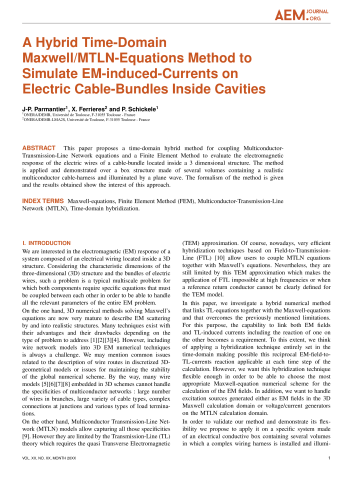
A Hybrid Time-Domain Maxwell/MTLN-Equations Method to Simulate EM-induced-Currents on Electric Cable-Bundles Inside Cavities
- Type de publi. : Article dans une revue
- Date de publi. : 29/08/2020
-
Auteurs :
Jean-Philippe ParmantierXavier FerrieresPierre Schickele
Fiche détaillée
A Hybrid Time-Domain Maxwell/MTLN-Equations Method to Simulate EM-induced-Currents on Electric Cable-Bundles Inside Cavities
- Type de publi. : Article dans une revue
- Date de publi. : 29/08/2020
-
Auteurs :
Jean-Philippe ParmantierXavier FerrieresPierre Schickele
-
Organismes :
DEMR, ONERA, Université de Toulouse [Toulouse]
DEMR, ONERA, Université de Toulouse [Toulouse]
DEMR, ONERA, Université de Toulouse [Toulouse]
- Publié dans Advanced Electromagnetics le 23/10/2020
Résumé : This paper proposes a time-domain hybrid method for coupling Multiconductor-Transmission-Line Network equations and a Finite Element Method to evaluate the electromagnetic response of the electric wires of a cable-bundle located inside a 3 dimensional structure. The method is applied and demonstrated over a box structure made of several volumes containing a realistic multiconductor cable-harness and illuminated by a plane wave. The formalism of the method is given and the results obtained show the interest of this approach.
Fichiers liés :
DEMR20044.1599663073_postprint.pdf
Source
-
The IL-17A and IL-22 cytokines like triggers of human liver fibrosis
- Type de publi. :
- Date de publi. : 27/08/2020
-
Auteurs :
Daria Kartasheva-EbertzJesintha GastonPierre-Philippe MassaultSébastien GaujouxOlivier ScattonJean-Christophe VaillantVladimir A. MorozovStanislas PolSylvie Lagaye
Fiche détaillée
The IL-17A and IL-22 cytokines like triggers of human liver fibrosis
- Type de publi. :
- Date de publi. : 27/08/2020
-
Auteurs :
Daria Kartasheva-EbertzJesintha GastonPierre-Philippe MassaultSébastien GaujouxOlivier ScattonJean-Christophe VaillantVladimir A. MorozovStanislas PolSylvie Lagaye
-
Organismes :
Université Paris Cité
Immunobiologie des Cellules dendritiques
Université Paris Cité
Immunobiologie des Cellules dendritiques
Chirurgie digestive, hépato-biliaire et endocrinienne [CHU Cochin]
Chirurgie digestive, hépato-biliaire et endocrinienne [CHU Cochin]
CHU Pitié-Salpêtrière [AP-HP]
CHU Pitié-Salpêtrière [AP-HP]
Robert Koch Institute [Berlin]
Université Paris Cité
Immunobiologie des Cellules dendritiques
Département d'hépatologie [CHU Cochin]
Immunobiologie des Cellules dendritiques
- Publié dans Journal of Hepatology le 23/10/2020
Source