Professeur chercheur en sciences de gestion et du management
-
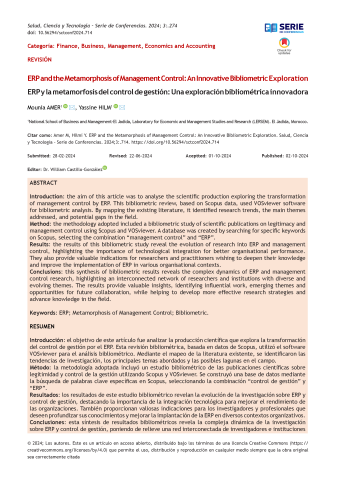
ERP and the Metamorphosis of Management Control: An Innovative Bibliometric Exploration
- Type de publi. : Article dans une revue
- Date de publi. : 23/09/2024
-
Auteurs :
Mounia AmerCaroline Hilmi
Fiche détaillée
ERP and the Metamorphosis of Management Control: An Innovative Bibliometric Exploration
- Type de publi. : Article dans une revue
- Date de publi. : 23/09/2024
-
Auteurs :
Mounia AmerCaroline Hilmi
-
Organismes :
Université Chouaib Doukkali
Université Chouaib Doukkali
- Publié dans Salud, Ciencia y Tecnología - Serie de Conferencias le 01/11/2024
Résumé : Introduction: The aim of this article was to analyse the scientific production exploring the transformation of management control by ERP. This bibliometric review, based on Scopus data, used VOSviewer software for bibliometric analysis. By mapping the existing literature, it identified research trends, the main themes addressed, and potential gaps in the field.Methods: The methodology adopted included a bibliometric study of scientific publications on legitimacy and management control using Scopus and VOSviewer. A database was created by searching for specific keywords on Scopus, selecting the combination "management control" and "ERP".Results: The results of this bibliometric study reveal the evolution of research into ERP and management control, highlighting the importance of technological integration for better organisational performance. They also provide valuable indications for researchers and practitioners wishing to deepen their knowledge and improve the implementation of ERP in various organisational contexts.Conclusion: This synthesis of bibliometric results reveals the complex dynamics of ERP and management control research, highlighting an interconnected network of researchers and institutions with diverse and evolving themes. The results provide valuable insights, identifying influential work, emerging themes and opportunities for future collaboration, while helping to develop more effective research strategies and advance knowledge in the field.
Fichiers liés :
SCTConf_2024_SinID_714.pdf
Source
-

Impact de l’innovation éducative sur l’entrepreneuriat chez les étudiants algériens
- Type de publi. : Article dans une revue
- Date de publi. : 16/05/2024
-
Auteurs :
Salim ChorfiAmal HassaineSamir B. MalikiCaroline Hilmi
Fiche détaillée
Impact de l’innovation éducative sur l’entrepreneuriat chez les étudiants algériens
- Type de publi. : Article dans une revue
- Date de publi. : 16/05/2024
-
Auteurs :
Salim ChorfiAmal HassaineSamir B. MalikiCaroline Hilmi
-
Organismes :
Université Aboubekr Belkaid de Tlemcen = University of Belkaïd Abou Bekr [Tlemcen]
Université Aboubekr Belkaid de Tlemcen = University of Belkaïd Abou Bekr [Tlemcen]
Aménagement des Usages des Ressources et des Espaces marins et littoraux - Centre de droit et d'économie de la mer
Université Chouaib Doukkali
- Publié dans Maghreb-Machrek le 28/10/2020
Résumé : Cet article vise à mettre en lumière l’importance de la formation à l’entrepreneuriat et le rôle de la perception des opportunités chez les étudiants universitaires algériens après des réformes significatives dans le secteur de l’enseignement supérieur et la mise en œuvre d’un processus d’innovation reconnaissant la notion largement acceptée selon laquelle l’entrepreneuriat est un moteur essentiel du développement économique. Nous examinons l’impact de la formation entrepreneuriale et de la perception des opportunités sur un échantillon de 228 étudiants de l’université de Tlemcen en utilisant la théorie du comportement planifié (TPB) et en employant la méthode des moindres carrés partiels (PLS) et l’outil SMARTPLS v3. Les résultats indiquent un impact positif et significatif de l’éducation et de la formation à l’entrepreneuriat. Plus précisément, les normes subjectives et l’auto-efficacité influencent directement et indirectement les intentions entrepreneuriales des étudiants. Cependant, contrairement aux attentes, la perception de l’opportunité n’a pas eu d’effet significatif sur l’échantillon. Cette étude met également en évidence la nécessité de poursuivre l’exploration et l’innovation dans la formation aux sciences de gestion. JEL: M00, M29, M53.
Source
-
Tropical blue carbon: solutions and perspectives for valuations of carbon sequestration
- Type de publi. : Article dans une revue
- Date de publi. : 26/06/2023
-
Auteurs :
Caroline HilmiMaria Belen Benitez CarrancoDavid BroussardMaryann MathewSalpie DjoundourianSandra CassottaAlain SafaSamir B. MalikiFlorence Descroix-ComanducciDenis AllemandClaude BerthomieuJason Hall-SpencerChristine Ferrier-Pagès
Fiche détaillée
Tropical blue carbon: solutions and perspectives for valuations of carbon sequestration
- Type de publi. : Article dans une revue
- Date de publi. : 26/06/2023
-
Auteurs :
Caroline HilmiMaria Belen Benitez CarrancoDavid BroussardMaryann MathewSalpie DjoundourianSandra CassottaAlain SafaSamir B. MalikiFlorence Descroix-ComanducciDenis AllemandClaude BerthomieuJason Hall-SpencerChristine Ferrier-Pagès
-
Organismes :
Université Chouaib Doukkali
Centre Scientifique de Monaco
Centre Scientifique de Monaco
Centre Scientifique de Monaco
Lebanese American University
Groupe de Recherche en Management - EA 4711
Université Aboubekr Belkaid de Tlemcen = University of Belkaïd Abou Bekr [Tlemcen]
Laboratoire International Associé Réponse des Organismes et Populations face au Stress Environnemental - Université Côte d’Azur - Centre Scientifique de Monaco
Centre d'Etudes en Macroéconomie et Finance Internationale
Plymouth University
Centre Scientifique de Monaco
- Publié dans Frontiers in Climate le 29/12/2020
Résumé : Tropical marine ecosystems provide a wide range of provisioning, regulating, supporting and cultural services to millions of people. They also largely contribute to blue carbon sequestration. Mangroves, seaweeds, and seagrass habitats are important because they store large amounts of organic carbon while fish play a fundamental role in the carbon transport to deep waters. Protecting and restoring tropical marine ecosystems is of great value to society because their decline impairs the vital services they provide, such as coastal protection and seafood supplies. In this marine policy paper, we present options for enhancing blue carbon sequestration in tropical coastal areas. In addition, we outline the economic value of four components of coastal ecosystems (mangroves, seagrass beds, seaweed forests and fish) and discuss the economic levers society can apply to ensure the end of the current gross mismanagement of tropical blue carbon ecosystems. Market-based solutions, such as carbon taxes or fines for violations that use the ‘polluter pays' principle, can be very effective in achieving national or international climate agreements. Private investment can also finance the preservation of blue carbon ecosystems. One widely known financing method for blue carbon conservation, particularly of mangroves, is the use of municipal bonds, which can be issued like traditional bonds to finance the day-to-day obligations of cities, states and counties. Non-philanthropic investments can also be used in order to protect these ecosystems, such as debt-for-nature swaps and the improved application of regulatory frameworks. Overall, the protection of tropical marine ecosystems is an ecological imperative and should also be seen as an opportunity for new revenue streams and debt reduction for countries worldwide.
Source
-
Actes du Colloque International Coopération Université -Entreprise : d'une recherche « sur » l'entreprise à une recherche « avec » l'entreprise
- Type de publi. :
- Date de publi. : 25/03/2022
-
Auteurs :
Caroline HilmiMounia Amer
Fiche détaillée
Actes du Colloque International Coopération Université -Entreprise : d'une recherche « sur » l'entreprise à une recherche « avec » l'entreprise
- Type de publi. :
- Date de publi. : 25/03/2022
-
Auteurs :
Caroline HilmiMounia Amer
-
Organismes :
Université Chouaib Doukkali
Université Chouaib Doukkali
Fichiers liés :
1. Proceeding yassine HILM.pdf
Source
-
Transformation digitale des cabinets d'audit par les réseaux sociaux : Cas de KPMG
- Type de publi. : Article dans une revue
- Date de publi. : 15/02/2022
-
Auteurs :
Caroline HilmiFatima Fatine
Fiche détaillée
Transformation digitale des cabinets d'audit par les réseaux sociaux : Cas de KPMG
- Type de publi. : Article dans une revue
- Date de publi. : 15/02/2022
-
Auteurs :
Caroline HilmiFatima Fatine
-
Organismes :
Université Chouaib Doukkali
Université Chouaib Doukkali
- Publié dans SSRG International Journal of Economics and Management Studies (SSRG-IJEMS le 16/10/2020
Résumé : Au Maroc, on assiste ces dernières années à de nouveaux investissements publicitaires et à une réorganisation de ce marché. Pour suivre cette nouvelle tendance, les innovations technologiques suivent de près l'évolution de la consommation des medias pour offrir aux entreprises marocaines toujours plus de solutions qui leur permettront d'être proche de leurs cibles ; réseaux sociaux, géolocalisation… L'objectif de cet article est d'établir un état des lieux de la politique de médiatisation utilisée par les entreprises marocaines à l'heure actuelle. Nous avons choisi une étude de cas du cabinet d'audit KPMG Maroc en s'intéressant à différents volets notamment au recrutement, actualité du cabinet, évènement… durant 2015 et 2016.
Fichiers liés :
3. KPMG+MEDIAS,+Yassine+Hilmi+Fatine+FZ-2.pdf
Source
-
Designing a blueprint for coral reef survival
- Type de publi. : Article dans une revue
- Date de publi. : 01/01/2021
-
Auteurs :
Joan KleypasDenis AllemandKen AnthonyAndrew BakerMichael BeckLynne Zeitlin HaleCaroline HilmiOve Hoegh-GuldbergTerry HughesLes KaufmanHajime KayanneAlexandre MagnanElizabeth McleodPeter MumbyStephen PalumbiRobert H RichmondBaruch RinkevichRobert S SteneckChristian R VoolstraDavid WachenfeldJean-Pierre Gattuso
Fiche détaillée
Designing a blueprint for coral reef survival
- Type de publi. : Article dans une revue
- Date de publi. : 01/01/2021
-
Auteurs :
Joan KleypasDenis AllemandKen AnthonyAndrew BakerMichael BeckLynne Zeitlin HaleCaroline HilmiOve Hoegh-GuldbergTerry HughesLes KaufmanHajime KayanneAlexandre MagnanElizabeth McleodPeter MumbyStephen PalumbiRobert H RichmondBaruch RinkevichRobert S SteneckChristian R VoolstraDavid WachenfeldJean-Pierre Gattuso
-
Organismes :
National Center for Atmospheric Research [Boulder]
Centre Scientifique de Monaco
The University of Queensland
The University of Tokyo
The University of Queensland
Stanford University
University of Hawai‘i [Mānoa]
University of Maine
Universität Konstanz
Laboratoire d'océanographie de Villefranche
Institut du Développement Durable et des Relations Internationales
- Publié dans Biological Conservation le 25/10/2020
Résumé : Maintaining coral reef ecosystems is a social imperative, because so many people depend on coral reefs for food production, shoreline protection, and livelihoods. The survival of reefs this century, however, is threatened by the mounting effects of climate change. Climate mitigation is the foremost and essential action to prevent coral reef ecosystem collapse. Without it, reefs will become extremely diminished within the next 20-30 years. Even with strong climate mitigation, however, existing conservation measures such as marine protected areas and fisheries management are no longer sufficient to sustain the ecosystem and many additional and innovative actions to increase reef resilience must also be taken. In this paper we assess the suite of protections and actions in terms of their potential be effective according to a set of criteria that include effectiveness, readiness, co-benefits and disbenefits. Even with the best scientific innovation, saving coral reefs will require a well-funded, welldesigned, and rapidly executed strategy with political and social commitments at the level of other grand challenges.
Fichiers liés :
kleypas_etal_inpress_Conservation_Biology.pdf
Source
-
A Roadmap for using the UN decade of ocean science for sustainable development in support of science, policy, and action
- Type de publi. : Article dans une revue
- Date de publi. : 01/01/2020
-
Auteurs :
Joachim ClaudetLaurent BoppWilliam W.L. CheungRodolphe DevillersElva Escobar-BrionesPeter HauganJohanna HeymansValérie Masson-DelmotteNele Matz-LückPatricia MiloslavichLauren MullineauxMartin VisbeckRobert WatsonAnna Milena ZivianIsabelle J. AnsorgeMoacyr AraujoSalvatore AricòDenis BaillyJulian BarbièreCyrille BarneriasChris BowlerVictor BrunAnny CazenaveCameron DiverAgathe EuzenAmadou Thierno GayeCaroline HilmiFrédéric MénardRosemary MorrowNorma Patricia MuñozRémi ParmentierAntoine PebayleHans-Otto PörtnerSilva OsvaldinaPatricia RicardRicardo Serrão SantosMarie-Alexandrine SicreStéphanie ThiébaultTorsten ThieleRomain TroubléAlexander TurraJacqueline UkuFrançoise Gaill
Fiche détaillée
A Roadmap for using the UN decade of ocean science for sustainable development in support of science, policy, and action
- Type de publi. : Article dans une revue
- Date de publi. : 01/01/2020
-
Auteurs :
Joachim ClaudetLaurent BoppWilliam W.L. CheungRodolphe DevillersElva Escobar-BrionesPeter HauganJohanna HeymansValérie Masson-DelmotteNele Matz-LückPatricia MiloslavichLauren MullineauxMartin VisbeckRobert WatsonAnna Milena ZivianIsabelle J. AnsorgeMoacyr AraujoSalvatore AricòDenis BaillyJulian BarbièreCyrille BarneriasChris BowlerVictor BrunAnny CazenaveCameron DiverAgathe EuzenAmadou Thierno GayeCaroline HilmiFrédéric MénardRosemary MorrowNorma Patricia MuñozRémi ParmentierAntoine PebayleHans-Otto PörtnerSilva OsvaldinaPatricia RicardRicardo Serrão SantosMarie-Alexandrine SicreStéphanie ThiébaultTorsten ThieleRomain TroubléAlexander TurraJacqueline UkuFrançoise Gaill
-
Organismes :
Centre de recherches insulaires et observatoire de l'environnement
Laboratoire des Sciences du Climat et de l'Environnement [Gif-sur-Yvette]
Laboratoire de Météorologie Dynamique (UMR 8539)
Institute for the Oceans and Fisheries
Centre de recherches insulaires et observatoire de l'environnement
Memorial University of Newfoundland = Université Memorial de Terre-Neuve [St. John's, Canada]
Instituto de Ciencias del Mar y Limnología
Institute of Marine Research [Bergen]
European Marine Board
Scottish Association for Marine Science
Glaces et Continents, Climats et Isotopes Stables
Christian-Albrechts-Universität zu Kiel = Christian-Albrechts University of Kiel = Université Christian-Albrechts de Kiel
University of Tasmania [Hobart]
Woods Hole Oceanographic Institution
Leibniz-Institut für Meereswissenschaften
Tyndall Centre for Climate Change Research
Ocean Conservancy
Department of Oceanography [Cape Town]
Laboratoria de Oceanografia Fisica Estuarina e Costeira
United Nations Educational, Scientific and Cultural Organization
Aménagement des Usages des Ressources et des Espaces marins et littoraux - Centre de droit et d'économie de la mer
United Nations Educational, Scientific and Cultural Organization
Agence Française pour la Biodiversité
Institut de biologie de l'ENS Paris
Centre de recherches insulaires et observatoire de l'environnement
Laboratoire d'études en Géophysique et océanographie spatiales
Pacific community [Nouméa, nouvelle Calédonie]
Laboratoire Techniques, Territoires et Sociétés
Laboratoire de Physique de l'Atmosphère et de l'Océan Siméon Fongang
Centre Scientifique de Monaco
Institut méditerranéen d'océanologie
Laboratoire des Sciences du Climat et de l'Environnement [Gif-sur-Yvette]
Centro Interdisciplinario de Investigaciones y Estudios sobre Medio Ambiente y Desarrollo
The Varda Group
Centre de recherches insulaires et observatoire de l'environnement
Alfred-Wegener-Institut, Helmholtz-Zentrum für Polar- und Meeresforschung = Alfred Wegener Institute for Polar and Marine Research = Institut Alfred-Wegener pour la recherche polaire et marine
Instituto Nacional de Desenvolvimento das Pescas
Institut Océanographique Paul Ricard
Instituto do Mar - Universidade dos Açores
Variabilité de l'Océan et de la Glace de mer
Institut Ecologie et Environnement - CNRS Ecologie et Environnement
Institute for Advanced Sustainability Studies [Potsdam]
Tara Expéditions
Instituto Oceanográfico
Kenya Marine and Fisheries Research Institute - KMFRI (KENYA)
Institut Ecologie et Environnement - CNRS Ecologie et Environnement
Plateforme Océan et Climat
- Publié dans One Earth le 13/11/2020
Résumé : The health of the ocean, central to human well-being, has now reached a critical point. Most fish stocks are overexploited, climate change and increased dissolved carbon dioxide are changing ocean chemistry and disrupting species throughout food webs, and the fundamental capacity of the ocean to regulate the climate has been altered. However, key technical, organizational, and conceptual scientific barriers have prevented the identification of policy levers for sustainability and transformative action. Here, we recommend key strategies to address these challenges, including stronger integration of sciences and ocean-observing systems, improved science-policy interfaces, new partnerships supported by a new ocean-climate finance system, and improved ocean literacy and education to modify social norms and behaviors. Adopting these strategies could help establish ocean science as a key foundation of broader sustainability transformations.
Fichiers liés :
PIIS2590332219300934.pdf
Source
-
Climate impacts on the ocean are making the Sustainable Development Goals a moving target travelling away from us
- Type de publi. : Article dans une revue
- Date de publi. : 12/06/2019
-
Auteurs :
Gerald SinghCaroline HilmiJoey BernhardtAndres Cisneros MontemayorMadeline CashionYoshitaka OtaSevil AcarJason BrownRichard CottrellSalpie DjoundourianPedro González‐espinosaVicky LamNadine MarshallBarbara NeumannNicolas PascalGabriel ReygondeauJoacim RocklӧvAlain SafaLaura VirtoWilliam Cheung
Fiche détaillée
Climate impacts on the ocean are making the Sustainable Development Goals a moving target travelling away from us
- Type de publi. : Article dans une revue
- Date de publi. : 12/06/2019
-
Auteurs :
Gerald SinghCaroline HilmiJoey BernhardtAndres Cisneros MontemayorMadeline CashionYoshitaka OtaSevil AcarJason BrownRichard CottrellSalpie DjoundourianPedro González‐espinosaVicky LamNadine MarshallBarbara NeumannNicolas PascalGabriel ReygondeauJoacim RocklӧvAlain SafaLaura VirtoWilliam Cheung
-
Organismes :
University of British Columbia [Canada]
Centre Scientifique de Monaco
University of British Columbia [Canada]
University of British Columbia [Canada]
University of British Columbia [Canada]
University of Washington [Seattle]
Boǧaziçi üniversitesi = Boğaziçi University [Istanbul]
University of British Columbia [Canada]
University of Tasmania [Hobart]
Lebanese American University
University of British Columbia [Canada]
University of British Columbia [Canada]
James Cook University
Institute for Advanced Sustainability Studies [Potsdam]
HYGEOS (SARL)
University of British Columbia [Canada]
Umeå University = Umeå Universitet
Skill Partners
Aménagement des Usages des Ressources et des Espaces marins et littoraux - Centre de droit et d'économie de la mer
University of British Columbia [Canada]
- Publié dans People and Nature le 01/11/2020
Résumé : Climate change is impacting marine ecosystems and their goods and services in diverse ways, which can directly hinder our ability to achieve the Sustainable Development Goals (SDGs), set out under the 2030 Agenda for Sustainable Development. Through expert elicitation and a literature review, we find that most climate change effects have a wide variety of negative consequences across marine ecosystem services, though most studies have highlighted impacts from warming and consequences of marine species. Climate change is expected to negatively influence marine ecosystem services through global stressors—such as ocean warming and acidification—but also by amplifying local and regional stressors such as freshwater runoff and pollution load. Experts indicated that all SDGs would be overwhelmingly negatively affected by these climate impacts on marine ecosystem services, with eliminating hunger being among the most directly negatively affected SDG. Despite these challenges, the SDGs aiming to transform our consumption and production practices and develop clean energy systems are found to be least affected by marine climate impacts. These findings represent a strategic point of entry for countries to achieve sustainable development, given that these two goals are relatively robust to climate impacts and that they are important pre‐requisite for other SDGs. Our results suggest that climate change impacts on marine ecosystems are set to make the SDGs a moving target travelling away from us. Effective and urgent action towards sustainable development, including mitigating and adapting to climate impacts on marine systems are important to achieve the SDGs, but the longer this action stalls the more distant these goals will become.
Fichiers liés :
People and Nature - 2019 - Singh - Climate impacts on the ocean are making the Sustainable Development Goals a moving.pdf
Source
-
Socio-economic tools to mitigate the impacts of ocean acidification on economies and communities reliant on coral reefs — a framework for prioritization
- Type de publi. : Article dans une revue
- Date de publi. : 01/04/2019
-
Auteurs :
Caroline HilmiDavid OsbornSevil AcarTamatoa BambridgeFrederique ChlousMine CinarSalpie DjoundourianGunnar HaraldssonVicky W.Y. LamSamir B. MalikiAnnick de Marffy MantuanoNadine MarshallPaul MarshallNicolas PascalLaura Recuero VirtoKatrin RehdanzAlain Safa
Fiche détaillée
Socio-economic tools to mitigate the impacts of ocean acidification on economies and communities reliant on coral reefs — a framework for prioritization
- Type de publi. : Article dans une revue
- Date de publi. : 01/04/2019
-
Auteurs :
Caroline HilmiDavid OsbornSevil AcarTamatoa BambridgeFrederique ChlousMine CinarSalpie DjoundourianGunnar HaraldssonVicky W.Y. LamSamir B. MalikiAnnick de Marffy MantuanoNadine MarshallPaul MarshallNicolas PascalLaura Recuero VirtoKatrin RehdanzAlain Safa
-
Organismes :
Centre Scientifique de Monaco
Environment Laboratories
Boǧaziçi üniversitesi = Boğaziçi University [Istanbul]
Centre de recherches insulaires et observatoire de l'environnement
Patrimoines locaux, Environnement et Globalisation
Loyola University [Chicago]
Lebanese American University
intellecon
University of British Columbia [Canada]
Université Aboubekr Belkaid de Tlemcen = University of Belkaïd Abou Bekr [Tlemcen]
Institut du Droit Economique de la Mer
CSIRO Land and Water
Department of Computer Science [Bristol]
HYGEOS (SARL)
Aménagement des Usages des Ressources et des Espaces marins et littoraux - Centre de droit et d'économie de la mer
Centre de Recherche en Gestion I3
Christian-Albrechts-Universität zu Kiel = Christian-Albrechts University of Kiel = Université Christian-Albrechts de Kiel
Groupe de Recherche en Management - EA 4711
- Publié dans Regional Studies in Marine Science le 28/10/2020
Source
-
Socio-economic tools to mitigate the impacts of ocean acidification on economies and communities reliant on coral reefs — a framework for prioritization
- Type de publi. : Article dans une revue
- Date de publi. : 01/04/2019
-
Auteurs :
Caroline HilmiDavid OsbornSevil AcarTamatoa BambridgeFrédérique ChlousMine CinarSalpie DjoundourianGunnar HaraldssonVicky W.Y. LamSamir B. MalikiAnnick de Marffy MantuanoNadine MarshallPaul MarshallNicolas PascalLaura Recuero VirtoKatrin RehdanzAlain Safa
Fiche détaillée
Socio-economic tools to mitigate the impacts of ocean acidification on economies and communities reliant on coral reefs — a framework for prioritization
- Type de publi. : Article dans une revue
- Date de publi. : 01/04/2019
-
Auteurs :
Caroline HilmiDavid OsbornSevil AcarTamatoa BambridgeFrédérique ChlousMine CinarSalpie DjoundourianGunnar HaraldssonVicky W.Y. LamSamir B. MalikiAnnick de Marffy MantuanoNadine MarshallPaul MarshallNicolas PascalLaura Recuero VirtoKatrin RehdanzAlain Safa
-
Organismes :
Centre Scientifique de Monaco
Environment Laboratories
Boǧaziçi üniversitesi = Boğaziçi University [Istanbul]
Centre de recherches insulaires et observatoire de l'environnement
Laboratoire d'Excellence CORAIL
Muséum national d'Histoire naturelle
Loyola University [Chicago]
Lebanese American University
University of British Columbia [Canada]
Université Aboubekr Belkaid de Tlemcen = University of Belkaïd Abou Bekr [Tlemcen]
Institut du Droit Economique de la Mer
James Cook University
The University of Queensland
Centre de recherches insulaires et observatoire de l'environnement
Laboratoire d'Excellence CORAIL
Aménagement des Usages des Ressources et des Espaces marins et littoraux - Centre de droit et d'économie de la mer
Centre de Recherche en Gestion I3
Christian-Albrechts-Universität zu Kiel = Christian-Albrechts University of Kiel = Université Christian-Albrechts de Kiel
Skill Partners
- Publié dans Regional Studies in Marine Science le 28/10/2020
Résumé : Coral reef preservation is a challenge for the whole of humanity, not just for the estimated three billion people that directly depend upon coral reefs for their livelihoods and food security. Ocean acidification combined with rising sea surface temperatures, and an array of other anthropogenic influences such as pollution, sedimentation, over fishing, and coral mining represent the key threats currently facing coral reef survival. Here we summarize a list of agreements, policies, and socio-economic tools and instruments that can be used by global, national and local decision-makers to address ocean acidification and associated threats, as identified during an expert workshop in October 2017. We then discuss these tools and instruments at a global level and identify the key tasks for raising decision makers’ awareness. Finally, we suggest ways of prioritizing between different actions or tools for mitigation and adaptation.
Fichiers liés :
1-s2.0-S2352485518305991-main.pdf
Source