Professeur des universités en sciences de gestion
-

Effects of pulse width variations in pallidal stimulation for primary generalized dystonia.
- Type de publi. : Article dans une revue
- Date de publi. : 01/11/2007
-
Auteurs :
Laurent VercueilJean-Luc HouetoPierre KrystkowiakChristelle LagrangeFrançois CassimAbdelhamid BenazzouzBernard PidouxAlain DestéeYves AgidPhilippe CornuSerge BlondAlim-Louis BenabidPierre PollakMarie VidailhetSpidy Group
Fiche détaillée
Effects of pulse width variations in pallidal stimulation for primary generalized dystonia.
- Type de publi. : Article dans une revue
- Date de publi. : 01/11/2007
-
Auteurs :
Laurent VercueilJean-Luc HouetoPierre KrystkowiakChristelle LagrangeFrançois CassimAbdelhamid BenazzouzBernard PidouxAlain DestéeYves AgidPhilippe CornuSerge BlondAlim-Louis BenabidPierre PollakMarie VidailhetSpidy Group
-
Organismes :
Département de neurologie
CHU Pitié-Salpêtrière [AP-HP]
Service de neurologie [Amiens]
Département de neurologie
Service de neurologie [Amiens]
Département de neurologie
CHU Pitié-Salpêtrière [AP-HP]
Service de neurologie [Amiens]
CHU Pitié-Salpêtrière [AP-HP]
CHU Pitié-Salpêtrière [AP-HP]
Service de neurologie [Amiens]
Département de neurologie
Département de neurologie
CHU Saint-Antoine [AP-HP]
Neurologie et thérapeutique expérimentale
- Publié dans Deutsche Zeitschrift für Nervenheilkunde / Deutsche Zeitschrift f ur Nervenheilkunde le 09/12/2014
Résumé : BACKGROUND: Various pulse widths (from 60-450 mus) have been used for bilateral pallidal stimulation in generalized dystonia but, to date, no comparison of this parameter's effects is available. OBJECTIVE: To provide an analysis of the differential effects of bilateral short, medium and long stimulus pulse width (PW) on clinical improvement in primary generalized dystonia. METHODS: The most effective therapeutic stimulation parameters were recorded in 22 patients using bilateral pallidal stimulation. Six months after surgery, the effects of bilateral pallidal short (60-90 micros), medium (120-150 micros) and long (450 micros) PWs were studied in 20 of those patients. The effect of the stimulation was assessed by reviewing videotaped sessions by an observer blinded to treatment status (Burke-Fahn-Marsden movement score). Patients were tested on separate days, in random order, for the stimulation conditions (acute effect with the stimulation condition lasting 10 hours). The same contact was used for each stimulation condition. All the electrodes were set at 130 Hz (monopolar stimulation) and the intensity was set individually 10% below the side effect threshold. RESULTS: Median PWs of 60 (short), 120 (medium) and 450 micros (long) were compared,with a mean intensity of 4.46, 3.45 and 2.47 V, respectively. This study failed to demonstrate any significant difference in the movement scale dystonia mean scores depending on PW. CONCLUSION: According to our findings, short duration stimulus PWs are as effective as longer ones during a 10 hour period of observation. Confirmation of this finding for chronic use could be of importance in saving stimulator energy. Moreover, the use of smaller stimulus pulse widths are said to reduce charge injection and increase the therapeutic window between therapeutic effects and side effects.
Source
-
High Serum Cholesteryl Ester Transfer Rates and Small High-Density Lipoproteins Are Associated With Young Age in Patients With Acute Myocardial Infarction
- Type de publi. : Article dans une revue
- Date de publi. : 01/11/2007
-
Auteurs :
Marianne ZellerDavid MassonMichel FarnierLuc LorgisValérie DeckertJean-Paul Pais de BarrosCatherine DesrumauxPierre SicardJacques GroberDenis BlachePhilippe P. GambertLuc RochetteYves CottinLaurent Lagrost
Fiche détaillée
High Serum Cholesteryl Ester Transfer Rates and Small High-Density Lipoproteins Are Associated With Young Age in Patients With Acute Myocardial Infarction
- Type de publi. : Article dans une revue
- Date de publi. : 01/11/2007
-
Auteurs :
Marianne ZellerDavid MassonMichel FarnierLuc LorgisValérie DeckertJean-Paul Pais de BarrosCatherine DesrumauxPierre SicardJacques GroberDenis BlachePhilippe P. GambertLuc RochetteYves CottinLaurent Lagrost
-
Organismes :
Santé - STIC
Lipides - Nutrition - Cancer (U866)
Point médical (Dijon)
Observatoire RICO (ObseRvatoire des Infarctus de Côte d’Or) [Dijon]
Lipides - Nutrition - Cancer (U866)
Lipides - Nutrition - Cancer (U866)
Lipides - Nutrition - Cancer (U866)
Santé - STIC
Lipides - Nutrition - Cancer (U866)
Lipides - Nutrition - Cancer (U866)
Lipides - Nutrition - Cancer (U866)
Santé - STIC
Service de Cardiologie [CHU de Dijon]
Lipides - Nutrition - Cancer (U866)
- Publié dans Journal of the American College of Cardiology le 26/10/2020
Résumé : Our aim was to characterize cholesteryl ester transfer protein (CETP) activity in the early phase of acute myocardial infarction (MI). Cholesteryl ester transfer protein catalyzes the transfer of cholesteryl esters from high-density lipoprotein (HDL) donors to apolipoprotein B-containing lipoprotein acceptors. The CETP concentration, lipid profiles, and the rate of cholesteryl ester transfer (CET) from a tracer dose of radiolabeled HDL toward endogenous lipoproteins were determined within 24 h after symptom onset. Among 347 patients with first MI, CETP concentration, triglycerides, and non-HDL-cholesterol increased across tertiles of the CET rate, whereas HDL-cholesterol, HDL, and LDL sizes decreased gradually. Among lipoprotein donors and acceptors, the best predictors of the CET rate were HDL2b and non-HDL-cholesterol, respectively. Mean age at first MI was 8.5 years lower in the patients from the highest CET tertile than in those in the lowest CET tertile. Diagonal stratification according to both non-HDL-cholesterol and HDL2b tertiles revealed that patients in the highest CET group were 18 years younger than patients in the lowest CET group. Parameters of the high CETP mass/high non-HDL-cholesterol/low HDL2b triad were independently associated with the CET rate. In patients with acute MI, high CET rates are characterized by the presence of the high CETP mass/high non-HDL-cholesterol/low HDL2b triad. The association of high CET rates with young age at first MI lends support to a significant contribution of CETP to the accelerated progression of disease among asymptomatic patients.
Source
-
A study of polymorphism in human AMELX
- Type de publi. : Article dans une revue
- Date de publi. : 01/11/2007
-
Auteurs :
Béatrice RichardSidney DelgadoPhilippe GorryJean-Yves Sire
Fiche détaillée
A study of polymorphism in human AMELX
- Type de publi. : Article dans une revue
- Date de publi. : 01/11/2007
-
Auteurs :
Béatrice RichardSidney DelgadoPhilippe GorryJean-Yves Sire
-
Organismes :
Unité d'Écophysiologie forestière
Systématique, adaptation, évolution
Groupe de Recherche en Economie Théorique et Appliquée
Systématique, adaptation, évolution
- Publié dans Archives of Oral Biology le 27/10/2020
Source
-
Phosphatidylethanol Accumulation Promotes Intestinal Hyperplasia by Inducing ZONAB-Mediated Cell Density Increase in Response to Chronic Ethanol Exposure
- Type de publi. : Article dans une revue
- Date de publi. : 01/11/2007
-
Auteurs :
Julie PannequinNathalie DelaunayCharbel DaridoTangui MauricePhilippe CrespyMichael FrohmanMaria BaldaKarl MatterDominique JoubertJean-François BourgauxJean-Pierre BaliFrédéric Hollande
Fiche détaillée
Phosphatidylethanol Accumulation Promotes Intestinal Hyperplasia by Inducing ZONAB-Mediated Cell Density Increase in Response to Chronic Ethanol Exposure
- Type de publi. : Article dans une revue
- Date de publi. : 01/11/2007
-
Auteurs :
Julie PannequinNathalie DelaunayCharbel DaridoTangui MauricePhilippe CrespyMichael FrohmanMaria BaldaKarl MatterDominique JoubertJean-François BourgauxJean-Pierre BaliFrédéric Hollande
-
Organismes :
Institut de Génomique Fonctionnelle
Institut de Génomique Fonctionnelle
Institut de Génomique Fonctionnelle
Mécanismes moléculaires dans les démences neurodégénératives
Institut de Génomique Fonctionnelle
Stony Brook University [SUNY]
University College London [UCL]
University College London [UCL]
Institut de Génomique Fonctionnelle
Hôpital Universitaire Carémeau [Nîmes]
Institut de Génomique Fonctionnelle
Institut de Génomique Fonctionnelle
- Publié dans Molecular Cancer Research le 29/10/2020
Résumé : Chronic alcohol consumption is associated with increased risk of gastrointestinal cancer. High concentrations of ethanol trigger mucosal hyperregeneration, disrupt cell adhesion, and increase the sensitivity to carcinogens. Most of these effects are thought to be mediated by acetaldehyde, a genotoxic metabolite produced from ethanol by alcohol dehydrogenases. Here, we studied the role of low ethanol concentrations, more likely to mimic those found in the intestine in vivo, and used intestinal cells lacking alcohol dehydrogenase to identify the acetaldehyde-independent biological effects of ethanol. Under these conditions, ethanol did not stimulate the proliferation of nonconfluent cells, but significantly increased maximal cell density. Incorporation of phosphatidylethanol, produced from ethanol by phospholipase D, was instrumental to this effect. Phosphatidylethanol accumulation induced claudin-1 endocytosis and disrupted the claudin-1/ZO-1 association. The resulting nuclear translocation of ZONAB was shown to mediate the cell density increase in ethanol-treated cells. In vivo, incorporation of phosphatidylethanol and nuclear translocation of ZONAB correlated with increased proliferation in the colonic epithelium of ethanol-fed mice and in adenomas of chronic alcoholics. Our results show that phosphatidylethanol accumulation after chronic ethanol exposure disrupts signals that normally restrict proliferation in highly confluent intestinal cells, thus facilitating abnormal intestinal cell proliferation.
Source
-
Transferts et déséquilibres macroéconomiques des économies ultramarines
Fiche détaillée
Transferts et déséquilibres macroéconomiques des économies ultramarines
- Type de publi. : Article dans une revue
- Date de publi. : 01/11/2007
-
Auteurs :
Philippe Jean-Pierre
-
Organismes :
Centre d'Économie et de Management de l'Océan Indien
- Publié dans AFD Research Paper Series le 05/02/2020
Source
-
Human Collagen Krox Up-regulates Type I Collagen Expression in Normal and Scleroderma Fibroblasts through Interaction with Sp1 and Sp3 Transcription Factors
- Type de publi. : Article dans une revue
- Date de publi. : 01/11/2007
-
Auteurs :
Magdalini KypriotouGallic BeauchefChristos E ChadjichristosRussell WidomEmmanuelle RenardSergio JimenezJoseph KornFrançois-Xavier MaquartThierry OddosOtto von StettenJean-Pierre PujolPhilippe Galéra
Fiche détaillée
Human Collagen Krox Up-regulates Type I Collagen Expression in Normal and Scleroderma Fibroblasts through Interaction with Sp1 and Sp3 Transcription Factors
- Type de publi. : Article dans une revue
- Date de publi. : 01/11/2007
-
Auteurs :
Magdalini KypriotouGallic BeauchefChristos E ChadjichristosRussell WidomEmmanuelle RenardSergio JimenezJoseph KornFrançois-Xavier MaquartThierry OddosOtto von StettenJean-Pierre PujolPhilippe Galéra
-
Organismes :
Laboratoire de Biochimie du tissu conjonctif
CHU Caen Normandie – Centre Hospitalier Universitaire de Caen Normandie
IFR146
CHU Caen Normandie – Centre Hospitalier Universitaire de Caen Normandie
Laboratoire de Biochimie du tissu conjonctif
IFR146
CoRaKiD - Maladies rénales fréquentes et rares : des mécanismes moléculaires à la médecine personnalisée
IFR146
Laboratoire de Biochimie du tissu conjonctif
CHU Caen Normandie – Centre Hospitalier Universitaire de Caen Normandie
Boston University School of Medicine
IFR146
Laboratoire de Biochimie du tissu conjonctif
CHU Caen Normandie – Centre Hospitalier Universitaire de Caen Normandie
Jefferson (Philadelphia University + Thomas Jefferson University)
Boston University School of Medicine
Laboratoire de Biochimie Médicale et Biologie Moléculaire
Matrice Extracellulaire et Dynamique Cellulaire - UMR CNRS 7369
Johnson & Johnson Santé Beauté
Johnson & Johnson Santé Beauté
CHU Caen Normandie – Centre Hospitalier Universitaire de Caen Normandie
Laboratoire de Biochimie du tissu conjonctif
IFR146
Johnson & Johnson Santé Beauté
- Publié dans Journal of Biological Chemistry le 02/11/2020
Résumé : Despite several investigations, the transcriptional mechanisms that regulate the expression of both type I collagen genes (COL1A1 and COL1A2) in either physiological or pathological situations, such as scleroderma, are not completely known. We have investigated the role of hc-Krox transcription factor on type I collagen expression by human dermal fibroblasts. hc-Krox exerted a stimulating effect on type I collagen protein synthesis and enhanced the corresponding mRNA steady-state levels of COL1A1 and COL1A2 in foreskin fibroblasts (FF), adult normal fibroblasts (ANF), and scleroderma fibroblasts (SF). Forced hc-Krox expression was found to up-regulate COL1A1 transcription through a –112/–61-bp sequence in FF, ANF, and SF. Knockdown of hc-Krox by short interfering RNA and decoy strategies confirmed the transactivating effect of hc-Krox and decreased substantially COL1A1 transcription levels in all fibro-blast types. The –112/–61-bp sequence bound specifically hc-Krox but also Sp1 and CBF. Attempts to elucidate the potential interactions between hc-Krox, Sp1, and Sp3 revealed that all of them co-immunoprecipitate from FF cellular extracts when a c-Krox antibody was used and bind to the COL1A1 promoter in chromatin immunoprecipitation assays. Moreover, hc-Krox DNA binding activity to its COL1A1-responsive element is increased in SF, cells producing higher amounts of type I collagen compared with ANF and FF. These data suggest that the regulation of COL1A1 gene transcription in human dermal fibroblasts involves a complex machinery that implicates at least three transcription proteins, hc-Krox, Sp1, and Sp3, which could act in concert to up-regulate COL1A1 transcriptional activity and provide evidence for a pro-fibrotic role of hc-Krox.
Fichiers liés :
PIIS0021925820430248.pdf
Source
-
Fast Hydraulic Erosion Simulation and Visualization on GPU
- Type de publi. : Communication dans un congrès
- Date de publi. : 29/10/2007
-
Auteurs :
Xing MeiPhilippe DecaudinBao-Gang Hu
Fiche détaillée
Fast Hydraulic Erosion Simulation and Visualization on GPU
- Type de publi. : Communication dans un congrès
- Date de publi. : 29/10/2007
-
Auteurs :
Xing MeiPhilippe DecaudinBao-Gang Hu
-
Organismes :
Laboratoire Franco-Chinois d'Informatique, d'Automatique et de Mathématiques Appliquées
Laboratoire Franco-Chinois d'Informatique, d'Automatique et de Mathématiques Appliquées
Virtual environments for animation and image synthesis of natural objects
Laboratoire Franco-Chinois d'Informatique, d'Automatique et de Mathématiques Appliquées
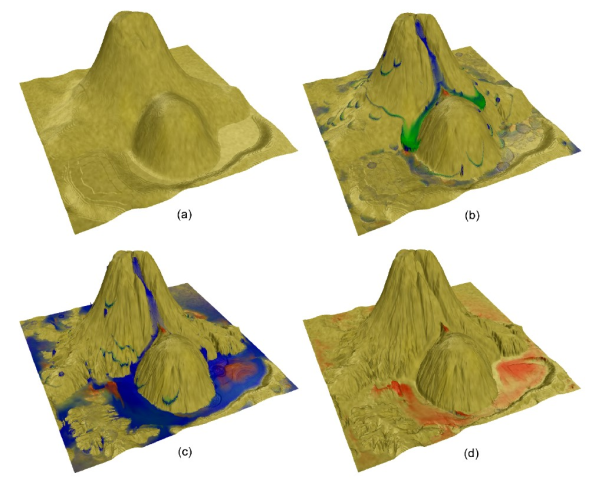
Résumé : Natural mountains and valleys are gradually eroded by rainfall and river flows. Physically-based modeling of this complex phenomenon is a major concern in producing realistic synthesized terrains. However, despite some recent improvements, existing algorithms are still computationally expensive, leading to a time-consuming process fairly impractical for terrain designers and 3D artists. In this paper, we present a new method to model the hydraulic erosion phenomenon which runs at interactive rates on today's computers. The method is based on the velocity field of the running water, which is created with an efficient shallow-water fluid model. The velocity field is used to calculate the erosion and deposition process, and the sediment transportation process. The method has been carefully designed to be implemented totally on GPU, and thus takes full advantage of the parallelism of current graphics hardware. Results from experiments demonstrate that our method is effective and efficient. It can create realistic erosion effects by rainfall and river flows, and produce fast simulation results for terrains with large sizes.
Fichiers liés :
FastErosion_PG07.pdf
Source
-
The ESA CoSMOS study for the validation of the SMOS soil moisture L2 prototype
- Type de publi. : Communication dans un congrès
- Date de publi. : 29/10/2007
-
Auteurs :
Kauzar Saleh ContellYann H. KerrGilles BouletMaria Jose EscorihuelaPhilippe MaisongrandePhilippe RichaumePatricia de RosnayWigneron J.-P.Aurelio CanoErnesto Lopez-BaezaJennifer P. GrantNiels SkouRocco PancieraJeffrey P. WalkerMichael Berger
Fiche détaillée
The ESA CoSMOS study for the validation of the SMOS soil moisture L2 prototype
- Type de publi. : Communication dans un congrès
- Date de publi. : 29/10/2007
-
Auteurs :
Kauzar Saleh ContellYann H. KerrGilles BouletMaria Jose EscorihuelaPhilippe MaisongrandePhilippe RichaumePatricia de RosnayWigneron J.-P.Aurelio CanoErnesto Lopez-BaezaJennifer P. GrantNiels SkouRocco PancieraJeffrey P. WalkerMichael Berger
-
Organismes :
Department of geography
Centre d'études spatiales de la biosphère
Centre d'études spatiales de la biosphère
Centre d'études spatiales de la biosphère
Centre d'études spatiales de la biosphère
Centre d'études spatiales de la biosphère
European Centre for Medium-Range Weather Forecasts
Écologie fonctionnelle et physique de l'environnement
Universitat de València = University of Valencia = Universidade de Valencia
Universitat de València = University of Valencia = Universidade de Valencia
Vrije Universiteit Amsterdam [Amsterdam]
Danmarks Tekniske Universitet = Technical University of Denmark
University of Melbourne
University of Melbourne
European Space Research and Technology Centre
Source
-
Status and description of level 2 algorithm (land)
- Type de publi. : Communication dans un congrès
- Date de publi. : 29/10/2007
-
Auteurs :
Yann H. KerrPhilippe WaldteufelPhilippe RichaumeFrançois CabotArnaud MialonWigneron J.-P.Paolo FerrazzoliAli MahmoodiMaria Jose EscorihuelaKauzar Saleh ContellSteven Delwart
Fiche détaillée
Status and description of level 2 algorithm (land)
- Type de publi. : Communication dans un congrès
- Date de publi. : 29/10/2007
-
Auteurs :
Yann H. KerrPhilippe WaldteufelPhilippe RichaumeFrançois CabotArnaud MialonWigneron J.-P.Paolo FerrazzoliAli MahmoodiMaria Jose EscorihuelaKauzar Saleh ContellSteven Delwart
-
Organismes :
Centre d'études spatiales de la biosphère
Institut Pierre-Simon-Laplace
Centre d'études spatiales de la biosphère
Centre d'études spatiales de la biosphère
Centre d'études spatiales de la biosphère
Écologie fonctionnelle et physique de l'environnement
Università degli Studi di Roma Tor Vergata [Roma, Italia] = University of Rome Tor Vergata [Rome, Italy] = Université de Rome Tor Vergata [Rome, Italie]
Array Systems Computing
Centre d'études spatiales de la biosphère
University of Cambridge [Cambridge, UK]
European Space Research and Technology Centre
Source
-

Modelling urbanization to simulate prospective scenarios : a comparative approach
- Type de publi. : Communication dans un congrès
- Date de publi. : 24/10/2007
-
Auteurs :
Jean-Philippe AntoniPierre FrankhauserCécile TannierSamy Youssoufi
Fiche détaillée
Modelling urbanization to simulate prospective scenarios : a comparative approach
- Type de publi. : Communication dans un congrès
- Date de publi. : 24/10/2007
-
Auteurs :
Jean-Philippe AntoniPierre FrankhauserCécile TannierSamy Youssoufi
-
Organismes :
Théoriser et modéliser pour aménager (UMR 6049)
Théoriser et modéliser pour aménager (UMR 6049)
Théoriser et modéliser pour aménager (UMR 6049)
Théoriser et modéliser pour aménager (UMR 6049)
Résumé : In France, managing urban growth and sprawl depends on the housing policies made by municipalities (or groups of municipalities), by the Department, the Region or the State (i.e. by public actors) through specific statutory documents like PLU (Plan locaux d'urbanisme) or SCOT (Schémas de cohérence territoriaux). Currently, the policies leading to such documents appear very crucial. Indeed, sustainability in urban development has become a crucial issue. To manage it, urban planners use a variety of prescriptive tools such as Geographic information systems (SIG) or Computer aided drafting (CAD) softwares. Nevertheless, these "traditional" tools have a reduced predictive capability and since about 20 years, researchers try to develop modeling approaches allowing to improve describing and forecasting urban growth and its consequences. The aim of this paper is to present and compare three of these modeling tools, relaying on different theories. The heterogeneity of the produced results is discussed in the conclusion and envisaged as a interesting contribution to feed debates about urban growth management in the current framework of territorial intelligence.
Fichiers liés :
Antoni_JP._Modeling_urbanization_to_simulate_prospective_scenarios.pdf
Source