Professeur des universités en sciences de gestion
-

Importance du domaine d’homologie au cytochrome b5 et du cytochrome b5 pour l’activité de la delta6-désaturase de rat
- Type de publi. :
- Date de publi. : 01/09/2003
-
Auteurs :
Hervé GuillouSabine D’andreaVincent RiouxR. BarnouinStéphanie DalaineFrédérique PédronoSophie JanPhilippe P. Legrand
Fiche détaillée
Importance du domaine d’homologie au cytochrome b5 et du cytochrome b5 pour l’activité de la delta6-désaturase de rat
- Type de publi. :
- Date de publi. : 01/09/2003
-
Auteurs :
Hervé GuillouSabine D’andreaVincent RiouxR. BarnouinStéphanie DalaineFrédérique PédronoSophie JanPhilippe P. Legrand
-
Organismes :
Institut National de Recherche pour l’Agriculture, l’Alimentation et l’Environnement
Département Santé Animale
ToxAlim
Université Paris-Saclay
AgroParisTech
Institut National de Recherche pour l’Agriculture, l’Alimentation et l’Environnement
Institut Jean-Pierre Bourgin - Sciences du végétal
Institut Agro Rennes Angers
Nutrition, Métabolismes et Cancer
Source
-
Spectrum of PTCH1 Mutations in French Patients with Gorlin Syndrome
- Type de publi. : Article dans une revue
- Date de publi. : 01/09/2003
-
Auteurs :
Nathalie BoutetYves-Jean BignonValérie Drouin-GarraudPierre SardaMichel LongyDidier LacombePhilippe Gorry
Fiche détaillée
Spectrum of PTCH1 Mutations in French Patients with Gorlin Syndrome
- Type de publi. : Article dans une revue
- Date de publi. : 01/09/2003
-
Auteurs :
Nathalie BoutetYves-Jean BignonValérie Drouin-GarraudPierre SardaMichel LongyDidier LacombePhilippe Gorry
-
Organismes :
Centre d'études techniques de l'équipement Ouest
Imagerie Moléculaire et Stratégies Théranostiques
Department of Genetics
Unité de Génétique Médicale et Foetopathologie
Département de pathologie
Service de génétique médicale
Groupe de Recherche en Economie Théorique et Appliquée
- Publié dans Journal of Investigative Dermatology le 24/10/2020
Source
-
A 4H-SiC high-power-density VJFET as controlled current limiter
- Type de publi. : Article dans une revue
- Date de publi. : 01/09/2003
-
Auteurs :
Dominique TournierPhilippe GodignonJosep MontserratDominique PlansonChristophe RaynaudJean-Pierre ChanteJean-François F de PalmaFranck Sarrus
Fiche détaillée
A 4H-SiC high-power-density VJFET as controlled current limiter
- Type de publi. : Article dans une revue
- Date de publi. : 01/09/2003
-
Auteurs :
Dominique TournierPhilippe GodignonJosep MontserratDominique PlansonChristophe RaynaudJean-Pierre ChanteJean-François F de PalmaFranck Sarrus
-
Organismes :
Centro Nacional de Microelectronica [Spain]
Centro Nacional de Microelectronica [Spain]
Centro Nacional de Microelectronica [Spain]
Ampère
Centre de génie électrique de Lyon
Ampère
Centre de génie électrique de Lyon
Ampère
Centre de génie électrique de Lyon
Ferraz
Ferraz
- Publié dans IEEE Transactions on Industry Applications le 31/10/2020
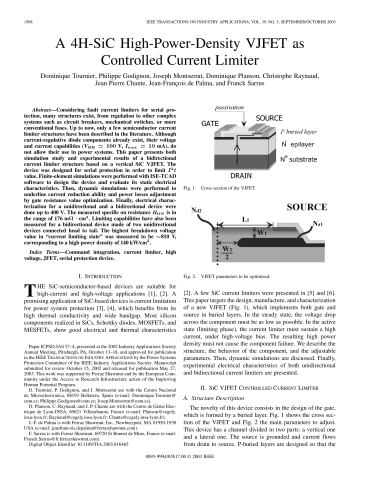
Résumé : Considering fault current limiters for serial protection, many structures exist, from regulation to other complex systems such as circuit breakers, mechanical switches, or more conventional fuses. Up to now, only a few semiconductor current limiter structures have been described in the literature. Although current-regulative diode components already exist, their voltage and current capabilities (V-BR = 100 V, I-max = 10 mA), do not allow their use in power systems. This paper presents both simulation study and experimental results of a bidirectional current limiter structure based on a vertical SiC VJFET. The device was designed for serial protection in order to limit I(2)t value. Finite-element simulations were performed with ISE-TCAD software to design the device and evaluate its static electrical characteristics. Then, dynamic simulations were performed to underline current reduction ability and power losses adjustment by gate resistance value optimization. Finally, electrical characterization for a unidirectional and a bidirectional device were done up to 400 V. The measured specific on resistance R-ON is in the range of 176 mOmega.cm(2). Limiting capabilities have also been measured for a bidirectional device made of two unidirectional devices connected head to tail. The highest breakdown voltage value in "current limiting state" was measured to be similar to810 V, corresponding to a high power density of 140 kW/cm(2).
Fichiers liés :
IEEE_T-InAp_39-5_09-2003_1508_A4HSiCHighPower.pdf
Source
-
Effect of ion implantation parameters on Al dopant redistribution in SiC after annealing: Defect recovery and electrical properties of p-type layers
- Type de publi. : Article dans une revue
- Date de publi. : 01/09/2003
-
Auteurs :
Mihai LazarChristophe RaynaudDominique PlansonJean-Pierre ChanteMarie-Laure LocatelliLaurent OttavianiPhilippe Godignon
Fiche détaillée
Effect of ion implantation parameters on Al dopant redistribution in SiC after annealing: Defect recovery and electrical properties of p-type layers
- Type de publi. : Article dans une revue
- Date de publi. : 01/09/2003
-
Auteurs :
Mihai LazarChristophe RaynaudDominique PlansonJean-Pierre ChanteMarie-Laure LocatelliLaurent OttavianiPhilippe Godignon
-
Organismes :
Ampère
Centre de génie électrique de Lyon
Ampère
Centre de génie électrique de Lyon
Ampère
Centre de génie électrique de Lyon
Ampère
Centre de génie électrique de Lyon
Ampère
Centre de génie électrique de Lyon
Laboratoire de thermodynamique, propriétés électriques, contraintes, structures aux échelles nanométriques
Centro Nacional de Microelectronica [Spain]
- Publié dans Journal of Applied Physics le 02/11/2020
Résumé : Epilayers of 6H and 4H-SiC were Al implanted with various doses to form p-type layers after a postimplantation annealing performed at 1700degreesC/30 min. Rutherford backscattering spectrometry in the channeling mode analyses carried out before and after annealing show virgin nonimplanted equivalent spectra if the implanted layers are not amorphized. The amorphous layers are recrystallized after annealing with a residual damage level of the lattice relative to the quantity of the dopant implanted. Secondary ion mass spectrometry measurements performed on the implanted samples before and after annealing illustrate a good superposition of the profiles obtained before and after the annealing on nonamorphized samples. Dopant redistribution occurs after annealing, only on amorphized layers, with an intensity that increases with the implanted dose. Deduced from sheet resistance measurements, the dopant activation increases with the implanted dose. Activation of 80%-90% is obtained from capacitance-voltage measurements on samples implanted with a 10(13) cm(-2) total dose. (C) 2003 American Institute of Physics.
Source
-
Vibrational spectroscopy of selectively prepared gas phase ions by coupling an FT-ICR-MS with a Free Electron Laser
- Type de publi. :
- Date de publi. : 31/08/2003
-
Auteurs :
Joël LemaireLuke MacaleeseCatherine KapotaGilles OhanessianPierre BoisselJean-Michel OrtegaPhilippe Maıtre
Fiche détaillée
Vibrational spectroscopy of selectively prepared gas phase ions by coupling an FT-ICR-MS with a Free Electron Laser
- Type de publi. :
- Date de publi. : 31/08/2003
-
Auteurs :
Joël LemaireLuke MacaleeseCatherine KapotaGilles OhanessianPierre BoisselJean-Michel OrtegaPhilippe Maıtre
-
Organismes :
Laboratoire de Chimie Physique D'Orsay
Laboratoire pour l'utilisation du rayonnement électromagnétique
Laboratoire de Chimie Physique D'Orsay
Laboratoire des Mécanismes Réactionnels
Laboratoire pour l'utilisation du rayonnement électromagnétique
Laboratoire des Mécanismes Réactionnels
Laboratoire de Chimie Physique D'Orsay
Laboratoire pour l'utilisation du rayonnement électromagnétique
Laboratoire de Chimie Physique D'Orsay
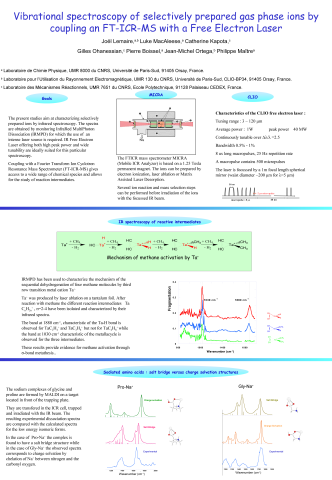
Résumé : The present studies aim at characterizing selectively prepared ions by infrared spectroscopy. The spectra are obtained by monitoring InfraRed MultiPhoton Dissociation (IRMPD) for which the use of an intense laser source is required. IR Free Electron Laser offering both high peak power and wide tunability are ideally suited for this particular spectroscopy. Coupling with a Fourier Transform Ion Cyclotron Resonance Mass Spectrometer (FT-ICR-MS) gives access to a wide range of chemical species and allows for the study of reaction intermediates.
Fichiers liés :
poster.pdf
Source
-

A VARIATIONAL APPROACH FOR GEOACOUSTIC INVERSION USING ADJOINT MODELING OF A PE APPROXIMATION MODEL WITH NON LOCAL IMPEDANCE BOUNDARY CONDITIONS
- Type de publi. : Communication dans un congrès
- Date de publi. : 11/08/2003
-
Auteurs :
Jean-Claude Le GacYann StéphanMark AschPhilippe HelluyJean-Pierre Hermand
Fiche détaillée
A VARIATIONAL APPROACH FOR GEOACOUSTIC INVERSION USING ADJOINT MODELING OF A PE APPROXIMATION MODEL WITH NON LOCAL IMPEDANCE BOUNDARY CONDITIONS
- Type de publi. : Communication dans un congrès
- Date de publi. : 11/08/2003
-
Auteurs :
Jean-Claude Le GacYann StéphanMark AschPhilippe HelluyJean-Pierre Hermand
-
Organismes :
EPSHOM
EPSHOM
Institut de Mathématiques de Toulon - EA 2134
Institut de Mathématiques de Toulon - EA 2134
Royal Netherlands Institute for Sea Research
Résumé : The adjoint model method of control theory is known to give accurate and efficient data assimilation processes in oceanography and meteorology. However, it has rarely been applied in underwater acoustics for inversion purposes. Based on the back-propagation of the mismatch between observations and their predictions, the adjoint model can produce the corrections to the associated direct forward model input parameters. In this paper, the adjoint of a parabolic equation propagation model with non local impedance boundary conditions at the water sediment interface is used in order to determine an acoustically equivalent representation of the seabed. The bottom is represented by these boundary conditions that play the role of the control parameter.
Fichiers liés :
asch_acoustic2.pdf
Source
-
Executive and social behaviors under nicotinic receptor regulation
- Type de publi. : Article dans une revue
- Date de publi. : 05/08/2003
-
Auteurs :
Sylvie GranonPhilippe FaureJean-Pierre Changeux
Fiche détaillée
Executive and social behaviors under nicotinic receptor regulation
Résumé : Nicotine enhances several cognitive and psychomotor behaviors, and nicotinic antagonists cause impairments in tasks requiring cognitive effort. To explore the contribution of nicotinic receptors to complex cognitive functions, we developed an automated method to investigate sequential locomotor behavior in the mouse and an analysis of social behavior. We show that, in the beta2-/- mutant, the high-order spatiotemporal organization of locomotor behavior, together with conflict resolution and social interaction, is selectively dissociated from low-level, more automatic motor behaviors. Such deficits in executive functions resemble the rigid and asocial behavior found in some psychopathological disorders such as autism and attention deficit hyperactivity disorder.
Source
-
A Single Intravenous Infusion of Apoptotic Cells, An Alternative Cell-Based Therapy Approach Facilitating Hematopoietic Cell Engraftment, Does Not Induce Autoimmunity
- Type de publi. : Article dans une revue
- Date de publi. : 01/08/2003
-
Auteurs :
Sylvain PerrucheFrançois KleinclaussRégis AngoninJean-Yves CahnEric DeconinckLuc ReiningerJosé BoucrautPierre TiberghienPhilippe Saas
Fiche détaillée
A Single Intravenous Infusion of Apoptotic Cells, An Alternative Cell-Based Therapy Approach Facilitating Hematopoietic Cell Engraftment, Does Not Induce Autoimmunity
- Type de publi. : Article dans une revue
- Date de publi. : 01/08/2003
-
Auteurs :
Sylvain PerrucheFrançois KleinclaussRégis AngoninJean-Yves CahnEric DeconinckLuc ReiningerJosé BoucrautPierre TiberghienPhilippe Saas
-
Organismes :
Interactions hôte-greffon-tumeur, ingénierie cellulaire et génique - UFC (UMR INSERM 1098)
- Publié dans Journal of Hematotherapy and Stem Cell Research le 23/10/2020
Résumé : Previously, we reported that intravenous infusion of apoptotic leukocytes facilitated bone marrow (BM) engraftment across major histocompatibility barriers. This cell-based therapeutic approach is of great interest for stem cell therapy across histocompatibility barriers. Autoimmunity associated with apoptotic cell administration may, however, limit the use of this approach. Indeed, autoantigens are concentrated on the surface of apoptotic cells, and defective clearance of apoptotic bodies is associated with the occurrence of systemic autoimmune disease. In consequence, we assessed the autoimmune responses raised against ubiquitous double-stranded DNA (dsDNA) and cardiolipin autoantigens following a single intravenous infusion of apoptotic cells simultaneously to allogeneic BM administration. No difference was observed between levels of natural circulating immunoglobulin M (IgM) (anti-dsDNA and anti-cardiolipin) autoantibodies found in mice receiving allogeneic BM alone and those found in mice receiving apoptotic cells also. Pathogenic IgG autoantibody titers after apoptotic cell infusion were 9- to 200-fold lower than autoantibody titers found in lupus-prone mice and not different from titers detected in BM grafted mice. Kinetic analysis of autoantibodies after transplantation did not demonstrate any immunization against tested autoantigens after apoptotic cell infusion. Finally, neither immune complex deposition nor specific lesions were observed in the renal glomeruli of mice infused with apoptotic cells 9 months post-BM transplantation. Overall, these results show no specific toxicity of a single infusion of apoptotic cells administrated simultaneously to BM and may also shed light on factors influencing the immunogenic properties of apoptotic cells.
Source
-
Soil moisture retrieval from L-band measurements over a variety of agricultural crops
- Type de publi. : Communication dans un congrès
- Date de publi. : 21/07/2003
-
Auteurs :
Mickhael PardéWigneron J.-P.André ChanzyPhilippe WaldteufelSten SchmidlNiels Skou
Fiche détaillée
Soil moisture retrieval from L-band measurements over a variety of agricultural crops
- Type de publi. : Communication dans un congrès
- Date de publi. : 21/07/2003
-
Auteurs :
Mickhael PardéWigneron J.-P.André ChanzyPhilippe WaldteufelSten SchmidlNiels Skou
-
Organismes :
Unité de bioclimatologie
Unité de bioclimatologie
Environnement Méditerranéen et Modélisation des Agro-Hydrosystèmes
Centre National de la Recherche Scientifique
Danmarks Tekniske Universitet = Technical University of Denmark
Danmarks Tekniske Universitet = Technical University of Denmark
Résumé : The objective of this work is to evaluate soil moisture retrieval methods over different canopy, with the view of developing an operational algorithm (for the SMOS project for instance).We tested different inversion process of the τ−ω model, using or not ancillary information, to estimate soil moisture and τ −ω parameters (vegetation parameters and soil roughness)simultaneously under different crop types. The best general method (same for all data sets)pr ovides a RMSE = 0.059 m3/m3 using no ancillary information and a RMSE = 0.048 m3/m3 if we use soil and vegetation a priori information. Moreover, using specific methods to each data set provide RMSE values between 0.04 and 0.05m3/m3.
Source
-
Monitoring land surface soil moisture from multiangular SMOS observations
- Type de publi. : Communication dans un congrès
- Date de publi. : 21/07/2003
-
Auteurs :
Wigneron J.-P.Paolo FerrazzoliJean-Christophe CalvetThierry PellarinPhilippe WaldteufelYann H. Kerr
Fiche détaillée
Monitoring land surface soil moisture from multiangular SMOS observations
- Type de publi. : Communication dans un congrès
- Date de publi. : 21/07/2003
-
Auteurs :
Wigneron J.-P.Paolo FerrazzoliJean-Christophe CalvetThierry PellarinPhilippe WaldteufelYann H. Kerr
-
Organismes :
Unité de bioclimatologie
Università degli Studi di Roma Tor Vergata [Roma, Italia] = University of Rome Tor Vergata [Rome, Italy] = Université de Rome Tor Vergata [Rome, Italie]
Centre national de recherches météorologiques
Centre national de recherches météorologiques
Institut Pierre-Simon-Laplace
Centre d'études spatiales de la biosphère
Résumé : The main objective of the SMOS (Soil Moisture and Ocean Salinity) mission over the land surfaces, is to monitor soil moisture (SM) with a frequent (3-day revisit) and global coverage (ground resolution of similar to50 km). In this paper, we present some examples of the current activities aiming at developing and improving SM retrieval methods.
Source