Professeur des universités en sciences de gestion
-
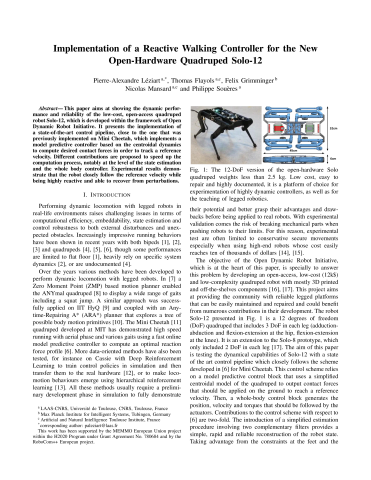
Implementation of a Reactive Walking Controller for the New Open-Hardware Quadruped Solo-12
- Type de publi. : Communication dans un congrès
- Date de publi. : 30/05/2021
-
Auteurs :
Pierre-Alexandre LeziartThomas FlayolsFelix GrimmingerNicolas MansardPhilippe Souères
Fiche détaillée
Implementation of a Reactive Walking Controller for the New Open-Hardware Quadruped Solo-12
- Type de publi. : Communication dans un congrès
- Date de publi. : 30/05/2021
-
Auteurs :
Pierre-Alexandre LeziartThomas FlayolsFelix GrimmingerNicolas MansardPhilippe Souères
-
Organismes :
Équipe Mouvement des Systèmes Anthropomorphes
Équipe Mouvement des Systèmes Anthropomorphes
Communauté d'universités et établissements de Toulouse
Max Planck Institute for Intelligent Systems [Tübingen]
Équipe Mouvement des Systèmes Anthropomorphes
Communauté d'universités et établissements de Toulouse
Équipe Mouvement des Systèmes Anthropomorphes
Résumé : This paper aims at showing the dynamic performance and reliability of the low-cost, open-access quadruped robot Solo-12, which is developed within the framework of Open Dynamic Robot Initiative. It presents the implementation of a state-of-the-art control pipeline, close to the one that was previously implemented on Mini Cheetah, which implements a model predictive controller based on the centroidal dynamics to compute desired contact forces in order to track a reference velocity. Different contributions are proposed to speed up the computation process, notably at the level of the state estimation and the whole body controller. Experimental results demonstrate that the robot closely follow the reference velocity while being highly reactive and able to recover from perturbations.
Fichiers liés :
leziart2021_Reactive_Walking_Controller_Solo12.pdf
Source
-
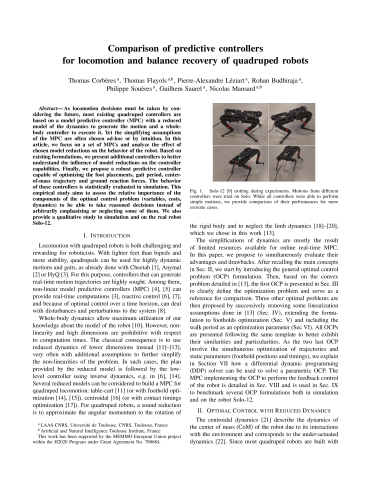
Comparison of predictive controllers for locomotion and balance recovery of quadruped robots
- Type de publi. : Communication dans un congrès
- Date de publi. : 30/05/2021
-
Auteurs :
Thomas CorbèresThomas FlayolsPierre-Alexandre LeziartRohan BudhirajaPhilippe SouèresGuilhem SaurelNicolas Mansard
Fiche détaillée
Comparison of predictive controllers for locomotion and balance recovery of quadruped robots
- Type de publi. : Communication dans un congrès
- Date de publi. : 30/05/2021
-
Auteurs :
Thomas CorbèresThomas FlayolsPierre-Alexandre LeziartRohan BudhirajaPhilippe SouèresGuilhem SaurelNicolas Mansard
-
Organismes :
Équipe Mouvement des Systèmes Anthropomorphes
Équipe Mouvement des Systèmes Anthropomorphes
Équipe Mouvement des Systèmes Anthropomorphes
Équipe Mouvement des Systèmes Anthropomorphes
Équipe Mouvement des Systèmes Anthropomorphes
Équipe Mouvement des Systèmes Anthropomorphes
Équipe Mouvement des Systèmes Anthropomorphes
Résumé : As locomotion decisions must be taken by considering the future, most existing quadruped controllers are based on a model predictive controller (MPC) with a reduced model of the dynamics to generate the motion, followed by a second whole-body controller to follow the movement. Yet the choice of the considered reduction in the MPC is often ad-hoc or decided by intuition. In this article, we focus on particular MPCs and analyze the effect of the reduced models on the robot behavior. Based on existing formulations, we offer additional controllers to better understand the influence of the reductions in the controller capabilities. Finally, we propose a robust predictive controller capable of optimizing the foot placements, gait period, center-of-mass trajectory and corresponding ground reaction forces. The behavior of these controllers is statistically evaluated in simulation. This empirical study is a basis for understanding the relative importance of the components of the optimal control problem (variables, costs, dynamics), that are sometimes arbitrarily emphasized or neglected. We also provide a qualitative study in simulation and on the real robot Solo.
Fichiers liés :
Comparison_of_predictive_controllers_for_locomotion_and_balance_recovery_of_quadruped_robots.pdf
Source
-
Assessment of genetically modified cotton GHB614 for renewal authorisation under Regulation (EC) No 1829/2003 (application EFSA–GMO–RX–018)
- Type de publi. : Article dans une revue
- Date de publi. : 28/05/2021
-
Auteurs :
Hanspeter NaegeliJean‐louis BressonTamas DalmayIan Crawford DewhurstMichelle M EpsteinLeslie George FirbankPhilippe GuercheJan HejatkoFrancisco Javier MorenoEwen MullinsFabien NoguéNils RostoksJose Juan Sánchez SerranoGiovanni SavoiniEve VeromannFabio VeronesiFernando ÁlvarezMichele ArdizzoneTommaso Raffaello
Fiche détaillée
Assessment of genetically modified cotton GHB614 for renewal authorisation under Regulation (EC) No 1829/2003 (application EFSA–GMO–RX–018)
- Type de publi. : Article dans une revue
- Date de publi. : 28/05/2021
-
Auteurs :
Hanspeter NaegeliJean‐louis BressonTamas DalmayIan Crawford DewhurstMichelle M EpsteinLeslie George FirbankPhilippe GuercheJan HejatkoFrancisco Javier MorenoEwen MullinsFabien NoguéNils RostoksJose Juan Sánchez SerranoGiovanni SavoiniEve VeromannFabio VeronesiFernando ÁlvarezMichele ArdizzoneTommaso Raffaello
-
Organismes :
Institut Jean-Pierre Bourgin - Sciences du végétal
Institut Jean-Pierre Bourgin - Sciences du végétal
- Publié dans EFSA Journal le 01/11/2020
Résumé : Following the submission of application EFSA-GMO-RX-018 under Regulation (EC) No 1829/2003 from BASF Agricultural Solutions Seed US LLC, the Panel on Genetically Modified Organisms of the European Food Safety Authority was asked to deliver a scientific risk assessment on the data submitted in the context of the renewal of authorisation application for the herbicide-tolerant genetically modified cotton GHB614, for food and feed uses, excluding cultivation within the European Union. The data received in the context of this renewal application contained post-market environmental monitoring reports, a systematic search and evaluation of literature, updated bioinformatic analyses, and additional documents or studies performed by or on behalf of the applicant. The GMO Panel assessed these data for possible new hazards, modified exposure or new scientific uncertainties identified during the authorisation period and not previously assessed in the context of the original application. The GMO Panel concludes that there is no evidence in renewal application EFSA-GMO-RX-018 for new hazards, modified exposure or scientific uncertainties that would change the conclusions of the original risk assessment on cotton GHB614.
Fichiers liés :
EFSA Journal - 2021 - - Assessment of genetically modified cotton GHB614 for renewal authorisation under Regulation EC .pdf
Source
-

Cost-Utility Analysis of Transarterial Radioembolization With Yttrium-90 Resin Microspheres Compared With Sorafenib in Locally Advanced and Inoperable Hepatocellular Carcinoma
- Type de publi. : Article dans une revue
- Date de publi. : 28/05/2021
-
Auteurs :
Kevin ZarcaMaroua MimouniHelena PereiraGilles ChatellierValérie VilgrainIsabelle Durand-ZaleskiEric AssenatElisabeth Delhom-ChristolBoris GuiuAlina IloncaJulie LonjonGeorges-Philippe PageauxMohamed Abdel-RehimWassim Al-LahamMohamed BouattourLaurent CasteraArnaud DieudonnéRachida LebtahiMaxime RonotAnnie SibertHélène BarraudChristophe BazinJean-Pierre BronowickiValérie LaurentElodie MathiasCarine Chagneau-DerrodeRémy PerdrisotChristine SilvainJean-Pierre TasuPatrick Borentain RenégerolamiOlivier MundlerJean-Francois SeitzVincent VidalChristophe AubéAntoine BouvierOlivier CouturierFrédéric ObertiLaurent VervuerenIsabelle Brenot-RossiJean-Luc RaoulAnthony Sar-RanJulia ChalayeCharlotte CostentinEmmanuel IttiHicham KobeiterAlain LucianiRené AdamMaïté LewinDidier SamuelJulien EdelineEtienne GarinYan RollandIsabelle ArchambeaudThomas EugeneEric FrampasC. CassinottoMartine GuyotJean-Baptiste HiriartBruno LapuyadeJulien VergniolPhilippe BachellierJulien DetourBernard DuclosMichel GregetFrancois HabersetzerAlessio ImperialePhilippe MerleAgnès RodeJulie MorvanEric Nguyen-KhacThierry YzetGuillaume BaudinPatrick ChevallierAbakar MahamatThierry PicheMicheline RazzoukPatrick HillonRomaric LoffroyMichel ToubeauJulie VincentGabriele BarabinoNadia BouariouaMuriel CuilleronMarie EcochardNathalie PrévotVincent LeroyJulie RouxChristian SengelValérie BourcierNathalie Ganne- CarrieOlivier SerorSylvie CostoThông DaoJean-Pierre PelageJérôme DumortierFrancesco GiammarilePierre-Jean ValetteNadia GhazzarOlivier PellerinGilles ManceauPierre WeinmannAlexandra Heurgue- BerlotClaude MarcusDaniele SommacaleMaria-Angéla Castilla-LièvreSophie MaitreLysiane Marthey
Fiche détaillée
Cost-Utility Analysis of Transarterial Radioembolization With Yttrium-90 Resin Microspheres Compared With Sorafenib in Locally Advanced and Inoperable Hepatocellular Carcinoma
- Type de publi. : Article dans une revue
- Date de publi. : 28/05/2021
-
Auteurs :
Kevin ZarcaMaroua MimouniHelena PereiraGilles ChatellierValérie VilgrainIsabelle Durand-ZaleskiEric AssenatElisabeth Delhom-ChristolBoris GuiuAlina IloncaJulie LonjonGeorges-Philippe PageauxMohamed Abdel-RehimWassim Al-LahamMohamed BouattourLaurent CasteraArnaud DieudonnéRachida LebtahiMaxime RonotAnnie SibertHélène BarraudChristophe BazinJean-Pierre BronowickiValérie LaurentElodie MathiasCarine Chagneau-DerrodeRémy PerdrisotChristine SilvainJean-Pierre TasuPatrick Borentain RenégerolamiOlivier MundlerJean-Francois SeitzVincent VidalChristophe AubéAntoine BouvierOlivier CouturierFrédéric ObertiLaurent VervuerenIsabelle Brenot-RossiJean-Luc RaoulAnthony Sar-RanJulia ChalayeCharlotte CostentinEmmanuel IttiHicham KobeiterAlain LucianiRené AdamMaïté LewinDidier SamuelJulien EdelineEtienne GarinYan RollandIsabelle ArchambeaudThomas EugeneEric FrampasC. CassinottoMartine GuyotJean-Baptiste HiriartBruno LapuyadeJulien VergniolPhilippe BachellierJulien DetourBernard DuclosMichel GregetFrancois HabersetzerAlessio ImperialePhilippe MerleAgnès RodeJulie MorvanEric Nguyen-KhacThierry YzetGuillaume BaudinPatrick ChevallierAbakar MahamatThierry PicheMicheline RazzoukPatrick HillonRomaric LoffroyMichel ToubeauJulie VincentGabriele BarabinoNadia BouariouaMuriel CuilleronMarie EcochardNathalie PrévotVincent LeroyJulie RouxChristian SengelValérie BourcierNathalie Ganne- CarrieOlivier SerorSylvie CostoThông DaoJean-Pierre PelageJérôme DumortierFrancesco GiammarilePierre-Jean ValetteNadia GhazzarOlivier PellerinGilles ManceauPierre WeinmannAlexandra Heurgue- BerlotClaude MarcusDaniele SommacaleMaria-Angéla Castilla-LièvreSophie MaitreLysiane Marthey
-
Organismes :
Direction de la Recherche Clinique et de l'Innovation [AP-HP]
Centre d'Investigation Clinique Henri Mondor
Centre for Research in Epidemiology and Statistics | Centre de Recherche Épidémiologie et Statistiques
Direction de la Recherche Clinique et de l'Innovation [AP-HP]
CIC - HEGP
CIC - HEGP
Centre de recherche sur l'Inflammation
Direction de la Recherche Clinique et de l'Innovation [AP-HP]
Centre d'Investigation Clinique Henri Mondor
Epidemiology and Clinical Statistics for Tumor, Respiratory, and Resuscitation | Epidémiologie Clinique, STatistique, pour la Recherche en Santé
Département d'Hépato-Gastroentérologie et de Transplantation Hépatique [CHU Saint-Eloi]
Département radiologie diagnostique et interventionnelle Saint Eloi [CHRU Montpellier]
Département d'Hépato-Gastroentérologie et de Transplantation Hépatique [CHU Saint-Eloi]
Equipe IFTIM [ImViA - EA7535]
- Publié dans Clinical Therapeutics le 30/10/2020
Résumé : Purpose: The SARAH (Sorafenib Versus Radioembolization in Advanced Hepatocellular Carcinoma) trial (ClinicalTrials.gov Identifier NCT01482442) did not show a significant survival benefit for patients treated with transarterial radioembolization (TARE) compared with continuous oral sorafenib. The improved toxicity profile of patients treated with TARE in the trial, however, could result in a quality of life benefit in economic evaluations. Our objective was to perform a cost-utility analysis of TARE versus sorafenib for locally advanced and inoperable hepatocellular carcinoma. Methods: This study used patient-level data of the SARAH trial regarding resource use, progression-free and overall survival, and quality of life for the within-trial period for the patients who received at least 1 dose of sorafenib or 1 treatment with TARE according to their randomization arm. Data were extrapolated by using a partitioned survival model that incorporated costs and health outcomes, measured in life-years and quality-adjusted life-years (QALYs). Findings: The use of TARE resulted in an average loss of 0.036 life-year and a gain of 0.006 QALY compared with sorafenib. The aerage cost for the TARE arm was €17,179 (95% CI, 9,926-24,280) higher than the sorafenib arm, for an incremental cost-effectiveness ratio of €3,153,086/QALY. The probabilistic sensitivity analysis revealed a 50% risk that the TARE strategy was dominated. TARE was consistently dominated by sorafenib or had an incremental cost-effectiveness ratio more than €450,000/QALY in all sensitivity analyses. Implications: This economic evaluation of SARAH found that using radioembolization with yttrium-90 microspheres for the treatment of hepatocellular carcinoma was not a cost-effective option at the usually accepted willingness-to-pay thresholds.
Fichiers liés :
1-s2.0-S0149291821002137-am-1.pdf
Source
-

Antibiotic Therapy for 6 or 12 Weeks for Prosthetic Joint Infection
- Type de publi. : Article dans une revue
- Date de publi. : 27/05/2021
-
Auteurs :
Louis BernardCedric ArvieuxBenoit BrunschweilerSophie TouchaisSeverine AnsartJean-Pierre BruEric OziolCyril BoeriGuillaume GrasJerome DruonPhilippe RossetEric SennevilleHoucine BentayebDamien BouhourGwénaël Le MoalJocelyn MichonHugues AumaitreEmmanuel ForestierJean-Michel LaffosseThierry BéguéCatherine ChirouzeFrederic-Antoine DauchyEdouard DevaudBenoit MarthaDenis BurgotDavid BoutoilleEric StindelAurelien DinhPascale BémerBruno GiraudeauBertrand IssartelAgnès Caille
Fiche détaillée
Antibiotic Therapy for 6 or 12 Weeks for Prosthetic Joint Infection
- Type de publi. : Article dans une revue
- Date de publi. : 27/05/2021
-
Auteurs :
Louis BernardCedric ArvieuxBenoit BrunschweilerSophie TouchaisSeverine AnsartJean-Pierre BruEric OziolCyril BoeriGuillaume GrasJerome DruonPhilippe RossetEric SennevilleHoucine BentayebDamien BouhourGwénaël Le MoalJocelyn MichonHugues AumaitreEmmanuel ForestierJean-Michel LaffosseThierry BéguéCatherine ChirouzeFrederic-Antoine DauchyEdouard DevaudBenoit MarthaDenis BurgotDavid BoutoilleEric StindelAurelien DinhPascale BémerBruno GiraudeauBertrand IssartelAgnès Caille
-
Organismes :
Centre Hospitalier Régional Universitaire de Besançon
Laboratoire Chrono-environnement (UMR 6249)
Bordeaux population health
methodS in Patients-centered outcomes and HEalth ResEarch
methodS in Patients-centered outcomes and HEalth ResEarch
- Publié dans New England Journal of Medicine le 29/10/2020
Résumé : BACKGROUND: The management of prosthetic joint infection usually consists of a combination of surgery and antimicrobial therapy. The appropriate duration of antimicrobial therapy for this indication remains unclear. METHODS: We performed an open-label, randomized, controlled, noninferiority trial to compare 6 weeks with 12 weeks of antibiotic therapy in patients with microbiologically confirmed prosthetic joint infection that had been managed with an appropriate surgical procedure. The primary outcome was persistent infection (defined as the persistence or recurrence of infection with the initial causative bacteria, with an antibiotic susceptibility pattern that was phenotypically indistinguishable from that at enrollment) within 2 years after the completion of antibiotic therapy. Noninferiority of 6 weeks of therapy to 12 weeks of therapy would be shown if the upper boundary of the 95% confidence interval for the absolute between-group difference (the value in the 6-week group minus the value in the 12-week group) in the percentage of patients with persistent infection within 2 years was not greater than 10 percentage points. RESULTS: A total of 410 patients from 28 French centers were randomly assigned to receive antibiotic therapy for 6 weeks (205 patients) or for 12 weeks (205 patients). Six patients who withdrew consent were not included in the analysis. In the main analysis, 20 patients who died during follow-up were excluded, and missing outcomes for 6 patients who were lost to follow-up were considered to be persistent infection. Persistent infection occurred in 35 of 193 patients (18.1%) in the 6-week group and in 18 of 191 patients (9.4%) in the 12-week group (risk difference, 8.7 percentage points; 95% confidence interval, 1.8 to 15.6); thus, noninferiority was not shown. Noninferiority was also not shown in the per-protocol and sensitivity analyses. We found no evidence of between-group differences in the percentage of patients with treatment failure due to a new infection, probable treatment failure, or serious adverse events. CONCLUSIONS: Among patients with microbiologically confirmed prosthetic joint infections that were managed with standard surgical procedures, antibiotic therapy for 6 weeks was not shown to be noninferior to antibiotic therapy for 12 weeks and resulted in a higher percentage of patients with unfavorable outcomes. (Funded by Programme Hospitalier de Recherche Clinique, French Ministry of Health; DATIPO ClinicalTrials.gov number, NCT01816009.).
Source
-
Capacité d'adaptation, solutions intelligentes et résilience dans le contexte des destinations insulaires, analyse et mesure
- Type de publi. : Communication dans un congrès
- Date de publi. : 27/05/2021
-
Auteurs :
Philippe Jean-PierreDavid Perrain
Fiche détaillée
Capacité d'adaptation, solutions intelligentes et résilience dans le contexte des destinations insulaires, analyse et mesure
- Type de publi. : Communication dans un congrès
- Date de publi. : 27/05/2021
-
Auteurs :
Philippe Jean-PierreDavid Perrain
-
Organismes :
Centre d'Économie et de Management de l'Océan Indien
Institut d'Administration des Entreprises - La Réunion
Centre d'Économie et de Management de l'Océan Indien
Institut d'Administration des Entreprises - La Réunion
Source
-
Genome wide association analysis in dilated cardiomyopathy reveals two new key players in systolic heart failure on chromosomes 3p25.1 and 22q11.23
- Type de publi. :
- Date de publi. : 27/05/2021
-
Auteurs :
Sophie GarnierMagdalena HarakalovaStefan WeissMichal MokryRichard IsnardLaëtitia Duboscq-BidotMichel KomajdaFrançois CambienJean-François DeleuzeMarcus DörrFolkert W AsselbergsEric VillardDavid-Alexandre TrégouëtPhilippe Charron
Fiche détaillée
Genome wide association analysis in dilated cardiomyopathy reveals two new key players in systolic heart failure on chromosomes 3p25.1 and 22q11.23
- Type de publi. :
- Date de publi. : 27/05/2021
-
Auteurs :
Sophie GarnierMagdalena HarakalovaStefan WeissMichal MokryRichard IsnardLaëtitia Duboscq-BidotMichel KomajdaFrançois CambienJean-François DeleuzeMarcus DörrFolkert W AsselbergsEric VillardDavid-Alexandre TrégouëtPhilippe Charron
-
Organismes :
Unité de Recherche sur les Maladies Cardiovasculaires, du Métabolisme et de la Nutrition = Research Unit on Cardiovascular and Metabolic Diseases
University Medical Center [Utrecht]
Universität Greifswald = University of Greifswald
German Center for Cardiovascular Research
University Medical Center [Utrecht]
Unité de Recherche sur les Maladies Cardiovasculaires, du Métabolisme et de la Nutrition = Research Unit on Cardiovascular and Metabolic Diseases
Unité de Recherche sur les Maladies Cardiovasculaires, du Métabolisme et de la Nutrition = Research Unit on Cardiovascular and Metabolic Diseases
Génomique cardiovasculaire
Centre National de Génotypage
Laboratory of Excellence GENMED [Paris]
Universität Greifswald = University of Greifswald
ICIN - Netherlands Heart Institute
University College London [UCL]
University Medical Center [Utrecht]
Unité de Recherche sur les Maladies Cardiovasculaires, du Métabolisme et de la Nutrition = Research Unit on Cardiovascular and Metabolic Diseases
Assistance publique - Hôpitaux de Paris (AP-HP)
Unité de Recherche sur les Maladies Cardiovasculaires, du Métabolisme et de la Nutrition = Research Unit on Cardiovascular and Metabolic Diseases
Unité de Recherche sur les Maladies Cardiovasculaires, du Métabolisme et de la Nutrition = Research Unit on Cardiovascular and Metabolic Diseases
Source
-
Inappropriate Use of Oral Antithrombotic Combinations in an Outpatient Setting and Associated Risks: A French Nationwide Cohort Study
- Type de publi. : Article dans une revue
- Date de publi. : 27/05/2021
-
Auteurs :
Lorène ZerahDominique Bonnet-ZamponiAya AjroucheJean-Philippe ColletYann de RyckeFlorence Tubach
Fiche détaillée
Inappropriate Use of Oral Antithrombotic Combinations in an Outpatient Setting and Associated Risks: A French Nationwide Cohort Study
- Type de publi. : Article dans une revue
- Date de publi. : 27/05/2021
-
Auteurs :
Lorène ZerahDominique Bonnet-ZamponiAya AjroucheJean-Philippe ColletYann de RyckeFlorence Tubach
-
Organismes :
CHU Pitié-Salpêtrière [AP-HP]
Institut Pierre Louis d'Epidémiologie et de Santé Publique
Institut Pierre Louis d'Epidémiologie et de Santé Publique
CHU Pitié-Salpêtrière [AP-HP]
Institut Pierre Louis d'Epidémiologie et de Santé Publique
Institut de cardiologie [CHU Pitié-Salpêtrière]
Unité de Recherche sur les Maladies Cardiovasculaires, du Métabolisme et de la Nutrition = Research Unit on Cardiovascular and Metabolic Diseases
Groupe Action
Institut Pierre Louis d'Epidémiologie et de Santé Publique
CHU Pitié-Salpêtrière [AP-HP]
Institut Pierre Louis d'Epidémiologie et de Santé Publique
- Publié dans Journal of Clinical Medicine le 29/10/2020
Résumé : With the increase in prevalence of cardiovascular diseases, multimorbidity, and medical progress, oral antithrombotic (AT) combinations are increasingly prescribed. The aims of this study were to estimate the incidence of oral AT combinations, their appropriateness (defined as indications compliant with guidelines), and the related risk of major bleeding (i.e., leading to hospitalization) or death, among new users. We conducted a 5-year historical cohort study, using the French national healthcare database, including all individuals ≥ 45 years old with a first delivery of oral ATs between 1 January 2013 and 31 December 2017. The cumulative incidence of oral AT combinations was estimated with the Fine and Gray method, taking into account the competitive risk of death. We compared the cumulative incidence of major bleeding according to the type of oral AT treatment initiated at study entry (monotherapy or oral AT combinations). During the study period, 22,220 individuals were included (mean (SD) age 68 (12) years). The cumulative incidence of oral AT combinations at 5 years was 27.8% (95% confidence interval (CI) 26.8–28.9). Overall, 64% of any oral AT combinations did not comply with guidelines. The cumulative incidence of major bleeding and death in the whole cohort at 5 years was 4.1% (95% CI 3.7–4.6) and 10.8% (95% CI 10.1–11.6), respectively. Risk of major bleeding increased among individuals with oral AT combinations versus oral AT monotherapy at study entry (subdistribution hazard ratio sHR: 2.16 (1.01–4.63)); with no difference in terms of death. The use of oral AT combinations among oral AT users is frequent, often inappropriately prescribed, and associated with an increased risk of major bleeding.
Fichiers liés :
jcm-10-02367-v2.pdf
Source
-
Safety of endoscopic retrograde cholangiopancreatography in the pediatric population: a multicenter study
- Type de publi. : Article dans une revue
- Date de publi. : 26/05/2021
-
Auteurs :
Clémence MercierMathieu PiocheEliane AlbuissonThierry PonchonJean-Michel GonzalèsMarc BarthetIsabelle BoytchevGeoffroy VanbiervlietClement Fortier BeaulieuFrederic PratArthur BelleJulien BranchePhilippe GrandvalJean-Christophe ValatsFranz RudlerTimothée WallenhorstStephane KochAurélie ComteNicolas WillietNicolas MusquerEmmanuel CoronAline DerosièreJean-Philippe Le MouelMarion SchaeferCaroline ChabotIsabelle ScheersPierre DeprezJean-Baptiste Chevaux
Fiche détaillée
Safety of endoscopic retrograde cholangiopancreatography in the pediatric population: a multicenter study
- Type de publi. : Article dans une revue
- Date de publi. : 26/05/2021
-
Auteurs :
Clémence MercierMathieu PiocheEliane AlbuissonThierry PonchonJean-Michel GonzalèsMarc BarthetIsabelle BoytchevGeoffroy VanbiervlietClement Fortier BeaulieuFrederic PratArthur BelleJulien BranchePhilippe GrandvalJean-Christophe ValatsFranz RudlerTimothée WallenhorstStephane KochAurélie ComteNicolas WillietNicolas MusquerEmmanuel CoronAline DerosièreJean-Philippe Le MouelMarion SchaeferCaroline ChabotIsabelle ScheersPierre DeprezJean-Baptiste Chevaux
-
Organismes :
Centre Hospitalier Régional Universitaire de Nancy
Laboratoire des applications thérapeutiques des ultrasons / Application des ultrasons à la thérapie
Hôpital Edouard Herriot [CHU - HCL]
Centre Hospitalier Régional Universitaire de Nancy
Hôpital Edouard Herriot [CHU - HCL]
Service d'hépatologie et de gastroentérologie [Hôpital Saint-Joseph - Marseille]
Service d'hépatologie et de gastroentérologie [Hôpital Saint-Joseph - Marseille]
Service d'Hépato-gastro-entérologie [APHP Kremlin-Bicêtre]
Centre Hospitalier Universitaire de Nice
Centre Hospitalier Universitaire de Nice
Hôpital Cochin [AP-HP]
Service de Gastro-entérologie [CHU Cochin]
Hôpital Cochin [AP-HP]
Service de Gastro-entérologie [CHU Cochin]
Hôpital Claude Huriez [Lille]
Service d'hépatologie et de gastroentérologie [Hôpital Saint-Joseph - Marseille]
Centre de Recherche en Cancérologie de Marseille
Centre Hospitalier Régional Universitaire [Montpellier]
Centre Hospitalier Régional Universitaire [Montpellier]
Université de Montpellier
Hôpital Sud [CHU Rennes]
Centre Hospitalier Régional Universitaire de Besançon
Service de chirurgie pédiatrique [CHU Besançon]
Centre Hospitalier Régional Universitaire de Besançon
Centre Hospitalier Universitaire de Saint-Etienne [CHU Saint-Etienne]
Centre Hospitalier Universitaire de Nantes = Nantes University Hospital
Centre Hospitalier Universitaire de Nantes = Nantes University Hospital
Service d'Hépato Gastroenterologie [CHU Amiens-Picardie]
Service d'Hépato Gastroenterologie [CHU Amiens-Picardie]
Centre Hospitalier Régional Universitaire de Nancy
Centre Hospitalier Régional Universitaire de Nancy
Cliniques Universitaires Saint-Luc [Bruxelles]
Cliniques Universitaires Saint-Luc [Bruxelles]
Centre Hospitalier Régional Universitaire de Nancy
- Publié dans Endoscopy le 22/10/2020
Résumé : Introduction The aims of this retrospective multicenter study were to assess the technical success and adverse events of endoscopic retrograde cholangiopancreatography (ERCP) procedures in children in French and Belgian centers. Methods All children aged 1 day to 17 years who underwent ERCP between January 2008 and March 2019 in 15 tertiary care hospitals were retrospectively included. Results 271 children underwent 470 ERCP procedures. Clinical long-term follow-up was available for 72 % of our patients (340/470 procedures). The median age at intervention was 10.9 years. ERCP was therapeutic in 90 % (423/470) and diagnostic in cases of neonatal cholestasis in 10 % of the patients. The most common biliary indication was choledocholithiasis; the most common pancreatic indication was chronic pancreatitis. Biliary cannulation was successful in 92 % of cases (270/294); pancreatic cannulation in 96 % of cases (169/176); and planned therapeutic procedures in 92 % of cases (388/423). The overall complication rate was 19 % (65/340). The most common complication was post-ERCP pancreatitis (PEP) in 12 % of cases (40/340) and sepsis in 5 % (18/340). On univariate analyses, pancreatic stent removal was protective against PEP (odds ratio [OR] 0.1, 95 % confidence interval [CI] 0.01 – 0.75; P = 0.03), and sepsis was associated with history of liver transplantation (OR 7.27, 95 %CI 1.7 – 31.05; P = 0.01). Five patients had post-ERCP hemorrhage and two had intestinal perforation. All complications were managed with supportive medical care. There was no procedure-related mortality. Conclusion Our cohort demonstrates that ERCP can be performed safely with high success rates in many pancreaticobiliary diseases of children. The rate of adverse events was similar to that in previous reports.
Source
-
Les pierres d'attente des morts en région Centre-Val de Loire (départements de l'Indre, de l'Indre-et-Loire et du Loir-et-Cher) : présentation d'une enquête en cours
- Type de publi. :
- Date de publi. : 26/05/2021
-
Auteurs :
Jean-Philippe ChimierJérôme LivetIsabelle PichonDenis GodignonSandrine BartholomeJérôme Defaix
Fiche détaillée
Les pierres d'attente des morts en région Centre-Val de Loire (départements de l'Indre, de l'Indre-et-Loire et du Loir-et-Cher) : présentation d'une enquête en cours
- Type de publi. :
- Date de publi. : 26/05/2021
-
Auteurs :
Jean-Philippe ChimierJérôme LivetIsabelle PichonDenis GodignonSandrine BartholomeJérôme Defaix
-
Organismes :
Cités, Territoires, Environnement et Sociétés
Institut national de recherches archéologiques préventives
Institut national de recherches archéologiques préventives
De la Préhistoire à l'Actuel : Culture, Environnement et Anthropologie
Résumé : Les pierres d’attente des morts correspondent à des dalles de pierre posées ou non sur des supports, aux dimensions variables mais ne dépassant qu’exceptionnellement 2 x 1 m. Il s’agit de reposoirs utilisés pour le cercueil lors de la levée du corps. Les pierres d’attente localisées à proximité des églises accueillent le défunt pour la cérémonie des funérailles.
Source